




What Are the Main Parts of Plants and Their Functions
Plants are fascinating organisms made up of several unique structures, each carrying out vital roles for survival and growth. Understanding the parts of plants is fundamental in biology, as it helps us learn how plants get food, grow, and reproduce. Let’s explore each part’s name, structure, and essential function with clear explanations and diagrams.
What Are the Parts of Plants?
The parts of plants include six main structures: roots, stems, leaves, flowers, fruits, and seeds. Each part works in harmony to help the plant grow, adapt, and continue its life cycle. For kids and beginners, these parts are often introduced first to build a foundation in biology.
Understanding the Main Parts of Plants
Main parts of a plant are:
- Root – Underground part absorbing water and anchoring the plant.
- Stem – Supports and transports nutrients and water.
- Leaf – Primary site for making food by photosynthesis.
- Flower – Reproductive organ; often colorful and attractive.
- Fruit – Protects the seed; aids in seed dispersal.
- Seed – Contains the embryo; grows into a new plant.
The aerial parts of plants refer to all the structures above the ground such as the stem, leaves, flowers, and fruits.
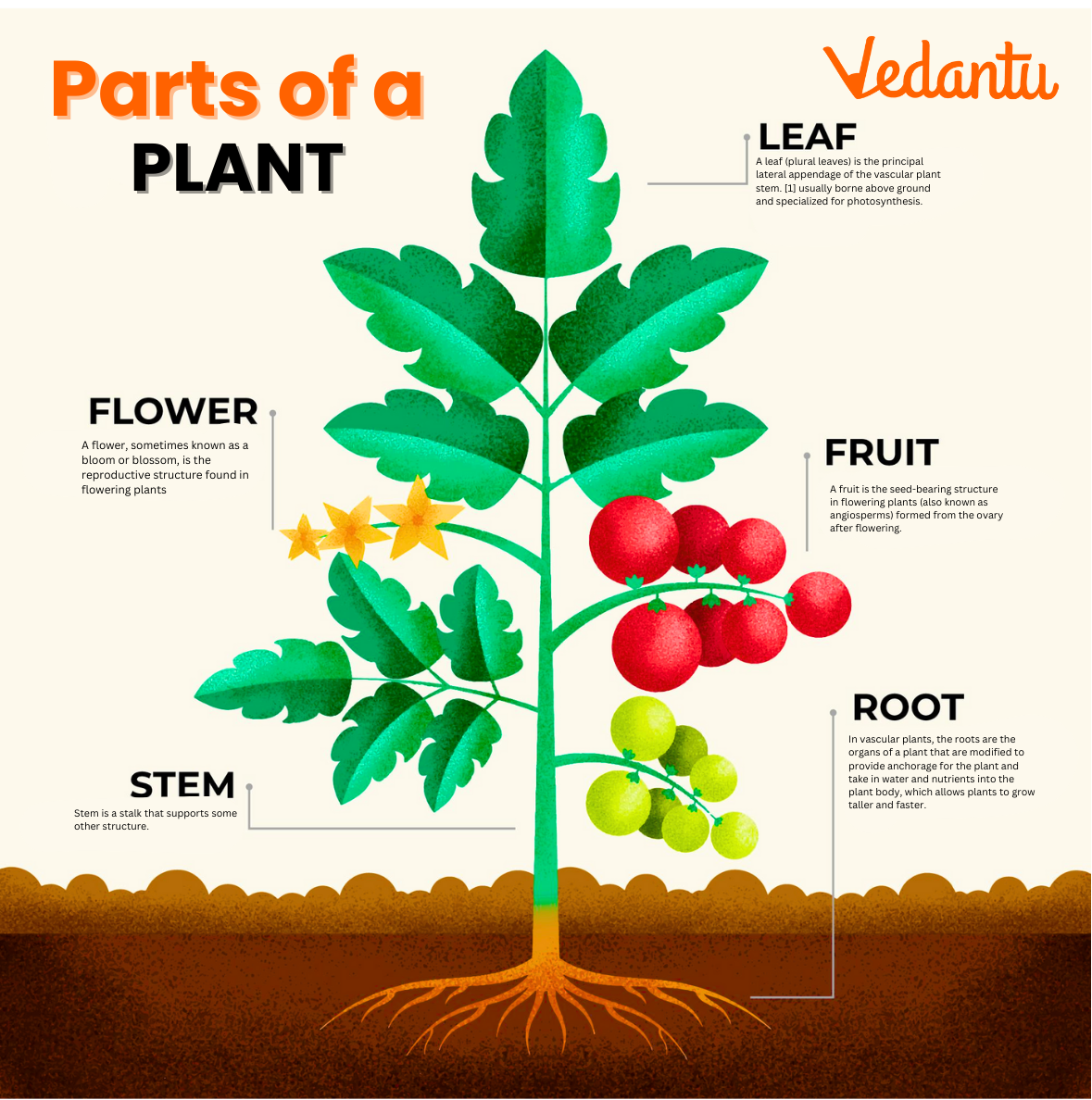
Parts of Plants Name and Their Functions
Every plant part has a particular job. Here’s a chart to show each key part and its function, providing a clear overview for students and educators.
| Parts of Plants Name | Main Function |
|---|---|
| Root | Anchors the plant, absorbs water & minerals from the soil |
| Stem | Supports the aerial parts; transports food, water & minerals |
| Leaf | Performs photosynthesis and creates food |
| Flower | Reproduction through pollination and seed formation |
| Fruit | Protects seeds and assists with their dispersal |
| Seed | Germinates to form a new plant (embryo inside) |
This parts of plants chart makes it easy to match each plant part with its unique job, reinforcing exam and workbook learning.
Parts of Plants Diagram: Visualizing Plant Structure
A labeled parts of plants diagram is essential for learning and revising. It shows each structure’s position and helps students remember the difference between roots, stem, leaves, and flowers. If you wish to deepen your diagram practice, check out important plant diagrams provided by Vedantu.
Parts of Plants for Kids: Simple Explanations
Parts of plants for kids focuses on simple definitions and fun activities:
- Root: The "anchor" holding the plant in place under the soil.
- Stem: The "straw" that lets water travel up to the leaves and flowers.
- Leaves: The "kitchen" where food is created from sunlight.
- Flower: The "show" or "party" that attracts insects and helps the plant make seeds.
- Fruit & Seed: The "package" that protects baby plants (seeds) inside.
Try drawing each part at home or in class to boost your memory of plant structure!
Worked Example: Exploring Plant Structure Step by Step
- Observe a local plant. Identify the root and stem.
- Notice where leaves are attached to the stem.
- Examine the flower if present—look for petals, stamens, and pistil.
- Find the fruit or seed if possible, such as a bean or apple.
Practice drawing and labelling a diagram. You’ll quickly master recognizing different plant parts for all biology classes!
Different Parts of Plants We Eat: Edible Parts and Real-Life Examples
Many foods come from various edible parts of plants. Recognizing which part we eat is both educational and fun! Here’s an edible parts of plants chart with examples:
- Roots: Carrot, beetroot, radish
- Stems: Potato, sugarcane, ginger
- Leaves: Spinach, lettuce, cabbage
- Flowers: Cauliflower, broccoli
- Fruits: Apple, mango, tomato
- Seeds: Rice, wheat, beans
Explore more with this food science overview by Vedantu!
Functions of Aerial and Underground Parts of Plants
The aerial parts of plants above ground—such as stems, leaves, and flowers—are important for photosynthesis, nutrient transport, and reproduction. Underground parts, mainly roots, secure the plant and help take up water and minerals. This division supports efficient growth and survival in different environments.
Parts of Plants and Their Functions – Quick Reference
- Root: Absorbs water, anchors the plant, stores some food.
- Stem: Carries nutrients, provides support, stores food in certain plants (like potato).
- Leaf: Makes food using sunlight (photosynthesis).
- Flower: Helps in reproduction, attracts pollinators (insects, birds).
- Fruit: Protects seeds, helps in dispersal.
- Seed: Starts a new plant through germination.
Real-World Applications and Significance
Learning about the different parts of a plants is useful in daily life. Farmers study plant parts to grow healthy crops. Scientists find medicines in roots and leaves. Environmentalists track how leaves and roots help clean the air and soil. Understanding the functions supports concepts like effect of climate change on crops and growth and development. This knowledge makes biology practical for both exams and life.
Common Mistakes to Avoid in Plant Parts Questions
- Not labeling roots and stem correctly in diagrams.
- Thinking flowers are only for decoration (they do reproduction too!).
- Confusing seeds with fruits (seeds are inside the fruit).
With practice and careful revision, these errors will become easy to spot and correct.
Explore More Plant Biology Topics
- Study parts of a seed in depth and learn how seeds grow.
- Dive into plant cell structure and learn how cells make up all plant parts.
- Discover the process of photosynthesis in leaves.
- Understand plant growth with plant tissues and morphology of flowering plants.
- Explore reproduction in plants and nature’s diverse methods.
Page Summary
The main parts of plants—roots, stems, leaves, flowers, fruits, and seeds—work together to help plants survive, grow, and reproduce. From food to medicines, every part plays an important role in our lives. Understanding these parts builds biology knowledge for children and supports exam success. Keep exploring with Vedantu for deeper science insights!


FAQs on Parts of Plants and Their Functions
1. What are the main parts of a plant?
The main parts of a plant are the roots, stem, leaves, and reproductive structures such as flowers, fruits, and seeds. These parts work together to help the plant survive and reproduce.
- Roots anchor the plant and absorb water and minerals.
- Stem supports the plant and transports substances.
- Leaves carry out photosynthesis.
- Flowers, fruits, and seeds are involved in reproduction.
2. What is the function of roots in plants?
The primary function of roots is to absorb water and mineral nutrients from the soil and anchor the plant firmly in place. Roots also play additional roles in plant growth and survival.
- Absorb water and minerals through root hairs.
- Anchor the plant in the soil.
- Store food in some plants like carrots and radishes.
- Transport absorbed substances to the stem.
3. What is the role of the stem in a plant?
The stem supports the plant and transports water, minerals, and food between roots and leaves. It acts as the central framework of the plant body.
- Supports leaves, flowers, and fruits.
- Transports water and minerals through xylem.
- Transports food through phloem.
- May store food in some plants like sugarcane and potato (modified stem).
4. What is the function of leaves in plants?
The main function of leaves is to perform photosynthesis, the process by which plants make their own food. Leaves are specially adapted for this role.
- Contain chlorophyll to capture sunlight.
- Use carbon dioxide and water to produce glucose.
- Release oxygen as a byproduct.
- Carry out transpiration and gas exchange through stomata.
5. What are the reproductive parts of a plant?
The reproductive parts of a flowering plant are the flowers, which produce seeds for reproduction. Flowers contain both male and female structures.
- Stamen – the male reproductive part that produces pollen.
- Pistil (carpel) – the female reproductive part that contains ovules.
- After fertilization, the ovule becomes a seed.
- The ovary develops into a fruit.
6. What is the difference between roots and stems?
The main difference between roots and stems is that roots anchor and absorb nutrients, while stems support and transport substances. They differ in structure and function.
- Roots: Usually underground, lack nodes and leaves, absorb water and minerals.
- Stems: Usually above ground, have nodes and internodes, bear leaves and flowers.
- Roots have root hairs, while stems contain xylem and phloem for transport.
7. How does water move from roots to leaves?
Water moves from roots to leaves through the xylem by a process driven mainly by transpiration pull. This upward movement is continuous and efficient.
- Roots absorb water from the soil.
- Water enters the xylem vessels.
- Transpiration from leaves creates a pulling force.
- Cohesion and adhesion help maintain the water column.
8. What is photosynthesis and which part of the plant performs it?
Photosynthesis is the process by which green plants use sunlight to make food, and it mainly occurs in the leaves. This process converts light energy into chemical energy.
- Takes place in chloroplasts containing chlorophyll.
- Uses carbon dioxide and water.
- Produces glucose and oxygen.
- Occurs primarily in leaf cells.
9. What are the two main systems of a plant?
A plant body is divided into two main systems: the root system and the shoot system. These systems work together to support plant life.
- Root system: Includes primary and lateral roots; anchors the plant and absorbs nutrients.
- Shoot system: Includes stem, leaves, flowers, and fruits; responsible for photosynthesis and reproduction.
10. Why are fruits and seeds important in plants?
Fruits and seeds are important because they protect the embryo and help in plant reproduction and dispersal. They ensure the continuation of the species.
- Seeds contain the embryo and stored food.
- Fruits protect seeds from damage.
- Fruits aid in seed dispersal by wind, water, or animals.
- Seed germination leads to the growth of a new plant.



