




Definition Structure and Modifications of Root Stem Leaf and Flower
The Morphology Of Flowering Plants forms a core study area in biology, helping students identify, classify, and understand plant structure and function. This topic explores visible features like roots, stems, leaves, flowers, fruits, and seeds, along with their unique adaptations. Knowledge of plant morphology is essential not just for botanists but also for medicine, agriculture, and environmental science.
What is Morphology Of Flowering Plants?
Morphology of flowering plants refers to the study of the external structure and form of angiosperms (flowering plants), with each part having distinct roles in survival and reproduction. By analyzing the shape and arrangement of organs, students gain insights into classification and plant evolution. The morphology of flowering plants definition includes all visible plant parts, helping in field identification and practical applications.
Main Parts of a Flowering Plant
The body of a flowering plant is organized into several organs, each with specific functions. Understanding these fundamental parts is crucial for further classification and plant science studies.
- Root system: Anchors the plant and absorbs water/nutrients.
- Stem: Supports leaves, branches, and flowers; transports substances.
- Leaves: Main site for photosynthesis and gas exchange.
- Inflorescence: Arrangement of flowers on the stem.
- Flowers: Reproductive organs responsible for seed and fruit formation.
- Fruits: Develop from fertilized ovary; protect and disperse seeds.
- Seeds: Contain the plant embryo and stored food for germination.
These organs can also adapt or modify for specialized functions, supporting survival in varied environments or benefiting agriculture and medicine.
Diagram: Morphology Of Flowering Plants
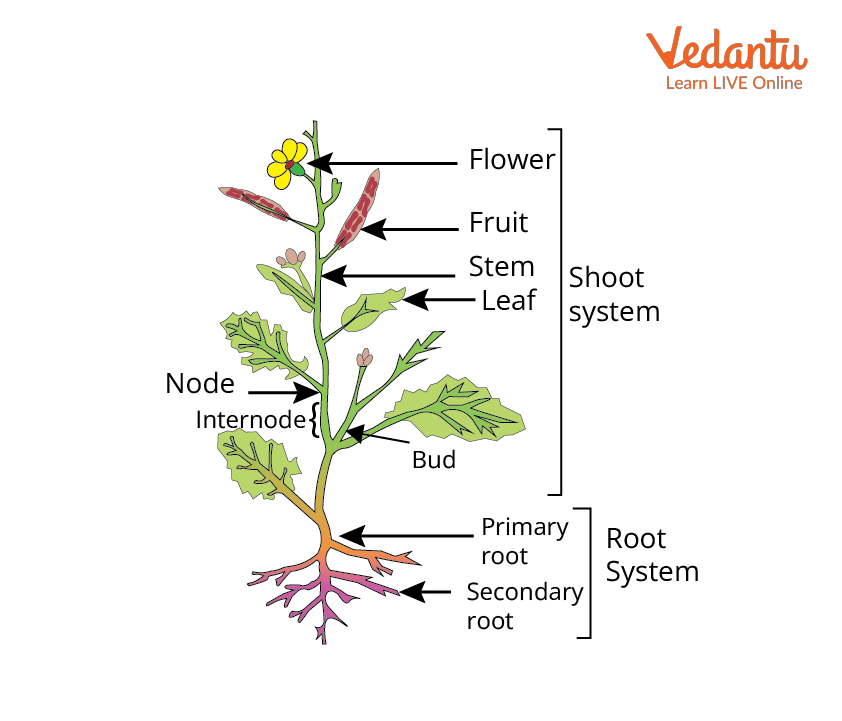
The diagram above illustrates the main organs, showing their arrangement and interconnection. Such visualizations are essential for exams and practical understanding. For well-labelled diagrams and more, explore our biology diagram resources.
Detailed Explanation of Plant Parts
Let’s explore the morphology of flowering plants by studying each organ’s features and modifications. These help in plant identification and understanding plant adaptations in nature and agriculture.
Root System
The root system anchors the plant and plays a key role in water and mineral absorption. There are three main types:
- Tap root: Single, thick primary root with smaller branches (e.g., carrot).
- Fibrous root: Thin, branching roots arising from the base of the stem (e.g., wheat).
- Adventitious root: Roots that grow from parts other than the radicle, like stems or leaves (e.g., grass, maize).
Roots often modify for functions like food storage (turnip, radish), climbing (ivy), or respiration (mangrove pneumatophores).
Stem
The stem provides support, bears leaves and flowers, and transports substances. Stems also show numerous modifications:
- Underground stem: Rhizome (ginger), tuber (potato), corm (colocasia).
- Climbing stem: Tendrils help plants climb (pea, grapevine).
- Protective stems: Thorns (citrus) deter herbivores.
These modifications enhance survival and have important agricultural uses. To learn more, read about stem modifications.
Leaves
Leaves are the chief site of photosynthesis and transpiration. Leaf morphology includes blade (lamina), petiole, and arrangement patterns (simple or compound leaves).
- Simple leaf: Single undivided blade (mango leaf).
- Compound leaf: Blade divided into leaflets (neem).
- Leaf modifications: Tendrils (pea), hooks (acacia), spines (cactus), storage leaves (onion).
These adaptations help plants survive drought, defend against animals, or climb. Check the detailed summary on leaves for more diagrams and explanations.
Inflorescence
Inflorescence describes how flowers are grouped on a plant. Common types include:
- Racemose: Main axis continues growth (mustard, snapdragon).
- Cymose: Main axis ends in a flower (jasmine, bougainvillea).
Inflorescence patterns influence pollination and seed formation.
Flowers
Flowers are reproductive organs necessary for sexual reproduction. Each typically has four whorls:
- Calyx: Outermost whorl (sepals) protects the bud.
- Corolla: Petals attract pollinators.
- Androecium: Male part (stamens).
- Gynoecium: Female part (carpels).
Flower structures vary to enhance pollination by wind, insects, birds, or animals. You can find advanced reproductive system topics in plants on Reproduction in Plants.
Fruits and Seeds
After fertilization, the ovary matures into a fruit, while ovules become seeds. Fruits protect seeds and assist in dispersal, ensuring the plant’s life cycle continues.
- Fruit types: Berry (tomato), drupe (mango), legume (pea), capsule (poppy).
- Seed adaptations: Wings, hooks, or fleshy fruits aid dispersal by wind, water, or animals.
For more on fruits and their role, see types of berries and seed structure.
Classification of Flowering Plants
Morphology aids in plant classification into families. The most common classification is based on floral structure and vegetative features. Below, you'll find a table for prominent angiosperm families.
| Family | Key Features | Examples |
|---|---|---|
| Fabaceae | Compound leaves, zygomorphic flowers, legume fruit | Pea, Beans, Gram |
| Solanaceae | Simple leaves, actinomorphic flowers, berry/capsule fruit | Tomato, Potato, Brinjal |
| Liliaceae | Linear leaves, trimerous flowers, capsule/berry fruit | Lily, Tulip, Aloe |
Classification also considers root, stem, and leaf variations, offering a systematic method for identifying plants in agriculture, research, and medicine.
Modifications and Adaptations in Flowering Plants
Adaptations in the morphology of flowering plants allow survival in diverse habitats. These modifications serve roles—from food storage to vegetative propagation or defense.
- Root tubers (sweet potato): Storage of nutrients.
- Bulbs (onion): Leaf stores food and resists drought.
- Thorns (bougainvillea): Defend against herbivores.
- Tendrils (cucumber): Help in climbing.
Understanding such adaptations enhances agricultural techniques and helps in the selective breeding of useful plants. For differences in plant families, visit this page.
Morphology Of Flowering Plants: Real-World Examples
Many daily-life plants show unique morphological features. Here are some important examples:
- Carrot: Tap root adapted for storage.
- Wheat: Fibrous root system for effective nutrient absorption.
- Potato: Tuber (underground stem) storing starch.
- Cactus: Leaves modified into spines for water conservation.
- Sweet pea: Leaves modified as tendrils for climbing.
These morphology of flowering plants examples are crucial for agriculture, food security, and even medicine. For more crops, check crops overview.
Applications of Morphology of Flowering Plants
Morphological study extends far beyond academics. It supports modern agriculture, environmental sustainability, taxonomy, and even pharmacology.
- Crop improvement: Identifying useful traits for breeding better varieties.
- Medicinal plants: Recognizing morphological features helps in identifying herbs (see food science resources).
- Environmental monitoring: Morphological changes may signal pollution or climate shifts (climate change impacts).
- Plant classification: Essential for taxonomy across all biological sciences (life sciences overview).
Morphology also aids in the conservation and propagation of valuable or endangered species.
Key Points and Practice for Morphology Of Flowering Plants Class 12
Students preparing for board exams or competitive tests should focus on:
- Identifying main plant organs and their functions
- Explaining modifications with suitable examples
- Interpreting diagrams and structure-function relationships
- Applying concepts in practical situations (e.g., crop selection, plant breeding)
Practice with morphology of flowering plants MCQs and questions to reinforce learning.
Summary
The morphology of flowering plants offers crucial insights into the form, function, and adaptations of angiosperms. Understanding these concepts supports successful careers in medicine, agriculture, and biological sciences. For detailed explanations, diagrams, and exam resources, Vedantu provides comprehensive study material for curious learners at every level.


FAQs on Morphology of Flowering Plants in Angiosperms
1. What is the morphology of flowering plants?
The morphology of flowering plants is the study of the external structure and form of angiosperms. It deals with the visible parts of a plant and their organization.
- Includes the study of root, stem, leaf, flower, fruit, and seed.
- Focuses on structure, shape, modification, and arrangement of plant organs.
- Helps in plant identification, classification, and understanding adaptation.
2. What are the main parts of a flowering plant?
The main parts of a flowering plant are the root system and the shoot system. These two systems together make up the plant body.
- Root system: Includes primary root, lateral roots, and root hairs.
- Shoot system: Includes stem, leaves, flowers, fruits, and seeds.
3. What are the functions of the root in flowering plants?
The primary function of the root in flowering plants is to anchor the plant and absorb water and minerals from the soil. Roots also perform additional supportive roles.
- Absorption of water and mineral salts.
- Anchorage of the plant in soil.
- Storage of food (e.g., carrot, radish).
- Conduction of water to the stem.
4. What is the structure of a typical flower?
A typical flower consists of four main whorls arranged on the thalamus: calyx, corolla, androecium, and gynoecium. These whorls perform protective and reproductive functions.
- Calyx: Outermost whorl made of sepals; protects the bud.
- Corolla: Petals; attract pollinators.
- Androecium: Male reproductive part made of stamens.
- Gynoecium: Female reproductive part made of carpels or pistil.
5. What is the difference between tap root and fibrous root system?
The main difference between a tap root system and a fibrous root system is the presence or absence of a dominant primary root. These systems are typical of dicots and monocots respectively.
- Tap root system: One main primary root with lateral branches (e.g., mustard, pea).
- Fibrous root system: Many thin roots of similar size arise from the base of the stem (e.g., wheat, rice).
6. What are the different types of leaves in flowering plants?
Leaves in flowering plants are mainly classified into simple leaves and compound leaves based on the division of the lamina. This classification depends on whether the leaf blade is divided.
- Simple leaf: Lamina is undivided (e.g., mango, guava).
- Compound leaf: Lamina is divided into leaflets (e.g., neem, rose).
7. What is the function of the stem in flowering plants?
The stem supports aerial parts of the plant and conducts water, minerals, and food. It acts as the main axis of the shoot system.
- Supports leaves, flowers, and fruits.
- Transports water through xylem.
- Transports food through phloem.
- May store food (e.g., potato, ginger).
8. What is inflorescence in flowering plants?
An inflorescence is the arrangement of flowers on the floral axis of a plant. It describes how flowers are grouped and attached to the stem.
- Racemose inflorescence: Main axis continues to grow; flowers are borne laterally.
- Cymose inflorescence: Main axis terminates in a flower; growth is limited.
9. What is placentation in flowering plants?
Placentation is the arrangement of ovules within the ovary of a flower. It determines how ovules are attached to the placenta inside the ovary.
- Marginal placentation (e.g., pea).
- Axile placentation (e.g., tomato, lemon).
- Parietal placentation (e.g., mustard).
- Basal placentation (e.g., sunflower).
10. What is the difference between a flower and an inflorescence?
A flower is a single reproductive unit of a plant, while an inflorescence is a cluster or arrangement of multiple flowers on a common axis. The difference lies in number and arrangement.
- Flower: Contains calyx, corolla, androecium, and gynoecium.
- Inflorescence: Refers to how many flowers are arranged on the peduncle.



