




How Renal Tubules Perform Filtration Reabsorption and Secretion
The concept of nephron function in renal tubules is essential in biology and helps explain real-world biological processes and exam-level questions effectively.
Understanding Nephron Function in Renal Tubules
Nephron function in renal tubules refers to how the filtration units of the kidney—nephrons—remove waste from blood and regulate water, ions, and pH through the renal tubules. This concept is important in areas like kidney filtration process, excretory system, urine formation, and human physiology for exams like CBSE, ICSE, and NEET.
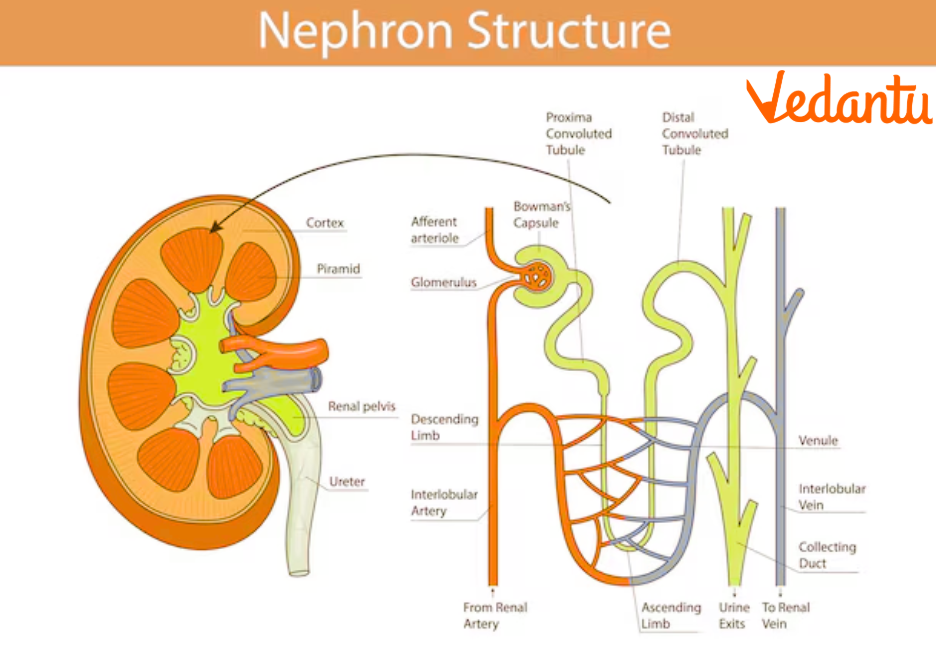
Structure of the Nephron and Renal Tubules
A nephron is the smallest structural and functional unit of the kidney. Each nephron has two key parts:
- Renal Corpuscle: Consists of the Bowman’s capsule and glomerulus. It’s the main site for filtration of blood.
- Renal Tubule: Begins after the renal corpuscle and is divided into:
- Proximal Convoluted Tubule (PCT)
- Loop of Henle (Descending and Ascending limbs)
- Distal Convoluted Tubule (DCT)
- Collecting Duct
The renal tubules are responsible for reabsorption and secretion, crucial processes in urine formation and maintaining body homeostasis.
Mechanism of Nephron Function in Renal Tubules
The basic mechanism of nephron function involves four main steps:
- Filtration: Blood is filtered in the glomerulus; small molecules and water enter Bowman’s capsule, forming filtrate.
- Reabsorption: Useful substances (glucose, amino acids, ions, water) are reabsorbed from the renal tubules back into the blood, mainly in the PCT and loop of Henle.
- Secretion: Wastes and extra ions (H+, K+, NH3) are actively secreted from blood into the tubules, primarily in the DCT and collecting duct.
- Excretion: Final urine (mostly wastes, some water and ions) is collected and sent to the bladder for elimination.
Here’s a helpful table to understand nephron function in renal tubules better:
Nephron Function in Renal Tubules Table
| Part of Nephron | Main Function | Key Process |
|---|---|---|
| Proximal Convoluted Tubule (PCT) | Reabsorbs most water, ions, glucose, amino acids | Active/passive reabsorption |
| Loop of Henle | Concentrates/dilutes urine by exchanging water and salts | Countercurrent mechanism, osmoregulation |
| Distal Convoluted Tubule (DCT) | Regulates pH, secretes K+/H+, reabsorbs Na+ | Tubular secretion and selective absorption |
| Collecting Duct | Adjusts final urine concentration, secretes H+/K+ | Water reabsorption (ADH dependent) |
Worked Example – Stepwise Urine Formation
Let’s understand the process step by step:
1. Blood enters the glomerulus and filtration occurs. Smaller particles (water, salts, urea, glucose) move into the Bowman’s capsule.
2. As filtrate passes through the PCT, essential nutrients and most water is reabsorbed into the blood.
3. Loop of Henle creates an osmotic gradient in the medulla, helping concentrate urine.
4. DCT finely tunes salt, pH, and waste levels by reabsorbing and secreting ions.
5. Collecting duct reabsorbs remaining water (regulated by ADH hormone), and final urine is collected.
Functions of Each Renal Tubule Segment
- Proximal Convoluted Tubule: Main site of reabsorption of water, electrolytes, glucose, amino acids.
- Loop of Henle: Establishes salt concentration gradient; descending limb reabsorbs water, ascending limb reabsorbs Na+ and Cl-.
- Distal Convoluted Tubule: Active secretion of H+, K+, and NH3; fine adjustment of sodium and water under hormonal control.
- Collecting Duct: Final water reabsorption (ADH-sensitive), acidic/basic urine formation, and potassium/hydrogen ion secretion.
Common Mistakes to Avoid
- Confusing reabsorption (return useful substances to blood) with secretion (remove extra substances from blood to tubule).
- Mixing up parts of the nephron and their specific roles in urine formation.
- Neglecting the importance of the loop of Henle in concentrating urine.
Practice Questions
- What is the main function of the renal tubules in a nephron?
- Draw and label a nephron showing the renal corpuscle and renal tubule.
- Explain the difference between reabsorption and secretion in the nephron.
- Describe the role of ADH in the collecting duct.
- Why is the loop of Henle important for osmoregulation?
Real-World Applications
The concept of nephron function in renal tubules is used in fields like nephrology, medicine (for kidney diseases, dialysis), biomedical research, and pharmaceuticals. Understanding this helps explain disorders such as diabetes insipidus, kidney stones, and chronic kidney disease. Vedantu helps students relate such topics to practical examples, competitive exams, and daily life health awareness.
In this article, we explored nephron function in renal tubules, its structure, stepwise processes, and significance. For further clarity on nephron, kidney health, and excretory system chapters, keep practicing and revising with Vedantu—especially before exams!
Structure of Kidney
Nephron
Loop of Henle
Kidney Stone Symptoms
Countercurrent Mechanism
Excretion and Its Importance
Human Excretory System
Urea Cycle
Osmoregulation
Modes of Excretion
Countercurrent Mechanism (urine formation)


FAQs on Nephron and Renal Tubules Function in Urine Formation
1. What is the function of the renal tubules in the nephron?
The renal tubules modify the filtrate by reabsorbing useful substances and secreting wastes to form urine. After filtration in the glomerulus, the filtrate passes through different tubular segments where its composition is adjusted.
- Reabsorption of water, glucose, amino acids, and ions back into the blood
- Secretion of hydrogen ions, potassium ions, and metabolic wastes into the tubule
- Formation of concentrated or dilute urine depending on body needs
2. What are the parts of the renal tubule?
The renal tubule consists of three main segments: the proximal convoluted tubule, loop of Henle, and distal convoluted tubule. These parts work sequentially to process filtrate.
- Proximal convoluted tubule (PCT) – major site of reabsorption
- Loop of Henle – creates concentration gradient in the medulla
- Distal convoluted tubule (DCT) – fine-tunes ion balance and pH
3. How does the proximal convoluted tubule function?
The proximal convoluted tubule (PCT) reabsorbs most of the filtered nutrients, water, and ions back into the bloodstream. It is highly active and contains many mitochondria for energy-dependent transport.
- Reabsorbs nearly all glucose and amino acids
- Reabsorbs about 65–70% of filtered water and sodium ions
- Secretes hydrogen ions and certain drugs into the filtrate
4. What is the role of the loop of Henle in urine formation?
The loop of Henle establishes a concentration gradient in the kidney medulla that allows urine to be concentrated. It functions through a countercurrent mechanism.
- Descending limb – permeable to water but not salts
- Ascending limb – impermeable to water but actively transports sodium and chloride
- Helps maintain osmotic gradient for water reabsorption
5. What is the function of the distal convoluted tubule?
The distal convoluted tubule (DCT) regulates electrolyte balance and pH under hormonal control. It performs selective reabsorption and secretion.
- Reabsorbs sodium under the influence of aldosterone
- Reabsorbs calcium under the influence of parathyroid hormone
- Secretes hydrogen and potassium ions to maintain acid–base balance
6. How do renal tubules help in maintaining water balance?
The renal tubules maintain water balance by adjusting water reabsorption according to the body's needs. This process is mainly regulated by hormones.
- Antidiuretic hormone (ADH) increases water reabsorption in the DCT and collecting duct
- Loop of Henle creates osmotic conditions for water movement
- Prevents dehydration or excessive water loss
7. What is tubular reabsorption in the nephron?
Tubular reabsorption is the process by which useful substances move from the filtrate in the renal tubules back into the blood. It ensures essential nutrients are not lost in urine.
- Occurs mainly in the proximal convoluted tubule
- Includes reabsorption of glucose, amino acids, water, and ions
- Occurs by active transport, diffusion, and osmosis
8. What is tubular secretion in the renal tubules?
Tubular secretion is the transfer of additional wastes and excess ions from the blood into the renal tubules. It helps maintain chemical balance and remove toxins.
- Secretion of hydrogen and potassium ions
- Removal of drugs and metabolic wastes
- Regulation of blood pH and electrolyte levels
9. What is the difference between proximal and distal convoluted tubules?
The main difference between the proximal convoluted tubule (PCT) and distal convoluted tubule (DCT) is the extent and type of reabsorption they perform.
- PCT – bulk reabsorption of nutrients, water, and sodium
- DCT – selective reabsorption regulated by hormones
- PCT has more microvilli forming a brush border; DCT has fewer microvilli
10. Why are renal tubules important in maintaining homeostasis?
The renal tubules are essential for homeostasis because they regulate fluid volume, electrolyte balance, and blood pH. By modifying the filtrate, they keep internal conditions stable.
- Control levels of sodium, potassium, and calcium
- Maintain acid–base balance
- Adjust water reabsorption to stabilize blood pressure and osmolarity



