




Comparison of Direct vs Indirect ELISA Principle Procedure and Advantages
The concept of Difference Between Direct and Indirect ELISA is essential in biology and helps explain real-world biological processes, clinical diagnostics, and exam-level questions effectively.
Understanding the Difference Between Direct and Indirect ELISA
Difference Between Direct and Indirect ELISA refers to how these two common types of Enzyme-Linked Immunosorbent Assay (ELISA) tests detect antigens or antibodies in a sample. This concept is important in areas like immunology, microbiology, and medical diagnostics, and is often asked in exams such as NEET and other medical entrance tests.
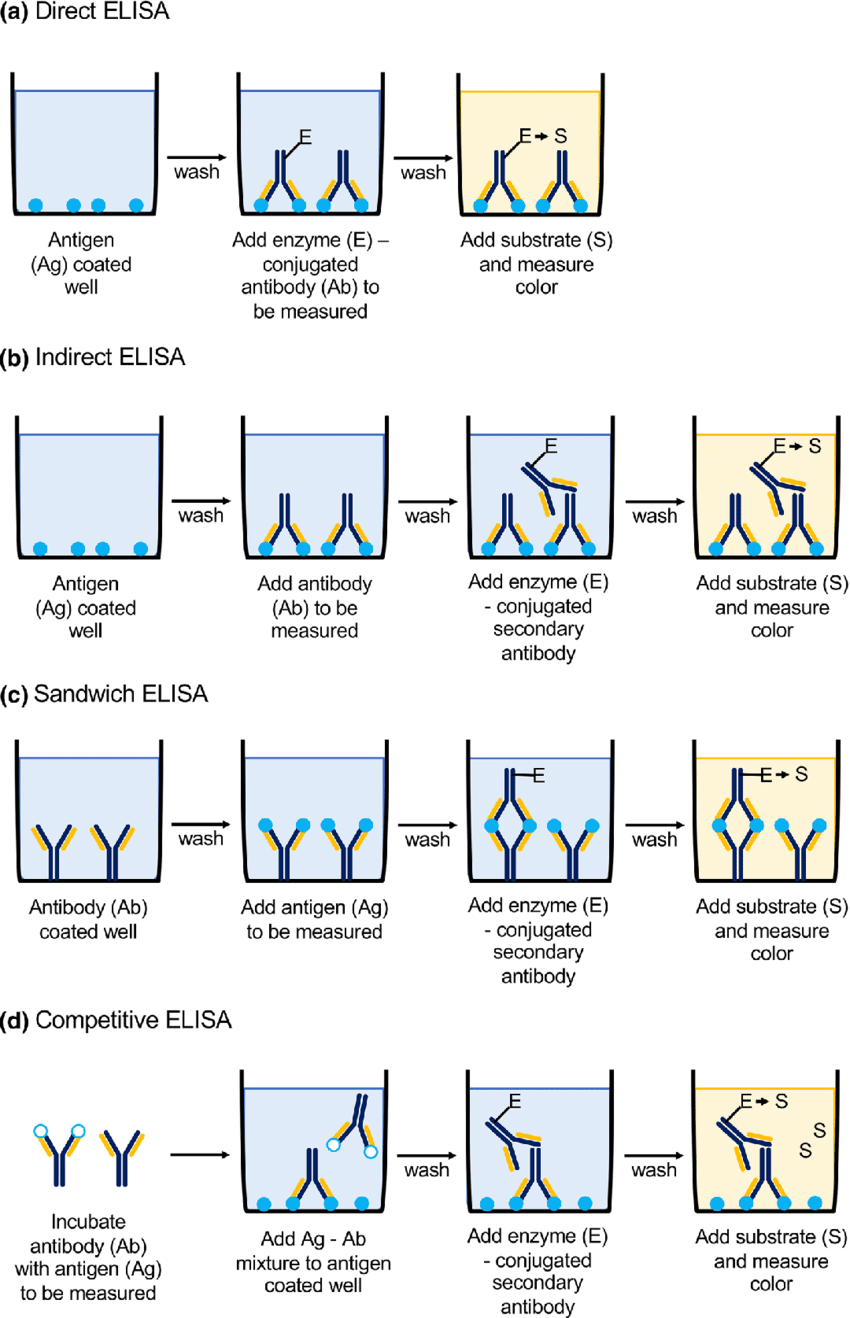
Direct ELISA: Principle and Steps
In Direct ELISA, the target antigen is immobilized on the microplate surface. A single, enzyme-labeled primary antibody is then added, which binds directly to the antigen. The enzyme reacts with a substrate, producing a visible signal (usually a color change) to indicate the presence of the antigen.
- Simpler and quicker method since only one antibody is used.
- Labeled antibody directly attaches to the target antigen.
- Lower sensitivity as there is no signal amplification.
- Less risk of cross-reactivity due to only one antibody species.
- Best used when high antigen concentration is expected or rapid results are needed.
Indirect ELISA: Principle and Steps
In Indirect ELISA, the antigen is first immobilized on the plate. An unlabeled primary antibody specific to the antigen is then added, followed by a secondary antibody that is enzyme-labeled and recognizes the primary antibody. The enzyme on the secondary antibody acts on the substrate to generate a stronger, amplified signal.
- Requires two antibodies (primary + labeled secondary antibody).
- Signal amplification occurs, resulting in higher sensitivity.
- Offers flexibility—same labeled secondary can be used for different primary antibodies.
- Increased risk of cross-reactivity since two antibody types are involved.
- Ideal for detecting small amounts of antigen or antibody in a sample.
Key Differences Between Direct and Indirect ELISA
Here’s a helpful table to understand Difference Between Direct and Indirect ELISA better:
Direct vs Indirect ELISA Table
| Feature | Direct ELISA | Indirect ELISA |
|---|---|---|
| Number of antibodies used | One (labeled primary) | Two (primary + labeled secondary) |
| Sensitivity | Lower | Higher |
| Signal amplification | No | Yes |
| Time taken | Shorter | Longer |
| Risk of cross-reactivity | Low | Moderate to high |
| Applications | Fast, specific detection | Detecting low-level targets |
When to Use Direct vs Indirect ELISA?
Choose direct ELISA when you need a fast, simple assay and expect a high amount of target molecule (antigen). Prefer indirect ELISA for higher sensitivity, when the antibody or antigen is present at a low concentration, and when you want flexible detection across different experiments.
- Direct ELISA: Suitable for rapid screening and specificity with minimal steps.
- Indirect ELISA: Best for research, confirmation tests, NEET-based exam questions, and detecting low-abundance analytes.
Other ELISA Types in Brief
- Sandwich ELISA: Antigen is caught between two specific antibodies. Highest sensitivity. Used for complex samples.
- Competitive ELISA: Competes labeled antigen vs. sample antigen for antibody binding. Used for small molecule detection.
Practice Questions
- What is the main difference between direct and indirect ELISA?
- Which ELISA method is more sensitive and why?
- Write two advantages of indirect ELISA over direct ELISA.
- List one application each of direct and indirect ELISA.
- Fill in the blank: Direct ELISA uses a _______ antibody with an attached enzyme.
Summary Table – Quick Difference
| Aspect | Direct ELISA | Indirect ELISA |
|---|---|---|
| Uses | Antigen detection | Antibody detection |
| Antibody type | Primary (enzyme-labeled) | Primary + labeled secondary |
| Sensitivity | Low | High |
| Steps involved | Fewer | More |
Common Mistakes to Avoid
- Confusing Difference Between Direct and Indirect ELISA with sandwich/competitive ELISA types.
- Skipping addition of secondary antibody during indirect ELISA protocol steps.
- Assuming direct ELISA is always better due to less time – neglecting sensitivity requirements.
Real-World Applications
The concept of Difference Between Direct and Indirect ELISA is used in fields like medicine (HIV, malaria, and viral detection), food safety (allergen testing), biotechnology (protein quantification), and in research labs. Vedantu helps students relate such topics to clinical and diagnostic techniques relevant for practical labs and exams.
In this article, we explored Difference Between Direct and Indirect ELISA, their principles, steps, real-life significance, and how to answer related exam questions confidently. To strengthen your basics and scoring ability for NEET and other medical exams, keep practicing with Vedantu!
Related Reading:
- Immunity
- Enzyme-Linked Immunosorbent Assay (ELISA)
- Differences Between Mitosis and Meiosis
- Difference Between Antigen and Antibody
- Difference Between Pathogen and Parasite
- Difference Between Active and Passive Immunity
- MCQs on Immunology
- Difference Between Virus and Bacteria


FAQs on Difference Between Direct and Indirect ELISA in Detail
1. What is the difference between Direct and Indirect ELISA?
The main difference between Direct ELISA and Indirect ELISA is that direct ELISA uses a single enzyme-labeled primary antibody, while indirect ELISA uses an unlabeled primary antibody followed by an enzyme-labeled secondary antibody.
- Direct ELISA: Antigen is detected by one enzyme-linked primary antibody.
- Indirect ELISA: Antigen is detected using a primary antibody and a labeled secondary antibody.
- Indirect ELISA generally provides higher sensitivity due to signal amplification.
2. What is Direct ELISA?
Direct ELISA is an immunoassay technique where a labeled primary antibody directly binds to the target antigen for detection.
- The antigen is coated onto a microplate.
- An enzyme-conjugated primary antibody binds directly to the antigen.
- A substrate is added to produce a measurable color change.
3. What is Indirect ELISA?
Indirect ELISA is an immunoassay method that uses an unlabeled primary antibody and an enzyme-linked secondary antibody to detect a specific antigen.
- The antigen is coated on the plate.
- A primary antibody binds to the antigen.
- An enzyme-labeled secondary antibody binds to the primary antibody.
- Substrate addition produces a color change.
4. Why is Indirect ELISA more sensitive than Direct ELISA?
Indirect ELISA is more sensitive because multiple enzyme-labeled secondary antibodies can bind to a single primary antibody, amplifying the signal.
- Each primary antibody can bind more than one secondary antibody.
- More enzyme molecules lead to stronger color development.
- This signal amplification improves detection of low antigen concentrations.
5. What are the advantages of Direct ELISA?
The main advantages of Direct ELISA are its simplicity, speed, and reduced risk of cross-reactivity.
- Fewer steps compared to indirect ELISA.
- No secondary antibody required.
- Lower chance of non-specific binding from secondary antibodies.
6. What are the advantages of Indirect ELISA?
Indirect ELISA offers higher sensitivity and greater flexibility compared to direct ELISA.
- Signal amplification due to multiple secondary antibodies.
- One labeled secondary antibody can detect different primary antibodies.
- Cost-effective because the same secondary antibody can be reused.
7. What are the steps involved in Direct ELISA?
Direct ELISA involves coating the antigen and detecting it using an enzyme-labeled primary antibody in a few simple steps.
- Coat microplate wells with antigen.
- Block unoccupied sites to prevent non-specific binding.
- Add enzyme-linked primary antibody.
- Add substrate to produce measurable color.
8. What are the steps involved in Indirect ELISA?
Indirect ELISA involves detecting an antigen using both primary and enzyme-linked secondary antibodies.
- Coat plate with antigen.
- Block non-specific binding sites.
- Add unlabeled primary antibody.
- Add enzyme-conjugated secondary antibody.
- Add substrate for color development.
9. When should you use Direct ELISA instead of Indirect ELISA?
Direct ELISA should be used when quick results and minimal cross-reactivity are more important than maximum sensitivity.
- Suitable for high antigen concentrations.
- Useful in rapid screening assays.
- Preferred when only one specific primary antibody is available.
10. What is a common example of Indirect ELISA in medical diagnosis?
A common example of Indirect ELISA is the detection of antibodies against HIV in blood samples.
- HIV antigens are coated on the plate.
- If present, patient antibodies bind to the antigen.
- An enzyme-linked secondary antibody detects the bound antibodies.
- Color change confirms antibody presence.



