




Structure and Parts of the Longitudinal Section of Flower
The longitudinal section of flower is a key concept in plant biology, offering a detailed view of internal floral structures. By observing a longitudinally cut flower, students can understand pollen transfer, fertilisation, and the complex arrangement of reproductive organs. This foundational approach brings clarity to questions in plant morphology, reproduction, and real-world applications in agriculture and botany.
Longitudinal Section of Flower: Definition and Overview
Longitudinal section of flower refers to a lengthwise cut made along the central axis of a flower, usually passing through the pistil and stamen. This biological technique exposes internal structures, allowing a clear view of how various parts are organized and interact during processes like pollination, fertilisation, and seed development. It’s an essential study topic in class 12, as it helps explain plant reproduction and floral diversity.
Parts of a Flower Seen in Longitudinal Section
In a flower’s longitudinal section, you can identify four primary whorls, each with unique roles. A labelled diagram typically reveals these essential floral parts and their arrangement.
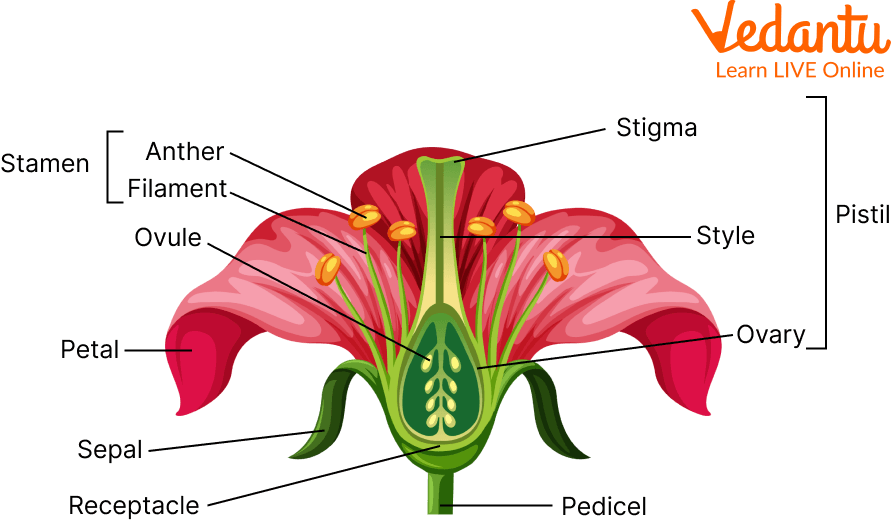
- Calyx (Sepals): Green, leaf-like structures; protect the flower in its bud stage.
- Corolla (Petals): Colorful whorl that attracts pollinators.
- Androecium (Stamens): The male part, consisting of filament and anther which produces pollen.
- Gynoecium/Pistil (Carpels): The female part, composed of stigma, style, and ovary (which contains ovules).
These whorls make up the visible and functional regions crucial for the reproductive cycle. Understanding them is important for reproduction in plants and foundational to plant science.
Longitudinal Section of Flower Diagram and Explanation
A longitudinal section of flower diagram presents the internal organization of the flower. When the flower is sliced vertically, you can easily observe the sequence and position of each whorl, along with the style, stigma, ovary, and chambers of the anther. Such illustration is especially helpful for learning in class 12 and answering MCQs or diagram-based biology questions.
- The central pistil with stigma at the top, leading down to the style and ovary.
- Stamens surrounding the pistil with filament and anther, often grouped around the style.
- Petals arranged in a whorl, often brightly colored for visual reference.
- Sepals forming the outermost protective layer.
By understanding the alignment seen in these diagrams, students appreciate how the flower operates as a reproductive organ and how fertilisation pathways function. For more on plant anatomy, visit our guide on morphology of flowering plants.
Longitudinal Section in Biology: Why Study It?
Longitudinal section in biology refers broadly to cutting any biological structure lengthwise for in-depth study. In flowers, it provides insights into the relationships between functional parts and reveals details that a transverse (cross) section cannot—such as the pathway of pollen tubes during fertilisation. This concept is vital for answering MCQs, practical questions, and understanding reproductive mechanisms in science and agricultural research. It also supports environmental studies on plant diversity and survival strategies.
Functions of Key Structures Seen in Longitudinal Section
Each floral part revealed in a longitudinal section has distinct functions in reproduction and survival:
- Stigma: Receives pollen grains during pollination.
- Style: Serves as a route for pollen tubes to reach the ovary.
- Ovary: Contains ovules; develops into fruit post-fertilisation.
- Anther: Houses pollen sacs where pollen matures and is released.
- Filament: Holds and positions the anther optimally for pollination.
- Petals: Attract pollinators with color and scent.
- Sepals: Shield the developing bud from damage or dehydration.
The longitudinal section of flower anther is particularly significant. It allows students to visualize pollen chamber arrangement, pollen maturation, and vascular bundles that nourish the anther—helping to clarify the sexual reproduction in flowering plants process.
Real-World Examples: Longitudinal Section of Hibiscus Flower
A classic example for practical learning is the longitudinal section of hibiscus flower. Hibiscus is often used in school labs due to its large, bisexual flowers where all four whorls are clear and distinct.
- Pronounced petals surround the reproductive structure.
- Branched style and visible stigma at the top.
- Ring of anthers encircle the style for easy observation.
- Basal ovary with multiple ovules, perfect for fertilisation studies.
Creating a labeled diagram of this example strengthens understanding of floral morphology for NEET, CBSE, and other exams. Such practical insights are useful in agriculture, medicine (in the case of medicinal plants), and plant breeding.
Importance and Applications in Biology
Studying the longitudinal section of flower equips students and researchers with a deeper understanding of how plants reproduce, adapt, and contribute to ecosystems. This knowledge guides crop improvement, supports climate change and environmental research, and aids in identifying plant family characteristics. For further comparison of plant anatomy and genetics, see topics like difference between acquired and inherited traits.
Summary
The longitudinal section of flower reveals critical internal structures necessary for pollination and fertilisation. Understanding this topic supports biology learning, enhances exam performance, and links foundational science with real-life agricultural and ecological applications. With clear diagrams and real-world examples like hibiscus, students can confidently answer questions and build a solid base in plant morphology with Vedantu’s engaging resources.


FAQs on Longitudinal Section of a Flower Explained with Labeled Diagram
1. What is the longitudinal section of a flower?
The longitudinal section (L.S.) of a flower is a vertical cut made through the flower to show its internal structures in detail. It divides the flower lengthwise from top to bottom, revealing key parts such as:
- Sepals
- Petals
- Stamens (anther and filament)
- Pistil/Carpel (stigma, style, ovary)
- Ovules inside the ovary
2. What parts are visible in the longitudinal section of a flower?
The longitudinal section of a flower shows all major floral organs arranged from outside to inside. These include:
- Calyx (sepals)
- Corolla (petals)
- Androecium (stamens: anther and filament)
- Gynoecium (stigma, style, ovary)
- Ovules within the ovary
- Receptacle and pedicel
3. Why is the longitudinal section of a flower important?
The longitudinal section of a flower is important because it helps in understanding the internal structure and reproductive organization of the flower. It is useful for:
- Studying the position of male and female reproductive organs
- Observing ovules inside the ovary
- Understanding pollination and fertilization
- Identifying floral symmetry and arrangement
4. How is a longitudinal section of a flower different from a transverse section?
A longitudinal section cuts the flower vertically, while a transverse section cuts it horizontally. The key differences are:
- Longitudinal section (L.S.): Shows lengthwise view and internal arrangement from top to bottom.
- Transverse section (T.S.): Shows cross-sectional view at a particular level.
- L.S. clearly displays stigma, style, and ovary in one plane.
- T.S. helps in counting floral parts and studying their arrangement in a circular pattern.
5. What does the ovary look like in the longitudinal section of a flower?
In the longitudinal section, the ovary appears as a swollen basal part of the pistil containing one or more ovules. It shows:
- Ovary wall
- Internal chamber(s) called locules
- Ovules attached to the placenta
6. What is the function of the pistil in the longitudinal section of a flower?
The pistil is the female reproductive part of the flower responsible for fertilization and seed formation. In the longitudinal section, it includes:
- Stigma – receives pollen grains
- Style – provides passage for pollen tube growth
- Ovary – contains ovules that develop into seeds
7. How does fertilization occur as seen in the longitudinal section of a flower?
Fertilization in a flower occurs when the pollen tube grows from the stigma through the style to reach the ovule inside the ovary. The steps include:
- Pollen lands on the stigma
- Pollen tube grows down the style
- Male gametes enter the ovule
- Double fertilization occurs in angiosperms
8. What is the role of stamens in the longitudinal section of a flower?
The stamens are the male reproductive organs that produce pollen grains. In the longitudinal section, each stamen consists of:
- Filament – supports the anther
- Anther – produces and contains pollen grains
9. What is placentation in the longitudinal section of a flower?
Placentation refers to the arrangement of ovules within the ovary as seen in the longitudinal section of a flower. Common types include:
- Marginal placentation
- Axile placentation
- Parietal placentation
- Free central placentation
10. Can you give an example of a flower commonly studied in longitudinal section?
The Hibiscus flower is a common example used to study the longitudinal section of a flower. It is preferred because:
- It has large and clearly visible floral parts
- It shows distinct stamens and pistil
- The ovary and ovules are easy to observe



