








NEET Urine Formation Process: Steps, Functions & Importance
Urine is one of the most important biological fluids studied in the NEET Biology syllabus, especially in excretory system topics. Understanding what urine is, how it forms, and its composition is crucial for building a strong foundation in human physiology. Questions often appear in NEET related to urine formation, filtration, and its clinical relevance, making this concept essential for every aspirant. This page will help you grasp the concept of urine, its key processes, and how to master this topic for NEET preparation.
What is Urine? Understanding the Concept
Urine is a liquid waste product produced by the kidneys through the filtration of blood. It contains water, dissolved salts, metabolic wastes like urea, and other substances that need to be removed from the body. The process of producing urine helps maintain the body's chemical balance by regulating the excretion of waste products and excess substances. Understanding urine and its formation gives you insight into how the body maintains homeostasis and eliminates toxins, which is a vital concept in human physiology for NEET.
Core Ideas and Fundamentals of the Concept
1. Urine Formation Process
Urine formation involves three main processes: glomerular filtration, tubular reabsorption, and tubular secretion. These processes occur within the nephrons of the kidneys and transform blood plasma into urine by selectively filtering and adjusting the composition of substances.
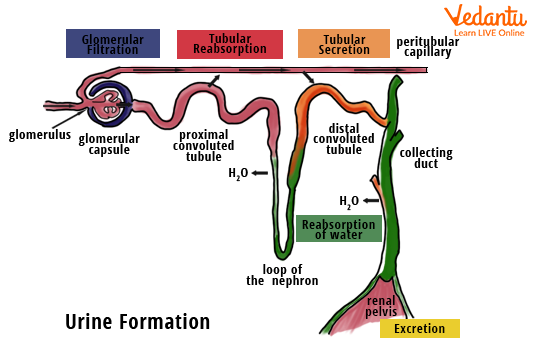
- Glomerular Filtration: High pressure forces water and small solutes from blood in the glomerulus into Bowman’s capsule, leaving behind blood cells and large proteins.
- Tubular Reabsorption: Essential substances like glucose, amino acids, and most water are reabsorbed from the filtrate back into the blood mainly in the proximal tubule.
- Tubular Secretion: Additional waste products or excess ions are secreted into the filtrate from the blood for elimination.
2. Composition of Urine
Urine is typically a pale yellow fluid containing about 95 percent water and 5 percent solutes. The major solutes include urea, creatinine, uric acid, ions like sodium, potassium, chloride, and small amounts of other metabolites.
Important Sub-Concepts Related to Urine
1. Nephron Structure and Function
The nephron is the structural and functional unit of the kidney. Each nephron carries out filtration, reabsorption, and secretion to form urine. Understanding nephron components helps in visualizing urine formation and its regulation - a core part of NEET questions.
2. Role of Hormones in Urine Formation
Several hormones regulate how much water and solutes enter or leave the urine. Antidiuretic hormone (ADH) and aldosterone are especially important in controlling water reabsorption, urine concentration, and maintaining body fluid balance.
3. Micturition (Urination)
Micturition is the process of expelling urine from the body. It involves both voluntary and involuntary muscle controls coordinated by the nervous system. This process links excretion with practical human health situations that may be tested in NEET.
Key Principles and Relationships Related to Urine
Several physiological principles govern urine formation and its properties.
- Osmoregulation: The kidneys adjust the concentration and volume of urine to maintain osmotic balance in the body fluids.
- Counter-Current Mechanism: This mechanism in the loop of Henle establishes concentration gradients that help produce concentrated urine when needed.
- Selective Reabsorption: Only essential substances are reabsorbed; waste and excess ions are retained in the filtrate for excretion.
Table: Formation and Composition of Urine
| Step | Location | Main Function |
|---|---|---|
| Glomerular Filtration | Glomerulus/Bowman’s Capsule | Filters blood plasma to form filtrate |
| Tubular Reabsorption | Proximal & Distal Tubule, Loop of Henle | Reabsorbs water and vital solutes |
| Tubular Secretion | Distal Tubule, Collecting Duct | Addition of wastes/ions to filtrate |
This table summarizes how urine forms in the nephron through sequential processes, each occurring at specific locations and serving critical functions in cleaning the blood and regulating body chemistry.
Features and Importance of Urine
- Helps eliminate nitrogenous waste products like urea and uric acid from the body
- Regulates body fluid volume, osmotic balance, and pH by adjusting urine composition
- Indicator of metabolic and kidney health - abnormalities in urine composition can signal disease
- Used in clinical tests (urinalysis) for diagnosis of diseases, a frequent application-based context in NEET questions
Why is the Concept of Urine Important for NEET?
Understanding urine and its formation is highly relevant for NEET because:
- Numerous questions in excretory system chapters are based on urine formation and composition
- Concepts of filtration, reabsorption, secretion, and osmoregulation are fundamental to many human physiology topics
- Application-based questions may test clinical understanding via abnormal urine analysis or system regulation
- Strong conceptual grounding helps in tackling assertion-reasoning and case-based MCQs in NEET
- Links to broader topics like homeostasis, hormone control, and overall human health
How to Study Urine Effectively for NEET
- Start with understanding nephron structure and labeling diagrams.
- Learn the sequence and logic of urine formation steps using clear images and flowcharts.
- Memorize the composition of normal urine and the function of each component.
- Practice MCQs on filtration, reabsorption, secretion, and hormone roles in the excretory system.
- Watch for diagrams-based and clinical application questions in previous NEET papers.
- Revise by rewriting tables of urine components and steps for last-minute recall.
- Clarify your doubts about osmotic mechanisms with simple examples.
Common Mistakes Students Make in This Concept
- Mixing up the order of urine formation steps (filtration, reabsorption, secretion)
- Not paying attention to the functions of specific nephron parts
- Ignoring the importance of hormones like ADH and aldosterone in urine dilution/concentration
- Errors in understanding normal vs. abnormal urine composition and its clinical significance
- Forgetting the counter-current mechanism and its role in nephron function
Quick Revision Points: Urine
- Urine is produced in the kidneys by filtering blood and removing wastes.
- Key steps: Glomerular filtration, tubular reabsorption, tubular secretion.
- Normal urine is 95 percent water and contains urea, uric acid, creatinine, and ions.
- Nephrons are the basic filtering units - each kidney has about 1 million nephrons.
- Hormones like ADH and aldosterone regulate urine concentration.
- Clinical analysis of urine helps diagnose diseases.
- Remember the counter-current mechanism for concentrating urine.
FAQs on Urine in Biology for NEET: Detailed Study and Concepts
1. What is urine and how is it formed?
Urine is a liquid waste product formed by the kidneys during the process of removing metabolic wastes and excess substances from the blood. The main steps in urine formation are:
- Glomerular filtration: Blood is filtered in the glomerulus, removing water, ions, and small molecules.
- Tubular reabsorption: Essential substances (like glucose, amino acids, and water) are reabsorbed into the blood.
- Tubular secretion: Additional wastes and excess ions are secreted into the filtrate.
2. What are the main components of urine?
Urine primarily consists of water and various dissolved substances removed from the body. The key components include:
- About 95% water
- Urea: Main nitrogenous waste
- Creatinine
- Uric acid
- Mineral ions like sodium, potassium, chloride
- Small quantities of hormones, vitamins, and other metabolites
3. What is the normal pH and colour of urine?
The normal pH of urine is generally acidic, ranging from 4.6 to 8.0, with an average of about 6. The usual colour of urine is light yellow to amber, mainly due to the pigment urochrome.
- pH: 4.6–8.0 (avg ~6)
- Colour: Light yellow (urochrome pigment)
4. How is urine different from plasma?
Urine and plasma differ in composition as the kidneys selectively remove wastes from plasma to form urine.
- Urine contains urea, uric acid, creatinine, and little to no proteins or glucose (in healthy individuals)
- Plasma is rich in proteins, glucose, and has lower concentrations of waste products
- Urine is typically more acidic and concentrated than plasma
5. What factors affect urine output and composition?
Several factors regulate the quantity and quality of urine produced by the kidneys.
- Water intake and hydration level
- Dietary habits (protein, salt, fluid consumption)
- Hormones like ADH (vasopressin), aldosterone
- Body temperature and activity level
- Health status (kidney diseases, diabetes, etc.)
6. What is micturition?
Micturition is the scientific term for the process of expelling urine from the urinary bladder through the urethra. It involves:
- Filling of the bladder with urine
- Stretch receptors triggering nerve impulses
- Relaxation of the sphincter muscles to allow urine to pass
7. What causes abnormal constituents in urine?
The presence of substances like glucose, proteins, or blood in urine indicates possible disorders.
- Glucose (glycosuria): Seen in uncontrolled diabetes mellitus
- Proteins (proteinuria): Associated with kidney damage
- Blood (hematuria): Indicates urinary tract infection or injury
8. Why is urine analysis important?
Urine analysis is an essential diagnostic tool for assessing kidney function and overall health.
- Detects kidney disorders and urinary tract infections
- Monitors systemic diseases (like diabetes)
- Checks for the presence of abnormal substances
9. What is osmoregulation and how does urine help in it?
Osmoregulation is the process by which the body maintains the balance of water and salts. Urine formation plays a key role by adjusting the amount of water and solutes excreted.
- Keeps body fluids isotonic
- Balancing water intake and loss
- Regulated by hormones like ADH and aldosterone
10. What is the role of antidiuretic hormone (ADH) in urine formation?
Antidiuretic hormone (ADH) regulates the amount of water reabsorbed by the kidneys during urine formation.
- Increases water reabsorption in kidney tubules
- Concentrates the urine, reducing water loss
- Works in response to dehydration or high blood osmolarity
11. Define urine.
Urine is a watery fluid produced by the kidneys containing waste products filtered from the blood. It is discharged from the bladder through the urethra and is integral for the excretion of metabolic wastes in the human body, making it a key concept in NEET biology.
12. Name the principal nitrogenous waste in human urine.
The main nitrogenous waste in human urine is urea, which is formed in the liver from the breakdown of amino acids. Urea excretion via urine is a significant part of the NEET syllabus under excretory products.
13. List two abnormal constituents of urine.
Two abnormal constituents of urine are:
- Glucose (indicates diabetes, glycosuria)
- Proteins (suggests kidney disorder, proteinuria)
