









How Are Sex Linked Characters Inherited in NEET Biology?
Sex linked characters are an essential biology concept that focuses on how certain traits are inherited via the sex chromosomes (X and Y). Understanding sex linked inheritance is crucial for NEET aspirants because questions on genetic disorders, inheritance patterns, and pedigree analysis often feature sex linked characters. Mastering this topic helps strengthen your overall grasp of genetics, a core part of NEET Biology.
What Are Sex Linked Characters?
Sex linked characters are traits controlled by genes located on the sex chromosomes. In humans, these are primarily the X and Y chromosomes. Most sex linked traits are found on the X chromosome, as it is much larger and carries more genes than the Y chromosome. The term "sex linked" usually refers to X linked inheritance, but a few traits are also Y linked. These inheritance patterns can produce unique results in offspring, especially regarding the differences seen between males and females.
Core Ideas of Sex Linked Inheritance
Chromosomes and Genetics Basics
Humans have 23 pairs of chromosomes, out of which one pair determines the sex: XX for females and XY for males. Genes located on these sex chromosomes can influence physical and physiological traits. Since males and females have different combinations of sex chromosomes, inheritance of sex linked characters differs between the two sexes.
X Linked Inheritance
Most sex linked characters are X linked because the X chromosome is larger and holds more genetic information. In X linked inheritance:
- Females (XX) have two copies of X-linked genes, so they can be homozygous or heterozygous for a trait.
- Males (XY) have only one X chromosome, so a single abnormal gene on the X can express the trait (hemizygous).
Y Linked Inheritance
Traits controlled by genes found only on the Y chromosome are called Y linked or holandric traits. Since only males carry a Y chromosome, these traits are only passed from father to son. Y linked inheritance is rare compared to X linked inheritance.
Diagrammatic Representation
Understanding sex linked inheritance is easier with diagrams. Below is a typical diagram showing how X linked recessive traits pass from parents to children:
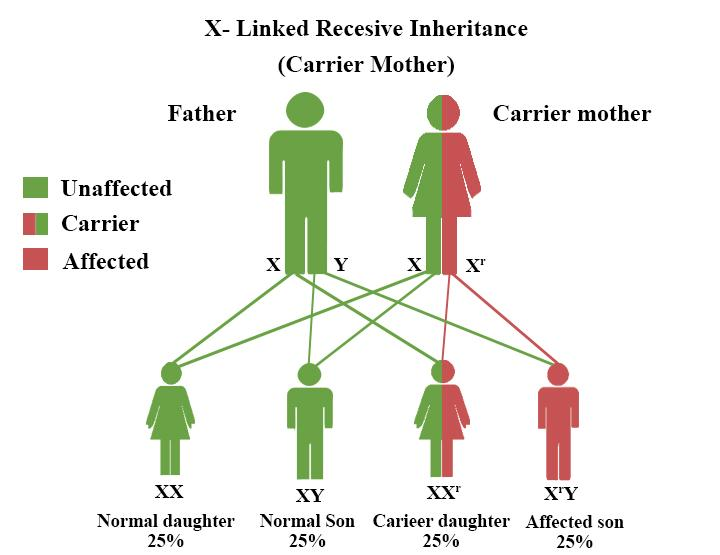
The diagram demonstrates that affected males transmit the trait to daughters (as carriers) but not to sons, while carrier females can pass the trait to both sons (who may be affected) and daughters (who may become carriers).
Important Sub-Concepts in Sex Linked Characters
X Linked Recessive Traits
These traits require two copies of the gene (one from each parent) to show in females, but only one copy in males. Classic examples include hemophilia and color blindness. Male children are more often affected, while females can be carriers if they inherit only one copy of the mutant gene.
X Linked Dominant Traits
Here, just one altered gene on the X chromosome can cause the trait to appear. Both males and females can be affected, but affected fathers cannot pass the trait to sons (since sons inherit the Y chromosome from their father), only to daughters.
Y Linked Traits
Only males inherit Y linked traits, which makes their inheritance straightforward: father to son to grandson. One example is the gene responsible for hairy pinna in some individuals.
Carrier Females
A heterozygous female who carries an X linked recessive allele is called a carrier. She may not show symptoms herself but can pass the trait to offspring, making this concept essential for understanding genetic counseling and predicting inheritance patterns.
Fundamental Patterns and Principles
Sex linked inheritance follows specific ratios and patterns. The following table summarizes key distinctions:
Comparison of Inheritance Patterns
| Inheritance Type | Who is affected? | Transmission Pattern |
|---|---|---|
| X linked recessive | Males > Females | Carrier mother to son; affected father’s daughters are carriers |
| X linked dominant | Females > Males | Affected parent to child; affected fathers transmit to all daughters, not sons |
| Y linked (holandric) | Males only | Father to all sons |
These patterns help predict the likelihood of traits appearing in future generations, a fundamental skill for NEET exam questions.
Why Sex Linked Characters Matter for NEET
Sex linked inheritance is a frequent theme in NEET Biology because it combines genetics, inheritance patterns, and problem-solving. Understanding it helps you tackle pedigree chart questions, distinguish between types of genetic disorders, and analyze inheritance in both theoretical and application-based NEET questions. It also connects to broader genetics chapters such as molecular basis of inheritance and disorders in humans, strengthening your overall conceptual framework.
How to Study Sex Linked Characters Effectively for NEET
- Start with the basics: Understand chromosomal structure, differences between autosomes and sex chromosomes, and the concept of carriers.
- Learn to identify inheritance patterns in pedigree diagrams. Practice drawing and analyzing family trees.
- Review classic examples (hemophilia, color blindness, Duchenne muscular dystrophy) and memorize their inheritance patterns.
- Solve multiple MCQs and case studies focusing on different inheritance scenarios (recessive, dominant, X, Y linked).
- Maintain quick notes or flashcards for key points, definitions, and exceptions.
- Regularly revise by summarizing patterns, drawing diagrams, and self-testing.
Common Mistakes Students Make in This Concept
- Confusing autosomal and sex linked inheritance patterns
- Misidentifying carriers, especially in pedigree questions
- Assuming all sex linked traits show the same inheritance pattern (not distinguishing between dominant and recessive)
- Overlooking that Y linked traits are only passed from father to son
- Not practicing enough diagram-based or problem-solving questions
Quick Revision Points: Sex Linked Characters
- Sex linked traits are mostly X linked; Y linked traits are rare.
- Males (XY) are more likely to be affected by X linked recessive disorders.
- Carrier females have one mutant and one normal allele.
- X linked dominant traits affect both sexes, but males may be more severely affected.
- Y linked traits are transmitted from father to all sons—never to daughters.
- Classic examples: Hemophilia, color blindness (X linked recessive); hairy pinna (Y linked).
- NEET questions often involve identifying inheritance type from pedigree charts.
FAQs on Sex Linked Characters in NEET Biology
1. What are sex linked characters in biology for NEET exams?
Sex linked characters are genetic traits controlled by genes located on the sex chromosomes, mainly the X or Y chromosome. These are crucial for NEET as they help in understanding inheritance patterns.
- Usually, the X chromosome carries most sex-linked genes, as it is larger than the Y chromosome.
- Common examples include colour blindness and haemophilia.
- Inheritance patterns differ between males (XY) and females (XX).
2. What are examples of sex-linked diseases for NEET?
Sex-linked diseases are commonly inherited disorders involving genes on the X chromosome.
- Haemophilia – a blood clotting disorder.
- Colour blindness – affects perception of red and green colours.
- Duchenne muscular dystrophy.
3. How are sex linked characters inherited?
Sex linked inheritance follows unique patterns due to genes present on sex chromosomes, which is central to NEET biology questions.
- X-linked: Traits are passed from carrier mothers to sons, since males have one X chromosome.
- Y-linked: Only males inherit these traits from their fathers.
- Reciprocal crosses show different results depending on the parent's sex.
4. What is the difference between sex linked and autosomal characters?
Sex linked characters are determined by genes on sex chromosomes, while autosomal characters are due to genes on autosomes.
- Sex-linked: Show sex-specific inheritance, e.g., more common in males (like colour blindness).
- Autosomal: Inherited equally by both sexes, e.g., tongue rolling ability.
5. Why are X linked disorders more common in males than females in NEET biology?
X-linked disorders are more common in males because they have only one X chromosome.
- If a male inherits a defective gene on the X chromosome, he will express the disorder because there is no second X to compensate.
- Females need mutations on both X chromosomes to show the disease, which is rare.
6. What is the significance of Morgan’s work on sex-linked inheritance for NEET?
Thomas Hunt Morgan established the concept of sex-linked inheritance using fruit flies, a breakthrough cited in NEET.
- Showed that some genes are carried on sex chromosomes.
- Discovered white eye mutation in Drosophila was X-linked.
- Laid foundation for understanding modern genetics and linked genes.
7. Define holandric genes with examples.
Holandric genes are genes located exclusively on the Y chromosome and inherited only by males.
- Passed directly from father to son in humans.
- Example: Genes controlling hairy pinna (external ear hair) in humans.
8. Explain Criss-cross inheritance seen in sex linked characters.
Criss-cross inheritance describes how X-linked traits pass from father to granddaughter and mother to son.
- Father passes X-linked gene to all daughters.
- Daughters act as carriers, passing trait to their sons.
- This results in the trait 'skipping' a generation.
9. What is the inheritance pattern of haemophilia?
Haemophilia is inherited as an X-linked recessive disorder.
- More common in males (XY) since one defective gene on the X chromosome causes disease.
- Females (XX) usually become carriers, requiring two faulty alleles to be affected.
- Mothers pass the gene to sons, while fathers cannot pass it to sons.
10. Why do sons inherit sex linked diseases from their mothers?
Sons inherit sex linked diseases from mothers because they receive their only X chromosome from their mother.
- If the mother is a carrier, there’s a 50% chance the son will inherit the faulty gene and express the disorder.
- Fathers transmit their X chromosome only to daughters, not sons.
11. Are all sex linked traits found on the X chromosome?
No, not all sex linked traits are found on the X chromosome.
- Most sex-linked traits are X-linked as the X chromosome is larger and carries more genes.
- Some are Y-linked (holandric), found only in males on the Y chromosome (e.g., hairy pinna).
12. Explain the role of carriers in sex linked inheritance for NEET.
Carriers are usually heterozygous females who possess one normal and one mutated X-linked gene.
- They do not show disease symptoms but can pass the defective gene to their offspring.
- Sons of carriers have a 50% chance of being affected by an X-linked disorder.
- This helps explain inheritance patterns in NEET-based pedigree problems.
13. What is a pedigree analysis and how does it help detect sex linked inheritance?
Pedigree analysis is a method to trace the inheritance of traits across generations, useful for detecting sex-linked inheritance in NEET.
- Shows occurrence and recurrence of genetic traits in family trees.
- Helps identify carriers and affected individuals.
- Distinguishes between autosomal and sex-linked inheritance for exam questions.
