




What Is the Difference Between Xylem and Phloem Structure and Functions
Understanding the Difference Between Xylem And Phloem is crucial for students studying plant biology, especially for class 12 and competitive exams. Both these tissues play an essential role in the transport of substances within plants, but their mechanisms, structure, and functions differ greatly. This topic page provides clear explanations, diagrams, notes, and examples to help you grasp these key concepts easily.
Difference Between Xylem and Phloem: Definition
Xylem and Phloem are the two main types of vascular tissues found in higher plants. Xylem transports water and soluble mineral nutrients from the roots throughout the plant. Phloem transports organic compounds, especially sugars, from the leaves to other parts of the plant. Understanding the difference between xylem and phloem definition builds a foundation for further topics in life science.
Structure and Components
Both xylem and phloem are classified as complex tissues because they consist of more than one type of cell. Let’s look at their cell composition:
- Xylem is composed of tracheids, vessel elements, xylem fibres, and xylem parenchyma.
- Phloem is made of sieve tube elements, companion cells, phloem fibres, and phloem parenchyma.
These structural differences allow each tissue to perform specialized functions, supporting the plant’s growth and survival.
Xylem and Phloem Diagram
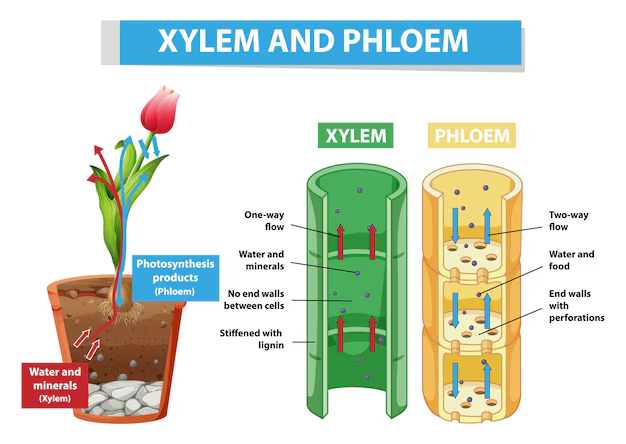
The above diagram shows the arrangement of xylem and phloem tissues in a plant stem. Xylem typically occupies an inner position, while phloem is found towards the outer layer. Observing such diagrams helps answer difference between xylem and phloem diagram-based questions in exams.
Tabular Comparison: Difference Between Xylem And Phloem
| Feature | Xylem | Phloem |
|---|---|---|
| Function | Transports water and minerals | Transports food and organic nutrients |
| Direction of Flow | Unidirectional (root to leaves) | Bidirectional (source to sink) |
| Location in stem | Inner side (towards pith) | Outer side (towards cortex) |
| Main Cell Types | Tracheids, vessels, fibres, parenchyma | Sieve tubes, companion cells, fibres, parenchyma |
| Living/Dead at maturity | Mostly dead (except parenchyma) | Mostly living (except fibres) |
| Thickness of cell walls | Thick-walled | Thin-walled |
The above table clearly highlights the difference between xylem and phloem in terms of their structure, function, and position within plant tissues. Such tabular notes are extremely useful for revision and quick reference, especially before exams.
Explanation: How Do Xylem and Phloem Work?
Xylem works like a one-way pipeline, conducting water from roots to the leaves using physical forces like capillary action, root pressure, and transpiration pull. In contrast, phloem carries food (mainly sucrose) in both directions—either from leaves to the rest of the plant or from storage organs back to growing tissues. This process is called translocation, and it requires metabolic energy.
Difference Between Xylem and Phloem: Key Examples
Let’s look at some real-world examples to clarify the difference between xylem and phloem:
- When you water a plant, the water travels upward via the xylem to reach the leaves.
- When glucose formed during photosynthesis in leaves moves to roots for storage or to flowers for growth, this transport happens through the phloem.
Studying these examples helps students answer application-based questions and MCQs on this topic.
Short Notes: Points to Remember
- Xylem transports water; phloem carries food.
- Xylem flow is unidirectional; phloem flow is bidirectional.
- Xylem cells are mostly dead at maturity; phloem cells are largely living.
- Xylem is found inside the vascular bundle; phloem occupies the outer part.
For revision, create difference between xylem and phloem short notes and use these points for class 12 board exams or quick recaps.
Application in Agriculture, Environment, and Human Life
These vascular tissues are vital in agriculture, as healthy xylem ensures crops get enough water and minerals, while efficient phloem enables proper food distribution. Problems in xylem can cause wilting, while phloem diseases can reduce yields. Understanding these differences supports key topics like adaptations in plants and reproduction in plants.
Related Topics for Deeper Understanding
To explore plant tissues further or deepen your biology concepts, check out these important resources on Vedantu:
- Classification of Tissues
- Difference Between Simple and Complex Tissues
- Difference Between Monocot and Dicot Stem
- Plant Tissues
- Transportation in Plants
Exploring these topics will help strengthen your biology foundation and score higher in exams.
Difference Between Xylem And Phloem: Sample Questions
- Define xylem and phloem. How are they different?
- Draw a well-labelled diagram showing xylem and phloem in a dicot stem.
- State two points of difference between xylem and phloem.
- Give one example that illustrates xylem function and one that illustrates phloem function.
- Solve MCQs based on the features of xylem and phloem for practice.
Practice these questions and review the difference between xylem and phloem notes or PPTs for revision.
Downloadable Resources
Vedantu offers curated difference between xylem and phloem notes, diagrams, and MCQ questions to help you prepare efficiently. These resources are helpful for quick revision and include class 12-level explanations, making your preparation complete.
In summary, the Difference Between Xylem And Phloem forms the backbone of plant physiology topics taught in biology. Grasping their structure, function, and unique features helps students build a strong base for more advanced concepts in plant science, agriculture, and environmental studies, as covered in various Vedantu resources.


FAQs on Difference Between Xylem and Phloem in Plants
1. What is the difference between xylem and phloem?
The main difference between xylem and phloem is that xylem transports water and minerals from roots to shoots, while phloem transports food from leaves to other parts of the plant.
- Xylem: Carries water and dissolved minerals upward (unidirectional).
- Phloem: Carries sugars and organic nutrients in both directions (bidirectional).
- Xylem cells are mostly dead at maturity, while phloem contains living cells.
2. What is xylem and what is its function?
Xylem is a complex vascular tissue responsible for transporting water and minerals from roots to the rest of the plant.
- Composed of tracheids, vessels, xylem parenchyma, and xylem fibers.
- Helps in upward conduction through transpiration pull.
- Provides mechanical support due to thick, lignified walls.
3. What is phloem and what is its function?
Phloem is a vascular tissue that transports food, mainly sugars, from leaves to other parts of the plant.
- Contains sieve tube elements, companion cells, phloem parenchyma, and phloem fibers.
- Transports sucrose produced during photosynthesis.
- Movement occurs by translocation through pressure flow.
4. How does transport occur in xylem and phloem?
Transport in xylem occurs through transpiration pull, while transport in phloem occurs by the pressure flow mechanism.
- Xylem transport: Driven by transpiration, cohesion, and adhesion of water molecules.
- Phloem transport: Driven by osmotic pressure differences between source and sink.
- Xylem flow is upward only; phloem flow is bidirectional.
5. Are xylem and phloem living or non-living tissues?
Xylem is mostly made of dead cells, while phloem is mainly composed of living cells.
- Xylem vessels and tracheids are dead at maturity.
- Sieve tube elements in phloem are living but lack a nucleus.
- Companion cells are living and control sieve tube functions.
6. What are the components of xylem and phloem?
Xylem and phloem are complex tissues made of multiple specialized cell types.
- Xylem components: Tracheids, vessels, xylem parenchyma, xylem fibers.
- Phloem components: Sieve tubes, companion cells, phloem parenchyma, phloem fibers.
7. Why is xylem transport unidirectional and phloem transport bidirectional?
Xylem transport is unidirectional because water moves only from roots to leaves, while phloem transport is bidirectional because food moves between source and sink tissues.
- Xylem: Movement depends on transpiration from leaves.
- Phloem: Movement depends on changing source–sink relationships.
- For example, sugars may move from leaves to roots or from storage organs to growing buds.
8. Where are xylem and phloem located in plants?
Xylem and phloem are found together in vascular bundles of roots, stems, and leaves.
- In stems, xylem is usually on the inner side and phloem on the outer side.
- In roots, xylem and phloem are arranged alternately.
- In leaves, they form veins.
9. What is the role of xylem and phloem in photosynthesis?
Xylem supplies water for photosynthesis, while phloem distributes the sugars produced during photosynthesis.
- Xylem: Delivers water needed for glucose formation.
- Phloem: Transports produced glucose (as sucrose) to other tissues.
- Together, they support energy production and distribution.
10. Can you give examples of xylem and phloem in real plants?
Xylem and phloem are present in all vascular plants such as mango, sunflower, and pine trees.
- In a tree trunk, wood mainly consists of secondary xylem.
- The inner bark contains phloem tissue.
- Annual rings seen in stems are formed by xylem growth.



