




Comparison of Leading and Lagging Strand with Diagram and Key Differences
The concept of difference between lagging and leading strand in DNA replication is essential in biology and helps explain real-world biological processes and exam-level questions effectively, especially for students preparing for CBSE, NEET, and other competitive exams.
Understanding the Difference Between Lagging and Leading Strand
Difference between lagging and leading strand in DNA replication refers to the distinct ways the two new DNA strands are built during DNA synthesis. In the replication fork, the leading strand is synthesized continuously in the 5' to 3' direction, while the lagging strand is made discontinuously as small fragments called Okazaki fragments. This concept is important in understanding the structure of DNA, the central dogma of molecular biology, and the basic mechanism of DNA replication.
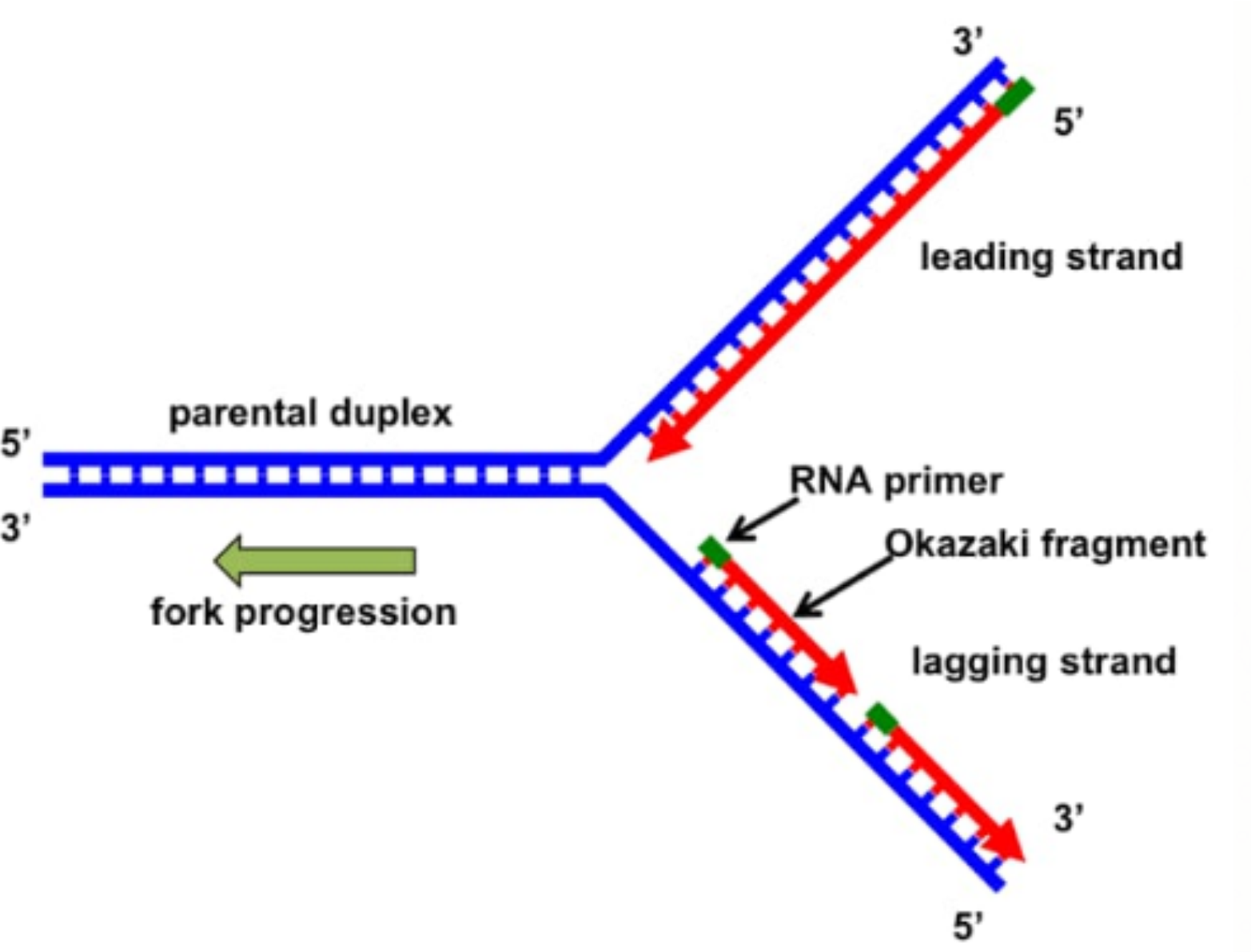
Mechanism of Difference Between Lagging and Leading Strand
The basic mechanism involves the action of DNA polymerase at the replication fork. Since DNA polymerase can only add nucleotides in the 5' to 3' direction, one strand is formed smoothly (leading), while the other is built in short bursts (lagging). The lagging strand needs repeated priming, and the resulting Okazaki fragments are later joined by DNA ligase.
Here’s a helpful table to understand the difference between lagging and leading strand better:
Difference Between Lagging and Leading Strand Table
| Feature | Leading Strand | Lagging Strand |
|---|---|---|
| Direction of Synthesis | 5' to 3' towards replication fork | 5' to 3' away from replication fork |
| Manner of Synthesis | Continuous | Discontinuous (forms Okazaki fragments) |
| Priming Requirement | Single RNA primer needed | Multiple RNA primers needed |
| Enzyme Actions | DNA polymerase moves smoothly | DNA polymerase detaches and reattaches |
| Associated Fragments | No Okazaki fragments | Okazaki fragments joined by DNA ligase |
Step-by-Step Process of DNA Replication: Leading vs Lagging Strand
Let’s understand the synthesis steps for each strand in DNA replication:
- Replication fork opens: DNA helicase unwinds the double helix.
- Leading strand: DNA polymerase starts adding nucleotides in the 5' to 3' direction continuously, following the fork.
- Lagging strand: Primase adds multiple RNA primers along the strand, and DNA polymerase synthesizes short Okazaki fragments between primers.
- Okazaki fragments: These fragments are synthesized as the fork exposes new template regions.
- Fragment joining: DNA ligase connects Okazaki fragments to form a continuous lagging strand.
Similarities and Common Misconceptions
- Both strands are synthesized in the 5' to 3' direction by DNA polymerase.
- Each uses common enzymes such as DNA polymerase, primase, and ligase.
- Common Mistake: Believing the lagging strand is made 3' to 5'. In reality, both are built 5' to 3'.
- Some students mix up which strand is continuous and which has Okazaki fragments.
Practice Questions
- What is the primary difference between lagging and leading strands in DNA replication?
- Explain how Okazaki fragments are formed and joined.
- List three differences between the lagging and leading strand.
- Label the leading and lagging strands on a diagram of the replication fork.
- Which strand is synthesized in a discontinuous manner and why?
Common Mistakes to Avoid
- Confusing difference between lagging and leading strand with template and coding strands.
- Assuming DNA polymerase can synthesize both strands continuously.
- Not mentioning the role of primers and DNA ligase in lagging strand synthesis.
Real-World Applications
The concept of difference between lagging and leading strand is widely used in genetics, biotechnology, and medical diagnostics. Understanding DNA replication helps in the study of genetic diseases, designing DNA tests, and research in fields like gene cloning. Vedantu helps students connect such topics to real-world biological research and modern healthcare advances.
In this article, we explored difference between lagging and leading strand, its key processes, real-life significance, and how to solve questions based on it. To learn more and build confidence, keep practicing with Vedantu.
Quick Revision Table
| Leading Strand | Lagging Strand |
|---|---|
| Synthesized continuously, single primer, no Okazaki fragments | Synthesized discontinuously, multiple primers, forms Okazaki fragments |
Explore Related Topics
- DNA Structure
- Nucleic Acid
- Central Dogma of Molecular Biology
- DNA Replication
- Difference Between Prokaryotic and Eukaryotic DNA Replication
- Okazaki Fragments
- Gene Definition
- RNA and Transcription
- Nucleotide
- Difference Between Gene and Chromosome


FAQs on Difference Between Leading and Lagging Strand in DNA Replication
1. What is the difference between the lagging strand and the leading strand?
The main difference between the leading strand and the lagging strand is that the leading strand is synthesized continuously, while the lagging strand is synthesized discontinuously in short fragments. During DNA replication:
- The leading strand is formed continuously in the 5' → 3' direction toward the replication fork.
- The lagging strand is formed away from the replication fork in short segments called Okazaki fragments.
- The lagging strand requires multiple RNA primers, whereas the leading strand requires only one primer.
2. Why is the lagging strand synthesized discontinuously?
The lagging strand is synthesized discontinuously because DNA polymerase can only synthesize DNA in the 5' → 3' direction. Since the two DNA template strands are antiparallel:
- One strand allows continuous synthesis toward the replication fork (leading strand).
- The other strand runs in the opposite direction, forcing synthesis away from the fork.
- This results in short DNA segments called Okazaki fragments.
3. What are Okazaki fragments?
Okazaki fragments are short DNA segments synthesized discontinuously on the lagging strand during DNA replication. They are formed because:
- DNA polymerase works only in the 5' → 3' direction.
- The lagging strand template runs in the opposite (3' → 5') direction relative to fork movement.
- Each fragment begins with an RNA primer.
4. How does DNA replication occur on the leading strand?
DNA replication on the leading strand occurs continuously in the 5' → 3' direction toward the replication fork. The process involves:
- Unwinding of DNA by helicase.
- Synthesis of a single RNA primer by primase.
- Continuous addition of nucleotides by DNA polymerase.
5. Which enzymes are involved in lagging strand synthesis?
Several key enzymes are involved in lagging strand synthesis during DNA replication. These include:
- Helicase – unwinds the DNA double helix.
- Primase – synthesizes multiple RNA primers.
- DNA polymerase – extends Okazaki fragments.
- DNA ligase – joins Okazaki fragments together.
6. Why does the leading strand need only one primer?
The leading strand needs only one primer because it is synthesized continuously during DNA replication. After:
- A single RNA primer is added by primase,
- DNA polymerase continuously adds nucleotides in the 5' → 3' direction,
- Synthesis proceeds without interruption toward the replication fork.
7. What is the role of DNA ligase in the lagging strand?
The role of DNA ligase in the lagging strand is to join Okazaki fragments into a continuous DNA strand. After:
- RNA primers are removed,
- Gaps are filled with DNA nucleotides,
- DNA ligase seals the sugar-phosphate backbone by forming phosphodiester bonds.
8. Is the lagging strand slower than the leading strand?
The lagging strand is not overall slower, but its synthesis is more complex because it occurs in fragments. Although:
- It is synthesized discontinuously,
- Multiple primers are required,
- Fragments must be joined by DNA ligase,
9. In which direction are the leading and lagging strands synthesized?
Both the leading strand and lagging strand are synthesized in the 5' → 3' direction. However:
- The leading strand is synthesized continuously toward the replication fork.
- The lagging strand is synthesized discontinuously away from the replication fork.
10. What is the importance of lagging and leading strands in DNA replication?
The leading and lagging strands ensure accurate and complete duplication of DNA during replication. Their coordinated synthesis:
- Allows both antiparallel DNA strands to be copied simultaneously.
- Maintains genetic continuity during cell division.
- Ensures faithful transmission of genetic information to daughter cells.



