




What are the four types of teeth in humans and their structure and functions
Teeth are hard, calcified structures in our mouth that help break down food into smaller pieces. Unlike some animals that can swallow large chunks of food, humans need their teeth to cut, tear, and grind food before swallowing. This essential process is supported by jaw muscles and saliva.
Humans have two sets of teeth in their lifetime: milk teeth (also called primary teeth) and permanent teeth (secondary teeth). In total, an adult has 32 permanent teeth, which include a special set called wisdom teeth. In this article, we will explore the different types of teeth, their functions, common types of teeth shapes, and the dental formula of human adults. We will also learn about why wisdom teeth often cause discomfort and how teeth differ across various groups of vertebrates.
Human Teeth Diagram
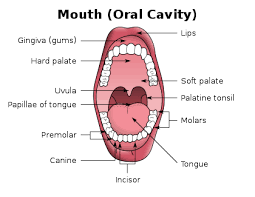
Different Types of Teeth in Humans
Humans generally have four main types of teeth:
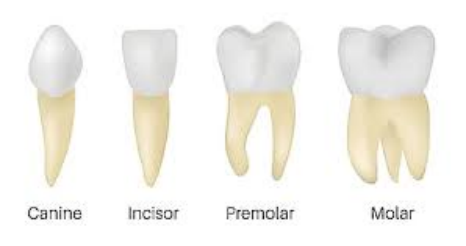
Incisors
Location: Front part of the mouth (upper and lower jaws).
Shape: Thin, blade-like edges.
Function: Cutting food into smaller chewable pieces.
Count in adults: 8 (4 in the upper jaw and 4 in the lower jaw).
Canines
Location: At the corners of the dental arch.
Shape: Pointed and sharp.
Function: Tearing and gripping food, especially tough foods like meat.
Count in Adults: 4 (2 in the upper jaw and 2 in the lower jaw).
Premolars
Other Name: Bicuspids.
Location: Behind the canines.
Shape: Flat biting surface with ridges.
Function: Crushing and grinding food.
Count in Adults: 8 (4 in each jaw, two on each side).
Molars
Location: At the back of the mouth.
Shape: Wide and flat biting surface.
Function: Grinding food into smaller particles for swallowing.
Count in Adults: 12 (6 in each jaw, including 4 wisdom teeth).
These four types of teeth and their functions help us handle different kinds of foods effectively.
Dental Formula of Human
A dental formula is a shorthand way to describe the number of each type of tooth in one half of the jaw (upper or lower). For adults, the dental formula of human teeth is:
2 (Incisors) : 1 (Canine) : 2 (Premolars) : 3 (Molars)
This is often written as 2.1.2.3 / 2.1.2.3, indicating the upper and lower halves of the jaw. Thus, for one half of the jaw, there are two incisors, one canine, two premolars, and three molars. When multiplied by four (both sides of the upper and lower jaw), the total comes to 32 permanent teeth.
Children have 20 milk teeth, which follow a simpler formula of 2.1.0.2 / 2.1.0.2, reflecting the absence of premolars in primary dentition. As the child grows, these milk teeth are replaced by permanent teeth.
Shapes of Teeth
We can also talk about types of teeth shapes and why they matter:
Incisors: Chisel-shaped edges for slicing through soft or moderately firm foods.
Canines: Cone-shaped and pointed for ripping and tearing.
Premolars and Molars: Broad surfaces and multiple cusps for crushing and grinding.
These shapes help us eat a variety of foods, from leafy vegetables to tougher meats.
Role and Functions of Teeth
Digestion: Teeth start the mechanical process of breaking down food.
Speech: Teeth help in pronouncing certain sounds clearly.
Facial Structure: Healthy teeth support facial muscles and maintain natural contours.
Teeth are made mostly of dentine and covered by the hardest substance in the body, enamel. Though enamel is very strong, it does not contain living cells. Hence, damaged enamel cannot repair itself naturally.
Wisdom Teeth
Wisdom teeth, also called third molars, typically appear between the ages of 17 and 25. They are considered vestigial because many people do not need them to chew effectively. Often, wisdom teeth grow in awkward positions or only partially emerge, leading to problems such as:
Pain and swelling
Jaw stiffness
Infection due to trapped food or bacteria
Many dentists recommend removing problematic wisdom teeth to avoid long-term complications.
Diphyodonts vs Polyphyodonts
Humans are diphyodonts: we have two sets of teeth in our lifetime – milk teeth (20) and permanent teeth (32).
Some animals, like geckos and fishes, are polyphyodonts, meaning they can replace teeth continuously throughout their life. Among mammals, elephants, kangaroos, and manatees can also replace their teeth multiple times, making them polyphyodonts.
Additional Information
Variation in Wisdom Teeth: In some people, wisdom teeth may never emerge or might be fewer in number.
Mixed Dentition: Around 6 to 12 years of age, children have a mix of milk teeth and newly erupting permanent teeth.
Enamel Care: Since enamel cannot repair itself, brushing twice a day with fluoride toothpaste, flossing, and regular dental check-ups are essential.
Quick Quiz (With Answers)
Test your understanding with this short quiz:
1. Which type of tooth is used mainly for cutting food?
A. Canines
B. Incisors
C. Molars
D. Premolars
Answer: B (Incisors)
2. How many premolars does a typical adult have?
A. 4
B. 8
C. 10
D. 12
Answer: B (8)
3. Which set of teeth appears between the ages of 17 and 25?
A. Milk Teeth
B. Premolars
C. Wisdom Teeth
D. Incisors
Answer: C (Wisdom Teeth)
4. Which of the following animals are considered polyphyodonts?
A. Elephants
B. Humans
C. Lions
D. Horses
Answer: A (Elephants)
Related Topics


FAQs on Types of Teeth in Humans and Their Functions
1. What are the different types of teeth in humans?
Humans have four main types of teeth: incisors, canines, premolars, and molars, each specialized for different functions in digestion.
- Incisors – Used for cutting and biting food.
- Canines – Used for tearing food.
- Premolars – Used for crushing and grinding.
- Molars – Used for heavy grinding and chewing.
2. How many types of teeth are present in adult humans?
Adult humans have four types of teeth and a total of 32 permanent teeth.
- 8 incisors
- 4 canines
- 8 premolars
- 12 molars (including 4 wisdom teeth)
3. What is the function of incisors in humans?
The main function of incisors is to cut and bite food during the first stage of digestion.
- They are flat and sharp-edged.
- Located at the front of the mouth.
- Humans have 8 incisors (4 upper and 4 lower).
4. What is the role of canines in human teeth?
The primary role of canines is to tear and pierce food.
- They are pointed and sharp.
- Located next to the incisors.
- Humans have 4 canines (2 upper and 2 lower).
5. What is the difference between premolars and molars?
The main difference between premolars and molars is their size and grinding function.
- Premolars – Smaller, usually have two cusps, used for crushing and grinding.
- Molars – Larger, broader surface with multiple cusps, used for heavy grinding.
6. What are wisdom teeth and why are they called third molars?
Wisdom teeth are the last set of molars that erupt at the back of the mouth, usually during late adolescence or early adulthood.
- They are also called third molars.
- Most people have 4 wisdom teeth.
- They typically erupt between ages 17 and 25.
7. How many teeth do children have and what are they called?
Children have 20 teeth known as primary teeth or milk teeth.
- 8 incisors
- 4 canines
- 8 molars
8. What is meant by heterodont dentition in humans?
Humans exhibit heterodont dentition, meaning they have different types of teeth specialized for different functions.
- Cutting – Incisors
- Tearing – Canines
- Grinding – Premolars and Molars
9. What is the dental formula of adult humans?
The dental formula of adult humans is 2-1-2-3 / 2-1-2-3, representing the number of each type of tooth in one half of the upper and lower jaws.
- 2 Incisors
- 1 Canine
- 2 Premolars
- 3 Molars
10. Why are molars important for digestion?
Molars are important for digestion because they grind food into smaller particles, increasing the surface area for enzymatic action.
- They have a broad, flat surface with multiple cusps.
- Located at the back of the mouth.
- Play a key role in mechanical digestion.



