








How is Recombinant DNA Technology Used in NEET Biology?
Recombinant DNA Technology is a key concept in Biology for NEET aspirants, as it explains how scientists manipulate genetic material to create new combinations of DNA. This technology forms the basis of genetic engineering, biotechnology, and several breakthroughs in medicine and agriculture. For NEET, having a solid grasp on recombinant DNA technology is essential—not only because it is directly asked in the exam, but also because it builds foundational understanding for modern biological processes and applications.
What is Recombinant DNA Technology?
Recombinant DNA Technology, commonly called genetic engineering, is the process of combining DNA molecules from different sources and inserting them into a host organism to produce new genetic combinations. This is achieved by manipulating the genetic material (DNA) outside the organism and then introducing this modified DNA into either the same or a different species. In simple terms, it is a method to "cut" and "paste" genes to create organisms with desired traits. This forms the backbone of biotechnology and is highly relevant for NEET Biology.
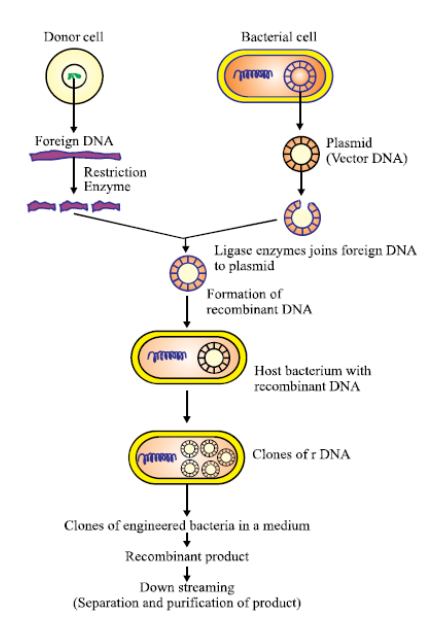
Core Principles and Fundamentals of Recombinant DNA Technology
To understand recombinant DNA technology deeply, it's vital to know its core principles and the steps involved in creating recombinant DNA molecules.
Main Steps Involved
- Isolation of Genetic Material: Extracting pure DNA from the donor organism using enzymes and chemicals.
- Cutting DNA at Specific Sites: Using restriction enzymes (molecular scissors) to cut DNA at precise locations to get the gene of interest and to open up the vector DNA (like plasmids).
- Insertion Into a Vector: Inserting the gene of interest into a vector (such as a plasmid or viral DNA) to carry it into the host cell. The enzyme ligase helps in joining the DNA segments.
- Transfer into Host Organism: Introducing recombinant DNA into a host cell (commonly bacteria) using techniques like transformation, transfection, or microinjection.
- Selection and Screening: Identifying and growing those cells that have taken up the recombinant DNA using selectable markers (like antibiotic resistance genes).
- Expression and Cloning: The host organism expresses the gene, producing the desired protein or trait. Cloning helps in making multiple copies of the recombinant DNA.
Key Toolkits Used
- Restriction Enzymes: Cut DNA at specific sequences.
- Ligases: Join DNA fragments together.
- Vectors: Facilitate DNA transfer into host cells (e.g., plasmids, bacteriophages).
- Host Cells: Organisms like bacteria or yeast used to multiply and express recombinant DNA.
Important Sub-Concepts in Recombinant DNA Technology
Understanding some related terms and ideas will further strengthen your grip on this topic for NEET.
Restriction Enzymes
Restriction enzymes are proteins that recognize and cut DNA at specific sequences called recognition sites. They are essential for making precise cuts required in creating recombinant DNA. Each enzyme recognizes a particular DNA sequence, helping in targeted gene isolation.
Vectors
Vectors are carriers used to transfer foreign DNA into host cells. Plasmids (circular DNA in bacteria), bacteriophages (viruses that infect bacteria), and cosmids are common vectors. An ideal vector should have an origin of replication, a selectable marker, and unique restriction sites for cloning.
Selectable Markers
Selectable markers are genes (such as antibiotic resistance genes) that help scientists identify which cells have successfully taken up the recombinant DNA. Only those with the marker gene will survive under specific selection conditions.
Transformation
Transformation is the process of introducing foreign recombinant DNA into a host cell. This can be done using various methods, such as chemical treatment, electroporation, or gene gun method, depending on the host organism.
Key Principles, Relationships, and Techniques
While there are no specific formulas, understanding the basic principles and relationships is crucial in recombinant DNA technology.
- Complementary Base Pairing: The process relies on the natural ability of DNA to pair via complementary bases (A-T, G-C) during ligation and hybridization steps.
- Sticky Ends vs. Blunt Ends: Some restriction enzymes produce "sticky ends" (with overhanging bases) while others create "blunt ends" (straight cuts), affecting the efficiency of DNA joining.
- Gene Cloning: The process of making identical copies of recombinant DNA, which relies on a vector replicating inside a host cell.
- PCR (Polymerase Chain Reaction): Although not part of classical recombinant DNA, PCR is often used to amplify desired DNA sequences before insertion.
Applications and Importance of Recombinant DNA Technology
Application and understanding are especially important both for exam questions and real-world relevance.
Major Applications
- Production of insulin, growth hormones, and other therapeutic proteins in bacteria for medicine.
- Creation of genetically modified crops (e.g., Bt cotton) for improved yield and pest resistance.
- Gene therapy: Treating genetic disorders by inserting correct genes into patient cells.
- Development of vaccines.
- DNA fingerprinting in forensic science.
Limitations and Challenges
- Ethical and social concerns about genetic modifications.
- Potential for unintended effects in organisms and ecosystems.
- Technical difficulties in expressing certain genes in host organisms.
Why Recombinant DNA Technology is Important for NEET
This topic is routinely covered in NEET because it forms a basis for understanding genetic engineering, biotechnology, and modern medicine. It sharpens conceptual skills required for other genetics questions and overlaps with genetics, physiology, and applied biology. Questions can involve principles, tools, applications, or even ethical aspects, so conceptual clarity is vital for scoring well.
How to Study Recombinant DNA Technology Effectively for NEET
- Focus on understanding the logic and sequence of each step, not just the names.
- Use diagrams to visualize processes and tools (refer to the recombinant DNA technology image above for clarity).
- Revise the roles of restriction enzymes, vectors, ligases, and host organisms.
- Practice MCQs on processes, tools, and applications to reinforce learning.
- Pay attention to real-world examples like insulin production or Bt crops.
- Regularly revise definitions, steps, and application areas for quick recall.
- Attempt previous years' NEET questions on biotechnology to spot question trends.
Common Mistakes Students Make in This Concept
- Confusing the role of restriction enzymes and ligases.
- Overlooking the importance and function of vectors.
- Not learning the correct sequence of steps in creating recombinant DNA.
- Ignoring application-based questions (like insulin and Bt crops).
- Mixing up selectable markers with vectors.
- Skipping diagrammatic questions and process visualization.
Quick Revision Points for Recombinant DNA Technology
- Recombinant DNA means combining DNA from different sources.
- Restriction enzymes cut DNA at specific sites - essential "scissors".
- Vectors (plasmids, phages) carry foreign genes into host cells.
- DNA ligase joins DNA fragments to form recombinant molecules.
- Selectable markers help identify cells with recombinant DNA.
- Applications include medicine (insulin), agriculture (GM crops), forensics (DNA fingerprinting).
- Diagram practice is important for exam success.
- Understand the logical sequence of the process steps.
FAQs on Recombinant DNA Technology for NEET Students Explained
1. What is recombinant DNA technology in biology for NEET?
Recombinant DNA technology is a set of techniques used to join DNA molecules from different sources, resulting in new genetic combinations important for NEET and biotechnology studies.
- It creates recombinant DNA by combining genes from two or more organisms.
- Common steps: isolation of DNA, cutting DNA with restriction enzymes, joining DNA fragments, and introducing the new DNA into host cells.
- Key applications: gene therapy, insulin production, crop improvement, and vaccine development.
2. What are the steps involved in recombinant DNA technology?
The main steps of recombinant DNA technology include several precise processes performed in sequence.
- Isolation of genetic material (DNA)
- Cutting DNA at specific sites using restriction enzymes
- Gene insertion into a vector (like plasmid)
- Transfer of recombinant DNA into a host cell (often bacteria)
- Selection and screening of transformed cells
- Expression of the introduced gene
3. Who is considered the father of recombinant DNA technology?
Paul Berg is known as the father of recombinant DNA technology for his pioneering work in gene splicing.
- Paul Berg constructed the first recombinant DNA molecules in 1972.
- He combined DNA from Simian Virus 40 (SV40) with that of lambda virus.
- This breakthrough laid the foundation for modern genetic engineering and biotechnology—both key areas of the NEET exam.
4. What are the applications of recombinant DNA technology in medicine?
Recombinant DNA technology is widely used in medicine to create new diagnostics, drugs, and therapies.
- Production of insulin, growth hormones, and clotting factors
- Development of recombinant vaccines (e.g., hepatitis B vaccine)
- Gene therapy for inherited diseases
- Monoclonal antibodies for cancer and autoimmune conditions
5. What is a vector in recombinant DNA technology?
Vector refers to a DNA molecule that delivers foreign genetic material into a host cell during recombinant DNA experiments.
- Common vectors: plasmids, bacteriophages, cosmids, and yeast artificial chromosomes
- Essential features include origin of replication (ori), selectable marker genes, and unique restriction sites
6. What are the main enzymes used in recombinant DNA technology?
The major enzymes in recombinant DNA technology are critical for manipulating DNA and are frequently asked in NEET.
- Restriction endonucleases – cut DNA at specific sites
- DNA ligase – joins DNA fragments
- Polymerases – synthesize DNA (e.g., Taq polymerase in PCR)
- Alkaline phosphatase – removes phosphates to prevent self-ligation of vectors
7. Explain the significance of restriction enzymes in recombinant DNA technology for NEET.
Restriction enzymes are crucial proteins that recognize and cut DNA at specific sequences, enabling gene manipulation central to NEET curriculum.
- They generate sticky or blunt ends to facilitate DNA fragment joining
- Provide precise and predictable DNA cuts
- Allow isolation and insertion of target genes into vectors
8. What are the advantages and disadvantages of recombinant DNA technology?
Recombinant DNA technology offers many benefits but also has limitations, both important for NEET knowledge.
Advantages:
- Improved medical treatments (drugs, vaccines)
- Enhanced crop quality and yield
- Accurate diagnostics
- Ethical concerns about GMOs
- Potential gene transfer risks
- High development costs
9. What is gene cloning and how is it related to recombinant DNA technology for NEET?
Gene cloning is the process of making multiple identical copies of a specific gene using recombinant DNA techniques—an important NEET topic.
- It uses restriction endonucleases, vectors, and host cells.
- Steps: isolate gene of interest, insert into vector, transform host, and allow replication.
- Applications: gene structure study, protein production, and gene therapy research.
10. What role do plasmids play in recombinant DNA technology?
Plasmids act as versatile vectors that transport foreign DNA into bacterial cells, a central process in recombinant DNA technology for NEET.
- Plasmids are circular, double-stranded DNA molecules separate from chromosomal DNA
- They carry necessary genes for selection markers and replication origin
- Widely used because they are easily manipulated and maintained in host cells
