








Pteridophytes Classification and Life Cycle in NEET Biology
Pteridophytes are a fascinating group of plants that represent a major evolutionary step in the plant kingdom. For NEET aspirants, understanding pteridophytes is crucial, as questions about their structure, reproduction, and significance often appear in the exam. This topic not only builds a strong conceptual foundation for plant morphology and diversity but also helps connect ideas across botany, making your NEET biology preparation more thorough and effective.
What Are Pteridophytes? Meaning and Basic Definition
Pteridophytes are vascular, seedless plants that occupy a unique position between bryophytes and gymnosperms in the plant kingdom. Commonly known as ferns and their relatives, pteridophytes have true roots, stems, and leaves but do not produce seeds or flowers. They reproduce through spores and flourish in moist, shady environments. Recognizing their features and evolutionary significance is important for mastering plant diversity in NEET biology.
Core Ideas and Fundamentals of Pteridophytes
Vascular Tissue
Unlike bryophytes, pteridophytes possess well-developed vascular tissues - xylem and phloem - which help in the transport of water, minerals, and food. This adaptation allows them to achieve greater heights and inhabit varied environments compared to non-vascular plants.
True Plant Organs
Pteridophytes have distinct plant organs: roots for absorption, stems for support and conduction, and leaves (often called fronds in ferns) for photosynthesis. This structural complexity is a marked evolutionary advancement over more primitive plant groups.
Sporophyte Dominance
In the life cycle of pteridophytes, the sporophyte (diploid) phase is dominant and free-living, while the gametophyte (haploid) is reduced but independent and photosynthetic. This alternation of generations is called heteromorphic alternation of generations and is a key concept for NEET.
Spore-Based Reproduction
Pteridophytes do not produce seeds. Instead, they reproduce through spores that develop in specialized structures called sporangia, often found on the undersides of leaves. When conditions are favorable, these spores germinate to form new gametophytes.
Important Sub-Concepts Related to Pteridophytes
Classification of Pteridophytes
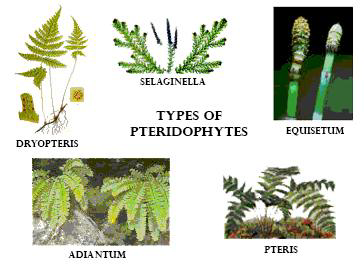
Pteridophytes include several major groups, each with distinctive features. The main classes are:
- Lycopodiopsida (Club mosses): Small, moss-like plants with microphyllous leaves.
- Equisetopsida (Horsetails): Plants with jointed stems and rough, silica-rich tissues.
- Psilotopsida (Whisk ferns): Simple plants lacking roots, with stem-based photosynthesis.
- Polypodiopsida (True ferns): The largest group with large, divided fronds.
Alternation of Generations
A hallmark of pteridophytes is their life cycle, which alternates between a dominant sporophyte and a smaller, independent gametophyte. Understanding how these generations interact and contribute to reproduction is frequently tested in NEET questions.
Homosporous vs Heterosporous Pteridophytes
Some pteridophytes produce only one type of spore (homosporous), while others produce two types: microspores (male) and megaspores (female) - a condition called heterospory. Heterospory is significant because it represents a key evolutionary step towards the development of seeds in higher plants.
Principles and Relationships in Pteridophyte Biology
Pteridophytes demonstrate several biological principles:
- Alternation of generations (haplo-diplontic life cycle)
- Vascular tissue organization (stele types such as protostele, siphonostele)
- Development of sporangia and methods of spore dispersal
- Homosporous vs. heterosporous reproduction
There are no specific formulas in pteridophyte biology, but students should be familiar with life cycle diagrams and the sequence of generational changes. Recognizing the structural differences between various classes through labeled diagrams can also help solidify understanding.
Key Features and Characteristics of Pteridophytes
- Possess true roots, stems, and leaves (first vascular plants to do so)
- Independent, dominant sporophyte phase
- Reproduce via spores; no seeds or flowers
- Mostly found in damp, shady places
- Often have frond-like leaves (in ferns)
- Exhibit alternation of generations
- Some species show heterospory
Why Pteridophytes Are Important for NEET Preparation
Pteridophytes are frequently tested in NEET because they illustrate key evolutionary transitions and biological concepts in the plant kingdom. They bridge the gap between non-vascular and seed plants, helping students understand plant structures, reproduction, and diversity. Questions may involve life cycles, identification, classification, and evolutionary significance, making them essential for scoring well in botany sections of NEET.
How to Study Pteridophytes Effectively for NEET
- Start with basic concepts: Understand the definition, structure, and life cycle of pteridophytes.
- Use diagrams: Practice drawing and labeling life cycles and plant parts; visual memory helps in MCQs.
- Learn the differences: Focus on what separates pteridophytes from bryophytes and gymnosperms.
- Grasp sub-group features: Note unique characteristics of ferns, club mosses, horsetails, etc.
- Practice MCQs: Solve NEET-level questions on life cycles, alternation of generations, and comparisons.
- Revise frequently: Use short notes and high-yield points for quick last-minute review.
Common Mistakes Students Make in Pteridophytes
- Mixing up the life cycles or confusing sporophyte with gametophyte phases.
- Not differentiating between homosporous and heterosporous species.
- Confusing pteridophytes with bryophytes or gymnosperms in classification questions.
- Neglecting structural details such as the type of leaves (microphylls vs. megaphylls) and stele type.
- Ignoring the relevance of alternation of generations in plant evolution.
Quick Revision Points for Pteridophytes
- Pteridophytes are vascular, seedless plants with true roots, stems, and leaves.
- Reproduce via spores, not seeds or flowers.
- Show alternation of generations with dominant sporophyte phase.
- Heterospory in pteridophytes is a link to seed habit in higher plants.
- Include ferns, horsetails, club mosses, and whisk ferns.
- Often found in moist and shady habitats.
- NEET questions often focus on structure, reproduction, classification, and evolutionary significance.
FAQs on Pteridophytes in NEET Biology: Basics, Characteristics & Examples
1. What are Pteridophytes in biology NEET syllabus?
Pteridophytes are vascular plants that reproduce by spores and do not produce seeds, important for NEET biology. Key features include:
- Presence of xylem and phloem (vascular tissues)
- True roots, stems, and leaves
- Life cycle displaying alternation of generations
- No flowers or seeds
2. What are the main characteristics of Pteridophytes?
Pteridophytes are the first terrestrial plants to show vascular tissues, making them crucial for NEET studies.
- Have true roots, stems, and leaves
- Possess vascular system (xylem and phloem)
- Reproduce via spores
- Show clear alternation of generations
- Lack growth of seeds and flowers
3. Explain alternation of generations in Pteridophytes.
Alternation of generations in Pteridophytes means their life cycle alternates between a dominant sporophyte and a smaller gametophyte. This cycle involves:
- Sporophyte (diploid, main plant body) produces spores by meiosis
- These spores develop into gametophytes (haploid, small, independent)
- Gametophytes form gametes that fuse to form a new sporophyte
4. What is the economic importance of Pteridophytes?
Pteridophytes have economic importance due to their various uses. Key points:
- Some used as ornamental plants (e.g., ferns)
- Soil binders prevent erosion
- Medicinal uses in traditional remedies
- Act as pioneer species in ecological succession
5. Name the main classes of Pteridophytes with examples.
Pteridophytes are divided into major classes based on morphology and reproduction. NEET-relevant classes are:
- Psilopsida (e.g., Psilotum)
- Lycopsida (e.g., Lycopodium, Selaginella)
- Sphenopsida (e.g., Equisetum)
- Pteropsida (e.g., Dryopteris, Pteris)
6. How do Pteridophytes differ from Bryophytes?
Pteridophytes and Bryophytes differ mainly in vascular tissues and body structure.
- Pteridophytes have vascular tissues; bryophytes lack them
- Pteridophytes show true stems, roots, and leaves
- Sporophyte is dominant and independent in Pteridophytes; in bryophytes, it's dependent
- Both reproduce by spores
7. What are heterosporous and homosporous Pteridophytes?
Pteridophytes can be homosporous or heterosporous based on the type of spores they produce.
- Homosporous: Produce only one kind of spore (e.g., Lycopodium)
- Heterosporous: Produce two types—microspores (male) and megaspores (female) (e.g., Selaginella, Salvinia)
8. What is the significance of vascular tissue in Pteridophytes?
Vascular tissues in Pteridophytes allow them to transport water and nutrients efficiently.
- Xylem transports water and minerals
- Phloem transports food
- Supports growth in terrestrial environments
- Key innovation over non-vascular plants (Bryophytes)
9. Why are Pteridophytes called vascular cryptogams?
Pteridophytes are called vascular cryptogams because they have vascular tissues but reproduce by spores, not seeds.
- ‘Vascular’ – presence of xylem and phloem
- 'Cryptogams' – hidden reproduction (no flowers or seeds)
- Intermediate position between bryophytes and gymnosperms in evolution
10. Which Pteridophytes are heterosporous?
Heterosporous Pteridophytes produce two different kinds of spores, which is an important NEET concept.
- Selaginella
- Salvinia
- Isoetes
11. Describe the habitat of Pteridophytes.
Pteridophytes mostly inhabit moist, shady habitats, which supports their reproduction.
- Commonly found in forests, hilly areas, and undergrowth
- Some aquatic varieties (e.g., Salvinia)
- Require water for fertilization
