




What Is the Difference Between Fragmentation and Regeneration with Definitions and Examples
Fragmentation and regeneration are two captivating biological processes often seen in plants, simple animals, and even some advanced organisms. They play a vital role in survival, reproduction, and adaptation in various environments. Understanding the difference between fragmentation and regeneration helps us appreciate how diverse life on Earth truly is. In this guide, we will also discuss the difference between fragmentation and fission, the difference between fragmentation and budding, and the difference between regeneration and reproduction, with a special look at the difference between fragmentation and regeneration in planaria. Additionally, we will share real-life examples of fragmentation and regeneration to illustrate these concepts more clearly.
Also, read Reproduction in Plants
What Is Fragmentation?
Fragmentation is an asexual mode of reproduction where an organism splits into fragments, and each fragment develops into a fully formed individual. Key points include:
Commonly observed in organisms such as sponges, flatworms, and certain algae like Spirogyra.
Each fragment must contain sufficient cellular structure or tissue to grow independently.
It is a highly efficient way for organisms to increase their population quickly, especially under favourable conditions.
How Fragmentation Differs from Fission
Fission typically involves a single cell splitting into two (as in binary fission in bacteria).
Fragmentation, on the other hand, can involve a multicellular organism breaking into several pieces, each growing into a new individual.
This highlights the difference between fragmentation and fission: fragmentation involves multicellular, often more complex organisms, while fission usually occurs in unicellular organisms.
What is Regeneration?
Regeneration is the process where an organism can regrow or repair lost or damaged body parts. While it may look like a form of reproduction in some cases (for instance, planaria), regeneration often serves more as a survival mechanism. Key points include:
Most organisms display some degree of regenerative ability (like healing wounds), but only a few can regenerate entire limbs or sections of their bodies.
Example: A lizard can regrow its amputated tail, and a starfish can regenerate lost arms.
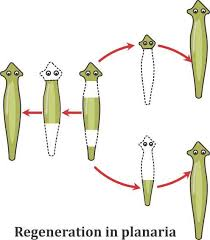
Certain species, such as planaria, can regenerate an entirely new individual if cut into several pieces, blurring the line between regeneration and reproduction.
Regeneration vs. Reproduction
While reproduction generally involves creating an entirely new organism, regeneration often focuses on repair.
However, in specific lower organisms (like planaria), regeneration leads to the formation of new individuals under certain circumstances, which can be mistaken for reproduction.
Hence, the difference between regeneration and reproduction is usually that regeneration is about restoring lost parts, while reproduction specifically aims to produce offspring.
Key Differences Between Fragmentation and Regeneration
This table effectively illustrates the difference between fragmentation and regeneration by focusing on how each process leads to different outcomes and purposes.
Also, read Asexual Reproduction
Difference Between Fragmentation and Regeneration in Planaria
Planaria are flatworms famous for their remarkable regenerative capabilities. When a planarian body is cut into multiple pieces, each piece can grow into a complete individual. In this sense, fragmentation directly triggers regeneration, resulting in the creation of new planaria. Therefore, the difference between fragmentation and regeneration in planaria blurs since the organisms use fragmentation as a reproductive strategy, and regeneration is the mechanism that completes the process.
Difference Between Fragmentation and Budding
Budding involves the formation of an outgrowth (bud) that remains attached to the parent until it matures and then detaches as a new individual (e.g., Hydra).
In fragmentation, the original body splits into fragments on its own, and each fragment develops into a new organism.
This emphasises the difference between fragmentation and budding: budding grows a small bud externally, while fragmentation breaks the original body into sections.
Difference Between Regeneration and Reproduction
Although regeneration can sometimes result in the formation of a completely new individual (especially in simpler organisms), it is primarily a repair mechanism. Meanwhile, reproduction (whether sexual or asexual) is the biological process specifically aimed at producing offspring. Thus, the difference between regeneration and reproduction lies in their biological intent: survival and repair versus the generation of new life.
Examples of Fragmentation and Regeneration
When looking for a clear example of fragmentation and regeneration, consider the following:
Fragmentation: Spirogyra (an algae) breaks into smaller filaments, each capable of growing independently.
Regeneration: A starfish losing an arm to a predator can regrow that arm; if certain conditions are met, the lost arm portion might even regenerate into a new starfish.
These examples show that some organisms use fragmentation purely for reproduction, while others rely on regeneration for healing or partial reproduction under specific circumstances.
Key Points
Partial vs. Complete Regeneration: Some organisms only regenerate superficial tissues, while others (like planaria and starfish) can regrow entire body structures.
Environmental Triggers: Certain species fragment under stress (e.g., sponges releasing gemmules in unfavourable conditions).
Cellular Basis: Advanced regenerative abilities often rely on pluripotent stem cells that can differentiate into various cell types necessary for regrowth.
These extra details showcase the broader contexts in which these processes operate, ensuring a well-rounded understanding beyond a simple chart or table.
Interactive Quiz: Test Your Knowledge
Which of these organisms commonly reproduces through fragmentation?
A. Hydra
B. Spirogyra
C. Amoeba
D. Paramecium
Regeneration typically helps an organism to:
A. Produce new spores
B. Regrow lost body parts
C. Perform photosynthesis
D. Increase oxygen intake
Which statement best describes the difference between fragmentation and budding?
A. Both involve outgrowths that detach from the parent.
B. Fragmentation needs external assistance, while budding does not.
C. In fragmentation, the body splits into pieces; in budding, a small bud grows and detaches.
D. Both are strictly sexual processes.
Planaria are well-known for which unique feature?
A. Bud formation
B. Complex organ systems
C. Advanced neural networks
D. Ability to regenerate from small fragments
Which of the following statements highlights the difference between regeneration and reproduction?
A. Regeneration repairs lost body parts; reproduction aims to create new individuals.
B. Both result solely in the formation of brand-new organisms.
C. Reproduction only takes place in mammals; regeneration takes place only in reptiles.
D. They are both forms of sexual reproduction.
Check Your Answers
B
B
C
D
A


FAQs on Difference Between Fragmentation and Regeneration in Biology
1. What is the difference between fragmentation and regeneration?
The main difference between fragmentation and regeneration is that fragmentation is a method of asexual reproduction where an organism breaks into pieces, while regeneration is the ability to regrow lost body parts.
- Fragmentation: The parent body splits into two or more fragments, and each fragment develops into a new individual.
- Regeneration: The organism regrows damaged or lost parts without forming a new individual (though in some cases, whole organisms can form).
- Fragmentation is mainly reproductive, whereas regeneration is primarily a repair process.
2. What is fragmentation in biology?
Fragmentation is a type of asexual reproduction in which an organism breaks into two or more parts, and each part grows into a complete individual.
- Common in simple multicellular organisms.
- Each fragment must contain sufficient cells to regenerate missing parts.
- Produces genetically identical offspring.
- Example: Spirogyra (a filamentous alga).
3. What is regeneration in biology?
Regeneration is the biological process by which an organism replaces or restores lost or damaged body parts.
- Involves cell division and differentiation.
- Can restore tissues, organs, or entire body parts.
- May or may not lead to formation of a new individual.
- Example: Planaria and starfish can regenerate lost parts.
4. How does fragmentation occur in organisms?
Fragmentation occurs when the parent organism splits into smaller pieces, and each piece grows into a new individual through mitotic cell division.
- The body breaks due to external forces or natural splitting.
- Each fragment contains cells capable of division.
- Cells undergo mitosis and differentiation.
- New complete organisms are formed.
5. How does regeneration take place step by step?
Regeneration takes place through cell division, growth, and differentiation to replace lost parts.
- Step 1: Wound healing at the injured site.
- Step 2: Formation of a mass of undifferentiated cells called a blastema.
- Step 3: Cells divide rapidly by mitosis.
- Step 4: Cells differentiate into specific tissues and organs.
6. Is regeneration a type of asexual reproduction?
Regeneration is not always a type of asexual reproduction, but in some organisms it can lead to asexual reproduction.
- In most animals, regeneration only replaces lost body parts.
- In organisms like Planaria, each cut piece can form a complete organism.
- When a whole new individual develops, regeneration acts as a form of asexual reproduction.
7. What are examples of fragmentation and regeneration?
Common examples of fragmentation include algae, while regeneration is seen in animals like starfish and planaria.
- Fragmentation example: Spirogyra breaks into fragments that grow into new filaments.
- Regeneration example: Starfish can regrow lost arms.
- Planaria can regenerate an entire body from small pieces.
8. Why is fragmentation common in simple organisms?
Fragmentation is common in simple organisms because their body structure is less complex and cells have high regenerative capacity.
- Simple body organization.
- Most cells can divide and differentiate.
- No specialized organ systems to limit regrowth.
- Efficient method of rapid asexual reproduction.
9. Can humans regenerate body parts like planaria?
Humans cannot regenerate entire body parts like planaria, but they can regenerate certain tissues.
- Liver tissue can regenerate after damage.
- Skin heals through cell division.
- Complex organs and limbs cannot regrow completely.
10. What are the key similarities between fragmentation and regeneration?
The key similarity between fragmentation and regeneration is that both involve cell division and the ability to regrow body parts.
- Both rely on mitosis.
- Both require cells capable of differentiation.
- Both are common in lower organisms.
- Both can result in formation of new tissues or individuals.



