




Agriculture Soil Definition Types and Key Properties
The concept of agriculture soil is essential in biology and helps explain real-world biological processes and exam-level questions effectively. Understanding how different soils support crop growth and food production is key for both board exams and practical farming.
Understanding Agriculture Soil
Agriculture soil refers to the uppermost layer of earth used for growing crops. It is rich in nutrients, holds water, and supports plant roots. This concept is important in areas like soil science, crop management, and environmental conservation. Agriculture soils differ from forest soils due to human involvement, regular ploughing, and various management practices. Correct understanding helps in selecting the best soil type for different crops and climates.
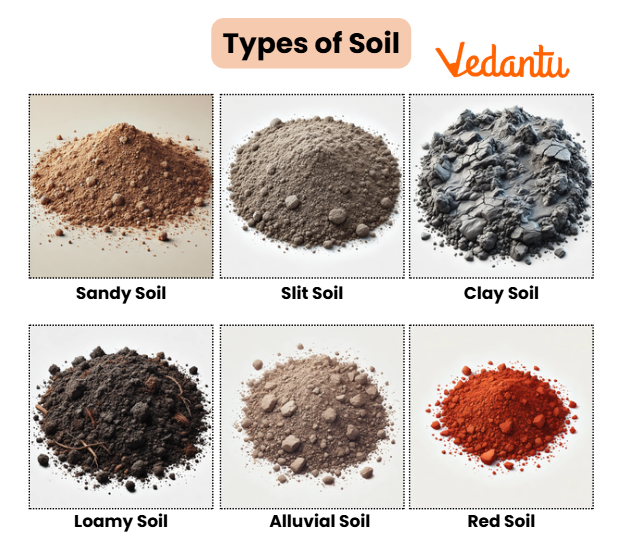
Types of Agriculture Soil
There are several important types of agriculture soil, each with unique properties suitable for different crops.
- Alluvial Soil: Found in river plains; good for wheat, rice, sugarcane.
- Black Soil: High clay content; ideal for cotton, soybeans, and pulses.
- Red Soil: Rich in iron; supports groundnut, millet, and potato.
- Loamy Soil: Balanced sand, silt, and clay; best for most crops.
- Sandy Soil: Drains quickly; suitable for peanuts, melons, and potatoes.
- Clayey Soil: Holds water well; used for paddy, sugarcane.
Key Characteristics of Agriculture Soil
The suitability of agriculture soil for farming depends on several characteristics:
| Characteristic | Description | Importance |
|---|---|---|
| Water Holding | Ability to retain water for crops | Ensures steady supply during dry spells |
| Aeration | Air spaces between particles | Helps roots and microbes breathe |
| Texture | Proportion of sand, silt, clay | Affects water/nutrient supply and root growth |
| Nutrient Content | Amount of minerals and organic matter | Directly impacts yield |
| pH Level | Acidity or alkalinity of soil | Some crops need acidic/alkaline soil |
Functions and Importance of Agriculture Soil
- Supports plant roots and anchors crops.
- Supplies essential nutrients for healthy plant growth.
- Stores water for plants to use over time.
- Harbours helpful microorganisms that boost plant health.
- Acts as a buffer against environmental changes (e.g., temperature, floods).
- Filters water, improving groundwater quality.
- Stores carbon and supports nutrient cycles like the nitrogen cycle.
- Acts as the foundation for global agriculture and food safety.
Agriculture Soil Testing and Management
Soil testing checks nutrient levels, pH, and contaminants, guiding farmers on fertilisation and crop selection. Soil management includes:
- Ploughing: Loosens soil, improves aeration (learn about soil profile).
- Levelling: Provides even surface for sowing and irrigation.
- Manuring and Fertilisation: Adds nutrients, organic matter (manure benefits).
- Irrigation Management: Prevents waterlogging; optimises crop yield (irrigation methods).
- Crop Rotation: Maintains soil fertility and prevents pest buildup.
Problems: Erosion, Degradation, and Pollution
Agriculture soil faces several threats:
- Soil Erosion: Loss of upper layer due to wind and water. Control with proper soil conservation.
- Soil Degradation: Decline in soil quality from overuse, chemicals, or salinity.
- Soil Pollution: Accumulation of harmful substances (pesticides, industrial waste) reduces fertility and harms crops.
Worked Example – Soil Preparation in Agriculture
Let’s understand the preparation and use of agriculture soil step by step:
1. Field is ploughed to loosen the soil and mix organic matter.
2. Soil is levelled to prevent uneven irrigation.
3. Manure or fertilisers are added for nutrients.
4. Crops are sown, and regular soil testing guides further care.
Practice Questions
- What are the main types of agriculture soil in India?
- Give two differences between agriculture soil and forest soil.
- Why is loamy soil considered best for farming?
- Explain how soil pollution affects food crops.
Common Mistakes to Avoid
- Confusing agriculture soil with forest soil or garden soil.
- Assuming all soils suit all crops.
- Ignoring the role of soil pH in crop selection.
- Not testing soil regularly before planting.
Real-World Applications
The concept of agriculture soil is used in sustainable farming, crop rotation, precision agriculture, land reclamation, and environmental monitoring. Understanding agriculture soil helps students and farmers improve crop yields, use resources wisely, and protect the ecosystem. Vedantu helps students relate this essential topic to real-life farming and academic success.
In this article, we explored agriculture soil, its types, properties, functions, common threats, and real-life applications. Knowing these basics is important for exams and practical farming. To learn more and strengthen your knowledge, practice regularly and use resources like Vedantu.


FAQs on Agriculture Soil and Its Role in Crop Production
1. What is agricultural soil?
Agricultural soil is soil that is used and managed for growing crops and supporting plant production. It contains a balanced mixture of mineral particles, organic matter, water, air, and living organisms. Key components include:
- Sand, silt, and clay (mineral fraction)
- Humus (decomposed organic matter)
- Soil microorganisms such as bacteria and fungi
- Essential plant nutrients like nitrogen (N), phosphorus (P), and potassium (K)
Healthy agricultural soil supports root growth, nutrient uptake, and sustainable crop yield.
2. What are the main components of agricultural soil?
The main components of agricultural soil are minerals, organic matter, water, air, and living organisms. These components function together to support plant growth:
- Mineral particles (sand, silt, clay) provide structure and texture
- Organic matter improves fertility and water retention
- Soil water dissolves and transports nutrients
- Soil air supplies oxygen for root respiration
- Soil biota (earthworms, bacteria, fungi) recycle nutrients
The balance of these components determines soil productivity and crop performance.
3. What is soil texture and why is it important in agriculture?
Soil texture is the relative proportion of sand, silt, and clay particles in soil, and it determines water retention and drainage. Based on particle size, soil can be classified as:
- Sandy soil – large particles, drains quickly
- Clay soil – very fine particles, retains water
- Loamy soil – balanced mix, ideal for agriculture
Loamy soil is considered best for crop production because it provides good aeration, moisture retention, and nutrient availability.
4. What is soil fertility?
Soil fertility is the ability of soil to supply essential nutrients to plants in adequate amounts for growth. Fertile soil contains:
- Primary macronutrients: Nitrogen (N), Phosphorus (P), Potassium (K)
- Secondary nutrients: Calcium, Magnesium, Sulfur
- Micronutrients: Iron, Zinc, Manganese
High soil fertility improves crop yield, plant health, and resistance to stress.
5. How does soil pH affect plant growth?
Soil pH affects plant growth by influencing nutrient availability and microbial activity. Soil pH is classified as:
- Acidic soil (pH below 7)
- Neutral soil (pH 7)
- Alkaline soil (pH above 7)
Most crops grow best in slightly acidic to neutral soil (pH 6–7.5) because essential nutrients are most available in this range.
6. What are soil microorganisms and why are they important?
Soil microorganisms are microscopic living organisms in soil that decompose organic matter and recycle nutrients. Important groups include:
- Bacteria (e.g., nitrogen-fixing bacteria like Rhizobium)
- Fungi (including mycorrhizae)
- Actinomycetes
They enhance soil fertility, improve nutrient cycling, and promote healthy root systems in agricultural soil.
7. What is soil erosion and how does it affect agriculture?
Soil erosion is the removal of the top fertile layer of soil by water, wind, or human activity. The most productive layer, called topsoil, contains high organic matter and nutrients. Effects include:
- Loss of soil fertility
- Reduced crop yield
- Decreased water-holding capacity
Preventing soil erosion through contour farming, cover crops, and terracing is essential for sustainable agriculture.
8. What is the difference between soil structure and soil texture?
The difference between soil texture and soil structure is that texture refers to particle size, while structure refers to particle arrangement. Specifically:
- Soil texture = proportion of sand, silt, and clay
- Soil structure = arrangement of particles into aggregates or clumps
Good soil structure improves aeration, root penetration, and water movement in agricultural soil.
9. What is humus and why is it important in agricultural soil?
Humus is the dark, stable organic matter formed by the decomposition of plant and animal residues. It plays several key roles:
- Improves soil structure and aggregation
- Increases water-holding capacity
- Enhances nutrient retention through cation exchange capacity (CEC)
Humus is essential for maintaining long-term soil fertility and sustainable crop production.
10. How can soil fertility be improved naturally?
Soil fertility can be improved naturally by adding organic matter and promoting biological activity. Effective methods include:
- Applying compost or farmyard manure
- Practicing crop rotation, especially with legumes
- Growing green manure crops
- Using cover crops to prevent nutrient loss
These practices enhance nutrient cycling, improve soil structure, and support sustainable agricultural soil management.



