




What is the Persimmon Plant Classification Structure and Types
Welcome, young botanists and curious minds! Are you ready to explore a magical fruit tree that looks almost like something straight out of a fairy tale? Today, we’ll discover the secret world of the persimmon plant—how it grows, why it’s special, and how to tell it apart from other famous fruit trees. Let’s become plant detectives together, with Vedantu as your friendly guide!
Say Hello to the Persimmon Tree – Nature’s Orange Gem
What Is a Persimmon Plant?
The persimmon plant is a deciduous (leaf-shedding) tree with the scientific name Diospyros. It belongs to the Ebenaceae family, just like the ebony tree. Persimmon trees are well-known for their bright orange berries, which are not only pretty to look at but also delicious to eat when ripe. The most popular types are Diospyros kaki (Asian persimmon) and Diospyros virginiana (American persimmon).
Persimmons love mild to cool areas and are found in places like China, Japan, Korea, the USA, and even the hilly regions of India (like Himachal Pradesh and Uttarakhand). They can grow as small trees or become big enough to shade your whole garden!
Persimmon’s Family and Home
- Scientific Name: Diospyros spp.
- Family: Ebenaceae
- Grows In: Asia, North America, Mediterranean, Indian hills
- Tree Type: Deciduous (sheds leaves yearly)
Peek Inside: The Special Parts of Persimmon
Leaves, Flowers, and Fruit – Let’s Look Closely!
Just like every person is unique, so is each part of the persimmon plant! Here’s what you might notice if you meet this plant on your next nature walk:
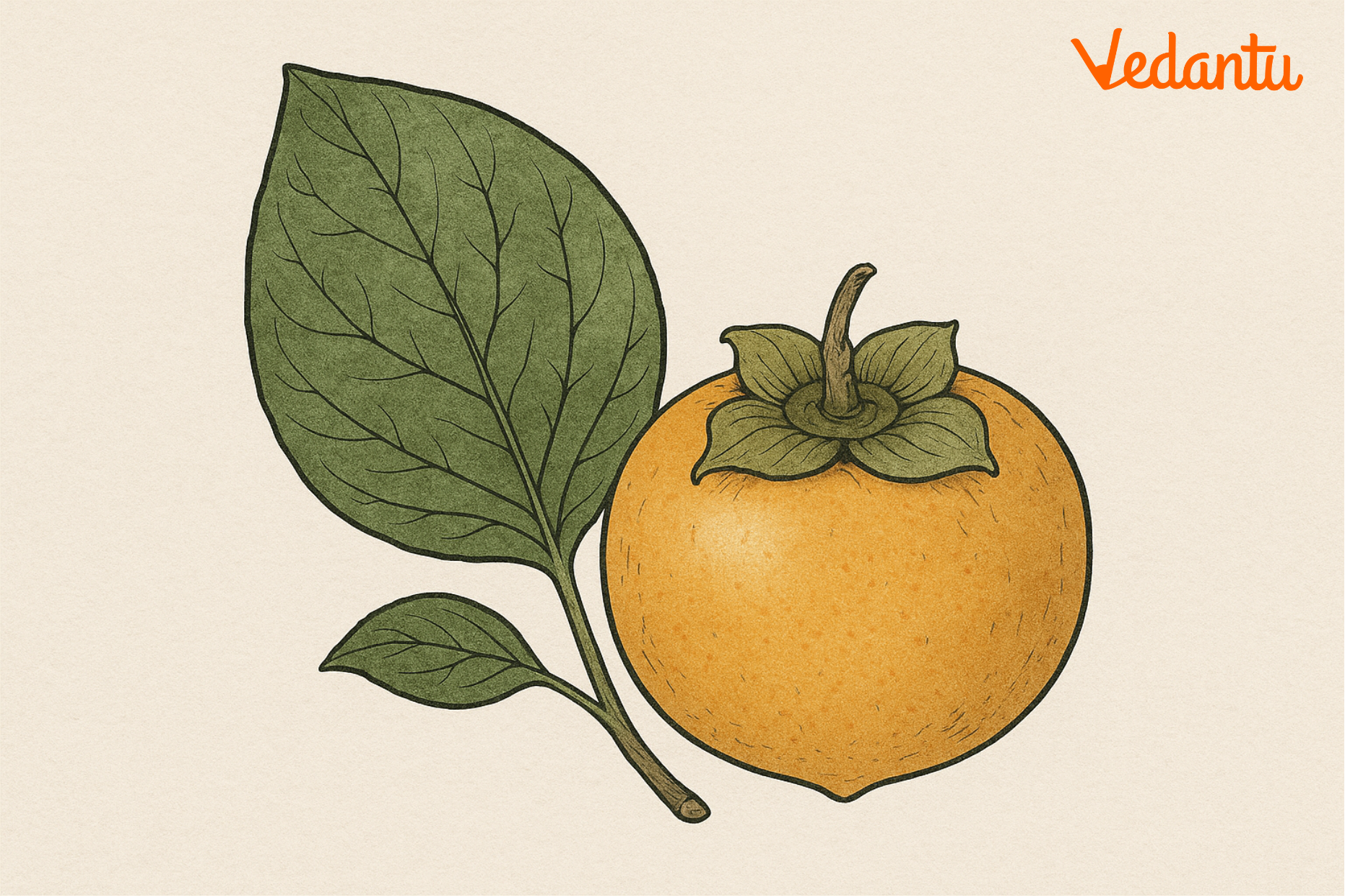
Leaves
- Simple (not divided), and arranged in an alternate pattern on branches
- Shiny dark green, oval-shaped, and a little leathery to touch
Flowers
- Small, creamy-white or yellow, shaped like tiny bells
- Boys and girls are on different trees! (That’s right—persimmons are usually dioecious.)
Fruit
- A real berry (botanically!), bright orange or red when ripe
- Edible and sweet, but only after it gets soft—otherwise, it can taste quite astringent
- Each fruit holds a handful of flat seeds inside
| Organ | Key Features |
|---|---|
| Leaf | Simple, alternate, smooth edge, shiny |
| Flower | Small, bell-shaped, separate male/female |
| Fruit | Berry, orange/red, 2–8 seeds, edible |
How Does a Persimmon Tree Grow Up?
Life Story: From Seed to Sweet Fruit
Persimmon trees begin life as little seeds or grafted plants. They need good soil, sunlight, and just enough water. It usually takes about three to five years before a persimmon tree gives its first yummy fruit!
- Persimmons use photosynthesis to make their own food, like other green plants
- They rely on wind or insects to help with pollination
- Seeds drop to the ground or get carried away and may sprout into new saplings
In colder places, the tree loses its leaves in autumn, showing off its orange fruits against bare branches – it looks like a natural ornament tree!
Super Survival Tricks
- Sturdy leaves save water during summer
- Fruit is astringent when unripe, keeping hungry animals away until seeds can be spread properly
Persimmons in Our Lives – More Than Just a Fruit!
Why People Grow and Love Persimmons
- Snack: Ripe fruit is sweet like candy and enjoyed as fresh slices, jams, or desserts.
- Medicine: Old remedies use persimmon for cough, blood pressure, digestion, and even to boost immunity (they are rich in vitamin C and A!).
- Wood: Some persimmon trees give strong wood used for sports equipment and fancy furniture.
- Gardens: Pretty fruits and colorful leaves make them a favorite in parks and home gardens.
Fun Around the World
- In Japan and China, persimmons are a traditional autumn treat
- In India, farmers grow them mainly in the Himalayan hills
- Birds and monkeys also love persimmon snacks!
| Use | Example |
|---|---|
| Food | Fresh/ dried fruit, puddings, jams |
| Traditional Medicine | Cough drops, digestion aid |
| Wood/ Timbers | Sports gear, ornaments |
Persimmon vs Mango vs Jackfruit – Spot the Differences!
It’s easy to mix up fruit trees! Here’s a handy comparison to keep things clear:
| Feature | Persimmon | Mango | Jackfruit |
|---|---|---|---|
| Leaf Arrangement | Simple, alternate | Simple, alternate | Simple, opposite |
| Fruit Type | Berry (true) | Drupe | Multiple fruit (syncarp) |
| Seeds Per Fruit | Multiple | One | Many |
Quick Facts Table – Persimmon at a Glance!
| Feature | What It Means | Fun to Know |
|---|---|---|
| Scientific Name | Diospyros kaki, D. virginiana | Also called ‘kaki’ or ‘American persimmon’ |
| Fruit Type | Berry | Looks like an orange tomato! |
| Tasty Part | The ripened fruit | Eaten fresh or in sweets |
| Where Grown | Asia, US, India hills | Loves mild hills and valleys |
| Harvest Time | Late autumn | Leaves fall, orange fruit shines |
Practice Like a Pro – Example Q&A
Q: Which family does persimmon belong to and what type of fruit does it produce?
Answer: The persimmon plant is from the Ebenaceae family and makes a true berry fruit with many seeds inside.
Try These Fun Questions!
- Why should you only eat ripe persimmons and not green ones?
- How can you tell a persimmon leaf from a mango leaf?
- What color are persimmon fruits when they are ready to eat?
Mistakes Kids Often Make – Let's Clear Them Up!
- Mix-up #1: Thinking all orange fruits are mangoes! (Check the fruit type and leaf shape!)
- Mix-up #2: Forgetting that Asian and American persimmons are different species but both called "persimmon"
- Mix-up #3: Confusing unripe fruit (which is very astringent!) with ripe, soft, and sweet ones
Bright Endings – What Makes Persimmon Special?
The persimmon plant brightens up forests, farms, and gardens around the world. Its sweet orange fruit is not only a treat for people but also important for wildlife. By learning to spot its special leaves, flowers, and berries, you’re one step closer to being a plant pro!
If you want to know more about fruit types and plant families, explore more fun topics like different fruit types or plant kingdoms on Vedantu, your learning buddy!
Keep exploring, keep asking questions, and remember—every great scientist started out just as curious as you!


FAQs on Persimmon Plant Overview and Botanical Features
1. What is a persimmon plant?
A persimmon plant is a deciduous fruit-bearing tree belonging to the genus Diospyros in the family Ebenaceae. It is grown for its sweet, orange-colored fruits and ornamental value.
- Common species include Diospyros kaki (Asian persimmon) and Diospyros virginiana (American persimmon).
- It sheds its leaves annually, showing typical deciduous growth.
- The fruit is botanically classified as a berry.
2. What type of fruit is a persimmon?
A persimmon is a true berry because it develops from a single ovary of a single flower. In botanical terms:
- The entire ovary wall develops into the fleshy fruit.
- It may contain multiple seeds embedded in pulp.
- The outer skin, fleshy middle, and inner portion are all derived from the same ovary.
3. What are the main parts of a persimmon plant?
The main parts of a persimmon plant include roots, stem, leaves, flowers, and fruit. Each part has a specific biological function:
- Roots – Anchor the plant and absorb water and minerals.
- Stem (trunk and branches) – Supports the plant and transports nutrients via xylem and phloem.
- Leaves – Perform photosynthesis to produce food.
- Flowers – Reproductive structures for pollination and fertilization.
- Fruit – Protects and disperses seeds.
4. How does a persimmon plant reproduce?
A persimmon plant reproduces sexually through pollination followed by fertilization in its flowers. The process involves:
- Transfer of pollen from the anther to the stigma.
- Growth of a pollen tube to the ovule.
- Fusion of male and female gametes to form a zygote.
- Development of seeds and fruit after fertilization.
5. Are persimmon plants monoecious or dioecious?
Many persimmon species are dioecious, meaning male and female flowers grow on separate plants. In detail:
- Dioecious plants require both male and female individuals for seed production.
- Some cultivated varieties may have both flower types or produce only female flowers.
- This floral variation influences fruit set and seed formation.
6. What is the scientific name of the persimmon plant?
The scientific name of the common Asian persimmon is Diospyros kaki. Other important species include:
- Diospyros virginiana – American persimmon.
- Diospyros lotus – Date plum persimmon.
7. What type of leaves does a persimmon plant have?
A persimmon plant has simple, alternate, deciduous leaves with a broad blade. Key features include:
- Simple leaves – Not divided into leaflets.
- Alternate arrangement – One leaf per node along the stem.
- Leaves are usually oval with smooth margins.
- They change color in autumn due to breakdown of chlorophyll.
8. Where do persimmon plants grow best?
Persimmon plants grow best in warm temperate to subtropical climates with well-drained soil. Optimal conditions include:
- Full sunlight for maximum photosynthesis.
- Moderate rainfall and good drainage.
- Slightly acidic to neutral soil pH.
9. What is the importance of persimmon plants in the ecosystem?
Persimmon plants are ecologically important because they provide food and habitat for wildlife. Their role includes:
- Fruits serve as food for birds and mammals, aiding in seed dispersal.
- Flowers attract insect pollinators.
- Trees contribute to carbon sequestration and oxygen production through photosynthesis.
10. What is the difference between astringent and non-astringent persimmons?
The difference between astringent and non-astringent persimmons lies in their tannin content and edibility when firm. Specifically:
- Astringent persimmons contain high soluble tannins and taste bitter until fully ripe and soft.
- Non-astringent persimmons have lower tannin levels and can be eaten while still firm.
- Tannins bind to proteins in saliva, causing a dry or puckering sensation.



