




What Is Pedigree Analysis Definition Symbols and Inheritance Patterns
Pedigree analysis is an essential tool in genetics used to trace the inheritance of traits and disorders across generations in a family. By creating a family tree diagram, called a pedigree chart, scientists and healthcare professionals can observe how certain characteristics, such as genetic conditions or specific physical attributes, are passed from parents to their children. This method is especially useful in human genetics, as controlled breeding experiments (like those performed on plants or animals) cannot be ethically conducted in people.
A pedigree chart uses standardized symbols to represent each family member and their relationships. Males are shown as squares, while females are circles. A horizontal line connecting a square and a circle represents a marriage. A vertical line descending from this pair leads to their offspring. Shaded symbols indicate individuals who express a particular trait or disorder being studied. Unshaded symbols denote unaffected people, and partially shaded shapes may represent carriers for certain conditions.
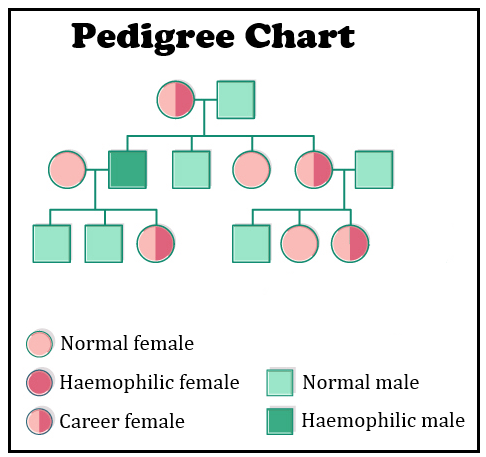
The main aim of pedigree analysis is to determine how specific genes or genetic disorders are inherited within a family. It helps scientists identify the transmission pattern, which can be autosomal dominant, autosomal recessive, X-linked dominant, or X-linked recessive. This knowledge is vital for medical counseling, predicting disease risks, diagnosing inherited conditions, and understanding how genes behave over generations.
Pedigree Chart Symbols and Their Meanings
| Symbol | Meaning |
|---|---|
| Square (□) | Male |
| Circle (○) | Female |
| Shaded Square/Circle | Affected Male/Female |
| Half-Shaded | Carrier (for recessive or sex-linked traits) |
| Horizontal line | Mating/Marriage |
| Vertical line | Descent/Offspring |
Types of Inheritance Patterns Observed in Pedigrees
| Inheritance Type | Main Features | Examples |
|---|---|---|
| Autosomal Dominant | Trait appears in every generation, affects both sexes equally | One parent usually affected |
| Autosomal Recessive | Trait may skip generations, both sexes equally affected | Parents can be unaffected carriers |
| X-linked Dominant | Often more severe in males, all daughters of affected father are affected | Expressed in both genders |
| X-linked Recessive | More common in males, mother can be a carrier | Affected males usually from carrier mothers |
Key Steps in Pedigree Analysis
-
Gather information about several generations of a family and identify individuals who are affected by a trait or disorder.
-
Draw the pedigree chart using standard symbols to represent each person, their gender, affected status, and relationships.
-
Analyze the chart to determine how the trait is passed—note whether it appears in every generation or skips generations, and whether one sex is more affected.
-
Based on patterns, infer if the inheritance is dominant, recessive, autosomal, or sex-linked.
-
Use this information for risk assessment, diagnosis, and genetic counseling.
Example of Pedigree Analysis
Suppose a pedigree chart shows a disorder in each generation, affecting both males and females. This suggests autosomal dominant inheritance. If an unaffected couple has an affected child, it points to autosomal recessive inheritance.
Scientific Significance of Pedigree Analysis
Pedigree analysis is important for tracing genetic disorders, such as hemophilia, cystic fibrosis, or sickle cell anemia. Understanding the inheritance pattern helps medical professionals predict risks, advise families, and guide decision-making for future offspring.
Important Definitions
| Term | Definition |
|---|---|
| Pedigree Chart | A family tree diagram showing inheritance of traits through generations |
| Carrier | An individual who has one copy of a recessive allele but does not show symptoms |
| Autosomal | Refers to chromosomes not involved in determining gender |
| Sex-linked | Traits determined by genes on X or Y chromosomes |
Further Learning and Practice
Sample Practice Question
Consider a pedigree where only males are affected and the disease skips generations. What type of inheritance is most likely observed?
Answer: X-linked recessive.
Understanding pedigree analysis gives students, families, and teachers insight into the continuity of genetic traits and helps in predicting, diagnosing, and managing inherited conditions with confidence.


FAQs on Pedigree Analysis in Genetics and Family Inheritance Patterns
1. What is pedigree analysis in genetics?
Pedigree analysis is a genetic method used to trace the inheritance of a specific trait or disorder through multiple generations of a family. It uses a pedigree chart to visually represent relationships and track how traits are passed down.
- Squares represent males and circles represent females.
- Shaded symbols indicate individuals affected by a trait.
- Horizontal lines show mating, and vertical lines show offspring.
2. What is the purpose of pedigree analysis in studying genetic history of a family?
The main purpose of pedigree analysis is to identify how a genetic trait or disease is inherited within a family over generations. It helps to:
- Determine the mode of inheritance (dominant, recessive, X-linked, etc.).
- Identify carriers of genetic disorders.
- Predict the risk of a trait appearing in future offspring.
3. How do you read a pedigree chart?
A pedigree chart is read by analyzing symbols, generations, and the distribution of affected individuals. Follow these steps:
- Identify generations labeled with Roman numerals (I, II, III).
- Note males (squares) and females (circles).
- Check which individuals are affected (shaded).
- Observe if the trait appears in every generation (suggesting dominant inheritance) or skips generations (suggesting recessive inheritance).
4. What is the difference between autosomal and sex-linked inheritance in a pedigree?
The difference is that autosomal inheritance involves genes on non-sex chromosomes, while sex-linked inheritance involves genes on the X or Y chromosome. In autosomal inheritance:
- Males and females are affected equally.
- Males are more frequently affected.
- Affected fathers pass the gene to daughters but not sons.
5. What is an example of a genetic disorder studied using pedigree analysis?
An example of a disorder commonly studied using pedigree analysis is hemophilia, an X-linked recessive disorder. In a pedigree chart:
- Affected males are more common.
- Females may act as carriers without showing symptoms.
- The disorder can skip generations through carrier females.
6. How can pedigree analysis identify carriers of genetic diseases?
Pedigree analysis identifies carriers by analyzing inheritance patterns and the presence of affected offspring. A carrier is an individual who has one copy of a recessive allele but does not show symptoms.
- If two unaffected parents have an affected child, both are likely carriers of a recessive allele.
- In X-linked traits, females with affected sons may be carriers.
7. What does it mean if a trait skips a generation in a pedigree?
If a trait skips a generation, it usually indicates a recessive pattern of inheritance. In autosomal recessive inheritance:
- Parents may be unaffected carriers.
- The trait appears only when an individual inherits two recessive alleles.
8. What are the symbols used in a pedigree chart?
Pedigree charts use standardized symbols to represent family members and traits. Common symbols include:
- Square – male
- Circle – female
- Shaded symbol – affected individual
- Half-shaded symbol – carrier
- Horizontal line – mating
- Vertical line – offspring
9. Why is pedigree analysis important in genetic counseling?
Pedigree analysis is important in genetic counseling because it helps estimate the probability of inherited diseases in future children. By studying the family genetic history, counselors can:
- Assess inheritance risks.
- Identify carriers of genetic mutations.
- Guide decisions about genetic testing and family planning.
10. Can pedigree analysis be used for both dominant and recessive traits?
Yes, pedigree analysis can be used to study both dominant and recessive genetic traits. For dominant traits:
- The trait appears in every generation.
- At least one affected parent is usually present.
- The trait may skip generations.
- Unaffected parents can produce affected offspring.



