




Types of Nitrogenous Bases and Base Pairing in DNA and RNA
Nitrogenous bases are essential organic molecules found in all living cells. They are the foundation of nucleic acids—DNA and RNA—which store and transmit the genetic information necessary for life. These bases have a unique ability to form specific pairings, ensuring correct copying and reading of genetic material.
In every DNA and RNA molecule, each unit called a nucleotide consists of three parts: a nitrogenous base, a five-carbon sugar (either ribose or deoxyribose), and a phosphate group. The nitrogenous base is the part responsible for genetic coding and diversity among living organisms. These bases are planar, aromatic, and can be divided into two main categories based on their chemical structure: purines and pyrimidines.
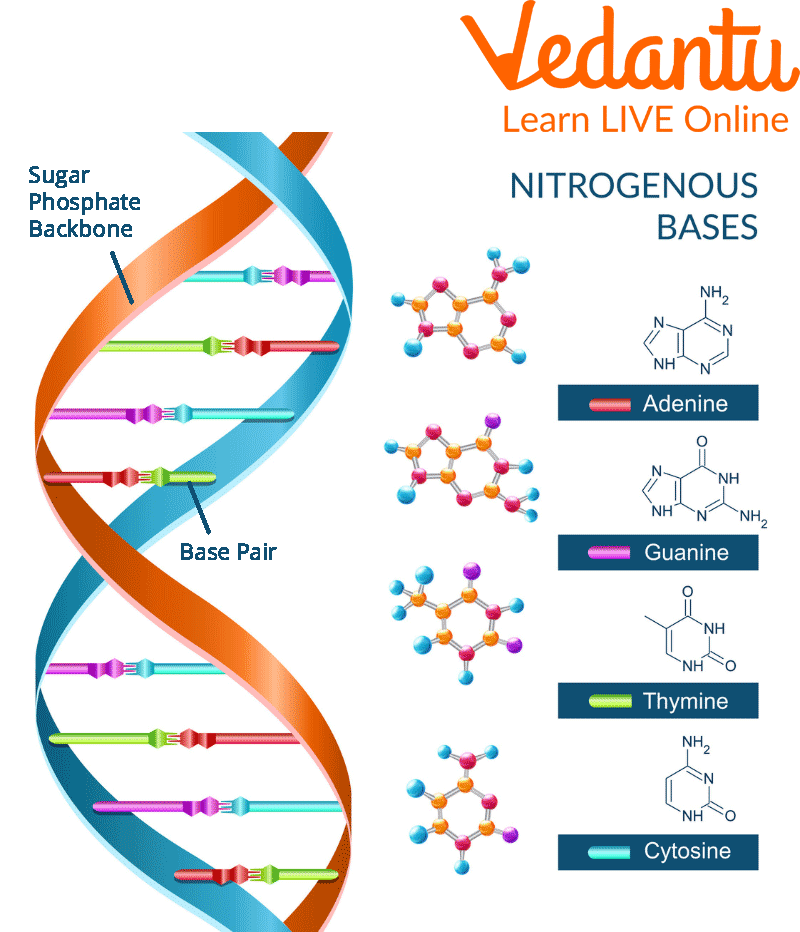
Classification of Nitrogenous Bases
Purines have a double-ring structure, consisting of a six-membered and a five-membered ring fused together. In both DNA and RNA, the purines are adenine (A) and guanine (G).
Pyrimidines are single-ringed structures. DNA contains two pyrimidines: cytosine (C) and thymine (T). RNA also has cytosine but replaces thymine with uracil (U).
| Base Type | DNA | RNA |
|---|---|---|
| Purines | Adenine (A), Guanine (G) | Adenine (A), Guanine (G) |
| Pyrimidines | Cytosine (C), Thymine (T) | Cytosine (C), Uracil (U) |
The presence of these specific nitrogenous bases and their arrangement along the nucleic acid chain are the basis for genetic coding. When nucleic acids are hydrolysed, they yield nitrogenous bases, sugars (ribose or deoxyribose), and phosphates.
Structure and Pairing in DNA and RNA
DNA is composed of two strands forming a double helix, with bases pairing in the center. Adenine always pairs with thymine, and guanine pairs with cytosine. This specificity is due to hydrogen bonding: A-T pairs form two hydrogen bonds, while G-C pairs form three. This rule ensures stability and accurate copying of genetic information during cell division.
In RNA, which is usually single-stranded, adenine pairs with uracil instead of thymine. The basic pairing rules are conserved: A with U, and G with C.
| Molecule | Base Pairing | Unique Feature |
|---|---|---|
| DNA | A–T, G–C | Thymine present, double-stranded |
| RNA | A–U, G–C | Uracil replaces thymine, usually single-stranded |
Functions and Importance
Nitrogenous bases form the genetic code by their sequence in DNA and RNA. DNA acts as the genome of the cell, storing all hereditary information. It is also responsible for controlling protein synthesis—a process essential for life. RNA, similarly, acts in various roles like messenger RNA (carries genetic instructions), transfer RNA (helps build proteins), and ribosomal RNA (forms part of ribosomes).
Besides their vital role in heredity, the base pairing mechanism ensures cellular functions such as DNA replication, transcription, and translation are accurate. This maintains genetic stability across generations. Even a small error in the sequence of these bases can lead to mutations, sometimes resulting in diseases.
Structural Insights
In DNA, nucleotides are held together by 3',5'-phosphodiester bonds. The base-pairing follows strict complementarities, with equal amounts of A and T, and G and C, in the double helix. This double helical structure imparts stability and enables reliable information transfer.
RNA molecules, though often single-stranded, can form complex shapes and secondary structures by folding back on themselves. Some types, like tRNA, even contain rare modified bases for specialized functions.
Scientific Significance and Biological Relevance
The specificity of nitrogenous bases underpins all molecular genetics. They are involved in encoding genes, regulating processes like cell replication, protein synthesis, and ensuring proper expression of hereditary characters. The study of these bases, and the rare alterations (such as methylated purines or pyrimidines), is crucial for understanding genetic diseases, biotechnology, and even approaches to cancer treatment.
Practice and Next Steps
- List the nitrogenous bases in both DNA and RNA and match them to their pairing partners.
- Describe the structural differences between purines and pyrimidines.
- Explain the importance of complementary base pairing in the transmission of genetic information.
- Practice with diagrams by drawing the double ring of purines and the single ring of pyrimidines.
To learn more about the structure and roles of nucleic acids, see DNA Structure, and deepen your understanding of genetics at Molecular Basis of Inheritance.
These core concepts will help you master the fundamentals of genetics and molecular biology, supporting your success in school and beyond.


FAQs on Nitrogenous Bases in DNA and RNA Structure and Functions
1. What are nitrogenous bases in DNA and RNA?
Nitrogenous bases in DNA and RNA are nitrogen-containing organic molecules that form the basic units of genetic information in nucleic acids. They are components of nucleotides, which make up DNA and RNA.
- In DNA: Adenine (A), Thymine (T), Cytosine (C), and Guanine (G)
- In RNA: Adenine (A), Uracil (U), Cytosine (C), and Guanine (G)
- They pair specifically to store and transmit genetic information.
2. What are the four nitrogenous bases in DNA?
The four nitrogenous bases in DNA are Adenine, Thymine, Cytosine, and Guanine. These bases form the genetic code in DNA.
- Adenine (A) pairs with Thymine (T)
- Cytosine (C) pairs with Guanine (G)
- This pairing follows the rule of complementary base pairing
3. What are the nitrogenous bases found in RNA?
The nitrogenous bases in RNA are Adenine, Uracil, Cytosine, and Guanine. RNA differs from DNA because it contains uracil instead of thymine.
- Adenine (A) pairs with Uracil (U)
- Cytosine (C) pairs with Guanine (G)
- RNA is usually single-stranded
4. What is the difference between purines and pyrimidines?
The main difference between purines and pyrimidines is their nitrogenous ring structure. Purines have two rings, while pyrimidines have one ring.
- Purines: Adenine (A) and Guanine (G) — double-ring structure
- Pyrimidines: Cytosine (C), Thymine (T), and Uracil (U) — single-ring structure
- In DNA base pairing, a purine always pairs with a pyrimidine
5. How do nitrogenous bases pair in DNA?
Nitrogenous bases pair in DNA through hydrogen bonds following the rule of complementary base pairing. Each base pairs with a specific partner.
- Adenine (A) pairs with Thymine (T) via two hydrogen bonds
- Cytosine (C) pairs with Guanine (G) via three hydrogen bonds
- This pairing forms the DNA double helix
6. Why does RNA use uracil instead of thymine?
RNA uses uracil instead of thymine because uracil is structurally simpler and energetically cheaper to produce. Thymine is a methylated form of uracil.
- Uracil (U) lacks a methyl group present in thymine
- RNA is short-lived, so it does not require the extra stability provided by thymine
- DNA uses thymine to enhance genetic stability
7. What is the function of nitrogenous bases in DNA?
The function of nitrogenous bases in DNA is to store and transmit genetic information. The sequence of bases forms the genetic code.
- The order of A, T, C, and G determines genes
- Base sequences are transcribed into RNA
- This information directs protein synthesis
8. How many hydrogen bonds are formed between DNA base pairs?
In DNA, adenine-thymine pairs form two hydrogen bonds, while cytosine-guanine pairs form three hydrogen bonds. The number of bonds affects DNA stability.
- A–T pairing: 2 hydrogen bonds
- C–G pairing: 3 hydrogen bonds
- Higher C–G content increases DNA stability
9. What is complementary base pairing?
Complementary base pairing is the specific pairing of nitrogenous bases in DNA and RNA according to fixed rules. Each base pairs with its complementary partner.
- In DNA: A pairs with T, and C pairs with G
- In RNA: A pairs with U, and C pairs with G
- This pairing occurs through hydrogen bonding
10. What happens if nitrogenous bases are arranged incorrectly?
If nitrogenous bases are arranged incorrectly, it can result in a mutation in the genetic code. Mutations change the DNA base sequence.
- They may alter the amino acid sequence of a protein
- Some mutations are harmless
- Others can cause genetic disorders or diseases



