









How Do Gene Transfer Methods Work in Bacterial Genetics for NEET?
Bacterial Genetics is a key concept in Biology that explores how bacteria inherit, transfer, and modify genetic material. This topic forms the basis for understanding microbial evolution, antibiotic resistance, and biotechnology applications. For NEET aspirants, mastering Bacterial Genetics is crucial, as it helps build strong fundamentals in genetics and prepares you for related questions in the exam. It also connects to advanced ideas in molecular biology and biotechnology important for NEET and future medical studies.
What is Bacterial Genetics?
Bacterial Genetics is the branch of genetics that studies the mechanisms by which bacteria store, change, and transfer genetic information. Unlike higher organisms, bacteria do not have a nucleus, but they do have a single circular chromosome and sometimes extra DNA called plasmids. Bacteria can change their genetic traits quickly, making them interesting models for studying genetics and gene transfer. Understanding Bacterial Genetics teaches us how traits, like antibiotic resistance, can be passed between bacteria, affecting health and medicine.
Core Ideas and Fundamentals of Bacterial Genetics
Structure of Bacterial Genetic Material
Bacterial DNA is mostly found in a single circular chromosome located in the nucleoid region of the cell. In addition to the main chromosome, many bacteria have plasmids - small, circular DNA molecules that can carry extra genes, often giving bacteria special abilities like antibiotic resistance.
Gene Transfer Mechanisms
Bacteria can exchange genetic material through different processes. This ability is a core reason for their rapid evolution and adaptability. The main mechanisms are:
- Transformation: Uptake of naked DNA fragments from the environment by a bacterial cell.
- Conjugation: Direct transfer of DNA from one bacterial cell (donor) to another (recipient) through a pilus.
- Transduction: Transfer of bacterial genes by bacteriophages (viruses that infect bacteria).
Genetic Variation
Bacteria reproduce asexually by binary fission but genetic variation still arises due to mutations and the above-mentioned gene transfer mechanisms. This genetic diversity is important for bacterial survival and evolution.
Key Sub-Concepts in Bacterial Genetics
Transformation
Transformation involves the uptake of free DNA fragments from the environment by a competent bacterial cell. This process can lead to a change in the bacterial genotype. It was first discovered by Frederick Griffith in his experiment with Streptococcus pneumoniae, proving that DNA is the genetic material.
Conjugation
Conjugation requires physical contact between bacterial cells. It is usually mediated by a plasmid (like the F plasmid), which codes for the formation of a pilus to connect donor and recipient cells. Genes can be transferred via this connection, often including important traits such as antibiotic resistance.
Transduction
Transduction is the process by which bacterial DNA is transferred from one cell to another by a bacteriophage (a virus that infects bacteria). There are two types: generalized transduction (random DNA fragments are transferred) and specialized transduction (specific genes are transferred).
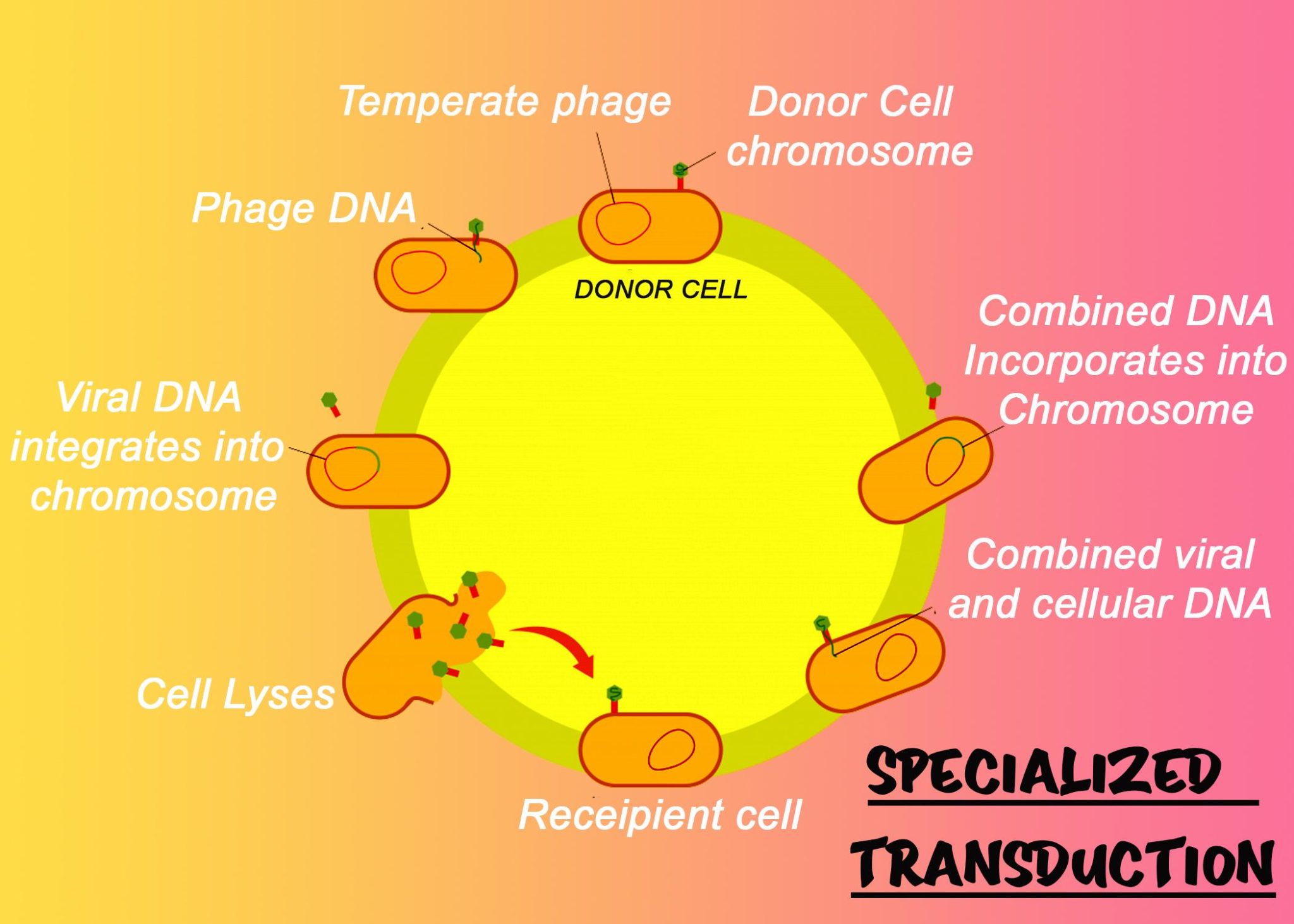
The above image demonstrates the process of bacterial transduction, where a bacteriophage carries DNA from one bacterial cell to another, enabling gene transfer and genetic diversity.
Plasmids
Plasmids are small, circular DNA molecules found in bacteria outside the main chromosome. They often carry genes for advantageous traits such as antibiotic resistance and can be transferred between bacteria during conjugation.
Important Principles, Rules, and Relationships
Bacterial genetics does not involve complex formulas but is built on understanding principles of gene transfer and genetic change. Key rules and relationships you should understand include:
- Gene transfer among bacteria is horizontal (between same generation), unlike vertical (parent to offspring) transfer in higher organisms.
- Antibiotic resistance often spreads due to plasmids and conjugation.
- Mutations are a major source of genetic variation in bacteria, driving evolution under selection pressures.
- Transduction can rapidly move genes between bacteria, even if they are not closely related.
Advantages and Limitations of Bacterial Genetics
Advantages
- Helps in understanding gene mapping, inheritance, and genetic engineering.
- Foundation for studying antibiotic resistance and developing new medicines.
- Essential for biotechnology, such as genetic cloning and recombinant DNA technology.
Limitations and Challenges
- Lab experiments can be complex and require sterile conditions.
- Rapid gene transfer can lead to challenges in controlling bacterial diseases.
- Emergence of multi-drug resistant bacteria due to genetic exchange is a major public health concern.
Why is Bacterial Genetics Important for NEET?
Understanding Bacterial Genetics is essential for NEET because:
- It underpins many questions in genetics, biotechnology, and microbiology sections of NEET.
- Concepts like transformation, transduction, and conjugation are directly tested in NEET MCQs.
- Improves conceptual clarity for related topics such as gene expression, genetic engineering, and antibiotic resistance.
- Helps students connect laboratory findings with real-world medical issues, such as the spread of infections.
How to Study Bacterial Genetics Effectively for NEET
- Start by understanding basic bacterial cell structure and differences from eukaryotic cells.
- Draw diagrams of gene transfer methods (transformation, conjugation, transduction) for visual memory.
- Use flashcards to remember definitions and differences between key terms like plasmid, transposon, and pilus.
- Solve NEET-focused MCQs and previous year questions to test your grasp of the concept.
- Regularly revise the flow and steps involved in gene transfer mechanisms.
- Link concepts of bacterial genetics with related topics such as molecular basis of inheritance and biotechnology for deeper understanding.
- Discuss confusing points with peers or teachers to clarify doubts immediately.
Common Mistakes Students Make in Bacterial Genetics
- Confusing the processes and steps of transformation, conjugation, and transduction.
- Believing that bacteria cannot show genetic variation due to asexual reproduction.
- Overlooking the role of plasmids in antibiotic resistance transfer.
- Mixing up vertical (parent-offspring) and horizontal (same generation) gene transfer.
- Ignoring diagram-based questions and thinking all genetics questions are text-based.
Quick Revision Points: Bacterial Genetics
- Bacteria have a single circular chromosome; plasmids provide extra traits.
- Horizontal gene transfer occurs via transformation, conjugation, and transduction.
- Transformation: Uptake of environmental DNA.
- Conjugation: Direct DNA transfer with cell-to-cell contact via pilus.
- Transduction: DNA transfer mediated by bacteriophages.
- Plasmids often carry antibiotic resistance genes.
- Mutations and gene transfer drive bacterial genetic variation and evolution.
- Link bacterial genetics with real-world issues like drug resistance and biotechnology applications.
FAQs on Bacterial Genetics for NEET: Fundamental Concepts and Mechanisms
1. What is bacterial genetics in NEET biology?
Bacterial genetics is the study of how genetic material, particularly DNA, is inherited and expressed in bacteria, an essential NEET biology topic.
Main features include:
- Structure of bacterial DNA (main chromosome, plasmids)
- Mechanisms of gene transfer such as conjugation, transformation, and transduction
- Mutation types and effects
- Applications in biotechnology and antibiotic resistance
2. What are the main methods of gene transfer in bacteria for NEET?
Bacteria exchange genetic material using three main methods: transformation, conjugation, and transduction.
The methods include:
- Transformation: Uptake of naked DNA from the environment.
- Conjugation: Direct transfer through cell-to-cell contact using a pilus.
- Transduction: Transfer mediated by bacteriophages (viruses that infect bacteria).
3. What is the significance of plasmids in bacterial genetics NEET syllabus?
Plasmids are extra-chromosomal, circular DNA molecules in bacteria with major roles in genetics.
Key points:
- Carry antibiotic resistance and other beneficial genes
- Essential for gene cloning and recombinant DNA technology
- Transferred between bacteria via conjugation
4. What is conjugation in bacteria?
Conjugation is a process where bacteria transfer genetic material directly via a pilus.
Process highlights:
- Requires contact between donor (F+) and recipient (F-)
- Exchange of plasmid DNA (e.g., F plasmid)
- Drives genetic diversity and horizontal gene transfer
5. How do mutations occur in bacterial genetics?
Mutations are permanent changes in a bacterium’s DNA sequence, crucial for NEET biology studies.
Main types of mutations:
- Point mutations (single base changes; e.g., substitution, insertion, deletion)
- Frameshift mutations (due to insertions/deletions causing reading frame shifts)
6. What is transformation in bacterial genetics?
Transformation is the uptake of free, foreign DNA by a bacterial cell from its environment.
Important aspects:
- DNA fragments from dead cells are incorporated
- Leads to new genetic traits in bacteria
- Significant for genetic engineering and NEET syllabus
7. What is transduction in bacteria as per NEET syllabus?
Transduction is the transfer of bacterial genes via bacteriophages (viruses that infect bacteria).
The two types are:
- Generalized transduction: Any gene can be transferred.
- Specialized transduction: Only specific genes near the phage integration site are transferred.
8. Why is genetic recombination important in bacterial genetics NEET?
Genetic recombination increases genetic variation and adaptability in bacterial populations.
It helps:
- Spread useful genes like antibiotic resistance
- Enhance survival in changing environments
- Drive evolution and diversity in bacteria
9. What is a plasmid and how is it used in biotechnology?
Plasmids serve as vectors to carry foreign genes in biotechnology and genetic engineering.
Main uses:
- Carry and multiply genes of interest (e.g., insulin production)
- Enable gene cloning and expression
- Transfer traits between organisms
10. How is bacterial genetics relevant to the NEET exam?
Bacterial genetics forms a crucial part of the NEET biology syllabus and is commonly questioned.
NEET relevance includes:
- Understanding gene transfer methods (conjugation, transformation, transduction)
- Explaining antibiotic resistance mechanisms
- Application in biotechnology and genetic engineering
- Concepts of mutations and genetic recombination
