




Structure and function of amoeba with diagram and labeling details
Amoebae are microscopic, unicellular organisms that belong to the Family Amoebidae. They are usually found in freshwater habitats like the bottoms of ponds and streams, often hiding among decaying vegetation. One of the most notable features of amoebae is their ability to change shape through cytoplasmic extensions called pseudopodia. These extensions help them move and capture food particles.
In 1755, a German naturalist named August Johann Rösel von Rosenhof became the first person to reference these ever-changing organisms. Since then, our understanding of amoebae has expanded significantly, making them an important topic of study in biology and a key concept for exams like NEET.
Classification of Amoeba
Amoeba can be classified under the following ranks:
Domain: Eukaryota
Phylum: Amoebozoa
Class: Tubulinea
Order: Euamoebida
Family: Amoebidae
Genus: Amoeba
Structure of Amoeba (Well-Labelled Diagram)
A typical amoeba is composed of jellylike cytoplasm enclosed by a thin plasma membrane. The cytoplasm is divided into:
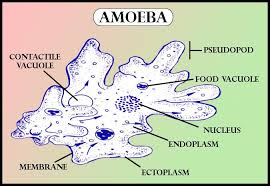
Ectoplasm: A clear, relatively firm layer just beneath the plasma membrane.
Endoplasm: A granular inner layer that contains organelles such as the nucleus, food vacuoles, and the contractile vacuole.
Key Characteristics of Amoeba
Shape-Shifting Ability: Amoebae can change shape by extending and retracting finger-like projections known as pseudopodia. These “false feet” enable movement and capture of food.
Feeding Mechanism: They do not possess a mouth or anus. Instead, they engulf food by surrounding it with pseudopodia and forming a food vacuole. Enzymes released into the vacuole help digest the food.
Contractile Vacuole and Osmoregulation: The contractile vacuole helps regulate the amount of water inside the cell, preventing it from bursting in a hypotonic (freshwater) environment. It collects excess water and expels it out of the cell.
Reproduction: The primary mode of reproduction is asexual reproduction by binary fission. The nucleus divides first, followed by the division of the cytoplasm, resulting in two daughter amoebae.
Encystation: In unfavourable conditions, amoebae can form a cyst by secreting a protective membrane around themselves. This process, known as encystation, helps them survive extreme conditions. When the environment improves, they emerge from the cyst and return to their active form.
Habitat: Amoebae thrive in freshwater environments, especially at the bottom of ponds and streams, where they often feed on decaying organic matter.
Additional Unique Adaptations
Sensitivity: Amoebae can sense chemicals in their environment, which helps them find food sources.
Locomotion Efficiency: Though seemingly random, the formation and retraction of pseudopodia are quite efficient, enabling amoebae to navigate their surroundings for optimal nutrient intake.
Short Quiz on Amoeba (With Answers)
1. What structure in Amoeba helps regulate water content?
Answer: The contractile vacuole.
2. Which scientist first referenced the Amoeba in 1755?
Answer: August Johann Rösel von Rosenhof.
3. Name the cytoplasmic extension that Amoeba uses for movement and feeding.
Answer: Pseudopodia.
4. What is the mode of reproduction in Amoeba?
Answer: Asexual reproduction by binary fission.
5. What is the primary habitat of Amoeba?
Answer: Freshwater habitats such as ponds and streams.
Related Topics


FAQs on Amoeba Diagram with Labeled Parts and Explanation
1. What is an amoeba diagram?
An amoeba diagram is a labeled drawing that shows the structure and parts of an Amoeba, a unicellular protozoan organism. It typically includes the following main components:
- Cell membrane – outer protective covering
- Cytoplasm – jelly-like substance inside the cell
- Nucleus – control center containing genetic material
- Pseudopodia – temporary finger-like projections for movement and feeding
- Food vacuole – stores and digests food
- Contractile vacuole – removes excess water
An amoeba diagram helps students understand the structure and basic life processes of this single-celled organism.
2. What are the main parts of an amoeba diagram?
The main parts of an amoeba diagram include the nucleus, cytoplasm, pseudopodia, and vacuoles. These parts are usually labeled as:
- Cell membrane – protects the cell and controls entry and exit of substances
- Nucleus – regulates cell activities
- Cytoplasm – contains organelles and supports life processes
- Pseudopodia – help in locomotion and capturing food
- Food vacuole – site of intracellular digestion
- Contractile vacuole – maintains water balance (osmoregulation)
These labeled parts are essential for understanding amoeba structure and function.
3. What is the function of pseudopodia in an amoeba?
The pseudopodia in an amoeba function in movement and food capture. These temporary cytoplasmic extensions help the organism in two main ways:
- Locomotion – the amoeba moves by extending pseudopodia in a process called amoeboid movement
- Feeding – pseudopodia surround and engulf food particles through phagocytosis
Thus, pseudopodia are essential for survival as they assist in both mobility and nutrition.
4. What is the role of the contractile vacuole in an amoeba?
The contractile vacuole in an amoeba removes excess water from the cell to maintain osmotic balance. It works by:
- Collecting excess water that enters by osmosis
- Swelling as it fills with water
- Contracting periodically to expel water outside the cell
This process, called osmoregulation, prevents the cell from bursting in freshwater environments.
5. How does an amoeba obtain its food?
An amoeba obtains its food by engulfing it through a process called phagocytosis. The feeding process occurs in the following steps:
- Pseudopodia surround the food particle
- The particle is enclosed within a food vacuole
- Digestive enzymes break down the food inside the vacuole
- Nutrients are absorbed into the cytoplasm
This method of nutrition is known as holozoic nutrition.
6. Is amoeba unicellular or multicellular?
An amoeba is a unicellular organism, meaning it consists of only one cell. Despite being single-celled, it performs all life processes within that one cell, including:
- Nutrition
- Respiration
- Excretion
- Reproduction
This single cell carries out all vital functions necessary for survival.
7. How does an amoeba move?
An amoeba moves by extending temporary projections called pseudopodia in a process known as amoeboid movement. The movement occurs as follows:
- The cytoplasm flows toward one side of the cell
- A pseudopodium forms in that direction
- The rest of the cell follows the extension
This type of movement allows the amoeba to crawl slowly over surfaces.
8. What is the function of the nucleus in an amoeba?
The nucleus in an amoeba controls all cellular activities and contains the genetic material. Its key functions include:
- Regulating growth and metabolism
- Controlling reproduction through binary fission
- Storing hereditary information in the form of DNA
The nucleus acts as the control center of the amoeba cell.
9. How does an amoeba reproduce?
An amoeba reproduces asexually by a process called binary fission. The steps of reproduction are:
- The nucleus divides into two daughter nuclei
- The cytoplasm divides
- The cell splits into two identical daughter cells
This method produces genetically identical offspring under favorable conditions.
10. What is the difference between food vacuole and contractile vacuole in amoeba?
The food vacuole is responsible for digestion, while the contractile vacuole is responsible for osmoregulation in an amoeba. The key differences are:
- Food vacuole – forms around ingested food and carries out intracellular digestion
- Contractile vacuole – collects and expels excess water from the cell
- Food vacuole is related to nutrition, whereas contractile vacuole is related to water balance
Both structures are important but perform completely different life functions.



