




Stages of Meiosis II and How It Differs from Meiosis I
Meiosis is a crucial process in sexually reproducing organisms because it creates haploid gametes, preventing the continuous doubling of chromosomes across generations. After completing Meiosis 1, cells enter Meiosis 2, which ensures the separation of sister chromatids and results in four distinct haploid cells. In this article, we will explain what happens in meiosis 2, describe the meiosis 2 stages in detail, provide an overview, and discuss the importance of cell division.
What is Meiosis 2 Also Known As?
Meiosis 2 is often called the “equational division” because, unlike Meiosis 1 (which reduces the chromosome number by half), the chromosome number in each daughter cell remains the same during Meiosis 2. Each cell that enters Meiosis 2 retains the haploid number of chromosomes, but the sister chromatids split into separate chromosomes, much like in a mitotic division.
What Happens in Meiosis 2?
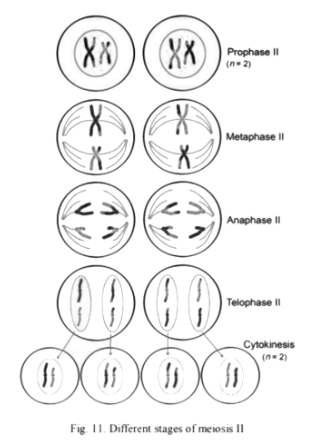
Meiosis 2 - Schematic Representation
Although this article focuses on descriptions, you can refer to a simple meiosis 2 diagram that typically shows:
One haploid cell with duplicated chromosomes enters Prophase II.
Chromosomes line up at the centre in Metaphase 2.
Sister chromatids separate in Anaphase 2.
Four haploid cells result at the end of Telophase 2 meiosis.
Such a diagram visually illustrates what happens in meiosis 2 and clarifies how each of the meiosis 2 stages progresses.
Meiosis 2 resembles mitosis in many ways. Each haploid cell produced after Meiosis 1 undergoes another round of division to separate the sister chromatids. The result is four haploid cells, each genetically unique. Let us delve deeper into the four meiosis 2 stages:
Prophase II
The nuclear membrane, if reformed after Meiosis 1, disappears once again.
Chromosomes condense and become visible under the microscope.
The centrosomes migrate to opposite poles.
The cell prepares its spindle apparatus for the next stage.
Metaphase II
During metaphase 2, the condensed chromosomes align at the equatorial plane of the cell (the metaphase plate).
Spindle fibres connect the centromeres to both poles.
Each chromosome’s sister chromatids are set to move to opposite poles.
Anaphase II
Anaphase 2 begins when the centromeres split, allowing the sister chromatids to separate.
The separated chromatids (now individual chromosomes) are pulled towards opposite poles of the cell by the spindle fibres.
This ensures that each new daughter cell will receive one copy of each chromatid.
Telophase II
In telophase 2 meiosis, the chromosomes reach the opposite ends of the cell.
Nuclear membranes reform around each set of chromosomes.
Chromosomes begin to decondense, turning back into a diffuse chromatin state.
Cytokinesis follows, dividing the cytoplasm and resulting in four distinct haploid daughter cells.
These four meiosis 2 stages (Prophase II, Metaphase 2, Anaphase 2, and Telophase 2 meiosis) are crucial for ensuring that each gamete has the correct set of genetic information.
Significance of Meiosis II
Ensures Haploid Gametes: By splitting sister chromatids, Meiosis 2 finalises the process started in Meiosis 1, guaranteeing that each gamete retains only a single copy of each chromosome.
Genetic Variability: While the main event of genetic recombination occurs during Prophase I of Meiosis 1, the distribution of chromatids in Meiosis 2 contributes to the overall assortment of chromosomes. This assortment, combined with fertilisation, increases genetic diversity in offspring.
Prevents Chromosome Doubling: Without both meiosis 1 and 2, the chromosome number would double each generation, eventually making normal development impossible.
Differences Between Meiosis 1 and 2
Chromosome Pairing
In Meiosis 1, homologous chromosomes pair up and may exchange genetic material. In Meiosis 2, there is no pairing of homologues; sister chromatids simply separate.
Division Type
Meiosis 1 is called reductional division because it reduces the chromosome number from diploid to haploid. Meiosis 2 is called equational division because the chromosome number remains haploid in the daughter cells.
Genetic Recombinations
Crossing over typically occurs in Prophase I of Meiosis 1. There is no crossing over in Meiosis 2.
Outcome
Meiosis 1 produces two haploid cells, each with duplicated chromosomes. Meiosis 2 produces four haploid cells, each with a single copy of each chromosome.
Understanding the key contrasts in meiosis 1 and 2 helps explain how organisms maintain stable chromosome numbers across generations and introduce genetic variation simultaneously.
Quick Quiz (With Answers)
Test your understanding of Meiosis 2 with these simple questions:
Which phase of Meiosis 2 involves the separation of sister chromatids?
Answer: Anaphase 2.
Name the stage in Meiosis 2 when chromosomes line up at the equator of the cell.
Answer: Metaphase 2.
How many haploid cells are produced at the end of Meiosis 2?
Answer: Four haploid cells.
What is Meiosis 2 also known as?
Answer: Equational division.
True or False: Meiosis 2 begins with diploid cells.
Answer: False. It begins with haploid cells (though each chromosome is duplicated).
Related Topics


FAQs on Meiosis II The Second Division of Meiosis
1. What is Meiosis II in cell division?
Meiosis II is the second division of meiosis in which sister chromatids separate to produce four haploid daughter cells. It resembles mitosis but occurs in cells that are already haploid after Meiosis I.
- No DNA replication occurs before Meiosis II.
- Sister chromatids are pulled apart.
- Results in four genetically distinct haploid (n) cells.
2. How is Meiosis II different from Meiosis I?
Meiosis II differs from Meiosis I because it separates sister chromatids rather than homologous chromosomes. Key differences include:
- Meiosis I: Reduction division (2n → n), homologous chromosomes separate.
- Meiosis II: Equational division (n → n), sister chromatids separate.
- Crossing over occurs only in Prophase I, not in Meiosis II.
3. What are the stages of Meiosis II?
Meiosis II consists of four main stages similar to mitosis. These stages are:
- Prophase II – Chromosomes condense and spindle fibers form.
- Metaphase II – Chromosomes align at the equator.
- Anaphase II – Sister chromatids separate.
- Telophase II – Nuclear membranes reform and cytokinesis occurs.
4. What happens during Prophase II?
During Prophase II, chromosomes condense and the spindle apparatus forms in each haploid cell. Important events include:
- Breakdown of the nuclear membrane.
- Formation of spindle fibers.
- Chromosomes, each with two sister chromatids, become visible.
5. What occurs in Anaphase II of meiosis?
In Anaphase II, sister chromatids separate and move toward opposite poles of the cell. This happens because:
- Centromeres divide.
- Spindle fibers shorten and pull chromatids apart.
- Each chromatid becomes an individual chromosome.
6. Does DNA replication occur before Meiosis II?
No, DNA replication does not occur before Meiosis II. After Meiosis I, cells enter a short interphase called interkinesis without DNA synthesis, so chromosomes remain composed of two sister chromatids.
7. What is the final result of Meiosis II?
The final result of Meiosis II is four genetically distinct haploid cells. These cells:
- Contain half the original chromosome number (n).
- Are genetically varied due to crossing over and independent assortment.
- Develop into gametes such as sperm or eggs in animals.
8. How is Meiosis II similar to mitosis?
Meiosis II is similar to mitosis because both processes separate sister chromatids. Similarities include:
- Chromosomes align at the equator.
- Centromeres split during anaphase.
- The chromosome number remains the same (n → n).
9. Why is Meiosis II important in sexual reproduction?
Meiosis II is important because it ensures the formation of functional haploid gametes required for sexual reproduction. Its significance includes:
- Maintaining the correct chromosome number after fertilization.
- Producing genetically unique gametes.
- Supporting genetic variation in offspring.
10. What would happen if Meiosis II does not occur properly?
If Meiosis II does not occur properly, it can lead to abnormal chromosome numbers in gametes, a condition called aneuploidy. This may result from:
- Nondisjunction of sister chromatids.
- Gametes with extra or missing chromosomes.
- Genetic disorders such as Down syndrome (if fertilization occurs).



