









Detailed Structure and Functions of 206 Bones for NEET Preparation
Understanding the "206 bones in our human body" is essential for NEET Biology aspirants, as the human skeletal system is a key topic that lays the foundation for learning about anatomy and physiology. This concept explains the structure, types, and functions of the bones that give our body its shape, protect organs, and help in movement. Mastering this topic not only builds conceptual clarity but also improves accuracy in answering NEET questions on skeletal structure and its roles in human biology.
What Are the 206 Bones in Our Human Body?
The human skeletal system is made up of 206 bones in a typical adult. These bones are rigid organs that together form the skeleton, providing structure, support, and protection to the body. At birth, the human body has around 270 bones, but as we grow, some bones fuse, resulting in 206 distinct bones in adulthood. These bones differ in shape, size, and function, and are vital for movement, blood cell formation, and mineral storage. Understanding the identity and role of each bone is a fundamental part of human physiology for NEET and medical entrance exams.
Core Ideas of the 206 Bones Concept
The human skeletal system can be categorized into major divisions, each with specific bone groups. The way bones are organized and classified is crucial for both structural and clinical understanding.
Axial and Appendicular Skeleton
The 206 bones are grouped into two main divisions:
- Axial skeleton (80 bones): Forms the central axis of the body and consists of the skull, vertebral column, and thoracic cage (ribs and sternum).
- Appendicular skeleton (126 bones): Includes the bones of the limbs (arms and legs) and girdles (shoulder and pelvic) that connect the limbs to the axial skeleton.

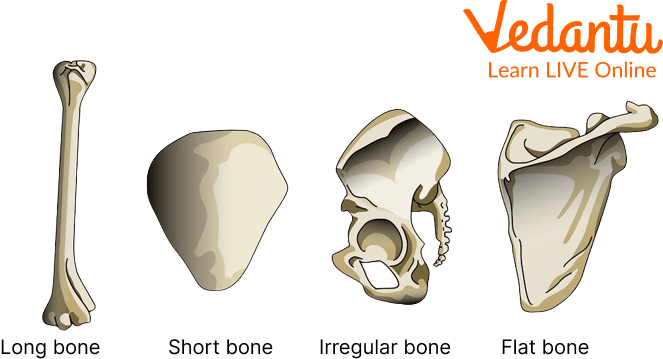
Types of Bones
Bones are classified based on their shapes and functions:
- Long Bones: Found in arms and legs (e.g., femur, humerus).
- Short Bones: Found in wrists and ankles (e.g., carpals, tarsals).
- Flat Bones: Provide broad surfaces (e.g., skull, ribs, scapula).
- Irregular Bones: Complex shapes (e.g., vertebrae, some facial bones).
- Sesamoid Bones: Embedded within tendons (e.g., patella).
Bone Structure and Composition
Every bone is a living tissue with a hard outer layer (compact bone) and a spongy inner part (spongy bone). The central cavity contains bone marrow, responsible for blood cell production.
Key Sub-Concepts Related to the 206 Bones
For NEET, it's important to connect the main idea of 206 bones to related sub-concepts in the skeletal system:
Skull and Facial Bones
The skull houses and protects the brain and consists of cranial and facial bones. Knowing the number and names of these bones is a common NEET question.
Vertebral Column
The vertebral column or backbone consists of 33 vertebrae in childhood, reducing to 26 in adults due to fusion. It supports the head and body and protects the spinal cord.
Rib Cage
The rib cage includes 12 pairs of ribs and the sternum, protecting vital organs like the heart and lungs. Understanding rib classification (true, false, floating) is important for NEET.
Limb Bones and Girdles
Limb bones (arms, legs) and their respective girdles (shoulder, pelvic) are key for movement. Knowing the bone names and locations aids in diagram-based and theoretical NEET questions.
Important Relationships and Principles
While the skeletal system does not have mathematical formulas like physics, it has logical groupings and relationships:
- Total bones in adults: 206
- Axial skeleton: 80 bones
- Appendicular skeleton: 126 bones
- Bone grouping by regions, e.g., hand (27 bones), foot (26 bones), etc.
Distribution of the 206 Human Bones
| Region | Axial/Appendicular | Number of Bones |
|---|---|---|
| Skull (Cranial + Facial) | Axial | 22 |
| Auditory Ossicles | Axial | 6 |
| Hyoid Bone | Axial | 1 |
| Vertebral Column | Axial | 26 |
| Thoracic Cage (Ribs + Sternum) | Axial | 25 |
| Pectoral (Shoulder) Girdles | Appendicular | 4 |
| Upper Limbs | Appendicular | 60 |
| Pelvic Girdle | Appendicular | 2 |
| Lower Limbs | Appendicular | 60 |
This distribution helps NEET aspirants remember bone grouping quickly and understand the interconnectedness of the skeletal framework.
Features and Importance of the 206-Bone Structure
- Provides shape, support, and rigidity to the body.
- Protects vital internal organs (e.g., skull protects the brain, ribs protect the heart and lungs).
- Enables movement by serving as points of muscle attachment and acting as levers.
- Plays a role in hematopoiesis (blood cell production) in bone marrow.
- Acts as a reservoir for minerals, mainly calcium and phosphorus.
Why Is This Concept Important for NEET?
Questions related to the 206 bones often appear in NEET, ranging from direct bone counts and types to their location, function, and related disorders. Understanding this concept provides a solid foundation for solving anatomy-based MCQs efficiently. Moreover, this knowledge connects to topics such as joints, muscular system, and nervous system, which further deepens your conceptual grasp required for both NEET and future medical studies.
How to Study the 206 Bones Concept Effectively for NEET
- Start by visualizing the human skeleton using labeled diagrams to associate bone names with their locations.
- Break down the skeleton into regions (axial and appendicular) and study each section separately.
- Use mnemonics for remembering the order and names of bones in complex areas like the skull or hand.
- Practice labeling blank skeletal diagrams regularly to aid memory retention.
- Solve NEET-level MCQs and previous year questions on the skeletal system.
- Revise using tables and quick lists for bone counts and types.
- Discuss confusing concepts or doubts with peers or teachers to clarify misunderstandings.
Common Mistakes Students Make in This Concept
- Confusing bone counts in certain regions, such as hand or skull bones.
- Forgetting the distinction between axial and appendicular skeleton.
- Mixing up bone names or functions, especially in complex areas (like carpal and tarsal bones).
- Neglecting the clinical importance of some bones, such as the role of the hyoid bone.
- Overlooking small bones such as auditory ossicles or sesamoid bones during revision.
Quick Revision Points: 206 Bones of the Human Body
- The adult human skeleton has 206 bones.
- Axial skeleton (80 bones): skull, vertebral column, rib cage.
- Appendicular skeleton (126 bones): limb bones and girdles.
- Skull has 22 bones: 8 cranial and 14 facial.
- Vertebral column in adults: 26 bones (7 cervical, 12 thoracic, 5 lumbar, sacrum, coccyx).
- Rib cage: 12 pairs of ribs + sternum = 25 bones.
- Learn bone names, locations, and groups for diagrams and MCQs.
- Common MCQ areas - number of bones in specific regions, types of ribs, skull bone names.
FAQs on 206 Bones In Our Human Body: Essential NEET Biology Overview
1. How many bones are there in the human body?
The human body has 206 bones in total. This number is standard for a typical adult and is an essential fact for NEET biology and human anatomy preparation. Understanding the bone count helps in remembering skeletal divisions:
- Axial skeleton: 80 bones (skull, spine, ribs, sternum)
- Appendicular skeleton: 126 bones (arms, legs, pelvis, shoulders)
Knowing the 206 bones is a core concept for NEET exam questions on human anatomy and skeletal system.
2. What are the main divisions of the human skeleton?
The human skeleton is divided into the axial and appendicular skeletons. This division is fundamental in NEET biology and often asked in exams:
- Axial skeleton: 80 bones (skull, vertebral column, rib cage, sternum)
- Appendicular skeleton: 126 bones (pectoral girdles, pelvic girdles, limbs)
Students should remember both divisions for NEET and label diagrams accurately in exams.
3. Why do infants have more bones than adults?
Infants have about 270 bones, which fuse to 206 in adulthood. This process is important for NEET skeletal system topics:
- Bone fusion: Several small bones (especially in the skull and spine) fuse as we grow.
- Example: Skull bones fuse at sutures; sacral vertebrae join to form the sacrum.
Understanding bone fusion helps in comparing child and adult skeletons, often asked in NEET questions.
4. What is the function of the human skeleton?
The skeleton provides support, protection, and movement. Key functions to remember for NEET and board exams:
- Support: Frame for the body
- Protection: Shields vital organs (e.g., skull protects the brain)
- Movement: Works with muscles for motion
- Mineral storage: Stores calcium, phosphorus
- Blood cell formation: Bone marrow produces blood cells
5. How is the human skeletal system important for NEET exam?
The human skeleton is a core topic in NEET Biology. It appears in MCQs and direct questions about structure, function, bone count, and types:
- Knowing 206 bones and skeletal divisions
- Identification of bone types and functions
- Understanding axial vs. appendicular framework
Focus on diagrams, labeled images, and functions for better NEET exam scoring.
6. What are the types of bones in the human body?
Bones are classified by shape into four main types. NEET requires memorization of these categories:
- Long bones: e.g., femur, humerus
- Short bones: e.g., carpals, tarsals
- Flat bones: e.g., sternum, ribs, skull
- Irregular bones: e.g., vertebrae, mandible
This classification simplifies identification and is exam-relevant for NEET aspirants.
7. Which is the longest and shortest bone in the human body?
The femur is the longest, and the stapes is the shortest bone in the human body. These facts are common NEET direct questions:
- Longest: Femur (thigh bone)
- Shortest: Stapes (in middle ear)
Remembering these helps tackle quick recall questions in NEET and other exams.
8. How can I remember the number of bones for NEET?
Use mnemonic tricks and practice skeletal diagrams to remember 206 bones for NEET. Tips include:
- Breakdown: 80 axial + 126 appendicular = 206
- Write and label diagrams repeatedly
- Make mnemonics for bone groups
- Revise frequently for retention
Smart memorization is crucial for accurate answers in NEET biology.
9. Name four bones found in the human arm.
Four main bones in the human arm are:
- Humerus
- Radius
- Ulna
- Carpals (wrist bones)
Knowing major arm bones helps in anatomical labeling for NEET and other competitive exams.
10. What is meant by an axial skeleton?
The axial skeleton forms the central axis of the human body. It includes:
- Skull (cranial and facial bones)
- Vertebral column
- Rib cage (ribs and sternum)
Comprising 80 bones, the axial skeleton's role is essential in NEET exams, particularly for diagram-based and labeling questions.
