






Master Triangles Class 9 NCERT PDF With Vedantu's Expert Solutions
NCERT Solutions for Triangles Class 9 focuses on triangles, an essential topic in geometry. This chapter helps students understand different kinds of triangles like isosceles, equilateral, and right-angled, and explores their properties and an overview of triangle congruence and congruence principles. Learning about triangles is important because they are a basic shape used in many aspects of mathematics and everyday life. Also study characteristics and inequalities of triangles. The key areas covered in this chapter include understanding the angle sum property, which is that the angles inside any triangle add up to 180 degrees, and theorems like the Pythagorean theorem. Vedantu has provided clear explanations and step-by-step guidance to help students master these concepts. Concentrating on these areas is crucial for building a strong foundation in geometry.
 Table of Content
Access Exercise wise NCERT Solutions for Chapter 7 Maths Class 9


Exercise 7.1: This exercise comprises eight questions, and it mainly deals with the basic properties of triangles such as interior angles, exterior angles, and inequalities. The questions are mostly objective and require students to apply simple formulas to find the values of angles and sides of triangles.
Exercise 7.2: This exercise consists of eight questions and mainly focuses on the congruence of triangles. The questions in this exercise deal with the criteria for congruence of triangles such as SSS, SAS, ASA, RHS, and AAS. The questions require students to apply these criteria to determine if the given triangles are congruent or not.
Exercise 7.3: This exercise comprises five questions, and it deals with the properties of isosceles and equilateral triangles. The questions in this exercise require students to apply the properties of these triangles to find the values of angles and sides.
Access NCERT Answers for Class-9 Maths Chapter 7 – Triangles
Exercise-7.1
1. In quadrilateral ACBD, AC = AD and AB bisects \[\angle A\] (See the given figure). Show that \[\Delta ABC{\text{ }} \cong \Delta ABD\]. What can you say about BC and BD?

Quadrilateral ABCD
Ans: Given: In quadrilateral ACBD, AC = AD and AB is bisected by \[\angle A\]
To find: Show that \[\Delta ABC{\text{ }} \cong \Delta ABD\].
In \[\Delta ABC{\text{ , }}\Delta ABD\]
\[AC{\text{ }} = {\text{ }}AD\] (Given)
\[\angle CAB{\text{ }} = \angle DAB\] (AB bisects ∠A)
\[AB{\text{ }} = {\text{ }}AB\] (Common)
\[\therefore \Delta ABC{\text{ }} \cong \Delta ABD\] (By SAS congruence rule)
\[\therefore BC{\text{ }} = {\text{ }}BD\] (By CPCT)
Therefore, BC and BD are of equal lengths.
2. ABCD is a quadrilateral in which AD = BC and \[\angle DAB{\text{ }} = \angle CBA\] (See the given figure). Prove that
(i) \[\Delta ABD{\text{ }} \cong \Delta BAC\]
(ii) BD = AC
(iii)\[\angle ABD{\text{ }} = \angle BAC\].
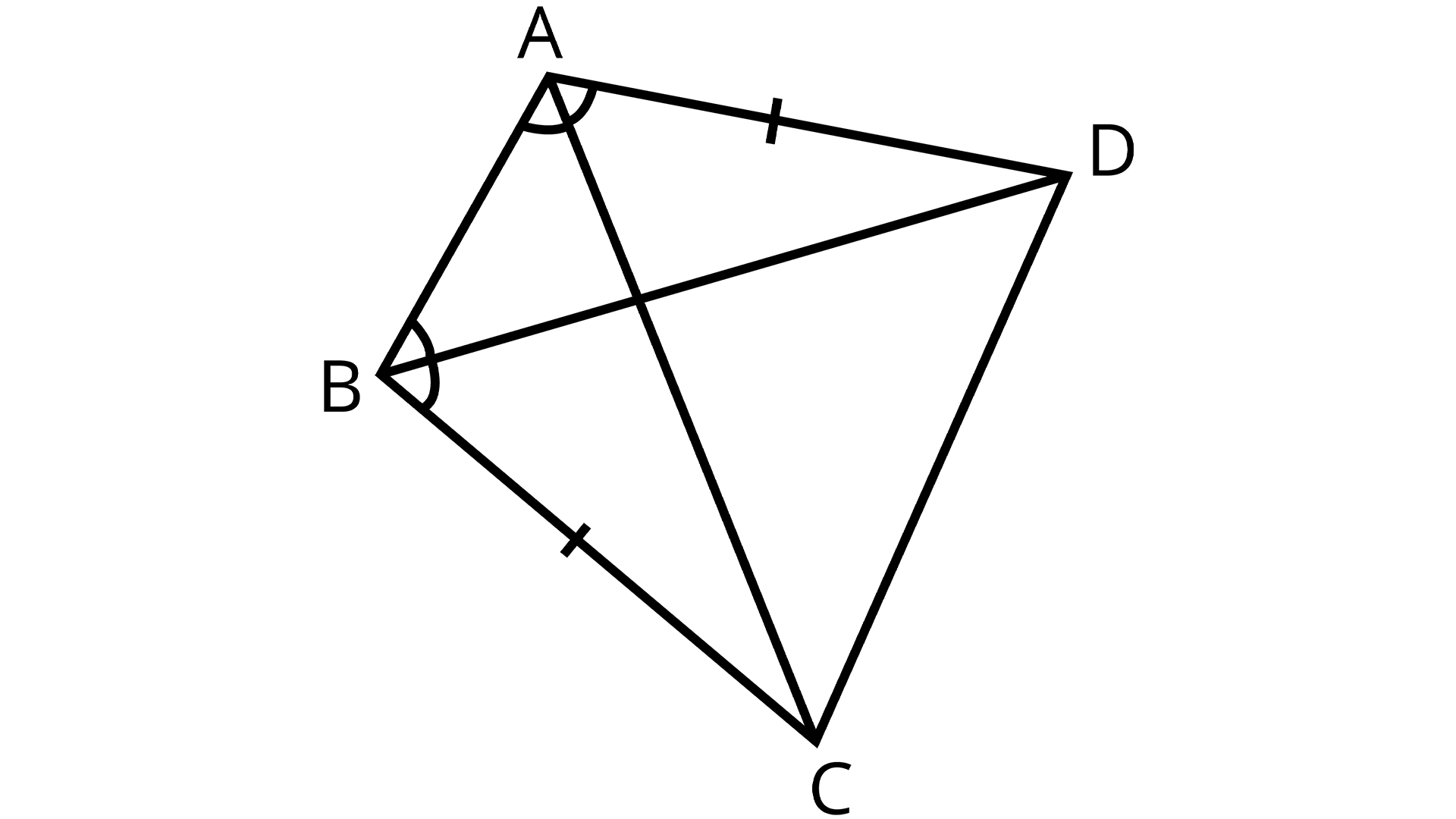
Quadrilateral ABCD with AD = BC
Ans : Given: ABCD is a quadrilateral where AD = BC and \[\angle DAB{\text{ }} = \angle CBA\]
To prove:
(i) \[\Delta ABD{\text{ }} \cong \Delta BAC\]
(ii) BD = AC
(iii)\[\angle ABD{\text{ }} = \angle BAC\].
In \[\Delta ABD{\text{ , }}\Delta BAC\],
AD = BC (Given)
\[\angle DAB{\text{ }} = \angle CBA\] (Given)
AB = BA (Common)
\[\therefore \Delta ABD{\text{ }} \cong \Delta BAC\] (By SAS congruence rule)
\[\therefore BD{\text{ }} = {\text{ }}AC\] (By CPCT)
And, \[\angle ABD{\text{ }} = \angle BAC\] (By CPCT)
3. AD and BC are equal perpendiculars to a line segment AB (See the given figure). Show that CD bisects AB.
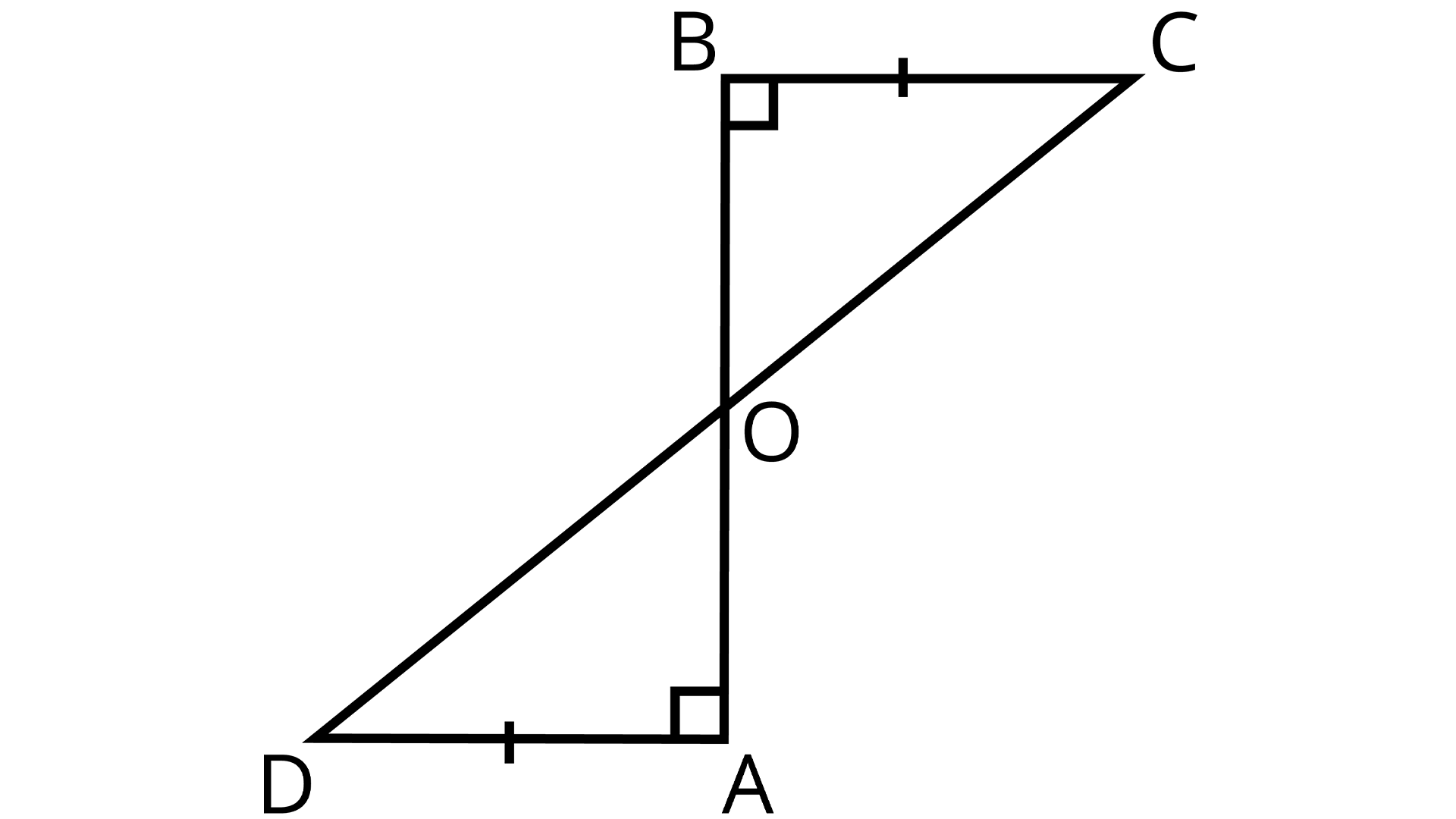
Figure showing AD and BC equal perpendiculars to a line segment AB
Ans: Given: AD and BC are equal perpendiculars to a line segment AB
To prove: CD bisects AB.
In \[\Delta BOC{\text{ , }}\Delta AOD\],
\[\angle BOC{\text{ }} = \angle AOD\] (Vertically opposite angles)
\[\angle CBO{\text{ }} = \angle DAO\] (Each right angle )
BC = AD (Given)
\[\therefore \Delta BOC{\text{ }} \cong \Delta AOD\] (AAS congruence rule)
\[\therefore BO{\text{ }} = {\text{ }}AO\] (By CPCT)
\[ \Rightarrow \]CD bisects AB.
4. l and m are two parallel lines intersected by another pair of parallel lines p and q (see the given figure). Show that \[\Delta ABC \cong \Delta CDA\].
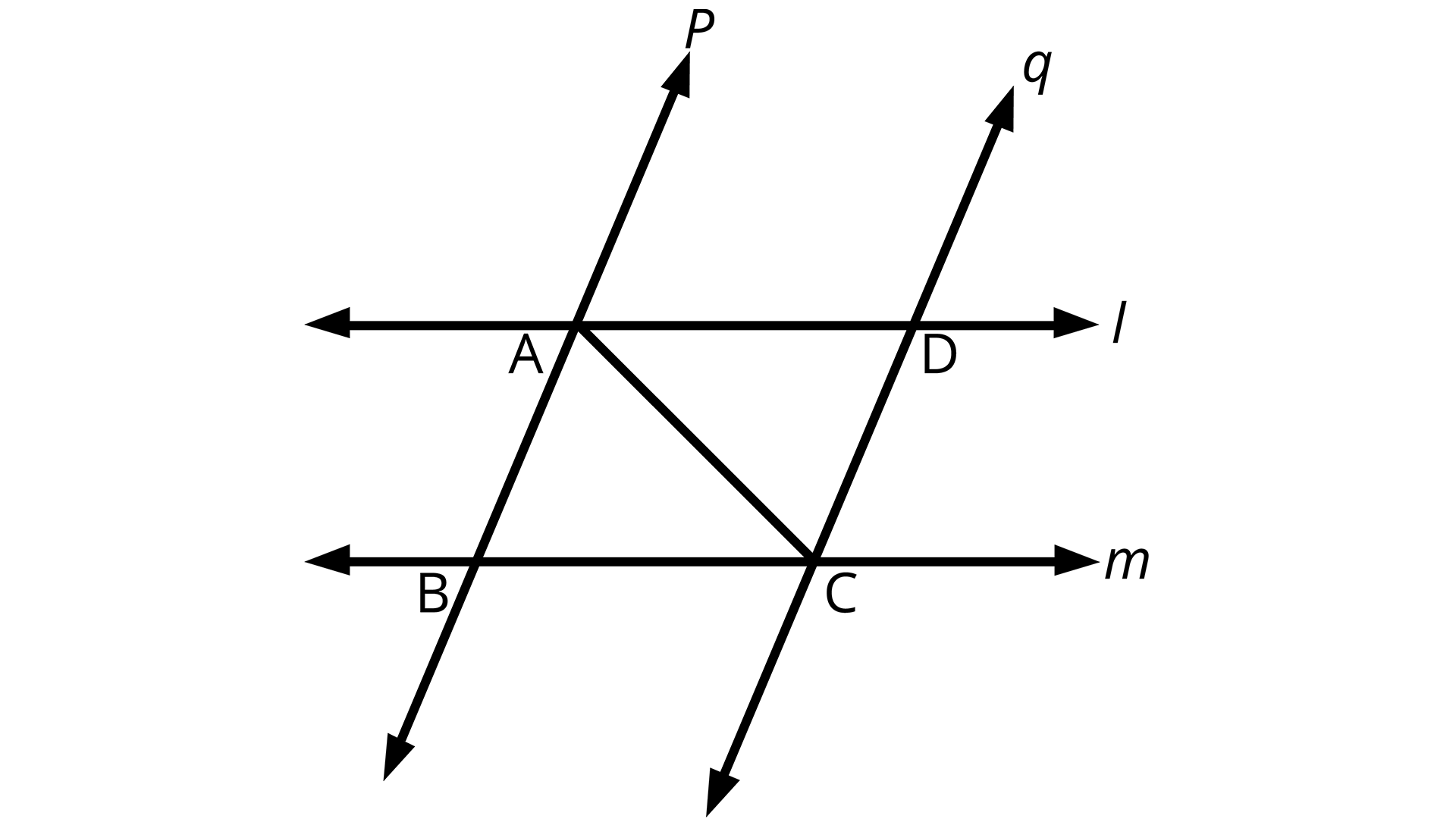
Two Parallel Lines L and M
Given: l and m are two parallel lines intersected by another pair of parallel lines p and q To prove: \[\Delta ABC \cong \Delta CDA\].
In \[\Delta ABC{\text{ , }}\Delta CDA\],
\[\angle BAC{\text{ }} = \angle DCA\] (Alternate interior angles, as\[p{\text{ }}||{\text{ }}q\])
2AC = CA (Common)
\[\angle BCA{\text{ }} = \angle DAC\] (Alternate interior angles, as \[l{\text{ }}||{\text{ }}m\])
\[\therefore \Delta ABC \cong \Delta CDA\] (By ASA congruence rule)
5. Line l is the bisector of an angle \[\angle A\] and B is any point on l. BP and BQ are $$perpendiculars from B to the arms of \[\angle A\] (see the given figure). Show that:
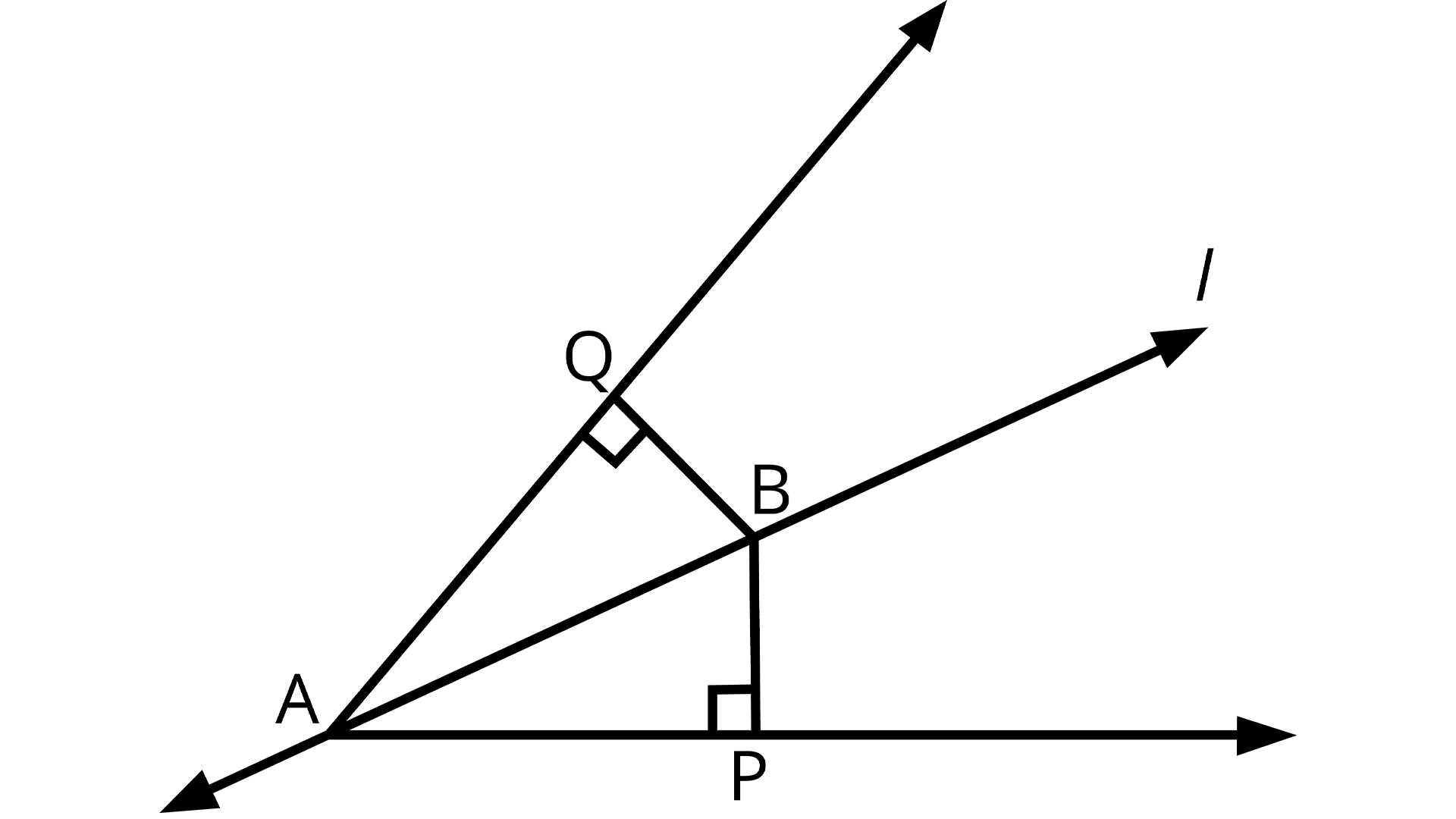
Line l the Bisector of an Angle A
(i) \[\Delta APB \cong \Delta AQB\]
(ii) BP = BQ or B is equidistant from the arms of ∠A.
Ans: Given: Line l is the bisector of an angle \[\angle A\] and B is any point on l.
To prove: (i) \[\Delta APB \cong \Delta AQB\]
(ii) \[BP{\text{ }} = {\text{ }}BQ\] or B is equidistant from the arms of \[\angle A\].
In \[\Delta APB{\text{ , }}\Delta AQB\],
\[\angle APB{\text{ }} = \angle AQB\] (Each right angle )
\[\angle PAB{\text{ }} = \angle QAB\] (l is the angle bisector of \[\angle A\])
AB = AB (Common)
\[\therefore \Delta APB \cong \Delta AQB\] (By AAS congruence rule)
\[\therefore BP{\text{ }} = {\text{ }}BQ\] (By CPCT)
Or, it can be said that B is equidistant from the arms of \[\angle A\].
6. In the given figure, \[AC{\text{ }} = {\text{ }}AE,{\text{ }}AB{\text{ }} = {\text{ }}AD\] and \[\angle BAD{\text{ }} = \angle EAC\]. Show that BC = DE.
Ans:
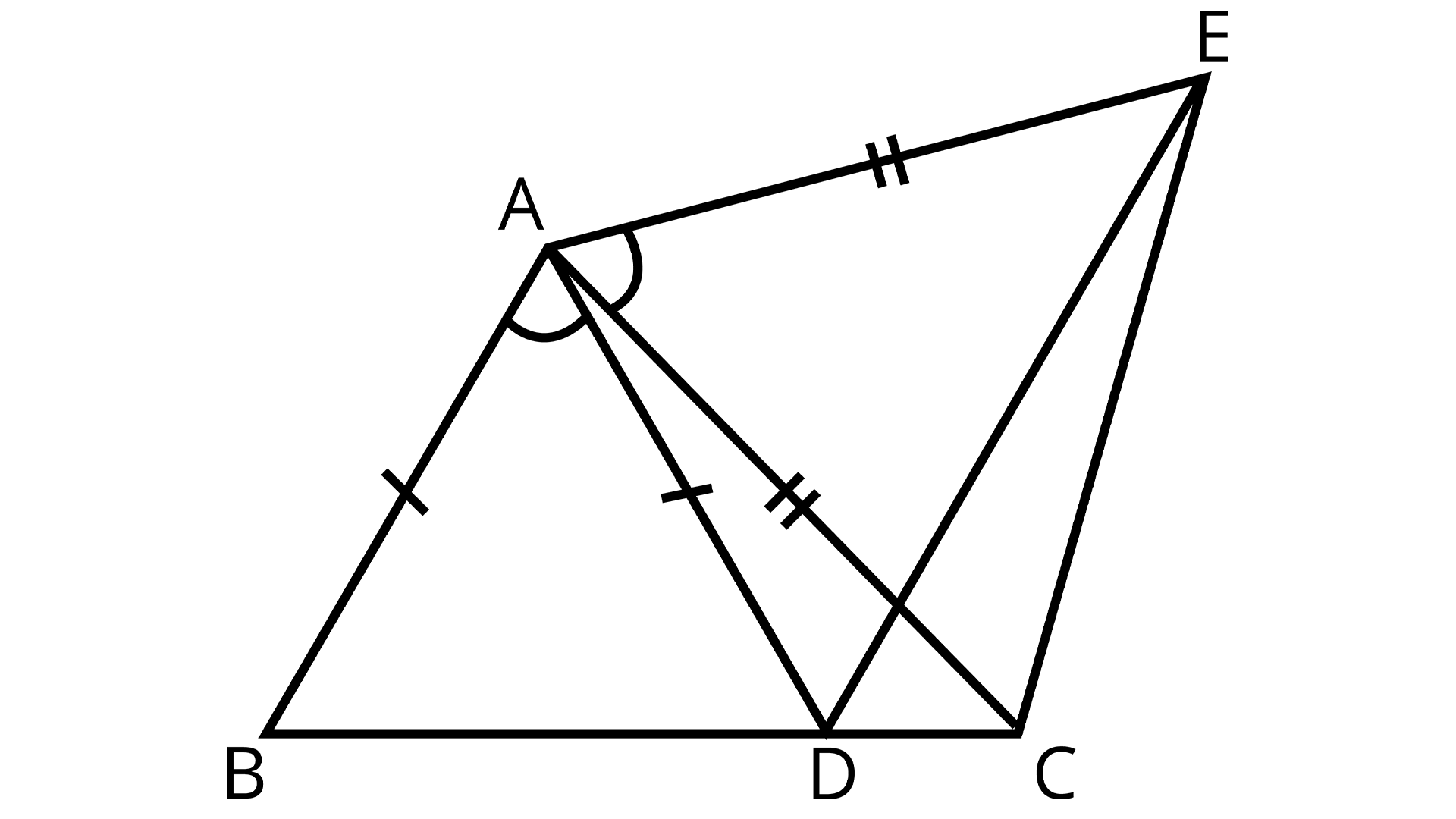
Angle BAD = angle EAC
Given: \[\angle BAD{\text{ }} = \angle EAC\]
To prove: BC = DE
It is given that \[\angle BAD{\text{ }} = \angle EAC\]
\[\angle BAD{\text{ }} + \angle DAC{\text{ }} = \angle EAC{\text{ }} + \angle DAC\]
\[\angle BAC{\text{ }} = \angle DAE\]
In \[\Delta BAC{\text{ , }}\Delta DAE\],
AB = AD (Given)
\[\angle BAC{\text{ }} = \angle DAE\] (Proved above)
AC = AE (Given)
\[\therefore \Delta BAC{\text{ }} \cong \Delta DAE\] (By SAS congruence rule)
\[\therefore BC{\text{ }} = {\text{ }}DE\] (By CPCT)
7. AB is a line segment and P is its mid-point. D and E are points on the same side of AB such that \[\angle BAD{\text{ }} = \angle ABE\] and \[\angle EPA{\text{ }} = \angle DPB\] (See the given figure). Show that
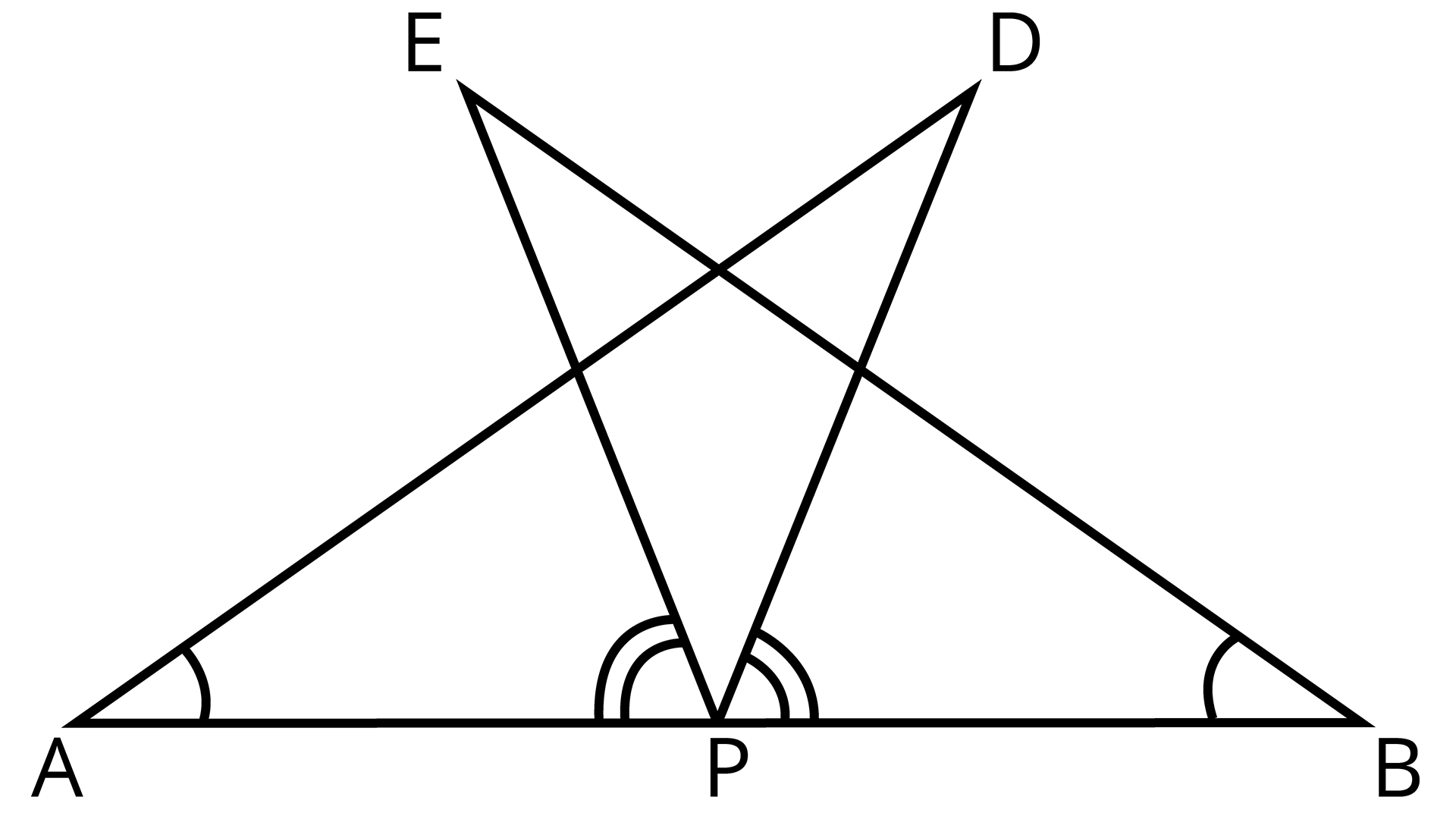
Line segment AB with its mid point P
(i) \[\Delta DAP \cong \Delta EBP\]
(ii) AD = BE
Ans: Given: AB is a line segment and P is its mid-point. D and E are points on the same side of AB such that \[\angle BAD{\text{ }} = \angle ABE\] and \[\angle EPA{\text{ }} = \angle DPB\]
To prove: (i) \[\Delta DAP \cong \Delta EBP\]
(ii) AD = BE
It is given that \[\angle EPA{\text{ }} = \angle DPB\]
\[\angle EPA{\text{ }} + \angle DPE{\text{ }} = \angle DPB{\text{ }} + \angle DPE\]
\[\therefore \angle DPA{\text{ }} = \angle EPB\]
In \[\Delta DAP{\text{ , }}\Delta EBP\],
\[\angle DAP{\text{ }} = \angle EBP\] (Given)
AP = BP (P is mid-point of AB)
\[\angle DPA{\text{ }} = \angle EPB\] (From above)
\[\therefore \Delta DAP \cong \Delta EBP\] (ASA congruence rule)
\[\therefore AD{\text{ }} = {\text{ }}BE\] (By CPCT)
8. In right triangle ABC, right angled at C, M is the mid-point of hypotenuse AB. C is joined to M and produced to a point D such that DM = CM. Point D is joined to point B (see the given figure). Show that:
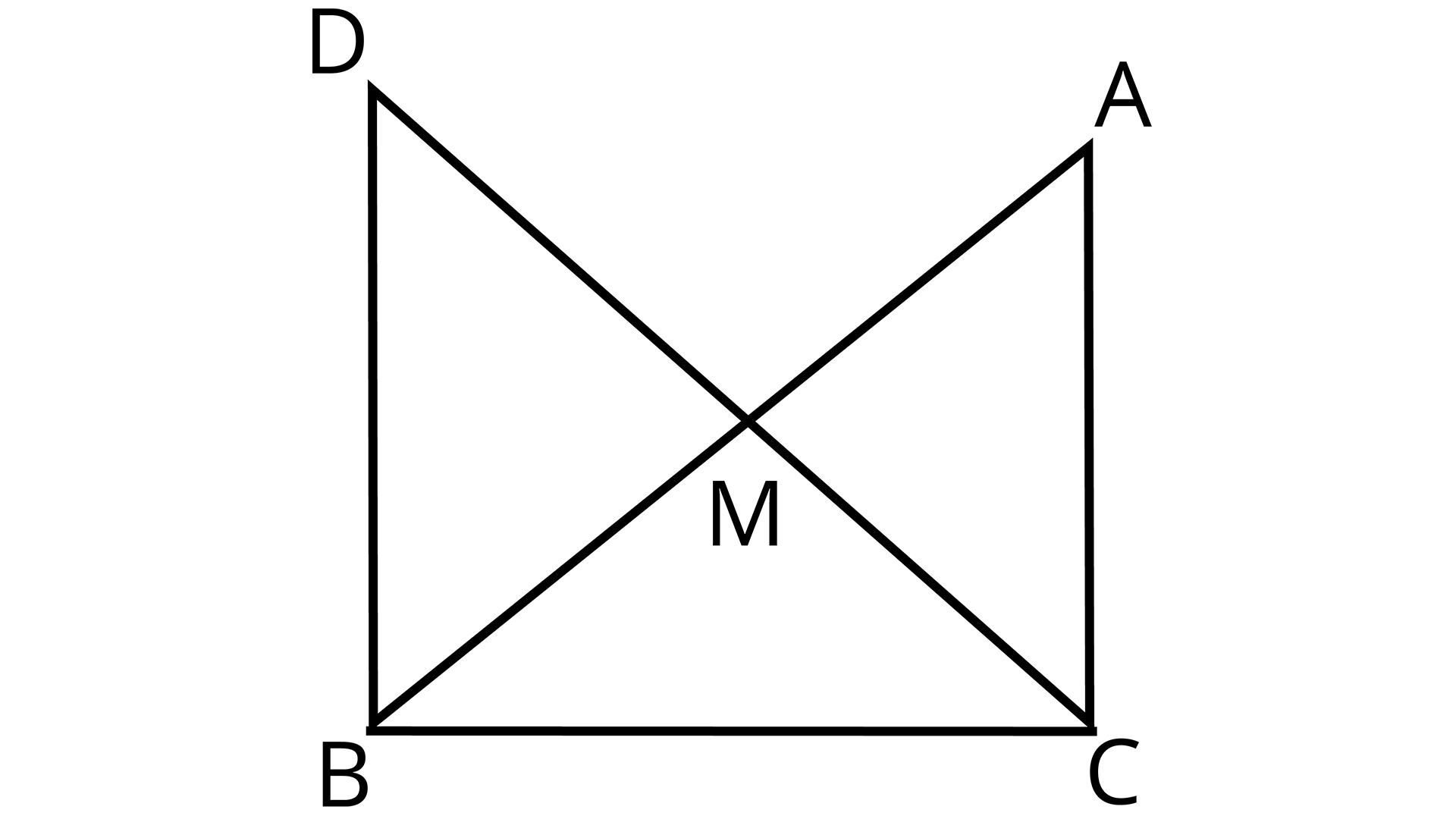
Triangle ABC right - angled at C and midpoint M of AB
i) \[\Delta AMC \cong \Delta BMD\]
ii) \[\angle DBC\] is a right angle.
iii) \[\Delta DBC \cong \Delta ACB\]
iv) \[CM{\text{ }} = {\text{ }}\dfrac{1}{2}{\text{ }}AB\]
Ans: Given: M is the mid-point of hypotenuse AB. DM = CM
(i) In \[\Delta AMC{\text{ }},{\text{ }}\Delta BMD\],
AM = BM (M is the mid-point of AB)
\[\angle AMC{\text{ }} = \angle BMD\] (Vertically opposite angles)
CM = DM (Given)
\[\therefore \Delta AMC \cong \Delta BMD\] (By SAS congruence rule)
\[\therefore AC{\text{ }} = {\text{ }}BD\] (By CPCT)
And, \[\angle ACM{\text{ }} = \angle BDM\](By CPCT)
(ii) \[\angle ACM{\text{ }} = \angle BDM\]
However, \[\angle ACM{\text{ , }}\angle BDM\] are alternate interior angles.
Since alternate angles are equal,
It can be said that \[DB{\text{ }}||{\text{ }}AC\]
(Co-interior angles)
(iii) In \[\Delta DBC{\text{ , }}\Delta ACB\],
DB = AC (Already proved)
\[\angle DBC{\text{ }} = \angle ACB\] (Each \[{90^o}\])
BC = CB (Common)
\[\therefore \Delta DBC \cong \Delta ACB\] (SAS congruence rule)
(iv) \[\therefore \Delta DBC \cong \Delta ACB\]
AB = DC (By CPCT)
AB = 2 CM
\[CM{\text{ }} = {\text{ }}\dfrac{1}{2}{\text{ }}AB\]
Exercise (7.2)
1. In an isosceles triangle ABC, with AB = AC, the bisectors of ∠B and ∠C intersect each other at O. Join A to O. Show that:
(i) OB = OC (ii) AO bisects ∠A
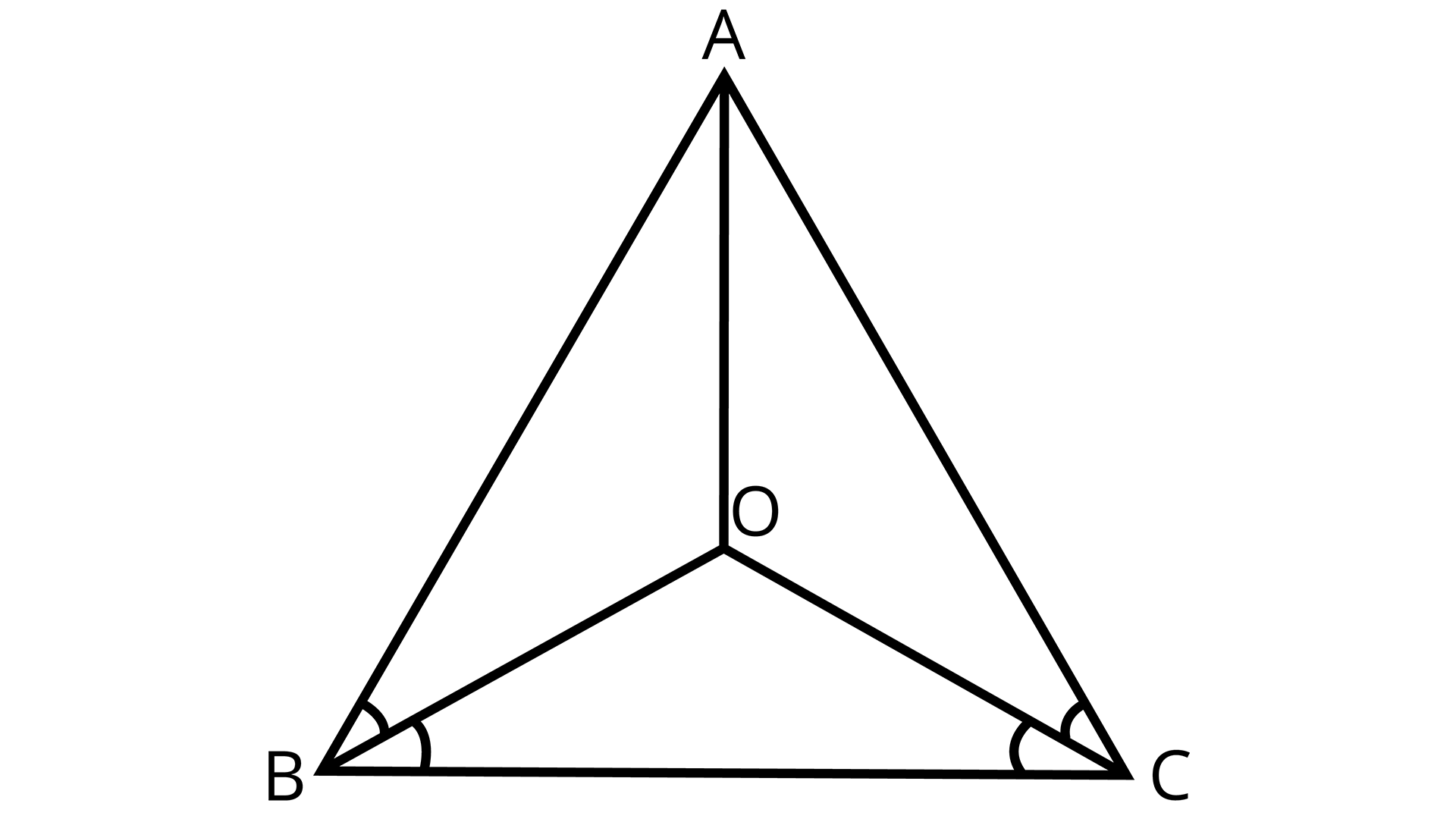
Isosceles triangle with AB = AC
Ans: We know, $\angle ABC = \angle ACB$ ${\text{[Equal angles of isosceles triangle]}}$
$ \Rightarrow \dfrac{1}{2}\angle ABC = \dfrac{1}{2}ACB$
$ \Rightarrow \angle OBC = \angle OCB$
$\therefore OB = OC$ ${\text{[Sides opposite to equal angles of Isosceles triangle are equal]}}$
Now, In $\Delta ABO$ and $\Delta ACO$,
$AB = AC$ ${\text{[Equal sides of Isosceles triangle]}}$
$OB = OC$ ${\text{[Proved above]}}$
AO=AO (Common)
$\therefore \Delta ABO \cong \Delta ACO$ ${\text{[By SSS]}}$
$\therefore \angle BAO = \angle CAO$ ${\text{[CPCT]}}$
$\therefore $ AO bisects angle A.
2. In ΔABC, AD is the perpendicular bisector of BC (see the given figure). Show that ΔABC is an isosceles triangle in which AB = AC.
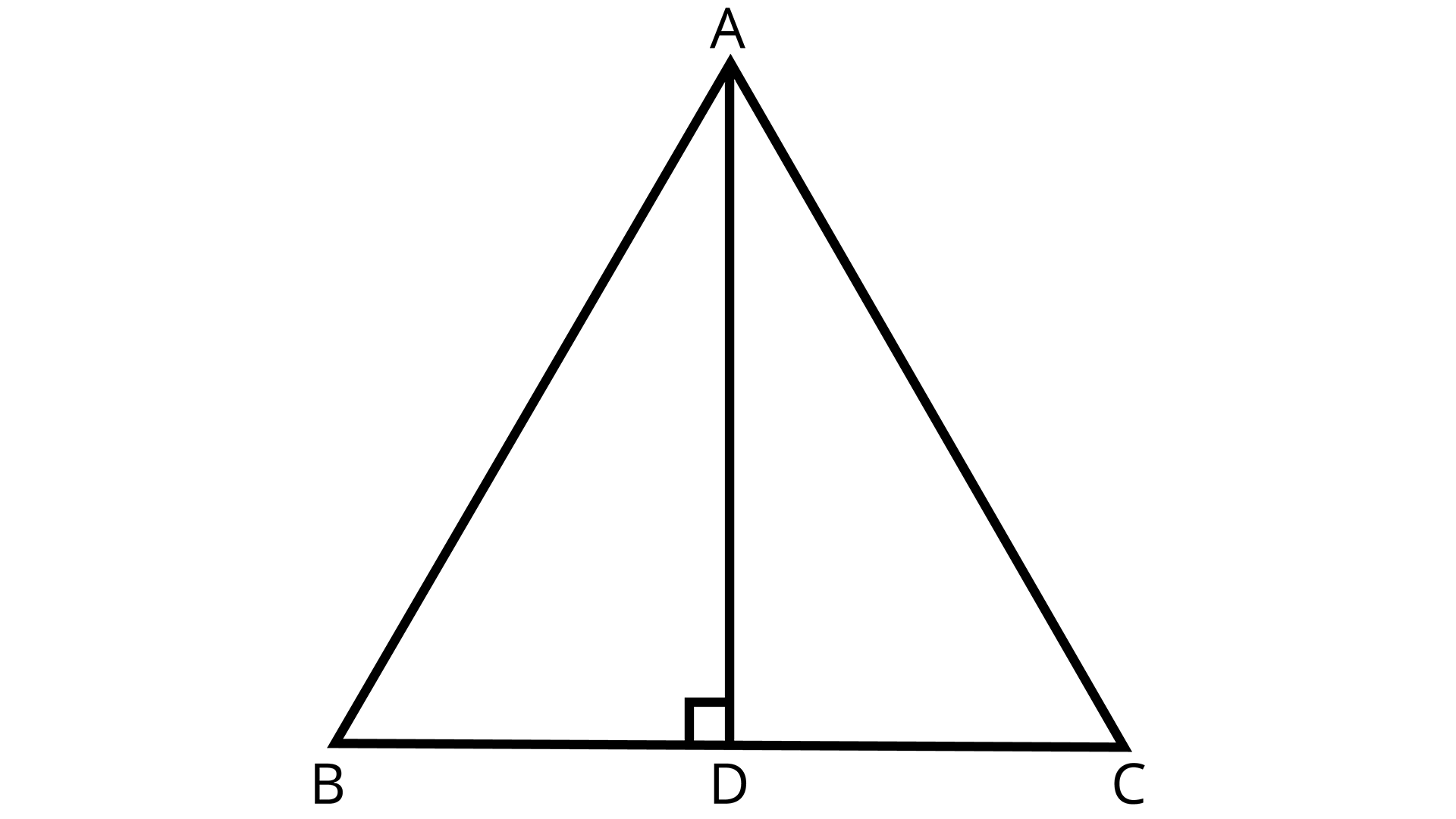
Triangle ABC , AD being the bisector of BC
Ans: $\because $ AD is perpendicular bisector of BC,
$\therefore $$BD = DC$
& $\angle ADB = \angle ADC$ ${\text{[Each 90°]}}$
Now, in$\Delta ABD$ and $\Delta ACD$,
$AD = AD$ (Common)
$\angle ADB = \angle ADC$ ${\text{[Proved above]}}$ $BD = CD$ ${\text{[Proved above]}}$
$\therefore \Delta ADB \cong \Delta ACD$ ${\text{[by SAS]}}$
$\therefore AB = AC$ (CPCT)
So, $\Delta ABC$ is an isosceles triangle with \[AB = AC\]
3. ABC is an isosceles triangle in which altitudes BE and CF are drawn to equal sides AC and AB respectively (see the given figure). Show that these altitudes are equal.
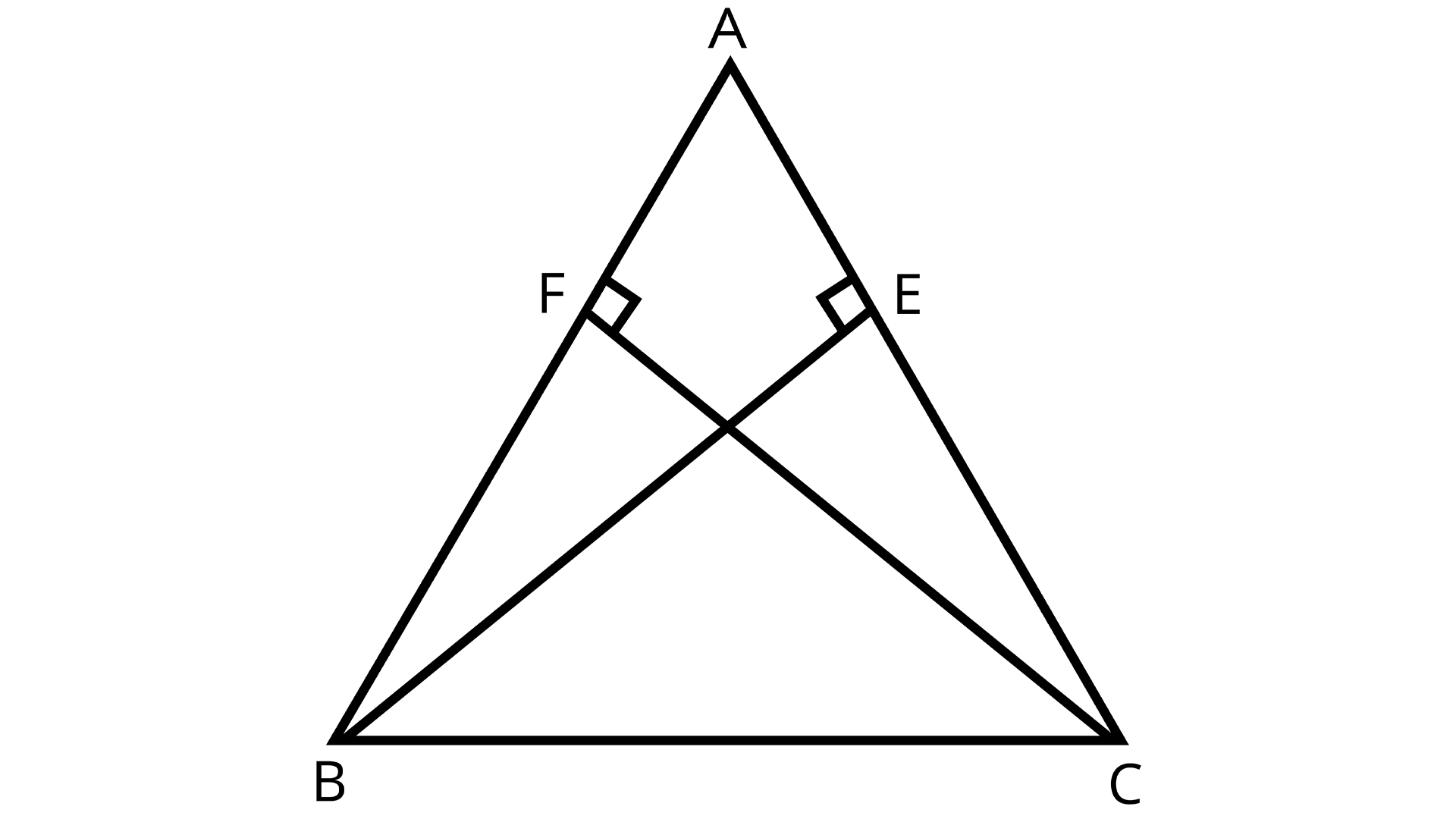
Isosceles triangle ABC
Ans: In $\Delta ABE$and $\Delta ACF$,
$\angle AEB = \angle AFE$ ${\text{[Each 90°]}}$
$\angle BAE = \angle CAF$ (Common)
$AB = AC$ [Given]
$\therefore \Delta ABE \cong \Delta ACF$ ${\text{[By AAS]}}$
$\therefore BE = CF$ (CPCT)
4. ABC is a triangle in which altitudes BE and CF to sides AC and AB are equal (see the given figure). Show that
(i) \[\Delta ABE \cong \Delta ACF\]
(ii) AB = AC i.e., ABC is an isosceles triangle
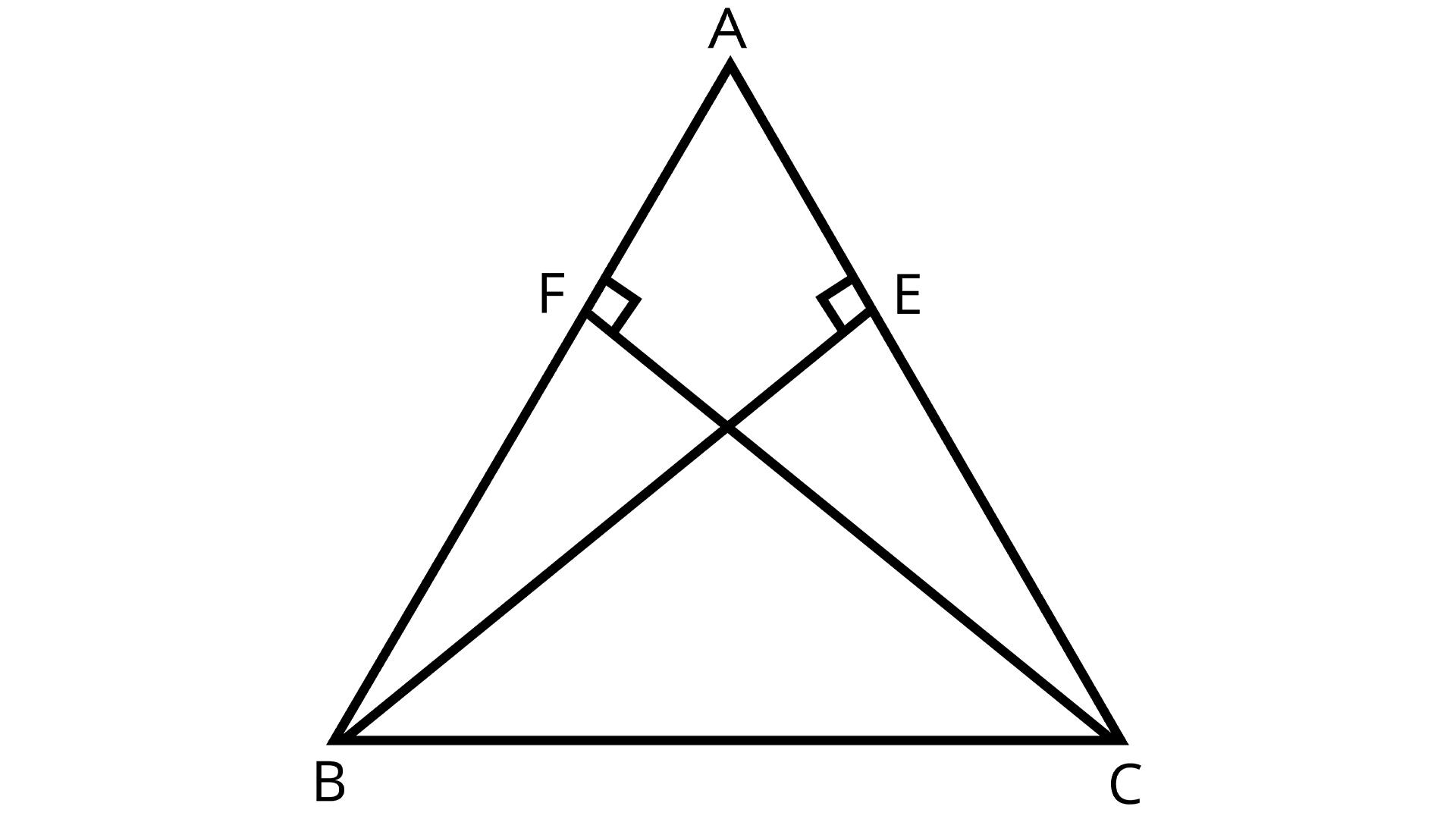
Triangle ABC with equal altitudes
Ans: In $\Delta ABE$and $\Delta ACF$,
\[\angle BAE = \angle CAF\] (Common)
$\angle BEA = \angle CFA$ ${\text{[Each 90°]}}$
$BE = CF$ [Given]
$\therefore \Delta ABE \cong \Delta ACF$ ${\text{[by AAS]}}$
$\therefore AB = AC$ (CPCT)
And therefore, $\Delta ABC$ is an isosceles triangle with AB=AC.
5. ABC and DBC are two isosceles triangles on the same base BC (see the given figure). Show that ∠ABD = ∠ACD.
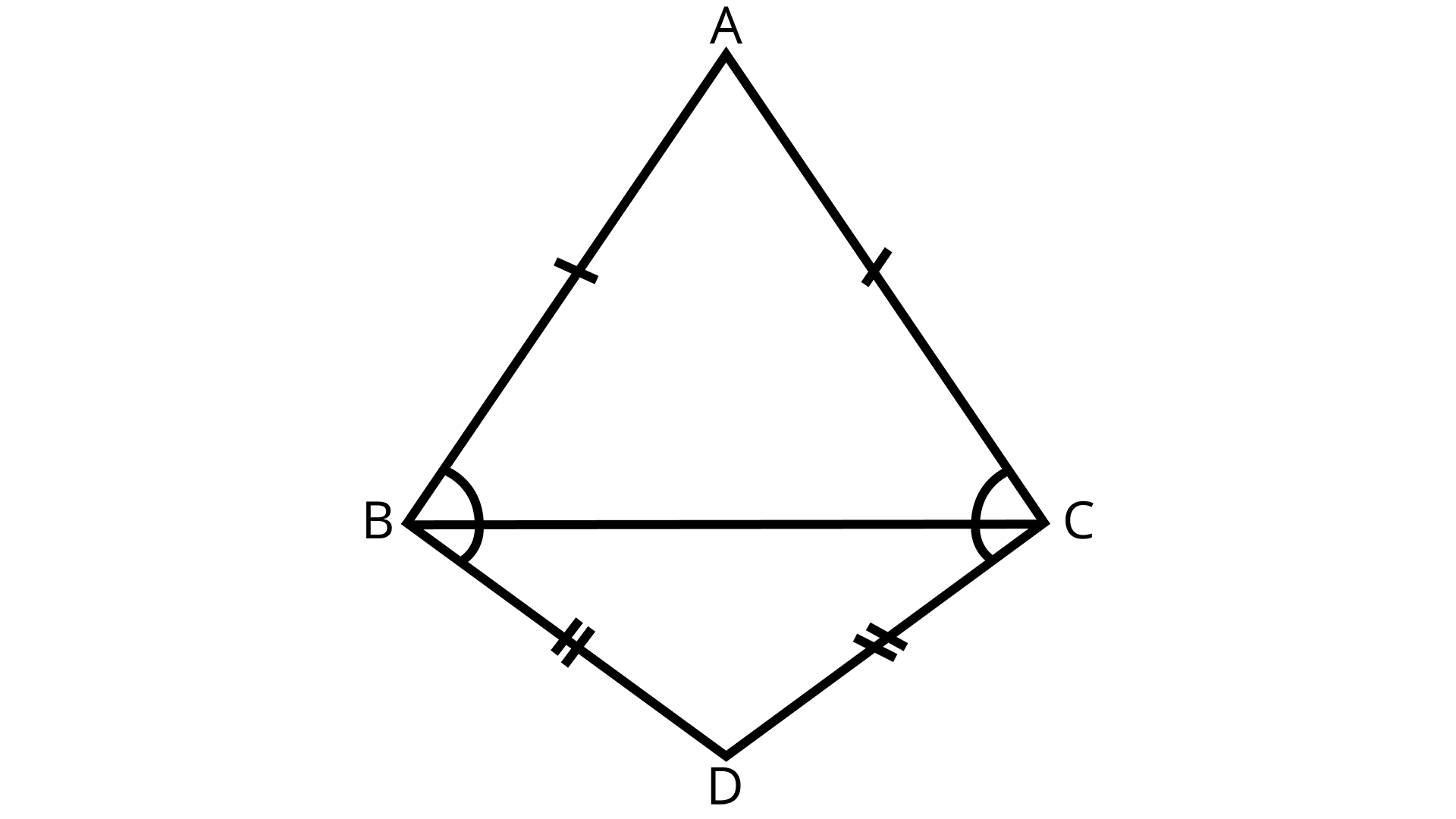
Two Isosceles Triangles
Ans: Since AB=AC, and DB=DC,
$\therefore $ABDC is a quadrilateral with adjacent sides being equal.
$ \Rightarrow $ABDC is a kite.
We know that one pair of opposite (obtuse) angles of kite are equal.
Hence, $\angle ABD = \angle ACD$
6. ΔABC is an isosceles triangle in which AB = AC. Side BA is produced to D such that AD = AB (see the given figure). Show that ∠BCD is a right angle.

Isosceles Triangle in which AB = AC
Ans: In $\Delta ABC$
$\angle ABC = \angle ACB$ ${\text{[angles opposite to equal sides of a triangle]}}$ … (1)
Similarly, in $\Delta ADC$
$\angle ADC = \angle ACD$ ${\text{[angles opposite to equal sides of a triangle]}}$ … (2)
Now since BD is a straight line,
$\angle BAC + \angle CAD = 180^\circ $ … (3)
And we know,
$\angle BAC = \angle ADC + \angle ACD$ ${\text{[Exterior angle of a triangle = sum of opposite interior angles]}}$
$ \Rightarrow \angle BAC = 2\angle ACD$ ${\text{[From 2]}}$ … (4)
Similarly,
$\angle CAD = \angle ABC + \angle ACB$
$ \Rightarrow \angle CAD = 2\angle ACB$ ${\text{[From 1]}}$ … (5)
$\therefore 2\angle ACB + 2\angle ACD = 180^\circ $ ${\text{[From 3, 4 and 5]}}$
$ \Rightarrow \angle ACB + \angle ACD = 90^\circ $
$ \Rightarrow \angle BCD = 90^\circ $
Hence proved.
7. ABC is a right-angled triangle in which ∠A = 90° and AB = AC. Find ∠B and ∠C.
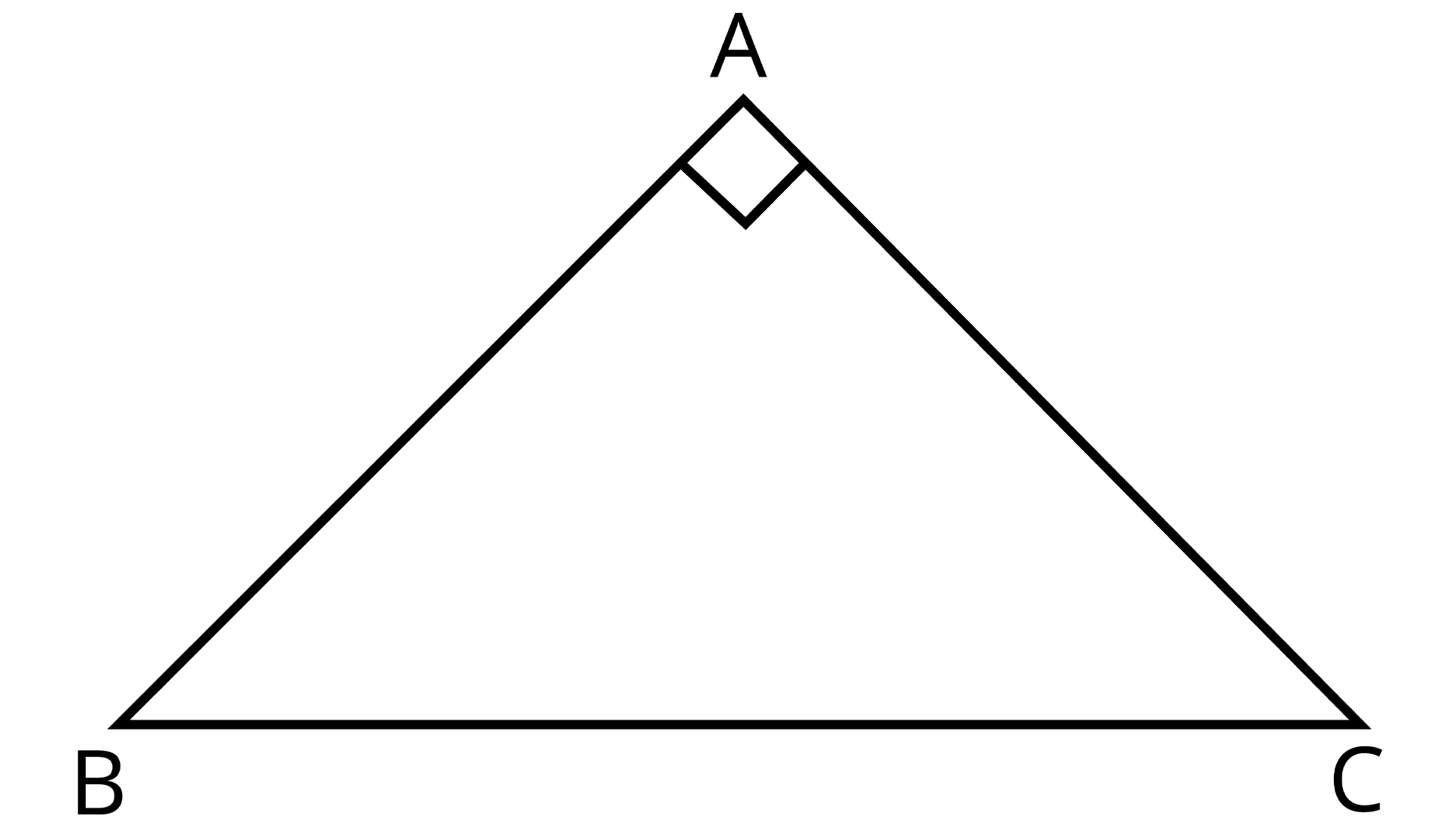
Right - Angled Triangle ABC
Ans: Since AB = AC,
$\angle B = \angle C$
${\text{[Angles opposite to equal sides of a triangle]}}$
Now, we know
$\angle A + \angle B + \angle C = 180^\circ $
${\text{[Angle sum property]}}$
$ \Rightarrow \angle A + 2\angle C = 180^\circ $
$ \Rightarrow 90^\circ + 2\angle C = 180^\circ $
$ \Rightarrow 2\angle C = 90^\circ $
$ \Rightarrow \angle C = 45^\circ $
$\therefore \angle B = 45^\circ $
Hence $\angle B$ and $\angle C$ are each 45$^\circ $
8. Show that the angles of an equilateral triangle are 60º each.
Ans:
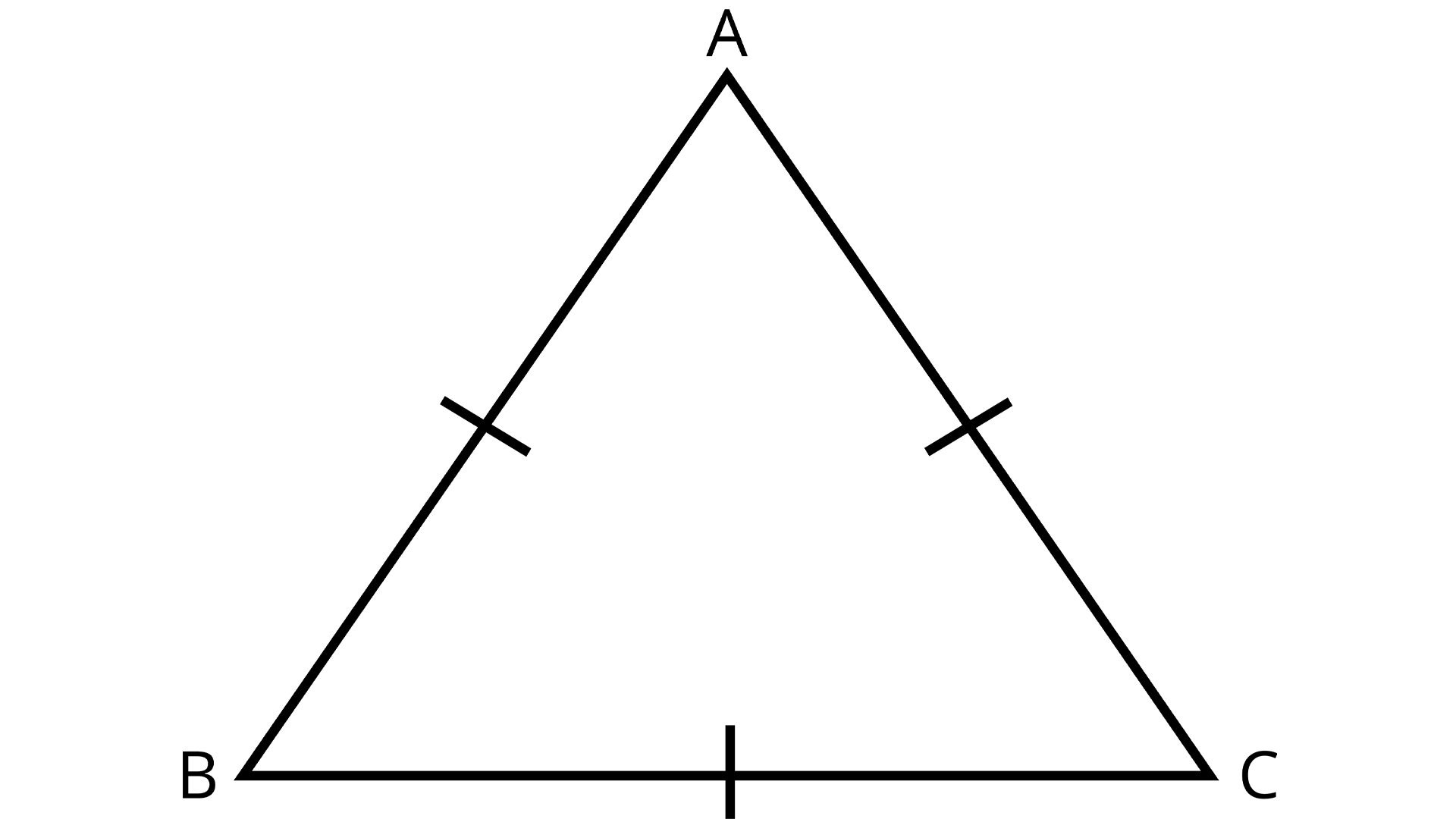
Equilateral Triangle
In $\angle B = \angle C$ ${\text{[Angles opposite to equal sides of a triangle]}}$
Similarly,
$\angle A = \angle B$
${\text{[Angles opposite to equal sides of a triangle]}}$
$ \Rightarrow \angle A = \angle B = \angle C$
Now, we know that
$\angle A + \angle B + \angle C = 180^\circ $ ${\text{[Angle sum property]}}$
$ \Rightarrow \angle A + \angle A + \angle A = 180^\circ $
$\Rightarrow 3\angle A = 180^\circ $
$ \Rightarrow \angle A = 60^\circ $
$\therefore \angle A = \angle B = \angle C = 60^\circ $
Hence proved.
Exercise 7.3
1. ΔABC and ΔDBC are two isosceles triangles on the same base BC and vertices A and D are on the same side of BC (see the given figure). If AD is extended to intersect BC at P, show that
(i) \[\Delta ABD \cong \Delta ACD\]
(ii) \[\Delta ABP \cong \Delta ACP\]
(iii) AP bisects $\angle A$ as well as $\angle D$
(iv)AP is the bisector of BC
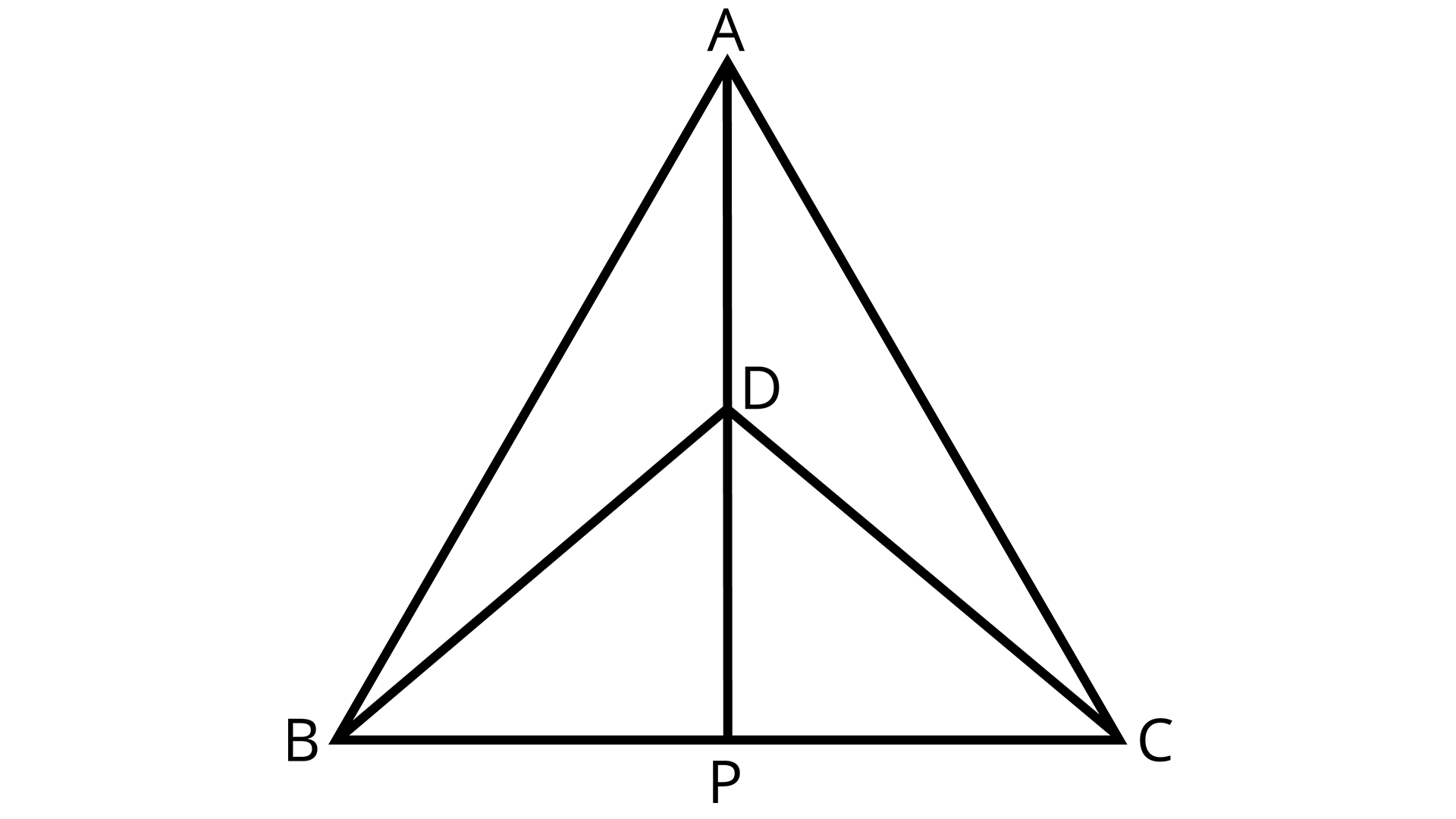
Two Isosceles Triangle on the same Base
Ans: (i) In $\Delta ABD$ and $\Delta ACD$,
$AB = AC$
${\text{[Equal sides of isosceles triangle]}}$
$DB = DC$
${\text{[Equal sides of isosceles triangle]}}$
AD=AD (Common)
$\therefore \Delta ABD \cong \Delta ACD$ ${\text{[By SSS]}}$
$ \Rightarrow \angle BAD = \angle CAD$ [CPCT]
$ \Rightarrow \angle BAP = \angle CAP$ … (1)
And $\angle ADB = \angle ADC$ (CPCT) … (2)
(ii) In $\Delta ABP$ and $\Delta ACP$
$AB = AC$
${\text{[Equal sides of isosceles triangle]}}$
$\angle BAP = \angle CAP$ ${\text{[From 1]}}$
$AP = AP$ (Common)
$\therefore \Delta ABP \cong \Delta ACP$
${\text{[By SAS]}}$
$\therefore BP = CP$ (CPCT) … (3)
Similarly, $\angle APB = \angle APC$ (CPCT) … (4)
(iii) AP is bisector of $\angle A$
${\text{[From 1]}}$
Now, since AP is a line segment
$\therefore \angle ADB + \angle BDP = 180^\circ $ … (5)
Similarly, $\angle ADC + \angle CDP = 180^\circ $ … (6)
Comparing equations 2, 5 and 6 we can say that
$\angle BDP = \angle CDP$
$\therefore $AP bisects $\angle D$
Hence AP bisects both $\angle A$ and $\angle D$
(iv)We know,
$\angle APB + \angle APC = 180^\circ $
$ \Rightarrow \angle APB + \angle APB = 180^\circ $
${\text{[From 4]}}$
$ \Rightarrow \angle APB = 90^\circ $ … (7)
From equations 3 and 7 we can say that,
AP is perpendicular bisector of BC.
2. AD is an altitude of an isosceles triangles ABC in which AB = AC. Show that
(i) AD bisects BC
(ii) AD bisects $\angle A$
Ans:
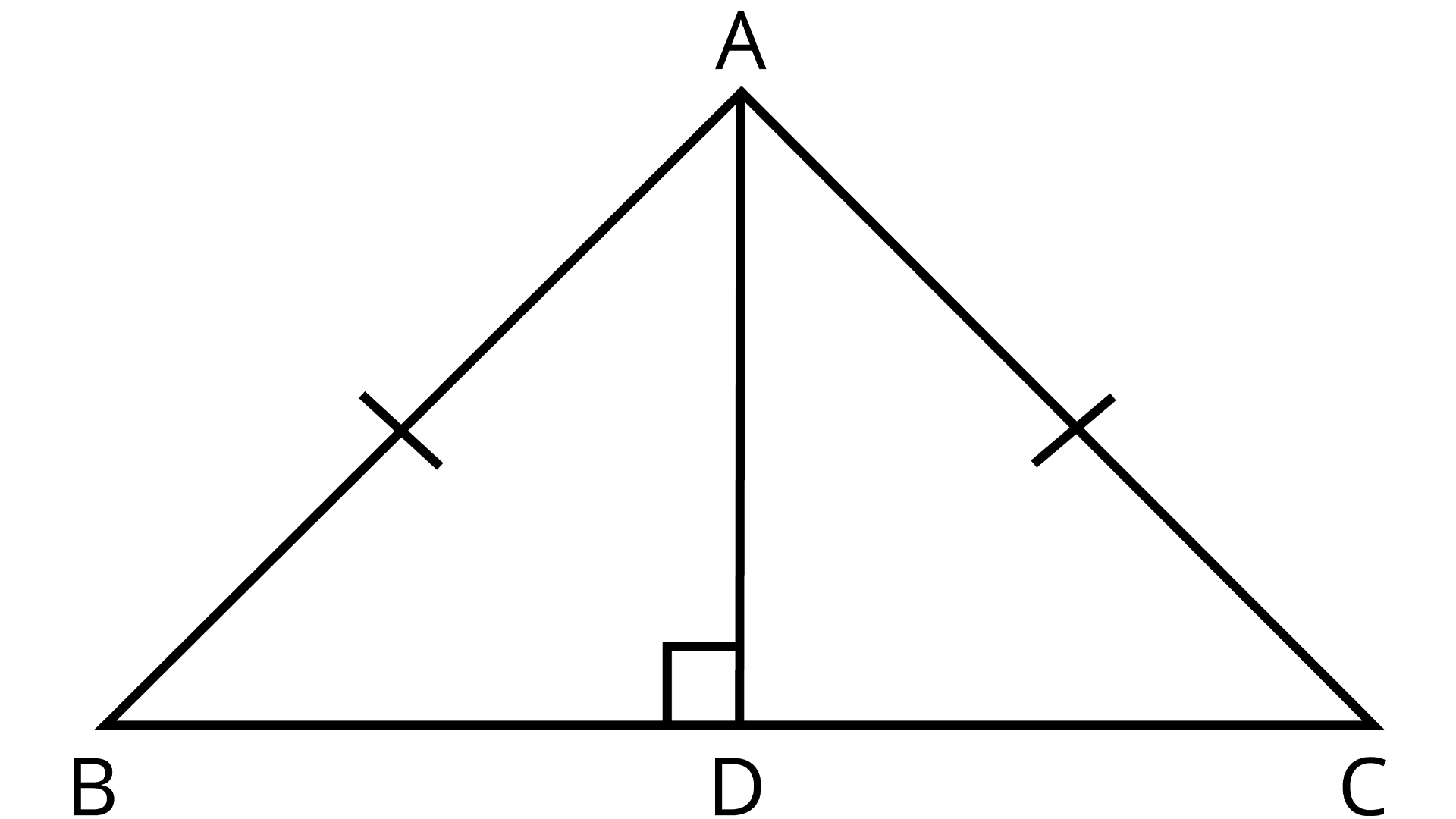
Isosceles Triangle BC with AB = AC
In $\Delta ADB$ and $\Delta ADC$
$AB = AC$ (Given)
$AD = AD$ (Common)
$\angle ADB = \angle ADC$ ${\text{[Each 90°]}}$
$\therefore \Delta ADB \cong \Delta ADC$ ${\text{[By RHS]}}$
$ \Rightarrow BD = DC$ (CPCT)
Therefore, AD is bisector of BC
Similarly, $\angle BAD = \angle CAD$ (CPCT)
Therefore, AD bisects $\angle A$as well.
3. Two sides AB and BC and median AM of one triangle ABC are respectively equal to sides PQ and QR and median PN of ΔPQR (see the given figure). Show that:
(i)\[\Delta ABM \cong \Delta PQN\]
(ii)\[\Delta ABC \cong \Delta PQR\]
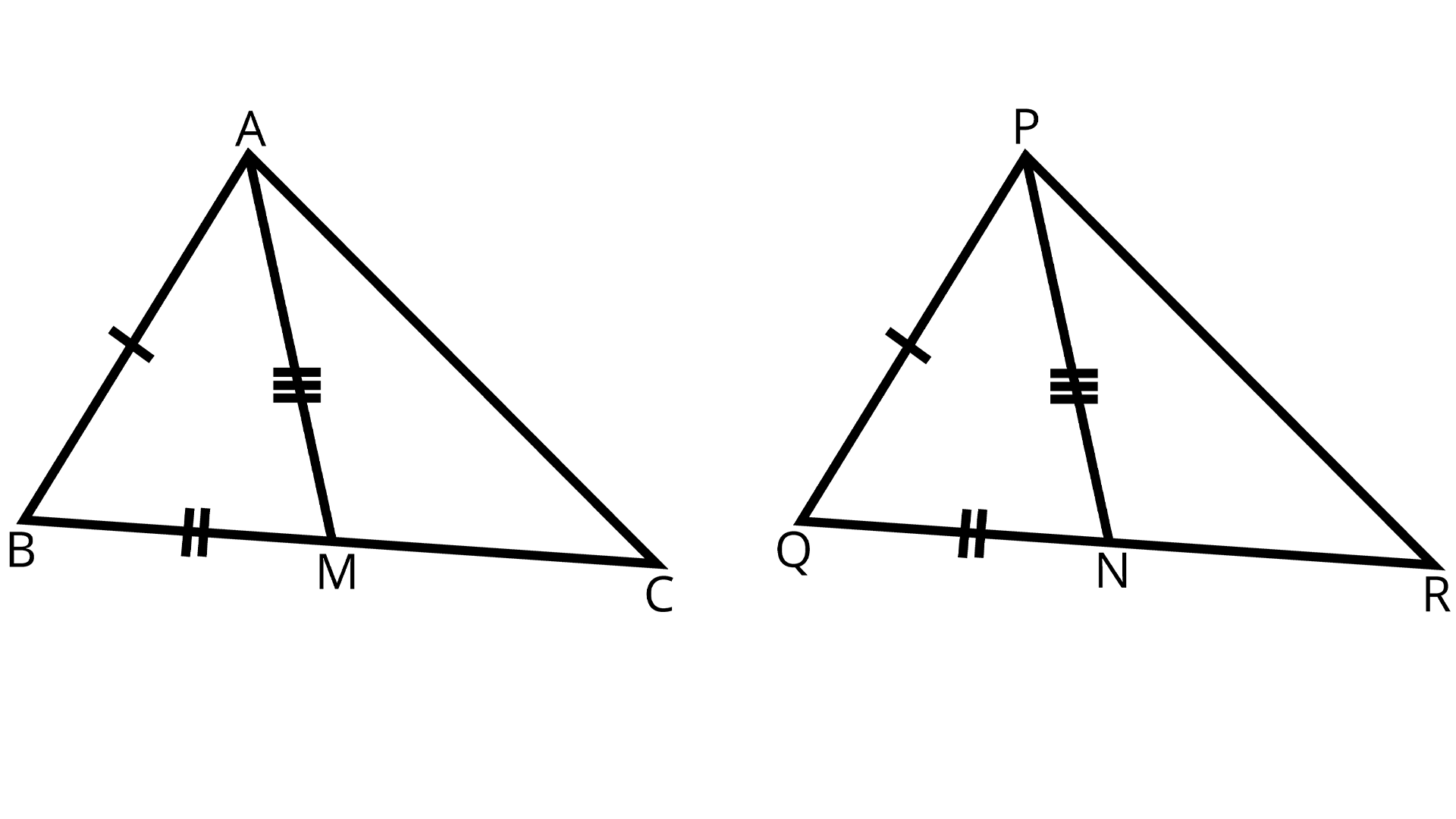
Two Triangles with Their Corresponding Parts
Ans: (i) We know that $BC = QR$ … (1)
Now, Since AM is median of ΔABC,
$ \Rightarrow BM = \dfrac{1}{2}BC$ … (2)
Similarly, PN is median of ΔPQR,
$ \Rightarrow QN = \dfrac{1}{2}QR$ … (3)
From equations 1, 2 and 3, we can say that,
$BM = QN$ … (4)
Now in $\Delta ABM$ and $\Delta PQN$
\[AB = PQ\] (Given)
\[BM = QN\] ${\text{[From 4]}}$
AM=PN (Given)
$\therefore \Delta ABM \cong \Delta PQN$ ${\text{[By SSS]}}$
$ \Rightarrow \angle ABM = \angle AQN$ (CPCT)
$ \Rightarrow \angle ABC = \angle PQR$ … (5)
(ii) Now in $\Delta ABC$ and $\Delta PQR$,
$AB = PQ$ (Given)
$\angle ABC = \angle PQR$ ${\text{[From 5]}}$
$BC = QR$ (Given)
\[\Delta ABC \cong \Delta PQR\] ${\text{[By SAS]}}$
4. BE and CF are two equal altitudes of a triangle ABC. Using RHS congruence rule, prove that the triangle ABC is isosceles.
Ans:
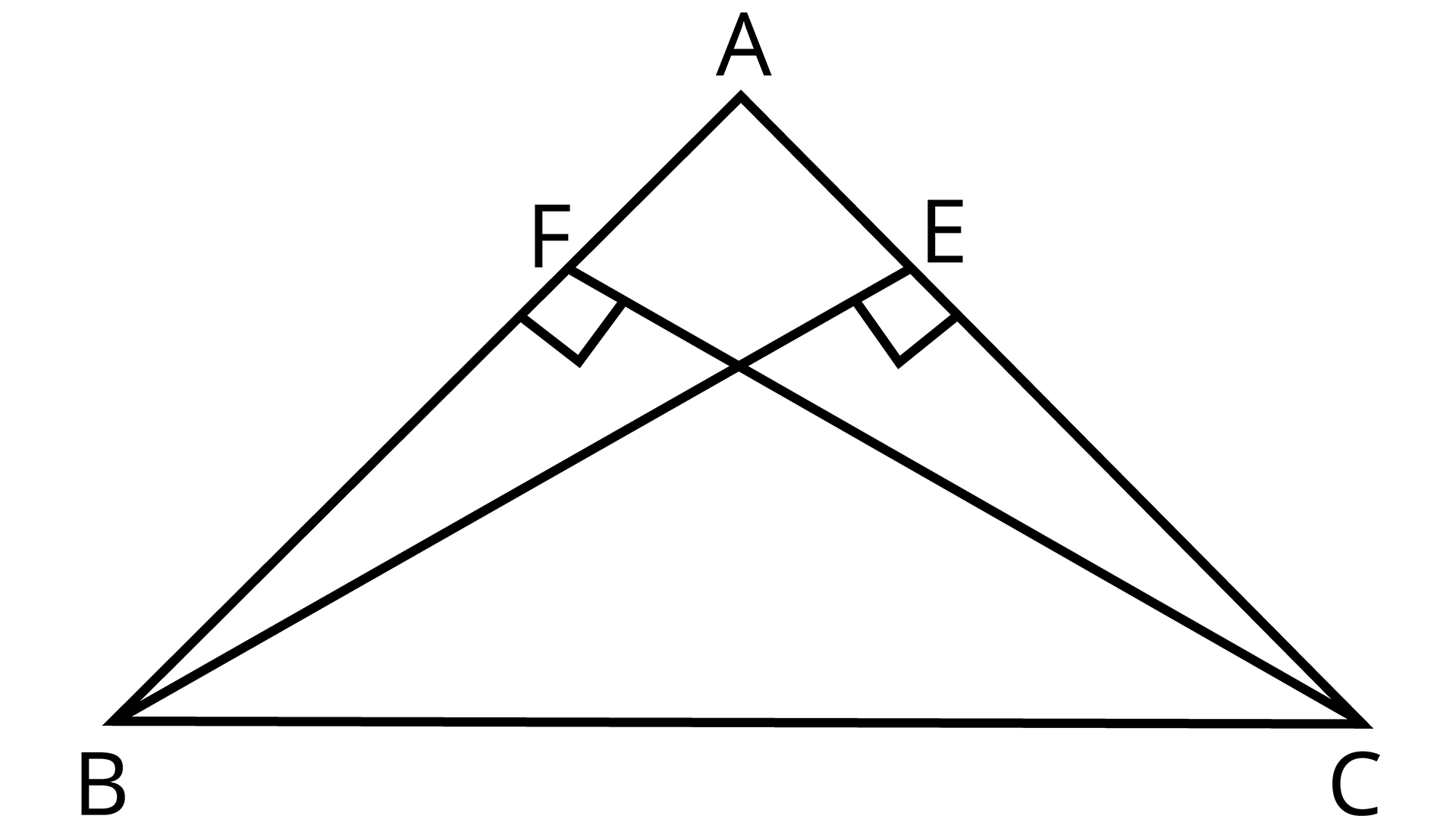
Two Equal Altitudes BE and CF of Triangle ABC
In $\Delta BEC$ and $\Delta CFB$
$BE = CF$ (Given)
$\angle BEC = \angle CFB$
${\text{[Each 90°]}}$
BC=CB (Common)
$\therefore \Delta BEC \cong \Delta CFB$ ${\text{[By RHS Congruency]}}$
$ \Rightarrow \angle BCE = \angle CBF$ (CPCT)
$\therefore AB = AC$ ${\text{[Sides opposite to equal angles of a triangle are equal]}}$
Therefore, ΔABC is an isosceles triangle.
5. ABC is an isosceles triangle with AB = AC. Draw AP ⊥ BC to show that ∠B= ∠C.
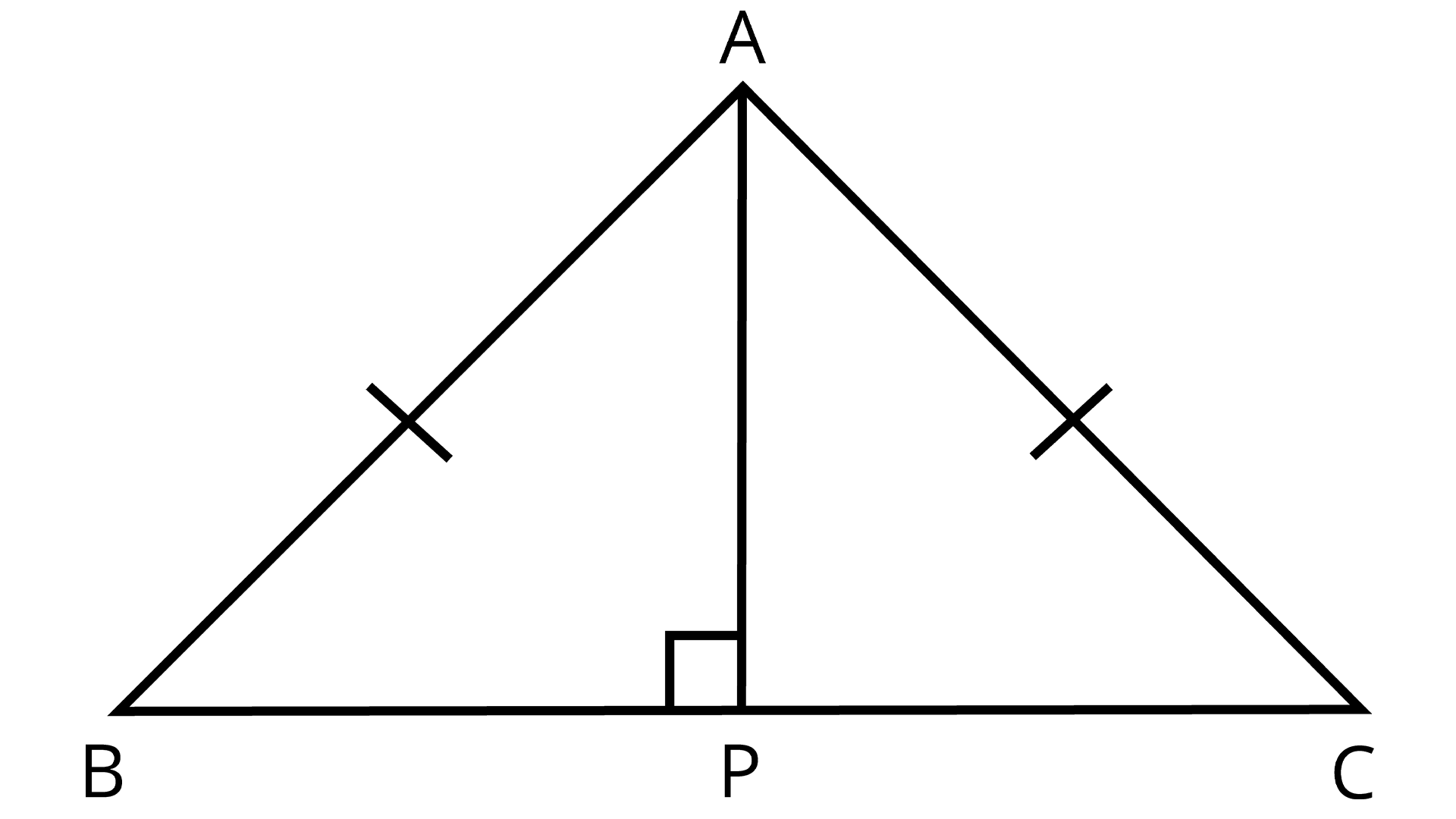
Isosceles Triangle ABC with AB = AC
Ans: In $\Delta ABP$ and $\Delta ACP$
$AB = AC$ (Given)
$AP = AP$ (Common)
$\angle APB = \angle APC$ ${\text{[Each 90°]}}$
$\therefore \Delta ABP \cong \Delta ACP$
${\text{[By RHS]}}$
$ \Rightarrow \angle ABP = \angle ACP$ (CPCT)
Overview of Deleted Syllabus for CBSE Class 9 Maths Chapter 7 Triangles
Class 9 Maths Chapter 7: Exercises Breakdown
Conclusion
Triangle-related NCERT Solutions for Class 9 Chapter 7 from Vedantu are an excellent resource for understanding important geometric ideas. Because it provides the foundation for understanding more difficult geometrical structures that students will encounter in higher grades, this chapter is essential. Along with several congruence criteria including SAS, SSS, and ASA, it concentrates on key theorems such as the Pythagorean Theorem, Angle Sum Property, and Triangle Inequality. The importance of understanding both the theoretical and practical elements of these geometric principles is made clear by the three to five problems from this chapter that have frequently appeared in earlier year's question papers.
Other Study Material for CBSE Class 9 Maths Chapter 7
Chapter-Specific NCERT Solutions for Class 9 Maths
Given below are the chapter-wise NCERT Solutions for Class 9 Maths. Go through these chapter-wise solutions to be thoroughly familiar with the concepts.
Important Study Materials for CBSE Class 9 Maths


FAQs on NCERT Solutions For Class 9 Maths Chapter 7 Triangles - 2025-26
1. What are the main types of triangles covered in Class 9 Chapter 7?
Triangles are classified based on sides (equilateral, isosceles, scalene) and angles (acute, obtuse, right). The chapter covers congruence criteria (SSS, SAS, ASA, RHS) and properties of isosceles triangles including angle relationships and median properties.
2. How do NCERT Solutions help students understand triangle congruence criteria effectively?
NCERT Solutions provide step-by-step proofs for SSS, SAS, ASA, and RHS congruence criteria with clear geometric reasoning and diagram analysis.
Congruence forms the foundation for advanced geometry concepts and theorem applications.
3. What topics are included in Exercise 7.1 and 7.2 of triangles chapter?
Exercise 7.1 focuses on triangle congruence using SSS, SAS, and ASA criteria with proof-based questions. Exercise 7.2 covers properties of isosceles triangles, angle bisector theorem, and applications of congruence in solving geometric problems and constructions.
4. Can students access triangles NCERT solutions as a Free PDF for offline study?
Yes, students can download the Free PDF of triangles NCERT solutions for offline access and convenient study. The PDF contains complete solutions for all exercises, in-text questions, and additional practice problems with detailed explanations and diagrams.
5. Why are properties of isosceles triangles important in Class 9 geometry?
Isosceles triangle properties establish that equal sides have equal opposite angles, and the altitude from vertex angle bisects both the angle and base.
These properties are fundamental for solving complex geometric problems and prove useful in coordinate geometry and trigonometry.
6. What are the key differences between SSS and SAS congruence criteria?
SSS (Side-Side-Side) requires all three sides of triangles to be equal, while SAS (Side-Angle-Side) needs two sides and the included angle between them to be equal. SAS is often easier to apply when angle measurements are given alongside side lengths.
7. How do triangle inequality theorem concepts appear in NCERT questions and answers?
Triangle inequality states that sum of any two sides must be greater than the third side, appearing in various NCERT problems testing valid triangle formation.
This theorem determines whether given measurements can form a triangle and helps solve optimization problems.
8. What additional practice questions are available beyond standard NCERT textbook exercises?
Vedantu provides extra questions covering advanced congruence applications, challenging proof problems, and real-life triangle applications. These include multiple-choice questions, assertion-reason problems, and case-study based questions that enhance problem-solving skills and exam preparation for different board patterns.
9. How does understanding angle bisector theorem help in solving triangle problems?
Angle bisector theorem states that an angle bisector divides the opposite side in the ratio of the adjacent sides, providing a powerful tool for solving proportion problems.
This theorem connects angle properties with side ratios, essential for coordinate geometry and trigonometry applications.
10. What makes Class 9 triangles chapter essential for higher Mathematics preparation?
Triangles chapter builds fundamental geometric reasoning, proof-writing skills, and spatial visualization abilities required for Class 10 coordinate geometry, trigonometry, and advanced theorems. The congruence concepts and logical thinking developed here form the foundation for circle theorems, similarity, and analytical geometry applications.
