



NCERT Solutions for Class 7 SST Chapter 6 The State, the Government, and You
The Big Questions (Page 143)
Question 1. What is the difference between a state and a government?
Answer: The differences between a state and a government are given below:
Question 2. What is the difference between a democracy and a republic? What makes India a democratic republic?
Answer: The differences between a democracy and a republic are given below:
India is called a democratic republic for the following reasons:
People elect their representatives at the local, state, and national levels. This makes India a democracy.
The President of India is an indirectly elected head of state and does not inherit the position. This makes India a republic.
The Constitution is the supreme law of the country. It guarantees equality, justice, liberty, and fundamental rights for citizens and requires all authorities to act in accordance with the law.
Question 3. How do citizens engage with the government in day-to-day life? How can one make government work for the people?
Answer: Citizens interact with the government in many ways during their daily lives. They use public facilities such as government schools, hospitals, roads, buses, water supply, electricity, and sanitation services. They also approach ward councillors, panchayat members, municipal offices, police stations, and other government departments when they need help or want to report a problem.
Citizens can make the government work for the people in the following ways:
(a) Citizens can use grievance platforms such as CPGRAMS to report problems related to public services, delays, or corruption and request government action.
(b) The Right to Information Act allows people to seek information about government decisions, expenditure, schemes, and public projects. For example, citizens may ask about the money spent on a road or the list of beneficiaries under a government scheme.
(c) Newspapers, television, radio, and social media can be used to highlight public problems and draw the attention of government authorities.
(d) Citizens may join civil society organisations and NGOs working in areas such as education, health, the environment, child welfare, and women’s empowerment.
(e) People can write to councillors, panchayat representatives, MLAs, MPs, ministers, and government officers to request action on public concerns.
(f) Through voting, citizens can elect responsible representatives and reject leaders who fail to work for the public interest.
Let’s Explore
Question 1. We learned about democratic, monarchic, theocratic, dictatorial, and oligarchic forms of government, and how they function differently. Can you recount some of the differences? (Page 144)
Answer: Different forms of government vary in how leaders are selected, how power is exercised, and how citizens participate in public affairs.
(a) Democratic Government
In a democracy, people elect their representatives through free and fair elections. Citizens enjoy political rights, can express their opinions, and may hold the government accountable.
Example: India.
(b) Monarchic Government
In a monarchy, a king or queen serves as the head of state. The position is generally hereditary and passes from one member of a royal family to another.
Example: Saudi Arabia.
(c) Theocratic Government
In a theocracy, religious leaders exercise political authority, and laws are strongly influenced by religious teachings or scriptures.
Example: Iran.
(d) Dictatorial Government
In a dictatorship, power is concentrated in the hands of a single ruler or a small ruling elite. Political opposition and freedom of expression are usually restricted.
Example: North Korea.
(e) Oligarchic Government
In an oligarchy, political power is controlled by a small group of wealthy, influential individuals. Government decisions often reflect the interests of this limited group.
Question 2.
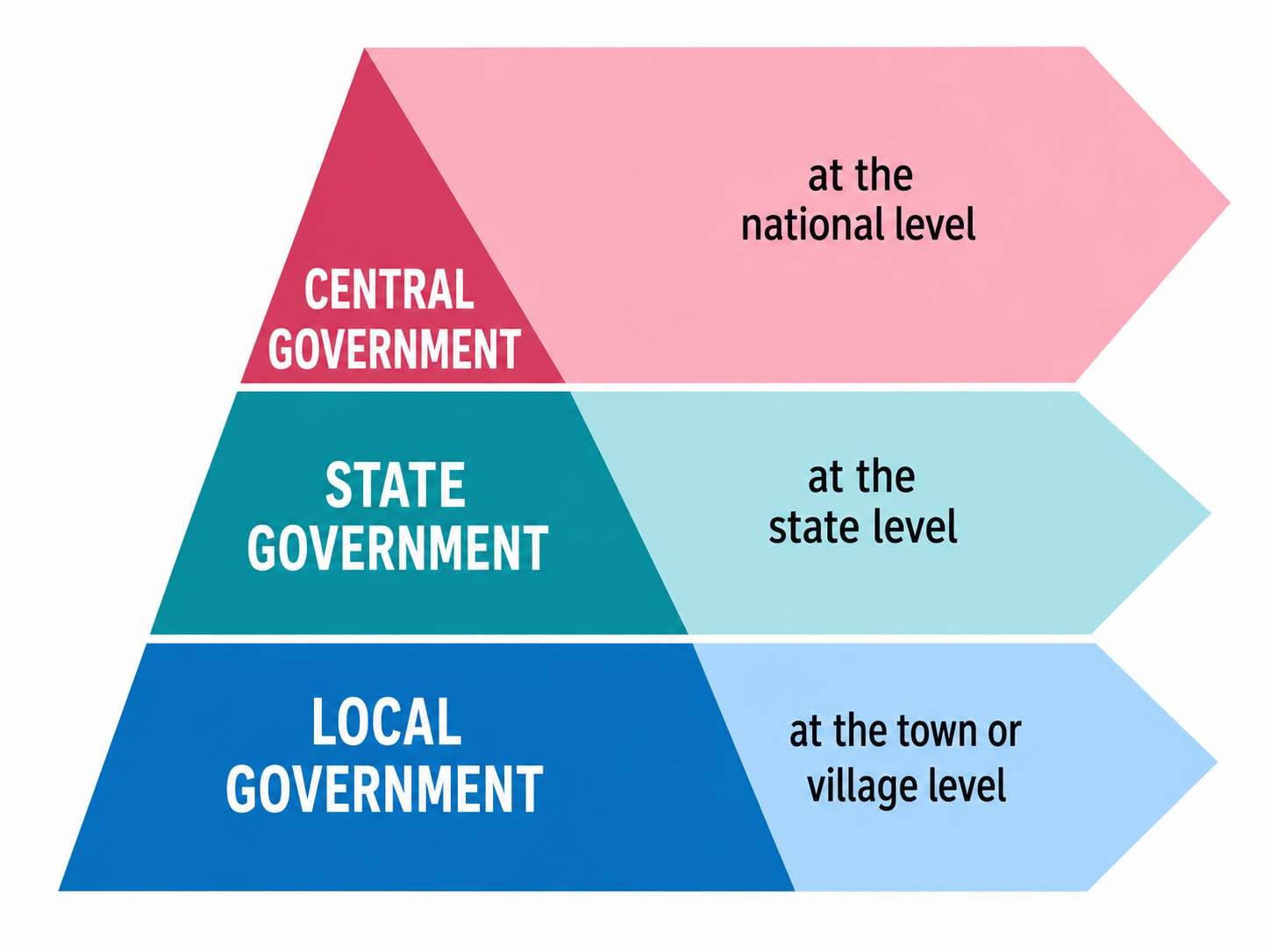
(a) Do you remember this image from Grade 6, Chapter 10? It represents the three tiers of Government in India.
(b) Why do we have these levels of Government in India?
(c) Can’t we have just one level to do fulfil all the functions? Let us explore this further. (Page 161)
Answer:
(a) Yes, the image represents the three levels of government in India: Central Government, State Government, and Local Government.
(b) India has different levels of government so that power and responsibilities can be shared effectively. The main reasons are:
India is a large and diverse country with many states, languages, cultures, villages, towns, and cities. A single authority cannot manage every issue efficiently.
Local problems require local attention. Matters such as streetlights, sanitation, drinking water, village roads, and garbage collection are handled more effectively by local authorities.
State governments deal with subjects that mainly concern their states, while the Central Government manages issues that affect the entire country.
The division of power prevents the excessive concentration of authority and helps protect democracy.
Different levels of government allow citizens to participate more closely in decision-making.
(c) No, one level of government cannot perform all the functions efficiently. India has a very large population and a vast geographical area. A single government would find it difficult to understand and address the specific needs of every region.
Sharing responsibilities among the Central, State, and Local Governments makes administration more efficient, brings decision-making closer to the people, and strengthens democracy.
Let’s Explore
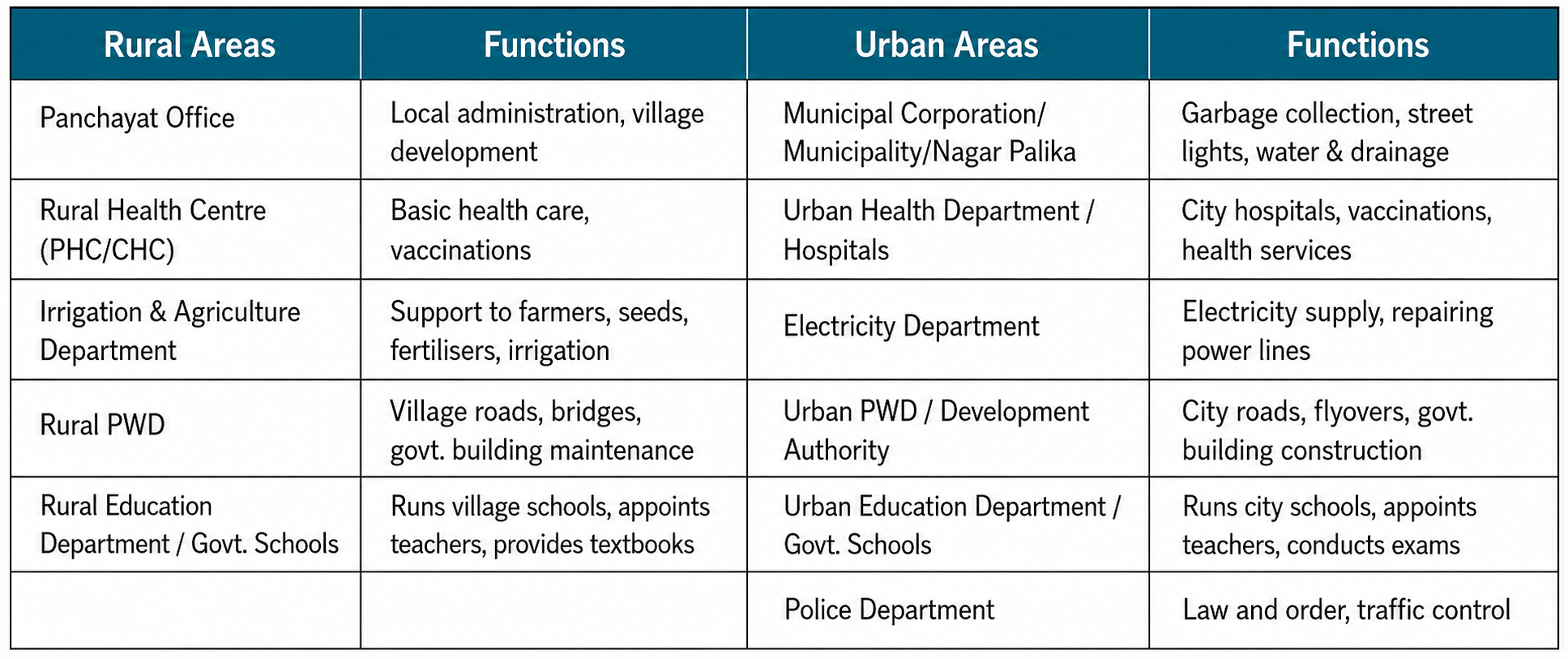
Question 1. Make lists of different government departments you are familiar with, or whose names you may have seen on boards around your home or on your way to school. What functions do you think they perform? (Page 148)
Answer:
Question 2. Collect editorials from a few newspapers. Read them in small groups. Identify the topics on which they have opinions. How many are about government policies? (Page 160)
Answer:
The collected newspaper editorials express opinions on different government policies.
The first editorial from The Hindustan Times discusses foreign policy.
The second editorial from The Hindustan Times discusses economic policy.
The third editorial from The Times of India discusses nuclear power policy.
Therefore, all three editorials are related to government policies. Students may collect additional editorials and classify them by topic, such as education, health, the environment, taxation, foreign relations, or economic development.
Question 3. What might be the reasons that decisions regarding local concerns should be taken locally to the extent possible? (Page 162)
Answer: Decisions about local concerns should be made locally because people living in an area understand its needs, resources, and challenges better than officials far away.
Residents are directly affected by problems such as water shortages, damaged roads, blocked drains, poor sanitation, and broken streetlights. Their participation can help authorities identify practical and suitable solutions.
Local governments can also respond more quickly because they are closer to the community. This reduces delays caused by waiting for instructions from higher authorities. Local decision-making also strengthens democracy by allowing citizens to participate directly in matters that affect their daily lives.
Question 4. It has been more than 75 years since India became a republic. During this time, we have had many governments at the national, state and local levels. Many policies and programs have been designed and implemented. We have come a long way by increasing literacy of our people, improving roads, trains, and airports, and strengthening communication systems such as the telephone and the internet. But we still have a long way to go in addressing India’s challenges. Have a class discussion on the following: (Page 165)
(a) List five major achievements of our country in improving the lives of ordinary people in your village, town or city. Which level of government made this possible and how?
Answer: Five important achievements that have improved the lives of ordinary people are:
These achievements became possible through cooperation among different levels of government. Each level performed responsibilities according to its authority and available resources.
(b) List five problems that ordinary people face frequently. At which level of government should these be addressed and how?
Answer: Five common problems and the ways in which they may be addressed are given below:
(a) Drinking Water Problem
Level of Government: Local Government
How it can be addressed: Local authorities can repair leaking pipelines, improve water-storage facilities, encourage rainwater harvesting, install public water points, and ensure a regular supply of clean water.
(b) Issue of Garbage
Level of Government: Local Government
How it can be addressed: Municipal bodies can improve door-to-door waste collection, provide separate bins, hire more sanitation workers, promote waste segregation, and enforce penalties for littering.
(c) Traffic Jams
Level of Government: Local Government and State Government
How it can be addressed: Authorities can improve traffic signals, expand public transport, repair roads, create parking areas, deploy traffic police, and construct flyovers or alternative routes where necessary.
(d) Women’s Safety
Level of Government: State Government
How it can be addressed: The police can increase patrolling, install CCTV cameras in public places, strengthen women’s helplines, improve street lighting, and provide a quick emergency response.
(e) High Pollution Levels (Air & Noise Pollution)
Level of Government: State and Central Governments
How it can be addressed: Governments can enforce pollution-control laws, inspect industries and vehicles, monitor air quality, restrict excessive noise, improve public transport, and promote tree planting.
Think About It
Question 1.
(a) If a streetlamp in your neighbourhood is broken, who would you contact to fix it?
Answer: If a street lamp in the neighbourhood is broken, we should contact the local government authority responsible for street lighting. In a city or town, we may report the issue to the Municipality, Municipal Corporation, or local ward councillor.
In a village, the complaint can be made to the Gram Panchayat or village Pradhan. Local governments are responsible for services such as streetlights, drains, garbage collection, local roads, and parks.
(b) If a village road needs to be repaired, would the local people reach out to the Central Government? (Page 162)
Answer: No, villagers would not usually approach the Central Government first. They should contact the Gram Panchayat, village Pradhan, Block Panchayat, or Zila Parishad, depending on which authority is responsible for maintaining the road.
Village roads generally fall under the jurisdiction of rural local governments or the State Government. If the Gram Panchayat does not respond, the residents may take the complaint to higher district or state authorities. Approaching the Central Government would normally be necessary only when the road is part of a centrally managed project or national programme.
The State, the Government, and You Class 7 Solutions (Exercise)
Question 1. “Every democracy is a republic.” Is this statement true or false? Explain.
Answer: The statement “Every democracy is a republic” is false.
A democracy is a form of government in which people elect their representatives and participate in political decision-making. A republic is a country in which the head of state is elected directly or indirectly, rather than inheriting the position.
A country can be democratic without being a republic. For example, the United Kingdom and Sweden are democracies because their governments are elected, but they have hereditary monarchs as heads of state.
India is both a democracy and a republic because its representatives are elected by the people, and its President is an elected head of state.
Question 2. Give two reasons why decentralisation is important in India.
Answer: Decentralisation is important in India for the following reasons:
(a) India is a large and diverse country. A single government cannot efficiently manage the different needs of every state, district, town, and village. Local authorities understand local problems and can provide quicker and more suitable solutions.
(b) Decentralisation increases people’s participation in democracy. Through Panchayats and Municipalities, citizens and their elected representatives can participate in decisions affecting their local communities. This makes the government more accountable and responsive.
Question 3. Imagine you are part of your school’s student council. The council works like a mini-parliament – it has members elected by students, debates issues and makes decisions.
(a) In this context, do you think it would be better if only the council president makes all the decisions or if power is to be shared among all members?
Answer: Power should be shared among all members of the student council rather than allowing only the president to make all decisions.
When all members discuss an issue, different opinions and needs can be taken into account. This leads to fairer, more balanced, and more representative decisions. Sharing power also prevents one person from becoming too powerful and teaches students the democratic values of cooperation, participation, and accountability.
(b) Should the student council have the power to make rules about the food you eat, or the language you speak?
Answer: No, the student council should not have the power to control the food students eat or the languages they speak. These are personal and cultural choices that must be respected.
Food habits may be connected to family traditions, culture, religion, or personal preference. Similarly, students should be free to communicate in the language with which they are comfortable, as long as school rules regarding classroom learning are followed.
A democratic institution should protect personal freedom and respect cultural and linguistic diversity rather than unnecessarily interfering in private choices.
(c) What can go wrong if the student council is the most powerful body in your school and no one questions its decisions?
Answer: If the student council becomes extremely powerful and no one is allowed to question its decisions, it may misuse its authority. It could make unfair rules, favour certain students, ignore minority opinions, or punish those who disagree.
Without checks and accountability, decisions may become biased and harmful. Therefore, the student council should be answerable to students, teachers, and the school administration. Power must be limited and shared to protect fairness, equality, and the rights of all students.
Question 4. Think about these real-life situations in relation to India’s democracy:
(a) Should the Parliament be the most powerful institution in the country? Why or why not?
Answer: Parliament is a powerful institution because it represents the people and has the authority to make laws. However, it should not possess unlimited power.
Parliament must work within the limits established by the Constitution. The judiciary can review laws passed by Parliament and declare them invalid if they violate constitutional provisions. The executive must also implement laws in accordance with the Constitution.
A balance of power among Parliament, the executive, and the judiciary prevents misuse of authority and protects democracy.
(b) Should the Parliament have the power to make any law it wants, even if it affects your rights?
Answer: No, Parliament should not have unlimited authority to make any law it wishes. Every law must comply with the Constitution and respect citizens' fundamental rights.
Parliament may pass laws for public welfare, national security, development, and social justice. However, if a law unfairly violates constitutional rights, citizens may challenge it in court. The judiciary can then examine whether the law is constitutional.
(c) What could go wrong if lawmaking has no limits? Can it lead to unfair or unjust laws?
Answer: If there are no limits on lawmaking, rulers may pass laws that favour certain groups while discriminating against others. Such laws could restrict important freedoms, including equality, freedom of speech, freedom of movement, and religious choice.
Unlimited lawmaking power may also allow leaders to silence opposition, remain in authority unfairly, and create a dictatorship-like system. Corruption and misuse of power could increase, while citizens might lose trust in public institutions.
Therefore, laws must be limited by the Constitution and subject to judicial review.
(d) Who is more powerful in India, the Parliament or the Supreme Court? Give your reasons.
Answer: Neither Parliament nor the Supreme Court has unlimited power. Both perform separate constitutional responsibilities and act as checks on each other.
Parliament has the authority to debate and pass laws for the country.
The Supreme Court interprets the Constitution and examines whether laws comply with it.
If a law violates the Constitution, the Supreme Court may declare it invalid.
The Constitution is the highest authority in India, and both Parliament and the Supreme Court must function within its limits.
Question 5. Ask your parents/guardians how they engaged with the government over the past year. Make a list and classify the items based on the level of government they had to work with. What challenges did they face?
Answer:
Over the past year, my parents or guardians interacted with different levels of government for several services.
This activity shows that citizens depend on all three levels of government in their daily lives. Although many services are now available online, people may still face delays, technical issues, unclear procedures, and repeated office visits.
Important Points to Remember from Class 7 SST Part 2 Chapter 6 The State, the Government, and You
A state is permanent, while governments may change after elections.
A democracy allows people to elect their representatives.
A republic has an elected head of state instead of a hereditary monarch.
India is a democratic republic governed by its Constitution.
India has Central, State, and Local levels of government.
Decentralisation brings administration closer to citizens.
Parliament makes laws, while the Supreme Court examines whether laws follow the Constitution.
The Constitution is the highest authority in India.
Citizens can participate through voting, RTI applications, grievance platforms, media, and elected representatives.
Local authorities handle issues such as roads, streetlights, sanitation, and water supply.
Importance of NCERT Solutions for Class 7 Social Science Chapter 6
NCERT Solutions for Class 7 Social Science Part 2 Chapter 6 The State, the Government, and You help students understand important civics concepts in simple language. The answers explain each topic clearly and include examples connected to daily life.
These solutions help students:
Understand the difference between a state, government, democracy, and republic
Learn the functions of Central, State, and Local Governments
Prepare accurate answers for textbook exercises
Revise long and short-answer questions quickly
Understand the importance of decentralisation and citizen participation
Improve answer-writing skills for school examinations
Complete homework and classroom assignments independently
CBSE Class 7 Social Science Part 2 Chapter 6 The State, the Government, and You Study Materials
Explore More NCERT Solutions for Class 7 Social Science Chapters
Related Study Material for Class 7 Social Science
FAQs on NCERT Solutions for Class 7 Social Science: Exploring Society India and Beyond Part 2 Chapter 6 The State, the Government, and You - 2026-27 Free PDF Download (Sign-in Required)
1. Where can I download NCERT Solutions for Class 7 Social Science Chapter 6 PDF?
Students can download the FREE PDF of NCERT Solutions for Class 7 Social Science Part 2 Chapter 6 The State, the Government, and You from Vedantu. The PDF can be saved for offline study and revision.
2. Is the Class 7 Social Science Chapter 6 solutions PDF available for free?
Yes, the NCERT Solutions for Class 7 Social Science Chapter 6 PDF is available for free. Students can use it for homework, examination preparation, and chapter revision.
3. What is the main difference between a state and a government, as explained in the NCERT Solutions for Class 7 Social Science Chapter 6?
A state is a permanent political organisation consisting of territory, population, government, and sovereignty. A government is a group of elected representatives and officials who administer the state for a particular period.
4. Why is India called a democratic republic from SST Class 7 Part 2 Chapter 6 The State, the Government, and You?
India is a democracy because its citizens elect their representatives. It is a republic because the President, who is the head of state, is elected indirectly and does not inherit the position.
5. What are the three levels of government in India from Chapter 6 The State, the Government, and You?
The three levels of government in India are the Central Government, State Government, and Local Government. Local Government includes Panchayats in rural areas and Municipalities or Municipal Corporations in urban areas.
6. Are these Class 7 Chapter 6 answers useful for CBSE exam preparation?
Yes, the solutions are useful for CBSE school examinations because they provide clear, structured answers to the in-text and exercise questions in the NCERT chapter. Students should also read the textbook carefully before using the answers for revision.
