Navratri 2026 Colours: Complete 9-Day List With Dates and Meanings
The Navratri colours 2026 for Shardiya Navratri are orange, white, red, royal blue, yellow, green, grey, purple and peacock green. The nine-day colour calendar in India runs from 11 October to 19 October 2026, followed by Vijayadashami (Dussehra) on Tuesday, 20 October. Each day follows a popular festive colour tradition alongside the worship of Goddess Durga.
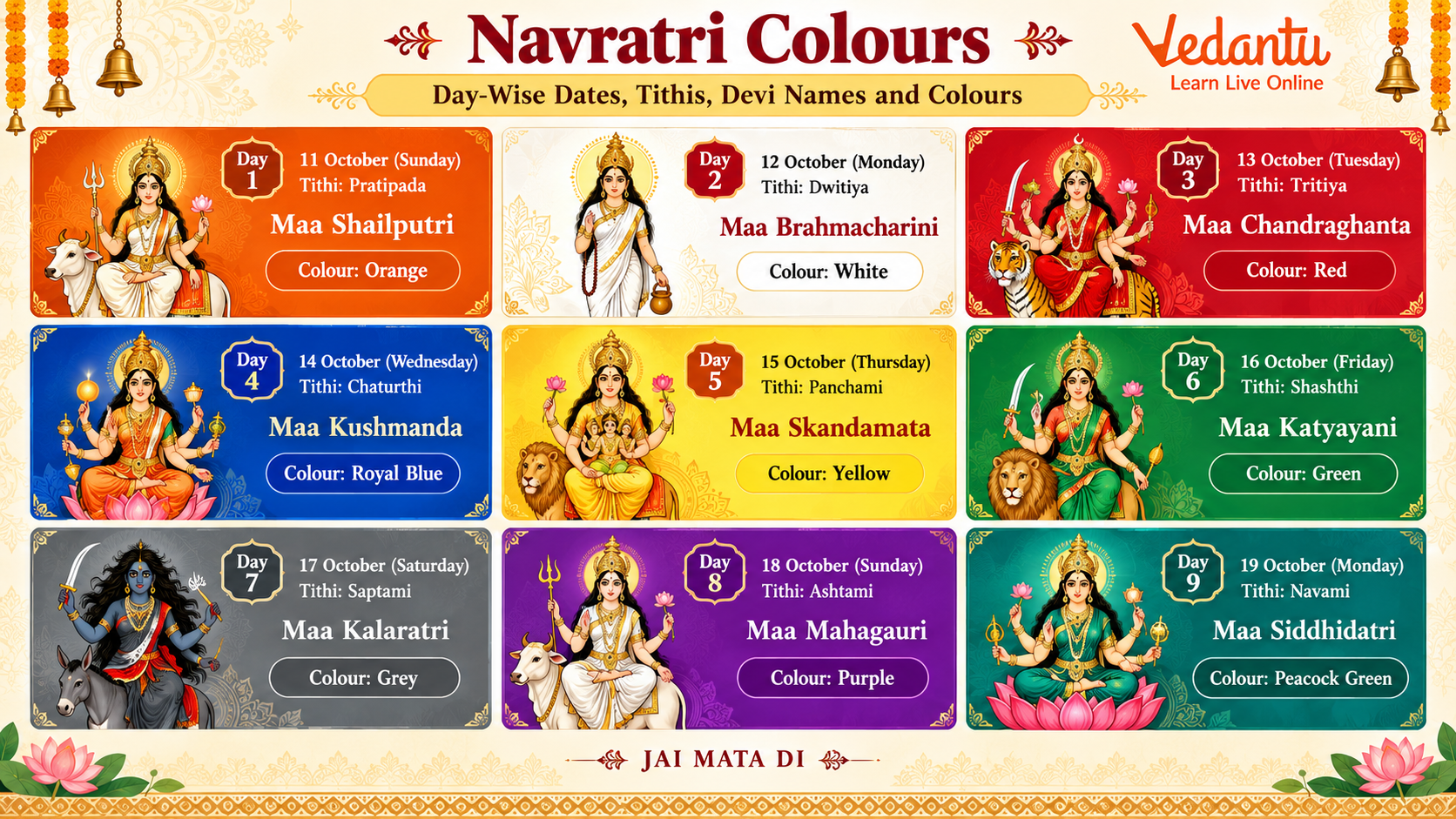
The 9 colours of Navratri are associated with qualities such as courage, peace, joy, strength and devotion. Many families wear the day's colour, decorate their homes with flowers or select matching accessories for puja and Garba celebrations. Wearing a particular shade is a popular custom, not a compulsory religious practice.
Know About: Ram Navami 2026 Correct Date, Muhurat, Significance & Celebrations
Explore the complete Navratri 2026 colours with dates, nine Devi names, meanings of each colour, Marathi colour names, and the colour to wear today or tomorrow. This guide covers October's Sharad Navratri, also called Shardiya Navratri, rather than Chaitra Navratri in March.
Navratri 2026 Colours With Dates: 9 Days October Colour List
The Navratri colours 2026 list with dates begins with orange on Sunday, 11 October, and ends with peacock green on Monday, 19 October. The table below brings together the colours, dates, traditional Navadurga sequence and symbolic meanings.
Important: The Devi names follow the traditional nine-form sequence. Do not use the numbered dress-colour days to determine the exact dates of lunar puja observances. For example, Durga Ashtami and Mahagauri Puja fall on 19 October in the New Delhi Panchang.
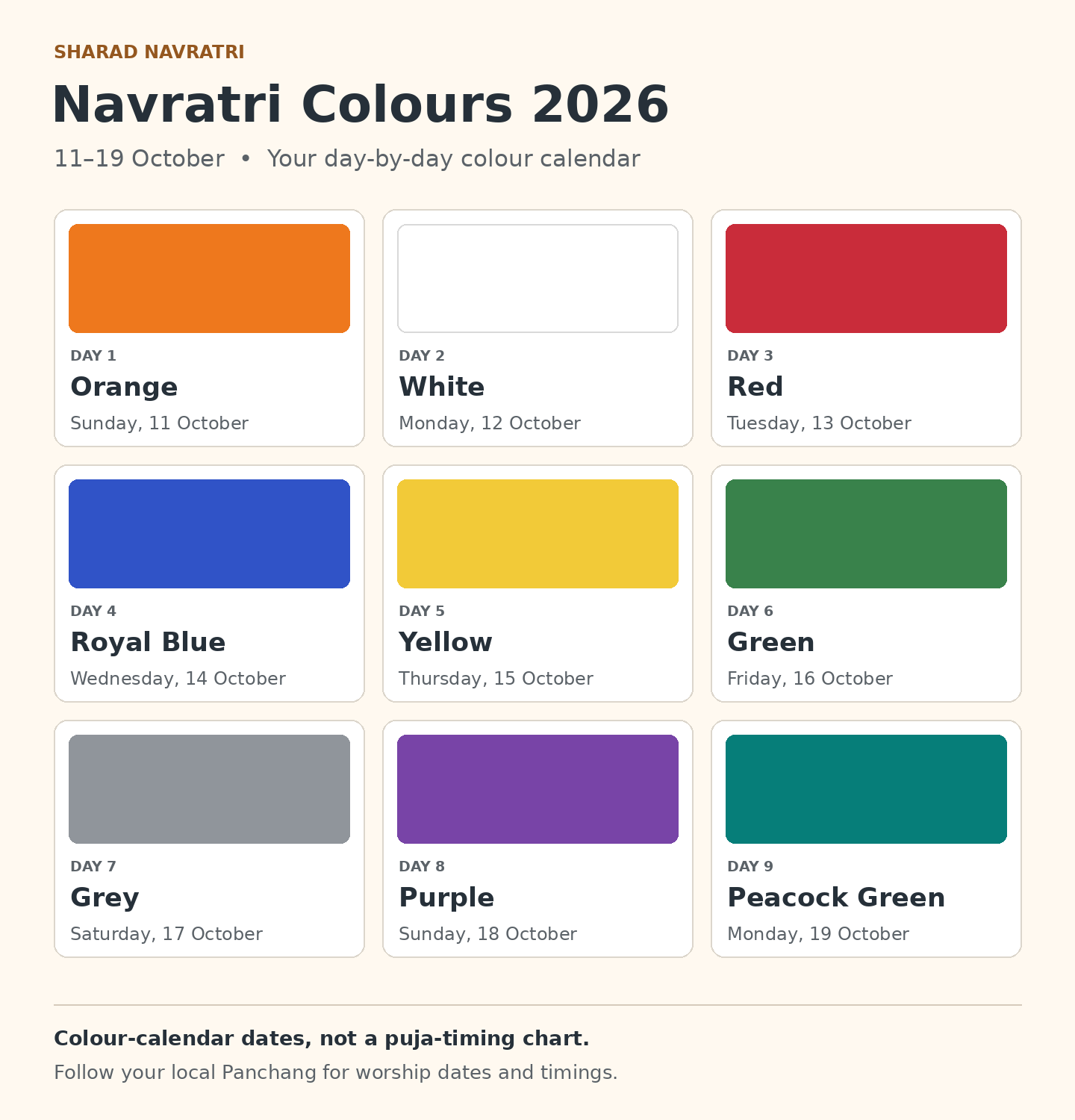
Save the Navratri Colours 2026 Calendar Image
A day-wise Navratri colour chart makes it easier to plan festive outfits and share the schedule with family. Save the calendar image for quick reference, or use the table above to check the date, colour and Devi name.
Know About: Durga Puja 2026 Calendar: Dates of Durga Ashtami, Maha Navami and Complete 5-Day Festival Schedule
Nine Colours of Navratri 2026 and Their Significance
The nine colours of Navratri 2026 have different symbolic meanings. Some represent energy and strength, while others suggest peace, renewal or compassion. These associations help families celebrate each day with a shared theme, although they may vary between regional traditions.
Day 1: Orange🟠 – Sunday, 11 October 2026 (Maa Shailputri)
Orange is the first Navratri colour of 2026, representing energy, warmth and new beginnings. The festival begins with worship of Maa Shailputri, the first form of Navadurga. Many households also perform Ghatasthapana, or Kalash Sthapana, to mark the beginning of Navratri.
You can wear an orange saree, kurta or dupatta, or decorate your home with orange marigold flowers. Even a small accessory can help you follow the day's colour.
Day 2: White⚪ – Monday, 12 October 2026 (Maa Brahmacharini)
White is associated with peace, purity and simplicity. The second day honours Maa Brahmacharini, who represents devotion, patience and self-discipline.
A white cotton kurta, saree or simple festive outfit is a comfortable choice. If you do not have pure white clothing, an off-white outfit or suitable accessory can also work.
Day 3: Red🔴– Tuesday, 13 October 2026 (Maa Chandraghanta)
Red represents strength, courage, love and devotion. It is also widely used in Goddess worship, particularly through red chunris and traditional festive clothing.
On the third day, devotees honour Maa Chandraghanta, who is associated with courage and protection. You can wear a red saree, kurta, scarf or bangles to include the colour in your celebration.
Day 4: Royal Blue🔵 – Wednesday, 14 October 2026 (Maa Kushmanda)
Royal blue suggests calmness, confidence and dignity. This deep shade adds a rich festive touch and is different from light blue or peacock green.
The fourth form of Navadurga is Maa Kushmanda, associated with the creation of the universe. A royal blue outfit, blouse or dupatta paired with traditional accessories is a simple choice for the day.
Day 5: Yellow🟡 – Thursday, 15 October 2026 (Maa Skandamata)
Yellow represents happiness, warmth, optimism and positivity. It is a familiar festive colour and can be used in outfits, flowers and rangoli decorations.
Maa Skandamata, the fifth form of Goddess Durga, is associated with motherly love and care. A yellow saree, kurta, dupatta or small accessory is an easy way to follow the colour theme.
Day 6: Green🟢 – Friday, 16 October 2026 (Maa Katyayani)
Green symbolises nature, growth, renewal and hope. It reflects the idea of positive change and fresh beginnings.
The sixth Navadurga form, Maa Katyayani, is associated with strength and righteousness. You can choose green traditional clothing or add a green accessory to an outfit you already own.
Day 7: Grey🩶 – Saturday, 17 October 2026 (Maa Kalaratri)
Grey represents balance, stability and quiet strength. Although it is less vibrant than red or yellow, it is part of the popular Navratri colour sequence for 2026.
Maa Kalaratri, the seventh form of Durga, represents fearlessness and protection from negativity. A grey kurta, saree or blouse with traditional jewellery can create a simple festive look.
Day 8: Purple🟣 – Sunday, 18 October 2026 (Maa Mahagauri in the Traditional Sequence)
Purple is associated with dignity, richness, spirituality and ambition. A purple outfit or accessory can add a festive touch without requiring elaborate clothing.
The eighth form in the traditional Navadurga sequence is Maa Mahagauri, who represents purity and grace. However, the eighth day of the dress-colour calendar should not automatically be treated as Durga Ashtami. In the Delhi Panchang, Mahagauri Puja is observed on 19 October 2026.
Day 9: Peacock Green🦚 – Monday, 19 October 2026 (Maa Siddhidatri in the Traditional Sequence)
Peacock green is a distinctive blue-green shade associated with freshness, compassion and fulfilment. It differs from the greener shade followed on Day 6.
The ninth form of Navadurga is Maa Siddhidatri, associated with spiritual accomplishment and wisdom. Peacock green clothing, a scarf or a small decorative element can mark the final colour-calendar day. For specific Navami rituals, follow your local Panchang.
Why Is Navratri Celebrated for 9 Days?
Navratri is celebrated for nine days to honour the nine forms of Goddess Durga, collectively known as Navadurga. Each form represents qualities such as strength, devotion, courage, compassion and wisdom. The festival celebrates divine feminine power and the victory of good over evil.
During these nine days, devotees observe prayers, fasting, aarti and other traditions. Celebrations vary across India, including Garba and Dandiya in Gujarat, Durga Puja in West Bengal and Golu displays in parts of South India.
What Are the 9 Days of Navratri 2026 and Their Devi Names?
The 9 days of Navratri Devi names and colours follow the traditional Navadurga sequence from Maa Shailputri to Maa Siddhidatri. Each form has a distinct devotional significance.
These Devi names represent the traditional worship order. They should not be interpreted as permanent assignments of specific clothing colours to the goddesses.
🔗Also Check: Nine Days, Nine Goddesses: Life Lessons from Each Day of Navratri
When Does Shardiya Navratri 2026 Start and End?
Shardiya Navratri 2026 begins on Sunday, 11 October, and its popular nine-day colour calendar runs until Monday, 19 October. Vijayadashami or Dussehra is on Tuesday, 20 October 2026.
This is the October Navratri celebration, also called Sharad Navratri. It differs from Chaitra Navratri, which was observed in March 2026. The festival's religious dates follow lunar tithis, so important rituals may not align exactly with numbered colour days.
When Is Durga Ashtami and Maha Navami in 2026?
For New Delhi, Durga Ashtami and Mahagauri Puja are observed on 19 October 2026. The Panchang also lists Maha Navami observances on 19 October, with Navami-related rituals continuing on 20 October.
Because tithi timings and local customs matter, check the calendar for your city before planning Ashtami Puja, Kanya Pujan, Navami Homa or other rituals.
Why Do Navratri Colours Change Every Year?
In the widely followed nine-colour tradition, the starting colour is associated with the weekday on which Shardiya Navratri begins. The subsequent colours follow the customary sequence, so their order changes from year to year.
In 2026, Navratri starts on Sunday, making orange the first colour. Older Navratri charts may show a different sequence, so it is important to check the year before choosing daily colours.
These colours are primarily a festive clothing tradition and are not permanently tied to individual forms of Goddess Durga.
Navratri Colours 2026 in Marathi: नवरात्री २०२६ चे नऊ रंग
शारदीय नवरात्री २०२६ ची सुरुवात ११ ऑक्टोबर रोजी होत आहे. नऊ दिवसांचे रंग आणि तारखा खाली दिल्या आहेत. पूजा आणि व्रतांच्या अचूक तिथींसाठी स्थानिक पंचांग पाहावे.
Navratri Colour Today and Tomorrow 2026: Check the Day-Wise Colours
Looking for today's Navratri colour or wondering which shade to wear tomorrow? The colours of Navratri change each day during the nine-day festival. For Shardiya Navratri 2026, the colour calendar runs from 11 October to 19 October, starting with orange and ending with peacock green.
Which Colour Is Today for Navratri 2026?
Today's Navratri colour, 12 October 2026, is white, which is associated with peace, purity and simplicity. It is the second day of the popular Navratri colour calendar, traditionally linked with Maa Brahmacharini in the nine-form sequence.
Tomorrow's Navratri colour, 13 October 2026, is red, representing courage, strength and devotion.
To check the Navratri colour for today on another date, refer to the complete calendar below.
The today Navratri colour changes according to the date, so always check the correct day's entry before choosing your outfit. You can wear the shade through a saree, kurta, dupatta or simple accessory. Following the colour theme is optional.
Note: This list applies to Shardiya Navratri 2026 in October. Outside these dates, there is no assigned colour for today under this particular nine-day calendar.
Navratri Dress Colours 2026: Easy Ways to Celebrate
Following the daily Navratri dress colours does not mean buying nine different outfits. You can use clothing already in your wardrobe or introduce the colour through simple accessories.
Traditional clothing: Choose a saree, kurta, lehenga or comfortable festive outfit in the day's shade.
Dupattas and accessories: Use a scarf, blouse, jewellery or hair accessory to match the colour theme.
Flowers and decorations: Add the day's colour through suitable flowers, rangoli or decorations without changing your household puja customs.
Garba and Dandiya: Choose comfortable clothing and secure footwear that allow easy movement.
Family celebrations: Children and adults can participate using small colour accents rather than complete matching outfits.
The colour tradition is meant to add joy to the celebrations. Devotion and family customs matter more than wearing an exact shade.
Celebrate the Nine Colours of Navratri With Devotion
The nine colours of Navratri 2026 offer a simple way to celebrate the festival from 11 to 19 October. Each shade carries a traditional meaning, while the nine forms of Goddess Durga reflect qualities such as courage, peace, compassion and strength.
Keep the date-wise colour list handy, celebrate according to your family's traditions and remember that wearing the assigned colour is optional. The spirit of Navratri lies in devotion, togetherness and the celebration of good over evil.
FAQs on Navratri Colours 2026: 9 Days Colour List With Dates and Devi Names
1. What are the 9 days' colours of Navratri in 2026?
The nine colours are orange, white, red, royal blue, yellow, green, grey, purple and peacock green. They correspond to the popular Shardiya Navratri colour calendar from 11 to 19 October 2026.
2. Is Sharad Navratri 2026 in September or October?
Sharad Navratri 2026 begins on 11 October, not in September. Its nine-day colour calendar ends on 19 October, followed by Vijayadashami on 20 October.
3. Are Chaitra Navratri colours 2026 different from the October colours?
Yes. Chaitra Navratri 2026 was observed from 19 to 27 March, and its colour sequence differs from the October Shardiya Navratri sequence. The March list begins with yellow, while the October list begins with orange.
4. Which colour should I wear on the first day of Navratri 2026?
Orange is the first colour of Shardiya Navratri 2026, which begins on Sunday, 11 October. You can wear an orange outfit or include the colour through a dupatta or accessory.
5. Why do Navratri colours change every year?
The popular Navratri colour sequence depends on the weekday on which the festival begins. Since that weekday changes across years, the day-wise colour order changes too.
6. Are Navratri colours permanently linked to particular goddesses?
No. The annual clothing-colour sequence is not a permanent colour assignment for the nine forms of Durga. The Navadurga worship tradition and festive colour calendar are related but distinct.
7. Is wearing the correct Navratri colour compulsory?
No. Wearing the day's colour is optional. Families can celebrate Navratri through prayers, rituals and gatherings without following a matching dress code.
8. Is pink included in the Sharad Navratri colours 2026 list?
No. Pink is not included in the commonly followed October 2026 colour sequence. The eighth and ninth colours are purple and peacock green.
9. Is Durga Ashtami on the eighth colour day in 2026?
Not for the Delhi calendar. The eighth colour day is 18 October, while Durga Ashtami and Mahagauri Puja are observed on 19 October 2026. Worship dates follow lunar tithis, so check the local Panchang.
10. Can I use flowers or accessories instead of a matching outfit?
Yes. You can use flowers, a dupatta, scarf, jewellery or other accessories to include the day's colour. There is no requirement to buy a separate outfit for each day.
11. Why is Navratri celebrated for nine days?
Navratri celebrates the nine forms of Goddess Durga and their qualities, including courage, devotion, protection and wisdom. The festival also represents the victory of good over evil.
12. What are the 9 days of Navratri 2026?
The traditional nine-day Navadurga sequence begins with Maa Shailputri and ends with Maa Siddhidatri. The 2026 Shardiya Navratri colour calendar runs from 11 to 19 October, followed by Dussehra on 20 October. Exact ritual observances follow the local lunar calendar.