



What is Motion in Physics? Understand the Types of Motion with Real-Life Examples
The concept of Kinematics in Physics is all about describing how objects move, without considering the forces that cause the motion. We begin with the basics, such as the frame of reference, which is the background or point from which an object's position and movement are observed. This understanding is vital as the measurements of motion depend on the chosen reference point. Motion in a straight line, also called rectilinear motion, is one of the simplest forms of motion studied in this chapter. This involves tracking the change in an object’s position with respect to time along a single dimension.
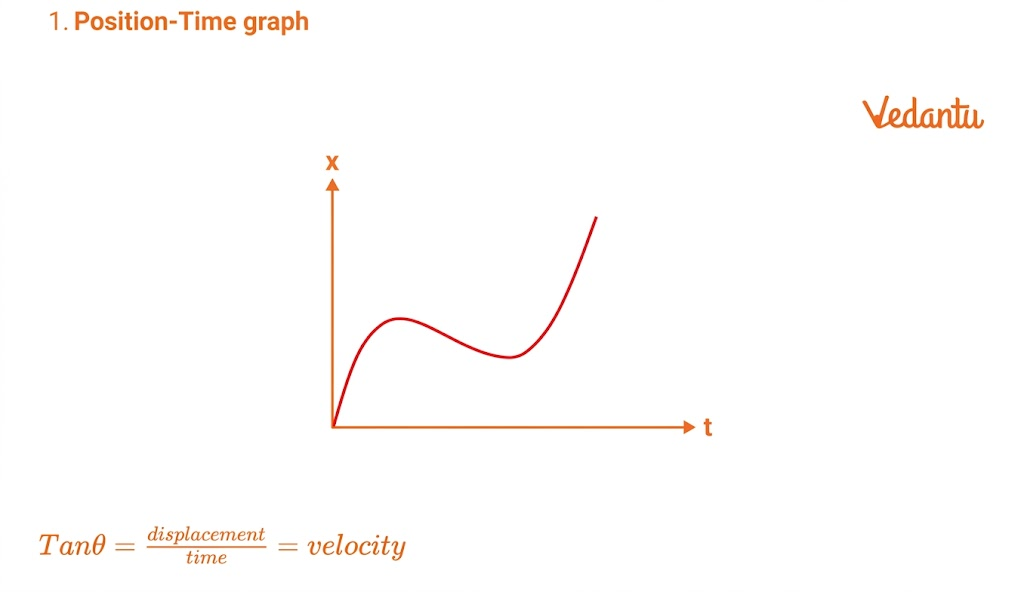
Position-Time Graphs and Motion Types
Position-time graphs are crucial for visualizing how an object’s location changes over time. In these graphs, a straight sloping line indicates uniform motion (constant speed), while a curved line shows non-uniform motion (changing speed). Uniform motion means that the object covers equal distances in equal time intervals; non-uniform motion is when the distances covered change over equal time intervals. Average speed is the total distance travelled divided by the total time taken, while instantaneous velocity tells us the speed and direction of an object at a particular moment.
Uniformly Accelerated Motion
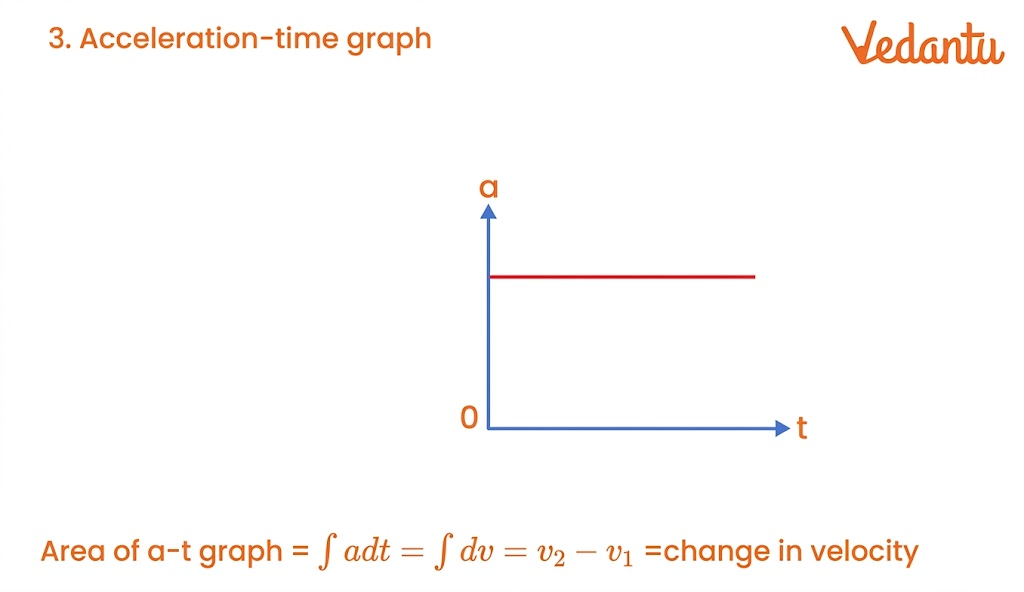
Uniformly accelerated motion refers to movement where acceleration remains constant. This type of motion is common in situations like a free-falling object under gravity. The velocity-time graph for such motion is a straight line, and the area under this graph gives the displacement. Important formulas for uniformly accelerated motion, known as equations of motion, include:
$v = u + at$
$s = ut + \dfrac{1}{2}at^2$
$v^2 = u^2 + 2as$
where $u$ is initial velocity, $v$ is final velocity, $a$ is acceleration, $t$ is time, and $s$ is displacement.
Velocity-Time and Position-Time Graphs
Velocity-time graphs help us understand how the velocity of a body changes with time. For uniform velocity, the graph is a horizontal straight line.
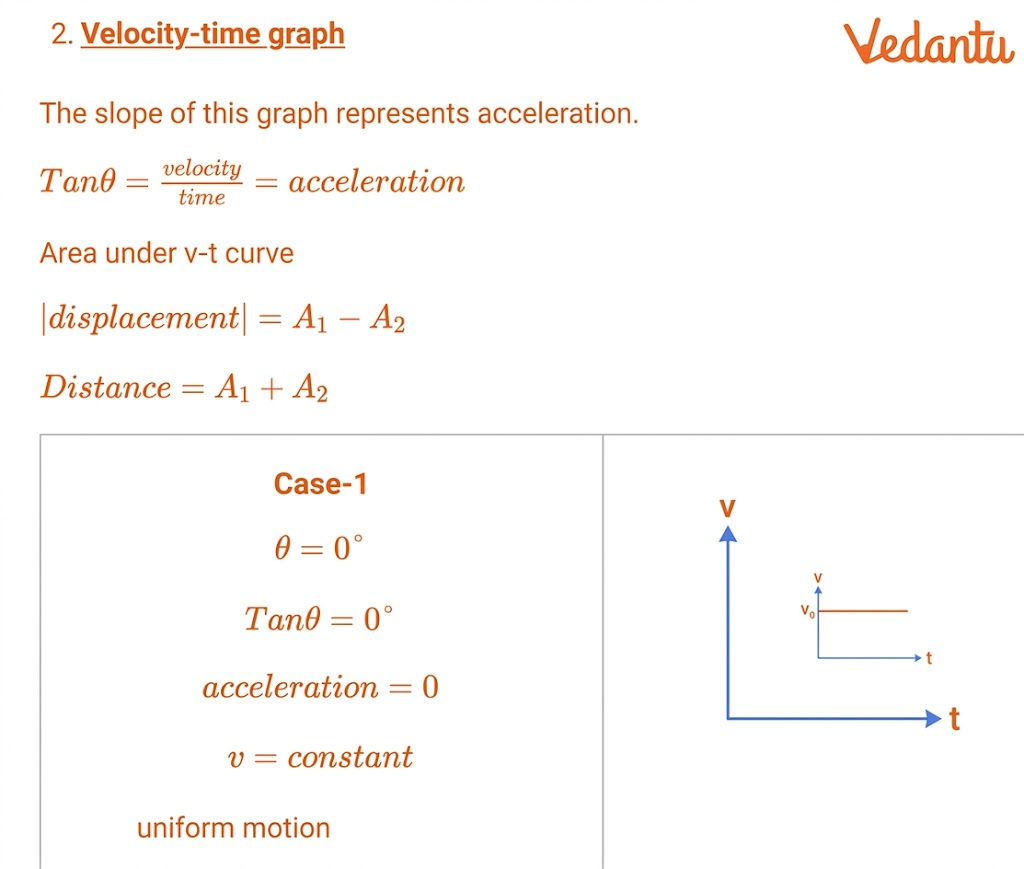
If there is constant acceleration, the graph will be a straight line inclined to the time axis. Position-time and velocity-time graphs together can help identify the nature of an object's motion and solve problems comfortably by analyzing their slopes and areas.
Scalars and Vectors
In Physics, physical quantities are categorized as scalars or vectors. Scalars have only magnitude and no direction (like distance, speed, mass), while vectors have both magnitude and direction (like displacement, velocity, acceleration). This distinction is important when solving problems, as vectors need to be handled using special rules.
Vector Operations: Addition, Subtraction, and Products
Vector addition follows the triangle law or parallelogram law. When adding two vectors, you can join them tip-to-tail or use geometric methods. For subtraction, we add the negative of a vector. Scalar product (dot product) and vector product (cross product) are ways to combine two vectors:
Scalar (dot) product: $A \cdot B = |A||B|\cos\theta$ gives a scalar result.
Vector (cross) product: $A \times B = |A||B|\sin\theta \, \hat{n}$ gives a vector result perpendicular to both A and B.
Unit vectors are vectors of unit magnitude, used to specify direction. Any vector can be resolved into components along chosen axes (usually x and y for 2D cases) using trigonometry, which simplifies calculations.
Relative Velocity
Relative velocity describes how the velocity of one object appears to an observer moving with another object. If two objects move with velocities $\vec{v}_A$ and $\vec{v}_B$, then the velocity of A relative to B is $\vec{v}_{AB} = \vec{v}_A - \vec{v}_B$. This concept is especially useful in boat-stream or rain-man type problems.
Motion in a Plane and Projectile Motion
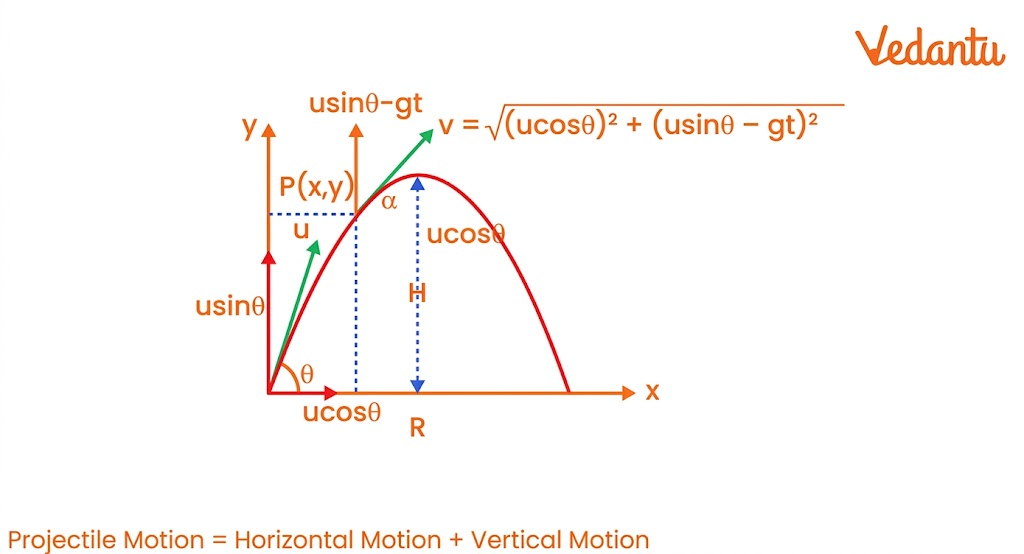
Motion in a plane is two-dimensional and involves both x and y axes. Projectile motion is a classic example, where an object is thrown at an angle and moves under gravity. In such problems, horizontal and vertical motions are analyzed separately:
Horizontal motion: Constant velocity ($v_x = u\cos\theta$)
Vertical motion: Uniformly accelerated motion ($v_y = u\sin\theta - gt$)
Essential results for projectile motion include maximum height $H = \dfrac{u^2\sin^2\theta}{2g}$, time of flight $T = \dfrac{2u\sin\theta}{g}$, and horizontal range $R = \dfrac{u^2\sin2\theta}{g}$.
Uniform Circular Motion
In uniform circular motion, an object moves in a circle at constant speed. However, its velocity keeps changing direction, so it is always accelerating towards the centre (centripetal acceleration). It is given by $a_c = \dfrac{v^2}{r}$, where $v$ is the speed and $r$ is the radius of the circle. The time taken to complete one revolution is called the period, and angular velocity ($\omega$) is related to speed as $v = \omega r$.
Key Terms and Formulae at a Glance
Displacement: The shortest distance from the initial to the final position; a vector.
Distance: Total path length; a scalar.
Average speed: $\dfrac{\text{Total distance}}{\text{Total time}}$
Average velocity: $\dfrac{\text{Total displacement}}{\text{Total time}}$
Instantaneous velocity: Velocity at a particular instant.
Acceleration: Rate at which velocity changes with time.
Projectile motion: Two-dimensional motion under gravity.
Practice sketching different types of motion using graphs and solve a variety of problems to master these concepts. Remember, revising kinematics improves your problem-solving skills for all Physics topics in NEET.
NEET Physics Notes – Kinematics: Key Points for Quick Revision
Kinematics is the backbone of NEET Physics and lays the foundation for advanced topics. Concise revision notes help you quickly understand core ideas like vectors, projectile motion, and relative velocity. Revisiting these concepts improves problem-solving speed and helps avoid common mistakes in calculations during exams.
By focusing on key formulas, graphs, and definitions, these notes offer clarity on important Physics subtopics covered in NEET. Regular revision ensures stronger grasp over motion in a straight line and enables you to tackle tricky questions with confidence.
Unit-Wise NEET Physics Notes FREE PDF Download
FAQs on Kinematics Motion in One Dimension, Equations, Graphs and Projectile Motion for NEET PDF Download (Login Required)
1. What are the most important points to include in revision notes for Kinematics in NEET Physics?
Summarize all key formulas, definitions of Scalars and Vectors, types of motion, and graphical interpretations. Focus on:
- Equations for uniformly accelerated motion
- Different graphs (position-time, velocity-time)
- Concepts of relative velocity and projectile motion
2. How do position-time and velocity-time graphs help in solving NEET Physics questions?
Both position-time and velocity-time graphs visually represent an object's motion. Use these graphs to identify rest, uniform/non-uniform motion, acceleration, and deceleration. Practice interpreting slopes and areas under curves, as these often appear in MCQs and numericals.
3. What are common mistakes to avoid when revising Scalars and Vectors?
Students often confuse scalar and vector quantities or forget direction in answers. Avoid these mistakes:
- Always mention units and directions where needed.
- Practice vector addition and subtraction with diagrams.
4. Which formulas for uniformly accelerated motion are essential to memorize for NEET?
Focus on three main equations of uniformly accelerated motion:
- v = u + at
- s = ut + ½at²
- v² = u² + 2as
5. How should I revise projectile motion and uniform circular motion for NEET Physics?
Break revision into key points:
- Understand equations for range, time of flight, and maximum height in projectile motion
- Revise centripetal acceleration and velocity for uniform circular motion
6. What is the best revision strategy for tackling vectors and their operations (addition, subtraction, resolution) in NEET exams?
Focus on visual learning for vector operations:
- Draw diagrams to add and subtract vectors using head-to-tail and parallelogram methods.
- Practice resolving vectors into components.
7. How can I quickly distinguish between uniform and non-uniform motion for NEET revision?
To identify uniform vs non-uniform motion quickly:
- Uniform: constant speed, straight-line graph
- Non-uniform: variable speed, curved graph
8. What are some key tips for practicing numericals on relative velocity for NEET Physics?
For relative velocity problems, always choose a clear frame of reference and set directions first.
- Draw a quick schematic for direction.
- Apply vector subtraction rules systematically.
9. How important is it to learn unit vectors and vector products for NEET revision notes?
Knowing unit vectors and vector (dot and cross) products is crucial, as they provide the basis for many motion questions. Ensure you can:
- Express vectors in i, j, k notation
- Calculate scalar and vector products accurately
10. What last-minute revision techniques work best for motion in a plane and frame of reference topics?
In final revisions for motion in a plane and frame of reference, quickly review concept maps, formula lists, and solved MCQs. Focus on practicing:
- Conceptual MCQs and previous NEET questions
- Short notes for quick recall
