



Class 12 History Chapter 8 Peasants, Zamindars and the State Important Questions with Answers PDF
This set of Chapter 8 History Class 12 Important Questions contains 24 solved questions: six MCQs, five very short answers, seven short answers and six long answers. It covers the Ain-i Akbari, agricultural technology, jins-i kamil, village artisans, caste panchayats, forest-based livelihoods, women's property rights, Mughal revenue assessment, and the circulation of silver.
Class 12 History Chapter 8 Important Questions MCQ Practice
Q1. Which of the following texts, written by Abu'l Fazl, provides important information about Mughal agrarian administration?
(a) Babur Nama
(b) Ain-i Akbari
(c) Tuzuk-i Jahangiri
(d) Amuktamalyada
Answer: (b) Ain-i Akbari.
Explanation: The Ain-i Akbari, written by Abu'l Fazl, records information about Akbar's administration, revenue arrangements and provincial resources. It is an important source for studying agrarian society under the Mughals.
Q2. What was the main difference between khud-kashta and pahi-kashta peasants?
(a) Khud-kashta were artisans, while pahi-kashta were soldiers.
(b) Khud-kashta cultivated land in their own village, while pahi-kashta cultivated land outside their village.
(c) Khud-kashta worked only for zamindars, while pahi-kashta worked for the emperor.
(d) Khud-kashta paid no revenue, while pahi-kashta paid all taxes.
Answer: (b) Khud-kashta cultivated land in their own village, while pahi-kashta cultivated land outside their village.
Explanation: Khud-kashta peasants were residents cultivating land in their own village. Pahi-kashta peasants were non-resident cultivators who worked on land elsewhere, sometimes because of favourable revenue conditions or economic difficulties.
Q3. Which crops were especially described as jins-i kamil in Mughal records?
(a) Cotton and sugarcane
(b) Rice and wheat
(c) Barley and millet
(d) Maize and potatoes
Answer: (a) Cotton and sugarcane.
Explanation: Jins-i kamil referred to valuable crops that brought higher revenue. Cotton and sugarcane were prominent examples mentioned in the chapter.
Q4. Who was commonly known as the muqaddam or mandal in a Mughal village?
(a) A military commander
(b) The village headman
(c) A royal historian
(d) A foreign merchant
Answer: (b) The village headman.
Explanation: The village headman, known as the muqaddam or mandal, supervised village affairs and, with the help of the patwari, kept accounts.
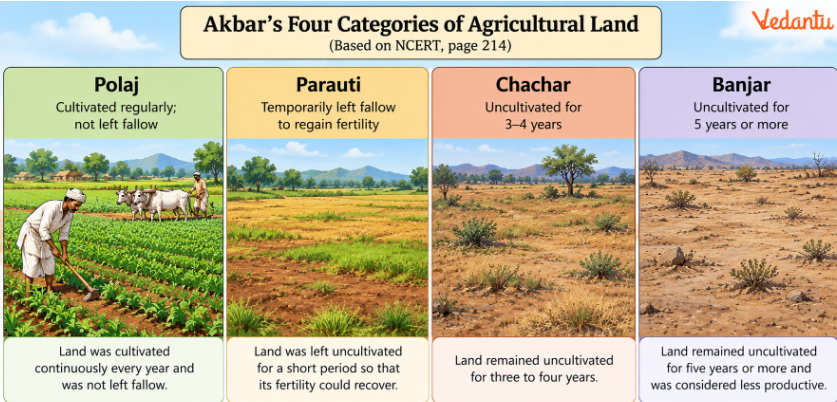
Q5. Which Mughal land category referred to land left uncultivated for three or four years?
(a) Polaj
(b) Parauti
(c) Chachar
(d) Banjar
Answer: (c) Chachar.
Explanation: Akbar's revenue classification described chachar as land left fallow for three or four years. Banjar referred to land uncultivated for five years or more.
Q6. Which term was used for the amount of land revenue actually collected, rather than the amount assessed?
(a) Jama
(b) Hasil
(c) Milkiyat
(d) Peshkash
Answer: (b) Hasil.
Explanation: In Mughal revenue administration, jama was the assessed amount, while hasil was the amount actually collected. The two could differ because of local conditions and collection difficulties.
Class 12 History Chapter 8 Very Short Answer Questions
Q7. What does the term raiyat mean in Mughal-period records?
Answer: Raiyat was a term commonly used in Indo-Persian sources for a peasant or cultivator. Other terms used for cultivators included muzarian, kisan and asami.
Q8. What were the two main agricultural seasons in Mughal India?
Answer: The two main agricultural seasons were kharif, associated with autumn crops, and rabi, associated with spring crops. Many regions produced two crops annually, while some well-watered regions supported three.
Q9. What were milkiyat lands?
Answer: Milkiyat lands were zamindars' personal property. These lands could be sold, inherited or mortgaged and were often cultivated using hired or dependent labour.
Q10. What was peshkash in the context of Mughal relations with forest communities?
Answer: Peshkash was a form of tribute the Mughal state collected. Forest communities sometimes supplied goods such as elephants as part of this tribute.
Q11. What role did the diwan play in the Mughal revenue system?
Answer: The diwan supervised the fiscal administration of the Mughal Empire. This included overseeing the machinery that assessed and collected land revenue.
Class 12 History Chapter 8 Short Answer Questions
Q12. Why did some peasants become pahi-kashta cultivators in Mughal India? Explain with examples.
Answer: Peasants became pahi-kashta cultivators when they cultivated land in villages other than those in which they normally lived.
Two important reasons are :
1. More Favourable Revenue Conditions: Some cultivators moved voluntarily to places where revenue demands were lower or agricultural opportunities were better.
2. Economic Distress: Others were forced to leave their villages because of famine or difficult living conditions.
3. Availability of Land: The availability of cultivable land in another region could encourage migration.
4. Mobility of Agricultural Labour: Peasant movement helped bring new land under cultivation and supported agricultural expansion.
Conclusion: Pahi-kashta cultivation shows that Mughal peasants were not always tied permanently to one village. Their movements were influenced by opportunities and economic hardship.
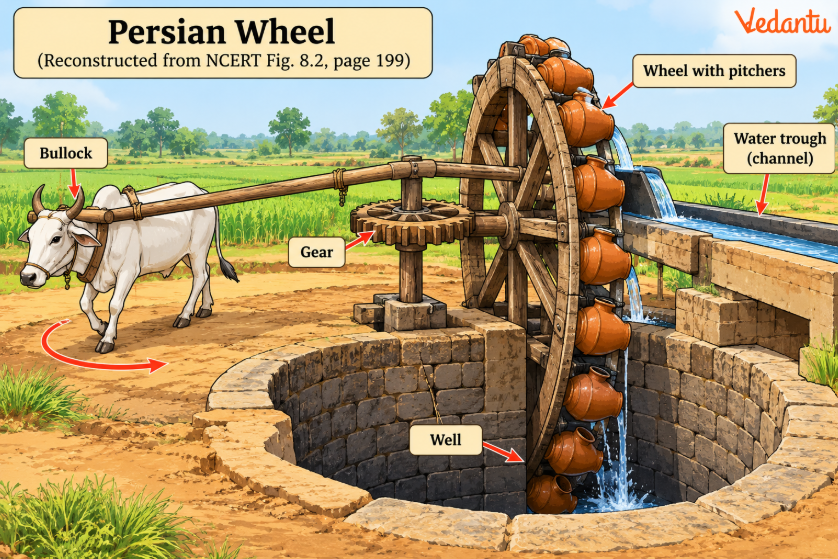
Q13. How did Babur describe irrigation methods in northern India? Explain how the Persian wheel worked.
Answer: In the Babur Nama, Babur described how cultivators used wells, buckets and water wheels to irrigate fields and orchards.
1. Dependence on Rainfall: Many crops were grown with monsoon rainfall, but trees and some cultivated fields required additional water.
2. Persian Wheel: Babur described a wheel system used in areas such as Lahore and Dipalpur.
3. Arrangement of Pitchers: Water pitchers were attached to a continuous rope arrangement running over a wheel.
4. Use of Animal Power: A bullock turned a connected wheel mechanism, causing the pitchers to move.
5. Water Distribution: The pitchers lifted water from the well and emptied it into a trough, from where it was directed towards fields.
6. Bucket Irrigation: Babur also described large buckets raised from wells with the help of bullocks in areas such as Agra, Chandwar and Bayana.
Conclusion: These methods show that cultivators combined rainfall with animal-powered irrigation technology.
Q14. Why can Mughal agriculture not be described as purely subsistence agriculture? Explain with reference to jins-i kamil.
Answer: Mughal agriculture produced food for consumption, but it also supplied commodities for markets and revenue collection.
1. Food Crops: Peasants cultivated rice, wheat, millets and other basic foodgrains.
2. Seasonal Cultivation: Kharif and rabi seasons allowed different crops to be grown during the year.
3. Commercial Crops: Crops such as cotton and sugarcane were cultivated because of their economic value.
4. Jins-i Kamil: Mughal sources referred to some valuable crops as jins-i kamil, meaning perfect crops.
5. State Encouragement: The Mughal state encouraged the cultivation of valuable crops because they could generate more revenue.
6. Market Connections: Villages were linked to towns through trade, and farmers sold part of their produce.
Conclusion: Subsistence and commercial farming existed together in Mughal agrarian society.
Q15. Explain the role of caste in determining social and economic relationships in Mughal villages.
Answer: Caste influenced occupations, social status and access to resources in many Mughal villages.
1. Unequal Status: Some communities were placed at the lower levels of the social hierarchy and had fewer resources.
2. Occupational Differences: Agricultural labourers, artisans and service providers often occupied different positions in village society.
3. Relationship with Poverty: Historical evidence shows a strong relationship between caste, poverty and social status among disadvantaged groups.
4. Changes in Status: Social positions were not completely fixed. Some communities gained influence through profitable occupations.
5. Examples: Ahirs, Gujars and Malis improved their position through cattle rearing and horticulture. Sadgops and Kaivartas in eastern India acquired peasant status.
6. Regional Variation: The relationship between caste and economic position differed across regions and communities.
Conclusion: Caste shaped village relationships, but economic activities and occupational changes could also influence social status.
Q16. How did village panchayats and headmen manage disputes and community resources in Mughal India?
Answer: Village panchayats were important institutions of local decision-making.
1. Village Elders: Panchayats generally consisted of influential elders who held rights over property.
2. Headman: The panchayat was headed by a muqaddam or mandal.
3. Village Accounts: The headman supervised the preparation of accounts with the help of the patwari.
4. Common Funds: Panchayats maintained funds collected through contributions from villagers.
5. Community Works: These funds could support activities such as digging canals, constructing bunds and providing relief during natural disasters.
6. Settlement of Disputes: Panchayats heard complaints about unfair taxation and demands for unpaid labour.
7. Social Regulation: They also enforced community rules and caste boundaries through fines and other penalties.
8. Resistance to Excessive Demands: Peasants sometimes approached panchayats to protest unfair revenue demands.
Conclusion: Panchayats managed village resources and disputes, but their authority also reflected the unequal social relationships of the time.
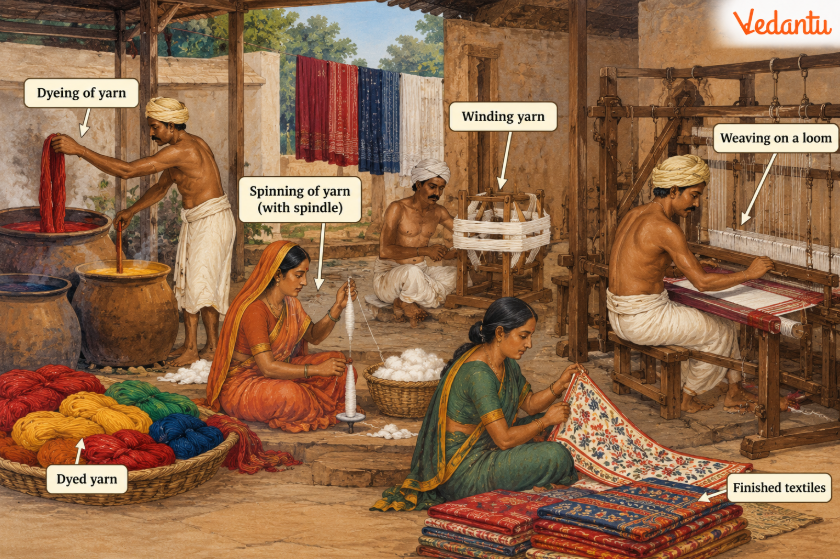
Q17. What was the relationship between village artisans and peasants during the Mughal period?
Answer: Village artisans and cultivators depended on each other for goods, services and agricultural production.
1. Different Occupations: Village artisans included potters, blacksmiths, carpenters, barbers and goldsmiths.
2. Agricultural Requirements: Blacksmiths and carpenters produced and repaired implements used by farmers.
3. Shared Occupations: Some peasant households engaged in crafts during periods when agricultural work was limited.
4. Payment in Produce: Artisans were sometimes compensated with a share of the harvest.
5. Land Allotments: Some received land as payment for their services.
6. Hereditary Rights: In Maharashtra, certain service lands became hereditary holdings known as miras or watan.
7. Other Forms of Payment: Payments could also be made through goods, small cash allowances and food.
Conclusion: Rural production depended on regular exchanges between cultivators and specialist artisans.
Q18. How did the introduction of new crops influence agricultural production in seventeenth-century India?
Answer: The sixteenth and seventeenth centuries witnessed the arrival and spread of crops from different parts of the world.
1. Tobacco: Tobacco first spread in the Deccan and reached northern India during the early seventeenth century.
2. Maize: Maize entered India through connections involving Africa and Spain and became an important crop in western India.
3. New Vegetables: Tomatoes, potatoes and chillies were introduced from the New World.
4. New Fruits: Pineapple and papaya also became known in the subcontinent.
5. Expanding Crop Diversity: These additions increased the range of crops available to cultivators and consumers.
6. Trade and Consumption: Some new crops gradually entered everyday consumption and commercial exchange.
Conclusion: The introduction of new crops reflected growing connections between India and overseas regions and contributed to changing patterns of agriculture.
Class 12 History Chapter 8 Long Answer Questions
Q19. Describe the agrarian structure of Mughal India. How did peasants, village communities, artisans and the state depend on one another?
Answer: Agrarian society in Mughal India was organised around cultivation, village communities, social relationships, and land revenue collection.
During the sixteenth and seventeenth centuries, approximately 85% of India's population lived in villages, according to the chapter.
1. Peasants as Agricultural Producers
Peasants performed the main tasks of agriculture, including ploughing, sowing, harvesting and processing agricultural produce.
They cultivated crops for household consumption and sale.
2. Categories of Peasants
Two important categories were:
Khud-kashta: Resident cultivators working in their own villages.
Pahi-kashta: Non-resident cultivators farming land in another village.
3. Agricultural Expansion
Available land and labour, along with peasants' mobility, helped expand cultivation.
4. Irrigation and Agricultural Technology
Farmers used wells, Persian wheels, animal-powered equipment, ploughs and other tools.
The state also supported some irrigation works, including canals.
5. Village Communities
Relationships between different families, caste groups, cultivators, and service providers shaped village life.
6. Panchayats
Panchayats managed local affairs and community resources.
They also settled disputes and regulated social conduct.
7. Village Artisans
Blacksmiths, carpenters, potters and other specialists supplied goods and services.
They were compensated with agricultural produce, land, or money.
8. Zamindars
Zamindars held important land rights and often collected revenue on behalf of the state.
They also maintained military forces and influenced rural society.
9. Mughal State
The Mughal government collected much of its income from agricultural production.
Revenue officials measured land, assessed revenue and attempted to collect taxes.
10. Trade and Markets
Commercial crops and the exchange of agricultural and craft products connected villages with markets and towns.
Relationship Between Major Groups
Conclusion: Mughal agrarian society consisted of interconnected groups whose relationships involved cooperation, exchange, unequal power and occasional conflict.
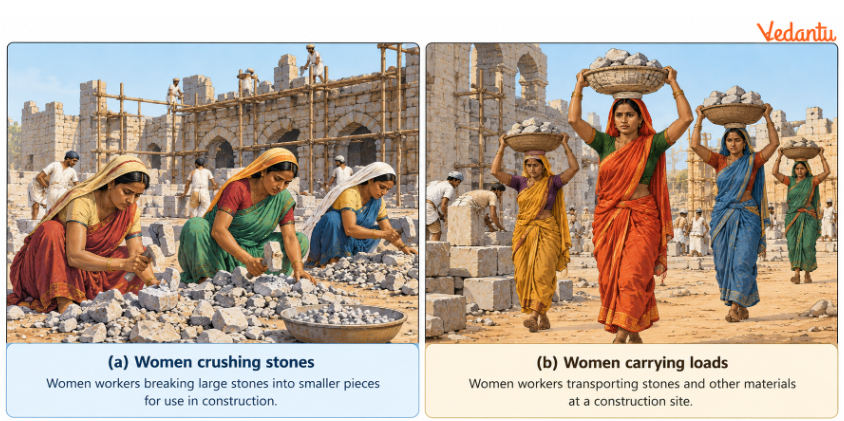
Q20. Examine the role of women in agricultural production and rural society during the Mughal period. Were women limited to domestic work?
Answer: Women played a significant role in rural production during the sixteenth and seventeenth centuries. Their contributions extended beyond household responsibilities.
1. Participation in Agriculture
Women worked alongside men in agricultural activities.
While men often tilled and ploughed fields, women sowed, weeded, threshed, and winnowed.
2. Labour in Craft Production
Women participated in textile production and other household-based work. Agricultural and artisan households often involved several family members.
3. Connection Between Household and Production
Rural families depended on both men's and women's labour. Household responsibilities and productive work were closely connected.
4. Women's Labour and Village Economies
Women contributed to agricultural output and activities needed to sustain village livelihoods.
Their work was therefore economically important even when it was not recorded in the same way as men's work.
5. Social Conditions
The chapter discusses the difficulties created by malnutrition, repeated pregnancies and high maternal mortality.
These conditions affected women's health and social relationships.
6. Marriage Customs
The chapter explains that some peasant and artisan communities practised bride-price and permitted remarriage of divorced or widowed women.
These customs reflected the importance attached to women's labour and childbearing.
7. Women's Property Rights
Some women possessed property and participated in property transactions. The textbook refers to petitions and documents showing women seeking recognition of their inheritance or property claims.
8. Women as Zamindars
Women could also exercise landed authority. The chapter mentions women zamindars in eighteenth-century Bengal, including the prominent Rajshahi zamindari, showing that women sometimes held powerful positions.
9. Unequal Social Relationships
Despite their contributions, women faced patriarchal restrictions and unequal power within households and society.
Conclusion: Women played an essential role in Mughal agrarian production. Their roles included farming, household-based crafts and, in some cases, property ownership and estate management.
Q21. Explain how forest dwellers interacted with the Mughal state and the wider economy. How did their lives change during the sixteenth and seventeenth centuries?
Answer: Forest dwellers played an important role in Mughal society. They supported themselves through activities other than settled agriculture but remained connected to states and markets.
1. Forest-Based Livelihoods
Forest communities depended on hunting, gathering forest produce and shifting cultivation.
Their activities often changed with the seasons.
2. Seasonal Activities
The chapter uses the example of the Bhils:
Spring: Collection of forest products.
Summer: Fishing.
Monsoon: Cultivation.
Autumn and winter: Hunting.
3. Mobility
Seasonal movement was a key feature of many forest communities' lives.
4. Forests as Places of Refuge
Mughal rulers sometimes viewed forested regions as areas where people resisting imperial authority could seek protection.
5. State Demand for Elephants
The Mughal state needed elephants for military and other purposes.
Forest communities may have been required to supply elephants as tribute or peshkash.
6. Commercial Exchange
Forest products such as honey, beeswax and gum lac were valuable commodities.
Some were sold in regional and overseas markets.
7. Trade Between Hills and Plains
Communities exchanged forest products for cloth, salt, ornaments and other goods.
Barter was one method of exchange.
8. Growth of Tribal Leadership
Some tribal chiefs became zamindars or rulers.
They organised armed forces and exercised authority over their communities.
9. Examples
The chapter discusses the Ahom rulers, who used a system of compulsory military service involving paiks.
It also describes the expansion of political authority among groups such as the Koch rulers.
10. Religious and Cultural Change
New cultural and religious influences entered forested regions.
The chapter notes the role of Sufi pirs in spreading Islam among some communities in newly cultivated regions.
Conclusion: Forest communities were not isolated from the wider economy. Trade, tribute, military organisation, and the expansion of agriculture and state authority changed their livelihoods and social relationships.
Q22. How did zamindars acquire and maintain power in Mughal rural society? Explain their relationship with peasants and the state.
Answer: Zamindars were influential landed groups in Mughal India. They enjoyed economic, social and military privileges and played an important role in rural administration.
1. Control over Land
Zamindars possessed extensive personal lands known as milkiyat.
They could sell, inherit, or mortgage these lands.
2. Collection of Revenue
Many zamindars collected land revenue for the Mughal state and received financial compensation for this service.
3. Social Position
Factors such as caste, hereditary position, property, and service to the state influenced their authority.
4. Military Strength
Zamindars often maintained fortified residences or small forts known as qilachas.
Some possessed cavalry, infantry, artillery and other military resources.
5. Expansion of Landed Rights
Zamindars could expand their rights by bringing new lands under cultivation, purchasing rights, and receiving state recognition.
6. Encouraging Cultivation
Zamindars sometimes helped settle cultivators by providing land and resources such as loans.
7. Role in Markets
They sold agricultural produce from their own lands and helped establish village markets or haats.
8. Economic Inequality
Zamindars occupied a powerful position compared with ordinary cultivators.
They could exercise considerable influence over local resources and revenue collection.
9. Relationship with Peasants
Although zamindars could exploit peasants, their relationships also involved patronage and mutual dependence.
Peasants sometimes supported zamindars in struggles against the Mughal state.
10. Rural Conflicts
Revenue demands, land disputes, and competing claims to authority could create conflicts among zamindars, peasants, and imperial officials.
Conclusion: Zamindari power rested on landownership, revenue collection, social influence, and military resources; their relationships with cultivators involved both dependence and unequal authority.
Q23. Describe the Mughal land revenue system. Explain jama, hasil and Akbar's classification of agricultural land.
Answer: Land revenue was the economic foundation of the Mughal Empire. The state developed administrative arrangements to assess and collect revenue from cultivated land.
1. Importance of Land Revenue
Agricultural revenue financed the imperial administration, military establishment and other state activities.
2. Role of Revenue Officials
Officials measured land, recorded cultivation and assessed expected agricultural production.
The diwan supervised the fiscal administration.
3. Assessment and Collection
The revenue process involved two major stages:
Assessment of the amount due.
Collection of the amount actually paid.
4. Jama and Hasil
The amount collected could be lower than the amount assessed because local agricultural and economic conditions affected collection.
5. Land Measurement
The state attempted to measure cultivated and cultivable land to determine its revenue claims.
However, extensive forested and difficult regions could not always be measured successfully.
6. Akbar's Classification of Land
The Ain-i Akbari identifies four main categories.
7. Revenue from Different Land Categories
The state treated different types of land differently for revenue purposes.
The classification helped the administration recognise variations in cultivation and productivity.
8. Revenue Collection in Cash and Kind
The state encouraged cash payments but also allowed collection in agricultural produce.
9. Kankut
Kankut was a method of estimating crop output.
The term combined references to grain and estimation.
10. Batai or Bhaoli
Under batai or bhaoli, cultivators and those entitled to revenue divided the harvested crop.
11. Administrative Challenges
Actual collection depended on crop output, local conditions, and officials' ability to enforce state demands.
12. Importance of Revenue Records
Mughal records provide historians with evidence about agricultural production, land categories and the state's relationship with rural communities.
Conclusion: The Mughal revenue system combined land measurement, assessment, crop estimates and collection procedures. It was designed to secure income for the empire while operating within the changing conditions of rural society.
Q24. Why is the Ain-i Akbari an important source for studying Mughal agrarian society? Discuss its contents and limitations.
Answer: The Ain-i Akbari, written by Abu'l Fazl, is one of the most important sources for understanding the Mughal Empire's administration, economy, and society under Akbar.
1. Author and Historical Context
Abu'l Fazl was a court historian of Emperor Akbar.
The Ain-i Akbari formed the third part of the Akbar Nama.
2. Nature of the Work
The text recorded imperial regulations, administrative practices and detailed information about different provinces.
It served as both an administrative compilation and a description of the empire.
3. Information about Agriculture
The Ain provides information about crops, cultivation and agricultural production.
4. Revenue Administration
It describes revenue assessment, rates, land categories, and collection procedures.
5. Provincial Information
The text contains details about the Mughal provinces, or subas.
Its statistical records help historians compare different regions of the empire.
6. Social and Economic Information
The Ain includes material about occupations, administration, people and various economic activities.
7. A View from the Mughal Court
Because Abu'l Fazl wrote under imperial patronage, his account emphasised Akbar's authority and administrative achievements.
The perspectives of ordinary peasants are not directly represented in the same way.
8. Incomplete Coverage
Information was not equally detailed across regions.
Some important records, including certain categories of zamindari information, were unavailable for Bengal and Orissa.
9. Regional Bias in Prices and Wages
Some price and wage lists relied heavily on information from areas around Agra.
These figures cannot automatically be treated as representative of every part of the empire.
10. Other Historical Sources
To develop a more balanced understanding, historians compare the Ain with:
Regional revenue records.
Documents from Gujarat, Maharashtra and Rajasthan.
Petitions and records of agrarian disputes.
Later East India Company records.
Other contemporary writings.
11. Importance of Comparison
These additional sources reveal disputes, local practices and the experiences of people who may be less visible in imperial accounts.
12. Historical Value
Despite its limitations, the Ain-i Akbari provides unusually detailed information on administration, revenue and society.
Conclusion: The Ain-i Akbari is an essential source for Mughal agrarian history, but historians must read it critically and compare its claims with evidence from other regions and communities.
Why Practise Class 12 History Chapter 8 Important Questions with Vedantu?
Practising Class 12 History Chapter 8 Important Questions helps students understand Mughal agriculture, village society, zamindari authority, and land-revenue administration. These solved chapter-based questions support revision of important historical terms, source-based evidence and descriptive answers.
How to Prepare Class 12 History Chapter 8 Important Questions with Vedantu?
Revise important terms: Learn raiyat, khud-kashta, pahi-kashta, milkiyat, jama and hasil.
Understand agrarian relationships: Focus on peasants, zamindars, artisans and panchayats.
Practise comparisons: Differentiate land categories, cultivator types and revenue methods.
Study source-based questions: Read excerpts from the Babur Nama and Ain-i Akbari carefully.
Study chapter illustrations: Identify agricultural tools, irrigation devices, rural work and Mughal coins.
Important Study Material Links for Class 12 History Chapter 8
Chapter-Wise Important Questions for Class 12 History
Important Study Materials for Class 12 History
FAQs on Important Questions and Answers for Class 12 History Chapter 8 – Peasants, Zamindars and the State (Themes in Indian History-II) | 2026-27
1. Why is the Ain-i Akbari considered important for understanding Mughal village life?
The Ain-i Akbari provides detailed information about crops, land revenue, agricultural production, imperial administration and different provinces. However, it mainly presents the Mughal court's perspective, so historians also use regional records to understand peasants' experiences.
2. What was the difference between khud-kashta and pahi-kashta peasants?
Khud-kashta peasants cultivated land in their own village. Pahi-kashta peasants lived in one village but cultivated land elsewhere, sometimes because of favourable revenue conditions or economic distress.
3. Why were cotton and sugarcane called jins-i kamil in Mughal India?
Cotton and sugarcane were considered valuable crops that could generate higher revenue. Mughal sources described these commercially important crops as jins-i kamil, or "perfect crops."
4. How did the Persian wheel help Mughal-period farmers irrigate their fields?
The Persian wheel used animal power to raise water from wells. Pitchers attached to a rotating mechanism collected water and emptied it into a trough, from which it could flow into cultivated fields.
5. Why was the village panchayat important in Mughal agrarian society?
The panchayat managed local affairs, community funds and disputes. It could support irrigation works and hear complaints about taxation, although it also enforced caste-related social rules.
6. What was the relationship between Mughal peasants and village artisans?
Peasants depended on artisans for tools and services. Artisans could receive grain, land, goods or money in exchange for their work. Some peasant households also practised crafts during less busy agricultural periods.
7. Were women involved in agriculture during the Mughal period?
Yes. Women participated in sowing, weeding, threshing, winnowing and other productive activities. They also contributed to household-based crafts, and some women held property and managed landed estates.
8. How did caste influence economic relationships in Mughal villages?
Caste affected social status, occupations and access to resources. Some disadvantaged communities had fewer opportunities, while certain groups improved their standing through profitable activities such as cattle rearing and horticulture.
9. Why did the Mughal state demand elephants from forest communities?
Elephants were valuable for military and royal purposes. The Mughal state sometimes collected them as part of peshkash, a form of tribute from forest communities.
10. How did zamindars maintain their power over rural society?
Zamindars controlled personal land, collected revenue, maintained armed forces and exercised social influence. Some also provided loans to cultivators and established markets.
11. What is the difference between jama and hasil in Mughal revenue records?
Jama was the assessed amount of revenue, while hasil was the amount actually collected. The two could differ because of local conditions and difficulties in recovering the full assessment.
12. What were the four land categories used in Akbar's revenue system?
They were polaj, parauti, chachar and banjar. The categories distinguished regularly cultivated land, temporarily fallow land, land left fallow for three or four years, and land uncultivated for five years or longer.
13. Why did silver become important in the Mughal economy?
The expansion of overseas trade brought silver into India. This increased the availability of silver currency, supported commercial exchange, and enabled the collection of land revenue in cash.
14. Why was the Mughal economy connected with trade and markets despite being mainly agricultural?
Farmers produced both food and marketable crops, while artisans supplied goods and services. Villages exchanged products with towns, and overseas trade created additional demand for certain agricultural and craft goods.
15. How should students prepare source-based questions from Class 12 History Chapter 8?
Students should identify the author of each source, understand its historical context and explain what it reveals about rural life. For example, Babur's observations help explain irrigation practices, while Abu'l Fazl's writings provide information about land revenue and imperial administration.