



Class 12 History Chapter 1 Important Questions with Answers for CBSE Exams
These questions cover key concepts from Bricks, Beads and Bones – The Harappan Civilisation. They are arranged by question type so students can practise factual recall, archaeological interpretation and descriptive answer writing. The questions are intended for NCERT-based practice and are not predictions of the exact CBSE examination questions.
Class 12 History Chapter 1 Multiple Choice Questions
Q1. During which period did the Mature Harappan Civilisation flourish?
(a) 6000–2600 BCE
(b) 2600–1900 BCE
(c) 1900–1300 BCE
(d) 1500–600 BCE
Answer: (b) 2600–1900 BCE
Q2. Which Harappan site provides evidence of a ploughed field with two sets of furrows crossing each other?
(a) Mohenjodaro
(b) Lothal
(c) Kalibangan
(d) Harappa
Answer: (c) Kalibangan
Q3. Which of the following was a distinctive feature of Harappan urban planning?
(a) Houses without drainage facilities
(b) Streets arranged in a grid pattern
(c) Buildings constructed without standardised bricks
(d) Absence of public structures
Answer: (b) Streets arranged in a grid pattern
Q4. The Great Bath was discovered at which Harappan site?
(a) Harappa
(b) Dholavira
(c) Mohenjodaro
(d) Chanhudaro
Answer: (c) Mohenjodaro
Q5. Which Harappan settlement was particularly associated with specialised craft production, including bead-making, shell-cutting and metal-working?
(a) Chanhudaro
(b) Rakhigarhi
(c) Kalibangan
(d) Ganweriwala
Answer: (a) Chanhudaro
Q6. What material was generally used to manufacture standardised Harappan weights?
(a) Iron
(b) Chert
(c) Wood
(d) Ivory
Answer: (b) Chert
Q7. What name was possibly used for the Harappan region in Mesopotamian texts?
(a) Magan
(b) Dilmun
(c) Meluhha
(d) Uruk
Answer: (c) Meluhha
Q8. Who announced the discovery of the Indus Valley Civilisation to the world in 1924?
(a) Alexander Cunningham
(b) John Marshall
(c) R.E.M. Wheeler
(d) George Dales
Answer: (b) John Marshall
Q9. Which statement about the Harappan script is correct?
(a) It has been completely deciphered.
(b) It was generally written from left to right.
(c) It contained approximately 375–400 signs.
(d) It was written only on copper plates.
Answer: (c) It contained approximately 375–400 signs.
Q10. Which archaeologist questioned the theory of a large-scale massacre at Mohenjodaro?
(a) Daya Ram Sahni
(b) Rakhal Das Banerji
(c) George Dales
(d) John Marshall
Answer: (c) George Dales
Class 12 History Chapter 1 Very Short Answer Questions
Q11. What is meant by the term Harappan Civilisation? Mention its three phases.
Answer:
The Harappan Civilisation, also known as the Indus Valley Civilisation, was an ancient civilisation known for its planned urban settlements, craft production and trade networks.
Its three phases were:
1. Early Harappan: 6000–2600 BCE.
2. Mature Harappan: 2600–1900 BCE.
3. Late Harappan: 1900–1300 BCE.
Q12. Mention any two crops grown by the Harappans. How do archaeologists identify them?
Answer:
1. The Harappans cultivated crops such as wheat, barley, lentils, chickpeas and sesame.
2. Archaeologists identify these crops by examining charred grains and seeds recovered during excavations. Archaeo-botanists study these plant remains.
Q13. What was the standard brick ratio used in Harappan settlements? Why was it important?
Answer:
1. Harappan bricks followed a standardised height, breadth and length ratio of 1:2:4.
2. This uniformity helped maintain consistency in construction and indicates organised planning across Harappan settlements.
Q14. What were the main functions of Harappan seals and sealings?
Answer:
1. Seals and sealings helped identify the sender of goods during long-distance exchanges.
2. Seal impressions on wet clay attached to packages helped show whether the goods had been tampered with during transportation.
Q15. Why is the Harappan script described as enigmatic?
Answer:
1. The Harappan script remains undeciphered, so its exact meaning is unknown.
2. It contained approximately 375–400 signs, and most inscriptions were short, making it difficult for historians to understand the language and written records of the civilisation.
Class 12 History Chapter 1 Short Answer Questions
Q16. Explain three types of archaeological evidence used to reconstruct the dietary practices of the Harappans.
Answer:
Archaeologists reconstruct Harappan dietary practices by examining various material remains.
1. Plant remains: Charred grains and seeds indicate that the Harappans consumed wheat, barley, lentils, chickpeas and sesame. Millets were found at sites in Gujarat.
2. Animal bones: Bones of cattle, sheep, goats, buffaloes and pigs suggest that these animals were domesticated. Bones of wild animals, fish and birds also provide information about possible food sources.
3. Food-processing equipment: Grinding stones, saddle querns and cooking vessels indicate that people processed grains and other food materials before consumption.
Thus, archaeological evidence suggests that the Harappans consumed a variety of plant and animal products.
Q17. Describe three features of the drainage system of Mohenjodaro.
Answer:
The drainage system of Mohenjodaro was one of the most distinctive features of Harappan town planning.
1. Connected drains: Bathrooms in residential houses were connected to street drains, allowing wastewater to flow outside the houses.
2. Covered drains: Main drains were constructed with bricks and covered with removable bricks or, in some cases, limestone, making cleaning possible.
3. Cleaning arrangements: House drains often emptied into sumps or cesspits, where solid waste settled before wastewater entered the street drains. Longer channels also had cleaning arrangements.
These features show that the Harappans paid considerable attention to drainage and urban maintenance.
Q18. How did the Harappans obtain raw materials for craft production? Explain with three examples.
Answer:
The Harappans obtained raw materials through settlements near resources, expeditions and long-distance contacts.
1. Shell: Settlements such as Nageshwar and Balakot were located near coastal areas where shells were available for making bangles and other objects.
2. Precious stones: Shortughai in Afghanistan was located near a major source of lapis lazuli. Lothal was situated near sources of carnelian and steatite.
3. Metals: Copper may have been obtained from the Khetri region of Rajasthan and Oman, while expeditions to South India may have helped procure gold.
These examples indicate that Harappan crafts depended on organised networks for obtaining materials.
Q19. Explain how archaeologists identify specialised craft production centres in Harappan settlements.
Answer:
Archaeologists identify craft production centres by examining materials and objects found during excavations.
1. Raw materials and tools: The presence of stone nodules, shells, copper ore, drills and other tools suggests manufacturing activities.
2. Unfinished objects: Partially completed beads, shell objects and other artefacts provide evidence of production at a particular site.
3. Waste materials: Discarded stone chips, shell fragments and other manufacturing waste indicate that objects were produced locally.
For example, Chanhudaro was an important craft centre associated with bead-making, shell-cutting and metal-working.
Q20. What do Harappan burials reveal about social and economic differences? Explain.
Answer:
Archaeologists study Harappan burials to understand possible social and economic differences.
1. Burial pits: Most dead bodies were placed in pits, but some pits were lined with bricks. These variations may indicate differences in burial practices.
2. Grave goods: Some burials contained pottery, ornaments and copper mirrors. Jewellery has been found in the graves of both men and women.
3. Limited valuable objects: Unlike some other ancient civilisations, Harappan burials generally did not contain large quantities of precious objects.
Therefore, burials provide clues about social differences, but the evidence is insufficient to establish a clear social hierarchy.
Q21. Describe three pieces of evidence suggesting trade contacts between the Harappans and Mesopotamia.
Answer:
Archaeological discoveries and written sources suggest that the Harappans maintained trade contacts with distant regions.
1. Mesopotamian records: Texts mention a region called Meluhha, possibly referring to the Harappan region, and list products such as carnelian, copper, gold and wood.
2. Seals and artefacts: Harappan seals, beads and other objects found in regions connected with Mesopotamia indicate commercial and cultural contact.
3. Maritime connections: Depictions of boats and references to Meluhha as a land of seafarers suggest that sea routes were used for communication and exchange.
These sources provide evidence of long-distance connections between Harappan settlements and West Asia.
Q22. Why is it difficult to identify the rulers of the Harappan Civilisation? Explain three reasons.
Answer:
The political organisation of the Harappan Civilisation remains uncertain because archaeologists have not found clear evidence of its rulers.
1. Absence of definite royal structures: Although some large buildings have been found, archaeologists cannot confidently identify them as palaces.
2. Uncertain sculptures: The famous statue called the "priest-king" does not provide definite proof of a ruler or priestly authority.
3. Undeciphered script: Since the Harappan script has not been deciphered, written evidence cannot establish the names or powers of rulers.
Therefore, historians have proposed different possibilities, including multiple rulers or a more unified political organisation.
Q23. Explain the contributions of Daya Ram Sahni, Rakhal Das Banerji and John Marshall to the discovery of the Harappan Civilisation.
Answer:
These archaeologists made important contributions to recognising the Harappan Civilisation.
1. Daya Ram Sahni: His work at Harappa helped bring to light seals and remains belonging to an ancient archaeological culture.
2. Rakhal Das Banerji: He discovered similar seals at Mohenjodaro, suggesting a connection between the two ancient settlements.
3. John Marshall: As Director-General of the Archaeological Survey of India, he announced the discovery of the Indus Valley Civilisation in 1924.
Their discoveries helped establish that the Indian subcontinent had an urban civilisation contemporary with ancient Mesopotamia.
Class 12 History Chapter 1 Long Answer Questions
Q24. Explain the distinctive features of town planning and urban architecture in the Harappan Civilisation.
Answer:
The Harappan Civilisation was known for its carefully planned urban centres. Mohenjodaro provides important archaeological evidence of its advanced town planning.
The main features were:
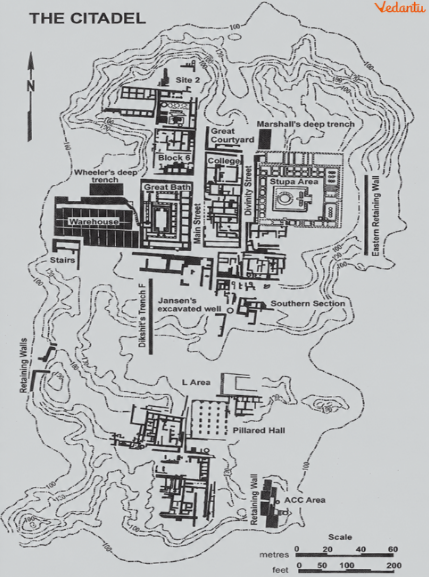
1. Division of the city: Mohenjodaro was divided into two main sections, the Citadel and the Lower Town. The Citadel was smaller and higher, while the Lower Town covered a larger area.
2. Planned streets: Roads and streets were arranged in an approximate grid pattern, intersecting at right angles. This suggests that streets were planned before residential buildings were constructed.
3. Standardised bricks: Harappan buildings were constructed using bricks with a standard height, breadth and length ratio of 1:2:4. This uniformity was maintained across settlements.
4. Efficient drainage system: Houses had drains connected to street drains. Main drains were covered and provided with arrangements for removing accumulated waste.
5. Residential architecture: Many houses were constructed around a central courtyard surrounded by rooms. The courtyard was probably used for activities such as cooking and weaving.
6. Privacy and sanitation: Ground-floor walls facing streets generally had no windows, and main entrances did not provide a direct view of the interior. Houses had brick-paved bathrooms.
7. Public structures: The Citadel contained distinctive buildings such as the Great Bath and a structure identified as a warehouse. These buildings suggest organised construction activities.
8. Wells and water facilities: Many houses had wells, and archaeologists estimate that Mohenjodaro contained approximately 700 wells.
Conclusion: The planned streets, standardised bricks, drainage systems and public structures indicate that Harappan cities were developed through careful planning and organised labour.
Q25. Describe the agricultural practices and subsistence strategies of the Harappan people.
Answer:
The Harappans depended on agriculture, animal domestication and other food resources for their livelihood. Archaeological discoveries provide information about their subsistence practices.
1. Cultivation of crops
The Harappans cultivated crops such as wheat, barley, lentils, chickpeas and sesame. Millets have been identified at sites in Gujarat, while evidence of rice is relatively rare.
Archaeologists study charred grains and seeds to identify the crops Harappan communities grew.
2. Animal domestication
Bones of cattle, sheep, goats, buffaloes and pigs suggest that these animals were domesticated.
Bones of fish, birds and wild animals such as deer and wild boar have also been found. However, archaeologists cannot always determine whether Harappan communities hunted wild animals directly.
3. Use of agricultural tools
Archaeologists have found terracotta models of ploughs at Banawali and in Cholistan.
Representations of bulls also suggest that oxen may have been used for ploughing fields.
4. Evidence of ploughed fields
Archaeologists discovered a ploughed field at Kalibangan in Rajasthan. It had two sets of furrows crossing at right angles, suggesting that two crops may have been cultivated together.
5. Irrigation facilities
Many Harappan settlements were located in semi-arid regions where agriculture probably required irrigation.
Canal evidence has been found at Shortughai in Afghanistan. Wells may also have been used for irrigation, while reservoirs at Dholavira could have stored water for agricultural purposes.
6. Food processing
Grinding stones, saddle querns, and vessels made of stone, metal, and terracotta were used to process and prepare food.
Conclusion: The Harappans followed diverse subsistence strategies involving crop cultivation, animal domestication and the use of available natural resources. Archaeological evidence indicates knowledge of agricultural technology and water management.
Q26. Explain the main features of Harappan craft production and the methods used to identify craft centres.
Answer:
Craft production was an important part of Harappan economic life. Archaeological findings indicate that the Harappans possessed specialised skills and used a wide variety of materials.
1. Important craft production centres
Chanhudaro was a major specialised craft centre. Activities there included bead-making, shell-cutting, metal-working, seal-making, and weight-making.
Other centres, such as Lothal, Nageshwar and Balakot, were also associated with different crafts.
2. Materials used in bead-making
Harappan beads were manufactured from several materials, including carnelian, jasper, crystal, quartz, steatite, copper, bronze, gold, shell, faience and terracotta.
Beads were produced in different shapes, such as spherical, cylindrical, disc-shaped and barrel-shaped.
3. Techniques of manufacturing
Different materials required different production methods.
For example, carnelian's red colour was produced by heating the raw material or beads at different stages. The process included shaping, flaking, grinding, polishing and drilling.
4. Shell industry
Nageshwar and Balakot were located near coastal areas and were important centres for manufacturing shell objects.
Craftspeople used shells to make bangles, ladles and decorative inlay work.
5. Identification through raw materials
Archaeologists identify craft centres by locating raw materials such as stone nodules, whole shells and copper ore.
6. Identification through tools and unfinished products
Specialised drills, incomplete beads and partially manufactured objects suggest that particular crafts were practised at a site.
7. Importance of manufacturing waste
Waste materials such as discarded shell fragments and small stone chips provide strong evidence of local craft production.
8. Distribution of finished products
Specialised centres may have transported finished products to major cities such as Mohenjodaro and Harappa.
Conclusion: Harappan craft production involved skilled workers, specialised techniques and organised distribution networks. Tools, raw materials, unfinished objects, and manufacturing waste help archaeologists identify where these activities took place.
Q27. Image-Based Question: Examine the illustration of the Great Bath at Mohenjodaro below. Describe its important architectural features and probable function.
Answer:
1. The Great Bath was a large rectangular tank located on the Citadel at Mohenjodaro.
2. It had two flights of steps, one on the north and another on the south.
3. Bricks set on edge and gypsum mortar were used to make the tank watertight.
4. The structure had surrounding rooms, a nearby well and a large drain to carry away water.
5. Archaeologists suggest that the Great Bath may have been used for a special ritual bath, although its exact function remains uncertain.
Harappan Sites and Archaeological Discoveries Every History Student Should Know
Learning the names of Harappan settlements is useful, but students should also understand what makes each site significant. Archaeological discoveries at different locations provide evidence of urban planning, agricultural practices, craft production, and water management.
The table below links key Harappan sites to discoveries students should know for Chapter 1 questions.
The interpretations of some archaeological structures, such as Lothal's basin, remain debated. Students should distinguish identified artefacts from interpretations about their uses.
Download Class 12 History Chapter 1 Important Questions PDF with Answers from Vedantu
Vedantu provides the Class 12 History Chapter 1 important questions PDF to help students access important questions and their solutions in one place. The PDF covers Bricks, Beads and Bones – The Harappan Civilisation and includes MCQs, very short-answer questions, short-answer questions, and long-answer questions based on NCERT concepts.
Students can download the important questions for Class 12 History Chapter 1 PDF and use it according to their learning needs.
Offline Access: Save the PDF on a mobile, tablet or laptop and access the questions without an internet connection.
Answer-Writing Practice: Attempt questions independently before checking the provided answers and explanations.
Print-Friendly Format: Print the PDF to practise writing answers on paper.
Self-Assessment: Compare written responses with the provided solutions to identify missing facts, explanations or historical examples.
Flexible Practice: Complete the MCQs in one session and attempt short or long-answer questions separately, depending on your available time.
With this Class 12 History Chapter 1 important questions with answers PDF, Vedantu makes it convenient for students to practise chapter-specific questions at home, at school or while studying independently. Students can download the PDF whenever needed and use the questions to prepare for their CBSE History examinations in 2026–27.
Important Study Material Links for Class 12 History (Themes in Indian History-I) Chapter 1
Chapter-Wise Important Questions for Class 12 History
Important Study Materials for Class 12 History
FAQs on Important Questions and Answers for Class 12 History (Themes in Indian History-I) Chapter 1 Bricks, Beads and Bones - The Harappan Civilisation | 2026-27
1. What are the benefits of practising Class 12 History Chapter 1 Bricks, Beads and Bones important questions?
Practising important questions from Bricks, Beads and Bones – The Harappan Civilisation helps students become familiar with different question formats and improve their answer-writing skills. Students can practise questions on Harappan town planning, agricultural practices, craft production, trade and archaeological discoveries. The answers also help them present historical facts and supporting evidence clearly in CBSE examinations.
2. How can students download the Class 12 History Chapter 1 important questions PDF from Vedantu?
Students can download the Class 12 History Chapter 1 important questions with answers PDF from the download section on this Vedantu page. The PDF contains chapter-specific questions and solutions that students can save on their devices or print for offline practice.
3. What types of questions are included in Bricks, Beads and Bones Class 12 important questions with answers?
The important questions include multiple-choice questions (MCQs), very short-answer questions, short-answer questions, long-answer questions, and source-based questions. These cover important NCERT concepts, including Harappan settlements, drainage systems, agricultural practices, trade networks and archaeological evidence. Each question includes an answer or explanation to support students during practice.
4. How should students practise Class 12 History Chapter 1 important questions with solutions effectively?
Students can start by attempting MCQs and very short-answer questions to check their knowledge of key facts. They can then move to short and long answer questions that require detailed explanations. After completing each answer, students should compare their responses with the provided solutions and check whether they have included relevant historical examples and archaeological evidence.
5. When should students start solving Bricks, Beads and Bones important questions for Class 12 History?
Students can start practising important questions after completing the chapter in their NCERT textbook. They can first attempt questions topic-wise, then practise a mix of MCQs, short answers, and long answers. Solving these questions during regular school assessments and before the CBSE board examinations helps students identify areas that need extra attention.
6. Why should students divide Bricks, Beads and Bones into smaller topics before practising important questions?
The chapter covers several aspects of the Harappan Civilisation, including subsistence strategies, urban planning, social differences, craft production and archaeological interpretations. Dividing these topics into smaller sections makes it easier to focus on one concept at a time. For example, students can complete questions on Mohenjodaro's town planning before moving to trade networks and craft production.
7. What is the difficulty level of Class 12 History Chapter 1 important questions provided by Vedantu?
Vedantu's Class 12 History Chapter 1 important questions cover different practice levels. MCQs and very short answer questions generally focus on factual knowledge and basic concepts. Short-answer questions require clear explanations, while long-answer and source-based questions require deeper understanding and interpretation of archaeological evidence. This combination lets students practise both straightforward and analytical questions from the chapter.
