



Class 12 History Chapter 7 An Imperial Capital: Vijayanagara Important Questions with Answers PDF
This set of Chapter 7 History Class 12 Important Questions contains 24 solved questions: six MCQs, five very short answers, seven short answers and six long answers. The questions focus on political developments, military administration, trade, historical evidence, Vijayanagara's three major urban zones, religious architecture and the problems historians face when interpreting archaeological remains.
Class 12 History Chapter 7 Important Questions MCQ Practice
Q1. Who prepared the first survey map of the ruins of Hampi in 1800?
(a) Alexander Greenlaw
(b) Colonel Colin Mackenzie
(c) John Marshall
(d) Domingo Paes
Answer: (b) Colonel Colin Mackenzie.
Explanation: Colin Mackenzie, an engineer and antiquarian working for the English East India Company, surveyed Hampi's ruins in 1800. He relied on local memories, including information from priests associated with the Virupaksha temple and the Pampadevi shrine.
Q2. Which dynasty did Krishnadeva Raya belong to?
(a) Sangama dynasty
(b) Saluva dynasty
(c) Tuluva dynasty
(d) Aravidu dynasty
Answer: (c) Tuluva dynasty.
Explanation: Krishnadeva Raya belonged to the Tuluva dynasty and ruled from 1509 to 1529. His reign was marked by military victories, territorial expansion, temple construction and prosperity.
Q3. Which system allowed military commanders to govern territories, collect revenue and maintain troops for the Vijayanagara rulers?
(a) Mansabdari system
(b) Amara-nayaka system
(c) Ryotwari system
(d) Permanent Settlement
Answer: (b) Amara-nayaka system.
Explanation: Under the amara-nayaka system, commanders received territories to govern. They collected taxes, maintained contingents of horses and elephants, and paid tribute to the king.
Q4. What was the name of the battle fought in 1565 in which the Vijayanagara army was defeated?
(a) Battle of Panipat
(b) Battle of Plassey
(c) Battle of Rakshasi-Tangadi
(d) Battle of Khanwa
Answer: (c) Battle of Rakshasi-Tangadi.
Explanation: The battle, also known as Talikota, was fought in 1565. The combined armies of Bijapur, Ahmadnagar and Golconda defeated the Vijayanagara forces led by Rama Raya. The victorious armies subsequently sacked the capital.
Q5. Which reservoir supplied water to fields near Vijayanagara and through a channel to the royal centre?
(a) Kamalapuram tank
(b) Chilika Lake
(c) Pulicat Lake
(d) Sambhar Lake
Answer: (a) Kamalapuram tank.
Explanation: The Kamalapuram tank, built in the early fifteenth century, supported irrigation and supplied water to the royal centre. It formed part of the city's water-management system.
Q6. Which building in Vijayanagara may have served as a council chamber, according to an interpretation of Mackenzie's map?
(a) Vitthala temple
(b) Lotus Mahal
(c) Hazara Rama temple
(d) Virupaksha temple
Answer: (b) Lotus Mahal.
Explanation: The Lotus Mahal is an important structure in the royal centre. Its exact purpose is uncertain, although one suggestion, based on Mackenzie's map, is that it may have been used for meetings between the king and his advisers.
Class 12 History Chapter 7 Very Short Answer Questions
Q7. Who founded the Vijayanagara Empire, and in which year?
Answer: According to tradition and inscriptional evidence, Harihara and Bukka founded the Vijayanagara Empire in 1336 CE. The textbook timeline marks the founding date as approximate or uncertain.
Q8. What does the name Vijayanagara mean?
Answer: Vijayanagara means “city of victory.” The name referred to both the imperial capital and the empire. The ruined city later became widely known as Hampi.
Q9. Who were the kudirai chettis?
Answer: The kudirai chettis were local horse-merchant communities who traded horses imported from Arabia and Central Asia. Horses were important for the cavalry of South Indian kingdoms.
Q10. What was the Hiriya canal?
Answer: The Hiriya canal was an important irrigation canal at Vijayanagara. It drew water from a dam across the Tungabhadra River and irrigated the cultivated valley between the sacred centre and the urban core.
Q11. What were raya gopurams?
Answer: Raya gopurams were large, monumental temple gateways associated with Vijayanagara rulers. They marked temple entrances and displayed the power, resources and architectural ambitions of the ruling kings.
Class 12 History Chapter 7 Short Answer Questions
Q12. How did historians rediscover Hampi and reconstruct the history of Vijayanagara?
Answer: Historians reconstructed Vijayanagara's history by examining different types of evidence.
1. Colin Mackenzie's Survey: In 1800, Colin Mackenzie surveyed the ruins and prepared the first survey map of the site.
2. Local Memories: Priests at the Virupaksha temple and the shrine of Pampadevi provided information based on local traditions.
3. Inscriptions: Epigraphists began collecting inscriptions from temples and other sites, helping historians identify rulers, donations and important events.
4. Photographs: From 1856, photographs recorded monuments and architectural features that could be studied and compared.
5. Foreign Travellers' Accounts: Writings by visitors such as Abdur Razzaq, Domingo Paes, Fernao Nuniz and Duarte Barbosa provided descriptions of the city's buildings, markets and daily life.
6. Archaeological Surveys: Later archaeological studies identified remains of temples, roads, markets, residential areas and fortifications.
Conclusion: By comparing written records, local traditions and material remains, historians developed a more detailed understanding of Vijayanagara.
Q13. Why was horse trading important for the Vijayanagara Empire? Explain the role of Arab traders and the Portuguese.
Answer: Horses mattered because Vijayanagara warfare relied heavily on effective cavalry.
1. Military Requirements: Kings needed good horses to maintain strong cavalry forces and compete with rival kingdoms.
2. Overseas Imports: Horses were imported from Arabia and Central Asia.
3. Arab Merchants: Arab traders initially controlled much of this trade.
4. Local Merchants: Communities known as kudirai chettis participated in the exchange of horses.
5. Portuguese Participation: After reaching the western coast of India in 1498, the Portuguese became important players in trade and regional politics.
6. Military Technology: Their use of muskets strengthened their military influence.
Conclusion: Horse trading was closely linked with military power, overseas commerce and political relations between South Indian kingdoms.
Q14. Explain the major achievements of Krishnadeva Raya during his reign from 1509 to 1529.
Answer: Krishnadeva Raya was one of the most prominent rulers of the Vijayanagara Empire. His reign saw territorial expansion, prosperity, and major building projects.
1. Raichur Doab: He acquired the territory between the Krishna and Tungabhadra rivers in 1512.
2. Campaigns Against Orissa: He subdued the rulers of Orissa in 1514.
3. Victory Against Bijapur: His armies inflicted severe defeats on the Sultan of Bijapur in 1520.
4. Architectural Development: He commissioned temples and added imposing gopurams to important South Indian temples.
5. Nagalapuram: He established a suburban township near Vijayanagara and named it after his mother.
6. Literary Contribution: He composed the Amuktamalyada, a Telugu work that also discusses the importance of trade and good government.
Conclusion: Krishnadeva Raya strengthened Vijayanagara politically and contributed to its architectural and cultural development.
Q15. Differentiate between nayakas and amara-nayakas in the Vijayanagara Empire.
Answer: Nayakas and amara-nayakas were important figures in the empire's military and administrative structure.
Explanation: The two categories were closely related. The amara-nayaka arrangement organised military authority and revenue collection.
Conclusion: These chiefs strengthened Vijayanagara's military power but could also challenge central authority when they became more independent.
Q16. What evidence shows that Vijayanagara was an important commercial city?
Answer: Vijayanagara had active trade networks and busy markets.
1. Horse Trade: Imported horses were important commodities because of military demand.
2. Valuable Goods: Markets sold spices, textiles, precious stones and jewellery.
3. Foreign Merchants: Arab merchants and later Portuguese traders participated in overseas commerce.
4. Travellers' Descriptions: Domingo Paes described extensive markets selling gems, cloth, horses and food products.
5. Agricultural Produce: Travellers reported the availability of rice, wheat, fruits, pulses and other food items.
6. Wealth and Revenue: Income from commercial activities contributed to the prosperity of the state.
Conclusion: Vijayanagara's markets connected local production, valuable imported goods and overseas trade, making commerce an important part of the imperial economy.
Q17. Why was Vijayanagara's location near the Tungabhadra River suitable for building an imperial capital?
Answer: Vijayanagara's location offered advantages for defence, water management and agriculture.
1. Natural Protection: Granite hills surrounded the city and formed natural barriers.
2. River Water: The Tungabhadra River provided an important source of water.
3. Irrigation: Water could be diverted through canals to irrigate agricultural land.
4. Reservoirs: Streams flowing from the surrounding hills were controlled through embankments to create tanks.
5. Fortification: Hills and rocky terrain could be integrated into defensive walls.
6. Sacred Associations: The area was connected with the Virupaksha and Pampadevi shrines, giving it religious significance.
Conclusion: The site combined defensive advantages, agricultural resources and religious importance, making it suitable for an imperial capital.
Q18. What do the discoveries of Chinese porcelain, mosques and ordinary houses reveal about Vijayanagara's urban core?
Answer: Archaeological evidence and travellers' accounts suggest that Vijayanagara's urban core supported people from different economic, occupational and religious backgrounds.
1. Chinese Porcelain: Archaeologists found fine Chinese porcelain in parts of the urban core, suggesting the presence of wealthy traders and access to imported goods.
2. Muslim Residential Quarter: Some areas contained mosques and tombs associated with Muslim residents.
3. Architectural Similarities: The architecture of these religious structures showed similarities with temple mandapas, indicating interaction between building traditions.
4. Ordinary Houses: Duarte Barbosa described houses made with thatched materials, arranged in long streets according to occupations.
5. Local Shrines: Numerous small temples and shrines indicate the presence of different religious communities and practices.
6. Water Facilities: Wells, rainwater tanks and temple tanks were probably important sources of water for ordinary residents.
Conclusion: Vijayanagara was not only a city of royal buildings and temples. Its urban core also contained merchants, artisans, residential areas and varied religious traditions.
Class 12 History Chapter 7 Long Answer Questions
Q19. Explain how the amara-nayaka system strengthened the Vijayanagara Empire and later contributed to the weakening of central authority.
Answer: The amara-nayaka system was an important political and military arrangement in the Vijayanagara Empire. It helped rulers manage territories and maintain military forces.
1. Appointment of Military Commanders
The king assigned territories to military commanders known as amara-nayakas.
These commanders governed the territories and exercised authority over the local population.
2. Collection of Revenue
Amara-nayakas collected taxes and other dues from:
Peasants.
Craftspersons.
Traders.
They retained part of the revenue for administration and personal expenses.
3. Maintenance of Military Forces
They used a portion of the collected revenue to maintain troops, including horses and elephants.
These military contingents supported the imperial army.
4. Support for Temples and Irrigation
They used some revenue to maintain religious institutions and irrigation facilities.
5. Relationship with the King
Amara-nayakas sent annual tribute to the king and appeared at the royal court with gifts to demonstrate loyalty.
6. Transfers as a Means of Control
Kings sometimes transferred amara-nayakas between territories to prevent them from becoming too powerful.
7. Similarity with the Iqta System
The chapter suggests that several features of the amara-nayaka system may have been derived from the iqta system of the Delhi Sultanate.
8. Weakening of Central Authority
Some military chiefs became increasingly independent.
During the seventeenth century, several established independent kingdoms, weakening the remaining imperial structure.
Comparison of Benefits and Challenges
Conclusion: The amara-nayaka system helped Vijayanagara maintain a large empire, but the growing independence of its military commanders eventually weakened the central rulers' authority.
Q20. Describe the water-management system and fortifications of Vijayanagara. Why did the rulers enclose agricultural land within the fortified area?
Answer: Vijayanagara had elaborate arrangements for water storage, irrigation and defence. These were closely related to its geographical location near the Tungabhadra River.
Part A: Water Management
1. Importance of the Tungabhadra River
The river provided a vital water source for the city and surrounding agricultural land.
2. Construction of Reservoirs
The city built embankments across streams flowing down from the granite hills to store water.
3. Kamalapuram Tank
Built in the early fifteenth century, this reservoir irrigated nearby fields.
A channel also carried water to the royal centre.
4. Hiriya Canal
The Hiriya canal drew water from a dam across the Tungabhadra River.
It irrigated the cultivated valley between the sacred centre and the urban core.
5. Engineering Knowledge
Domingo Paes described large tanks, water channels and pipes that supported irrigation.
Part B: Fortifications
6. Multiple Defensive Walls
The traveller Abdur Razzaq described seven lines of fortifications around the city.
These enclosed the settlement and portions of its surrounding agricultural land and forests.
7. Construction Techniques
The fortification walls were made using wedge-shaped stone blocks without mortar.
They packed earth and rubble inside, while bastions strengthened the outer walls.
8. Protection of Agricultural Land
One remarkable feature was that the outer fortifications enclosed cultivated fields.
This helped protect the city's food-producing areas.
9. Defence During Sieges
Enemy armies sometimes attempted to force cities into surrender by cutting off food supplies.
Protecting agricultural land helped Vijayanagara prepare for long sieges.
10. Roads and Gateways
Guarded gateways connected the city with roads that passed through valleys and avoided rocky terrain.
Conclusion: Vijayanagara's water-management system supported urban life and agriculture, while its fortifications protected the population, important buildings and food-producing land.
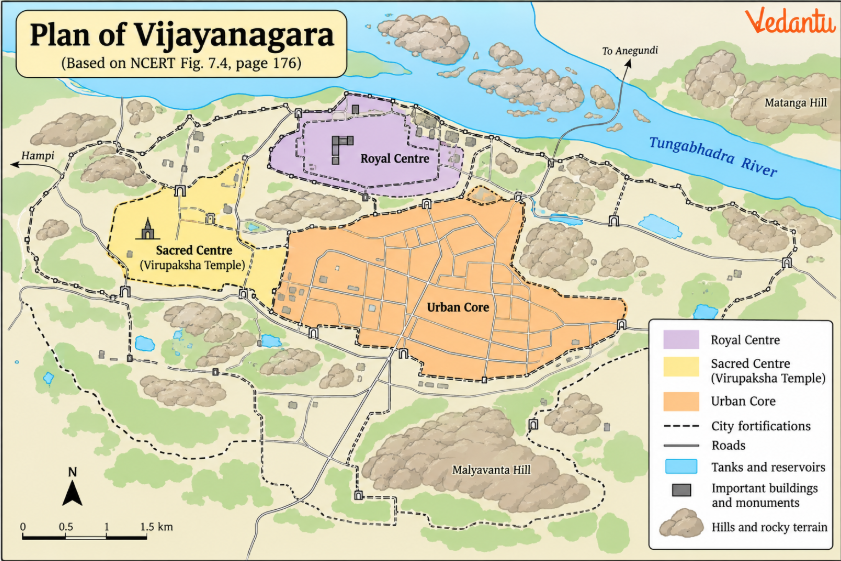
Q21. Was the royal centre of Vijayanagara used only by the king? Explain the buildings, religious structures and ceremonies associated with this area.
Answer: The royal centre was located in the south-western part of Vijayanagara. Although it contained buildings associated with royal authority, it also had important religious structures.
1. Location and Major Buildings
The royal centre contained approximately thirty large building complexes identified as palaces.
However, their exact functions are not always certain.
2. Religious Structures
More than sixty temples were located in the royal centre.
These temples helped rulers associate their authority with religious traditions.
3. Audience Hall
The audience hall was an elevated platform with regularly spaced slots for wooden pillars.
Its exact purpose remains uncertain because the pillars were positioned very closely.
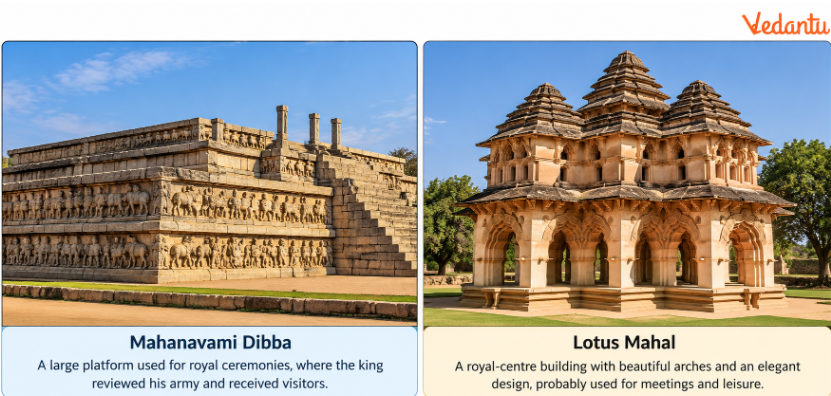
4. Mahanavami Dibba
The Mahanavami Dibba was a large, elevated platform with a base of approximately 11,000 square feet and a height of around 40 feet.
Its base contains sculpted reliefs.
5. Mahanavami Festival
Royal ceremonies accompanied Mahanavami, the ninth day of the festival celebrated as Dussehra, Durga Puja, or Navaratri in different regions.
These ceremonies included:
Worship of the royal deity.
Worship of the state horse.
Animal sacrifices.
Dances and wrestling matches.
Processions involving horses, elephants, chariots and soldiers.
6. Display of Royal Power
The king received gifts and tribute from subordinate chiefs and nayakas.
The festival displayed royal power and authority over the empire.
7. Lotus Mahal
The Lotus Mahal is an important structure in the royal centre.
Its arches show features associated with Indo-Islamic building traditions.
Its precise function is uncertain, though it may have served as a council chamber.
8. Elephant Stables
The structures known as elephant stables were located close to the Lotus Mahal.
Their design suggests elaborate architecture, although the name alone does not establish every aspect of their original use.
9. Hazara Rama Temple
The Hazara Rama temple may have been used mainly by the king and his family.
Its walls contain sculpted scenes from the Ramayana.
Conclusion: The term royal centre is useful because the area displayed imperial authority. However, it was not exclusively residential or administrative; it also contained important religious buildings and spaces used for ceremonies.
Q22. Explain the religious importance of Vijayanagara's sacred centre and describe the main architectural features of the Virupaksha and Vitthala temples.
Answer: The sacred centre was located in northern Vijayanagara, near the Tungabhadra River. It was associated with religious traditions that predated the empire's foundation.
Part A: Importance of the Sacred Centre
1. Religious Traditions
Local traditions associated the area with Vali and Sugriva from the Ramayana.
Other traditions connected the region with Pampadevi and Virupaksha, a form of Shiva.
2. Virupaksha as Guardian Deity
The Vijayanagara kings claimed to rule on Virupaksha's behalf.
Royal orders were signed with the phrase “Shri Virupaksha”, usually in Kannada script.
3. Temples and Royal Authority
Kings supported temple construction and maintenance to demonstrate religious devotion and strengthen political legitimacy.
4. Cultural and Economic Functions
Temples served as centres for religious ceremonies, learning and social activities.
Land grants and other resources supported their maintenance.
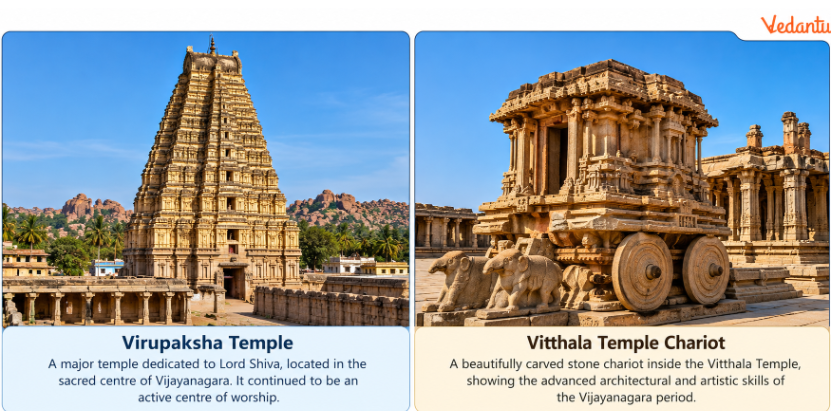
Part B: Virupaksha Temple
5. Earlier Origins
Historical inscriptions indicate the Virupaksha temple dates back to the ninth–tenth centuries.
6. Expansion under Vijayanagara
The temple expanded after the empire was established.
Krishnadeva Raya built a hall before the main shrine to mark his accession and is also credited with constructing the eastern gopuram.
7. Mandapas and Corridors
The temple contained halls, carved pillars, shrines and long corridors used for different activities.
Some halls were associated with music, dance, drama and ceremonies celebrating divine marriages.
Part C: Vitthala Temple
8. Principal Deity
The main deity was Vitthala, a form of Vishnu worshipped especially in Maharashtra.
The spread of Vitthala worship to Karnataka shows how Vijayanagara rulers incorporated different religious traditions.
9. Stone Chariot Shrine
The temple contains a distinctive chariot-shaped shrine.
10. Chariot Streets
Straight streets extended from the temple gateways and were lined with pillared pavilions where merchants could set up shops.
Comparison Table
Conclusion: Vijayanagara's temple architecture combined religious devotion, artistic achievement, economic activity and political authority.
Q23. How did Vijayanagara architecture combine earlier South Indian traditions with Indo-Islamic influences? Explain with examples.
Answer: Vijayanagara architecture developed by adopting and modifying existing South Indian temple-building traditions while also incorporating features associated with Indo-Islamic architecture.
1. Influence of Earlier South Indian Dynasties: Dynasties such as the Pallavas, Chalukyas, Cholas and Hoysalas had established traditions of constructing temples and other important buildings. Vijayanagara rulers drew upon these traditions.
2. Monumental Gopurams: The rulers constructed enormous temple gateways known as raya gopurams.
These were often much taller than the towers over the central shrines.
3. Mandapas: Large pillared halls were developed for religious rituals, ceremonies and public activities.
4. Sculpted Pillars: The temples featured intricately carved pillars decorated with animals, human figures and other motifs.
5. Temple Streets: Streets extending from temple gateways were frequently lined with pillared pavilions and markets.
6. Indo-Islamic Architectural Features: Some structures used arches and domes associated with architectural traditions introduced by Turkish Sultans and developed through interaction with regional building practices.
7. Fortification Gateways: The chapter identifies arches and domes on some fortification gateways as examples of Indo-Islamic architectural features.
8. Lotus Mahal: The arches of the Lotus Mahal suggest the influence of Indo-Islamic techniques within the royal centre.
9. Elephant Stables: The so-called elephant stables also display architectural forms that can be studied alongside other buildings at Vijayanagara.
10. Continuity under the Nayakas: After the weakening of the empire, Nayakas continued and developed traditions of temple and palace architecture.
Conclusion: Vijayanagara architecture was not based on a single tradition. Its buildings show the adaptation of earlier South Indian forms and the exchange of architectural ideas across political and cultural boundaries.
Q24. How do archaeologists and historians reconstruct Vijayanagara's history? What are the limitations of using monuments and travellers' accounts as evidence?
Answer: Historians reconstruct Vijayanagara's history through archaeological remains, inscriptions, maps, photographs, literary records, and travellers' accounts.
Each source provides valuable information but also has limitations.
1. Archaeological Remains
The ruins of temples, walls, roads, platforms, and other structures reveal the city's physical organisation.
2. Inscriptions
Inscriptions provide evidence of rulers, donations, religious institutions and political events.
3. Travellers' Accounts
Visitors such as Nicolo de Conti, Abdur Razzaq, Afanasii Nikitin, Domingo Paes, Duarte Barbosa and Fernao Nuniz left descriptions of Vijayanagara.
Their accounts discuss buildings, markets, water facilities and aspects of urban life.
4. Maps and Surveys
Colin Mackenzie's survey provided an early map of the ruins.
Later archaeological surveys documented thousands of structures, along with traces of roads and markets.
5. Photographic Evidence
Photographs from the nineteenth century onward helped document architectural features and the condition of monuments.
6. Systematic Mapping
During detailed archaeological investigations, researchers divided the Vijayanagara site into a grid of squares.
These smaller divisions let researchers record the location of individual remains more precisely.
7. Limitations of Monuments
Stone buildings survive more easily than wooden and thatched structures.
As a result, palaces, temples and fortifications are often better documented than ordinary houses.
8. Uncertain Building Functions
Some structures have modern names that do not conclusively establish how they were used.
For example, historians remain uncertain about the exact functions of the Lotus Mahal, the audience hall and some royal buildings.
9. Limitations of Travellers' Accounts
Travellers described what they observed or considered important.
Their writings may emphasise royal ceremonies, wealthy markets and large buildings rather than every aspect of daily life.
10. Missing Evidence about Ordinary People
The chapter raises questions that cannot yet be answered fully, including:
Who designed the city's major buildings?
Where did the stonecutters, sculptors and masons come from?
What wages did construction workers receive?
Who supervised the work?
How were building materials transported?
How did ordinary residents understand the symbols on royal buildings?
11. Comparing Different Sources
Historians compare monuments with inscriptions, literary sources and popular traditions to improve the reliability of historical interpretation.
Conclusion: Historians reconstruct Vijayanagara's history by combining different sources rather than relying on one type of evidence. Archaeological remains provide important clues, but many details of ordinary life and building activities remain uncertain.
Why Practise Class 12 History Chapter 7 Important Questions with Vedantu?
Practising Class 12 History Chapter 7 Important Questions helps students revise Vijayanagara's rulers, administration, architecture and historical sources. These chapter-based questions strengthen understanding and support CBSE exam preparation.
How to Prepare Class 12 History Chapter 7 Important Questions with Vedantu?
Revise key dates: Learn the foundation in 1336, Krishnadeva Raya's reign and the Battle of Talikota in 1565.
Understand administration: Focus on the amara-nayaka system and military organisation.
Study architecture: Compare major temples, royal buildings and fortifications.
Practise source-based questions: Revise travellers' accounts, inscriptions and archaeological findings.
Study chapter illustrations and maps: Identify important monuments, maps and architectural features.
Important Study Material Links for Class 12 History Chapter 7
Chapter-Wise Important Questions for Class 12 History
Important Study Materials for Class 12 History
FAQs on Important Questions and Answers for Class 12 History Chapter 7 – An Imperial Capital: Vijayanagara (Themes in Indian History-II) | 2026-27
1. Why was Vijayanagara called the City of Victory, and how is it connected to Hampi?
Vijayanagara means “city of victory” and was the name of both the empire and its capital. The ruined capital became known as Hampi, named after the local goddess Pampadevi. Its surviving monuments and local traditions help explain the city's historical importance.
2. How did Colin Mackenzie contribute to the discovery of Hampi?
Colin Mackenzie surveyed Hampi in 1800 and prepared the site's first survey map. He gathered information from local traditions, particularly from priests associated with the Virupaksha temple and Pampadevi shrine. Later historians combined these accounts with inscriptions and archaeological remains.
3. Why is Krishnadeva Raya considered an important Vijayanagara ruler?
Krishnadeva Raya expanded and consolidated the empire through military campaigns. His reign also witnessed prosperity, temple construction and major architectural additions. He wrote the Telugu work Amuktamalyada and founded the township of Nagalapuram.
4. Why did the Vijayanagara rulers depend on the amara-nayaka system?
The system helped rulers govern territories, collect revenue and maintain troops. Amara-nayakas maintained military contingents and paid tribute to the king. Over time, however, some commanders became powerful enough to challenge central authority.
5. What were the main reasons for Vijayanagara's defeat in the Battle of Talikota in 1565?
The chapter explains that political rivalries and Rama Raya's attempts to pit the Deccan Sultanates against one another contributed to the alliance. The combined armies of Bijapur, Ahmadnagar, and Golconda defeated Vijayanagara's forces and then sacked the capital.
6. Why did Vijayanagara rulers include agricultural fields inside the fortified area?
The rulers wanted to protect food-producing land during enemy attacks and prolonged sieges. Fortifying agricultural areas helped reduce the risk of food shortages and supported the city during military emergencies.
7. How did the Kamalapuram tank and Hiriya canal support Vijayanagara?
The Kamalapuram tank stored water for agricultural irrigation and supplied the royal centre through a channel. The Hiriya canal carried water from the Tungabhadra to fields between the sacred centre and urban core. Both were important parts of the city's water system.
8. What was the significance of the Mahanavami Dibba in Vijayanagara?
The Mahanavami Dibba was a large ceremonial platform associated with royal power. The chapter links it with festival rituals, military displays and the presentation of tribute by subordinate chiefs. However, historians remain uncertain about its exact use during every ceremony.
9. Why is the Lotus Mahal considered an example of architectural cultural exchange?
The Lotus Mahal features arches and other design elements associated with Indo-Islamic architecture. Its construction shows how builders adopted and adapted techniques from different traditions. Its exact original function remains uncertain.
10. How were the Virupaksha and Vitthala temples different?
The Virupaksha temple was associated with Shiva and closely linked to royal authority. The Vitthala temple was dedicated to a form of Vishnu and is known for its chariot-shaped shrine. Both reflect elaborate temple architecture and the empire's religious traditions.
11. What do the descriptions of Domingo Paes reveal about Vijayanagara's markets?
Paes described busy markets selling precious stones, jewellery, textiles, horses and food products. His observations suggest that Vijayanagara had extensive commercial activities and access to a wide range of goods.
12. What can Chinese porcelain found at Vijayanagara tell historians about the city?
Chinese porcelain finds suggest that some residents had access to imported luxury goods. Archaeologists associate certain areas containing such objects with wealthy traders, although the objects alone cannot establish every detail of the residents' identities.
13. Why is it difficult to reconstruct the lives of ordinary people in Vijayanagara?
Many ordinary residents' houses were made of perishable materials and did not survive. Important written accounts often describe rulers and monuments more extensively than the lives of common people. Historians therefore use travellers' observations, archaeological remains and other evidence to form cautious interpretations.
14. Which monuments and plans should students revise for image-based questions in Class 12 History Chapter 7?
Students should revise the Vijayanagara city plan, Mahanavami Dibba, Lotus Mahal, elephant stables, Hazara Rama temple, Virupaksha temple and Vitthala temple. They should practise identifying architectural features rather than memorising photographs alone.
15. How can students use Class 12 History Chapter 7 Important Questions PDF Download resources for board preparation?
Students can use a downloadable question-and-answer PDF, when available, to revise major dates, rulers, administration, historical sources and architectural features. They should practise writing answers independently before comparing them with solved explanations and the prescribed History textbook.
