



NCERT Solutions for Class 9 English Kaveri Chapter 4 Vitamin-M
Reflect and Respond
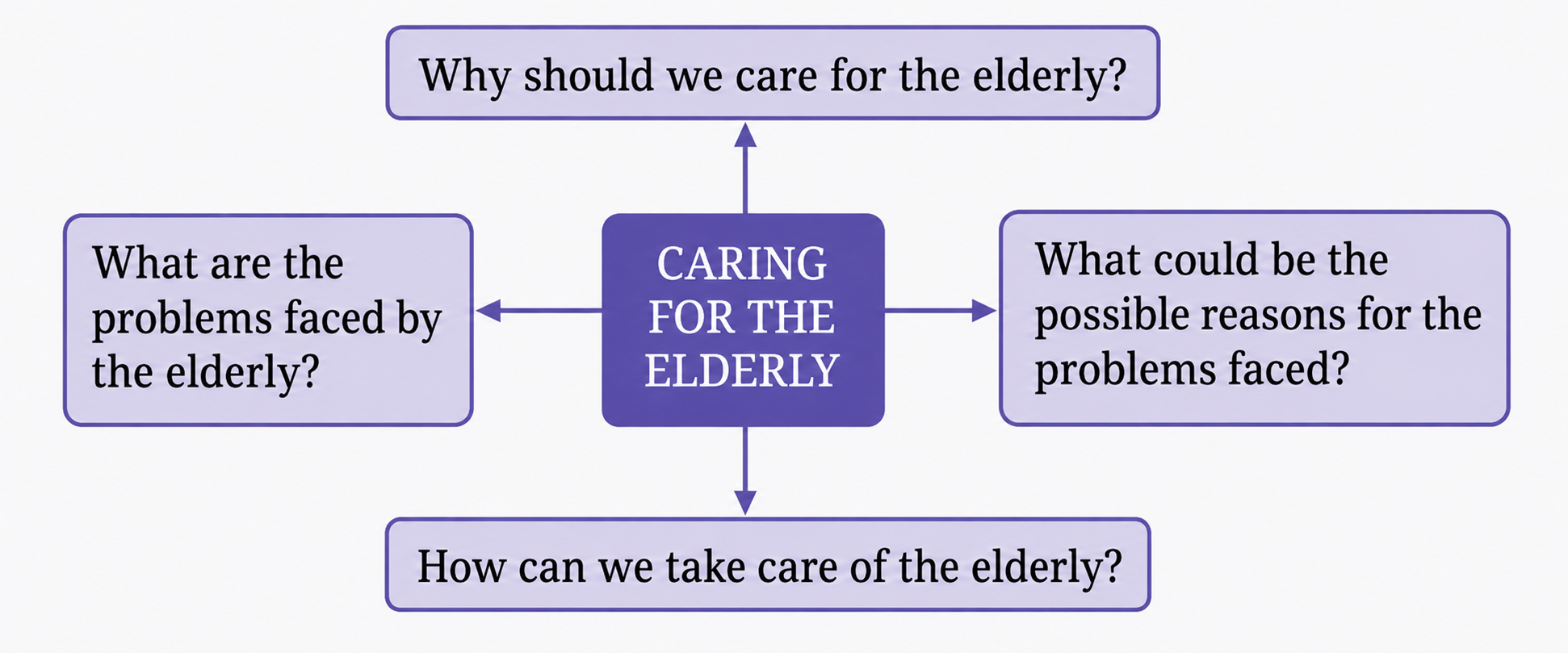
I. From your experience with an elderly person at home or in your neighbourhood, complete the following graphic organiser.
Answer:
We should care for the elderly because they have cared for us, guided us, and supported the family for many years. They have valuable life experiences and deserve love, respect, and emotional support.
Elderly people often face physical weakness, health problems, memory issues, loneliness, and difficulty adjusting to fast-paced modern life. Some may also feel dependent on others for daily needs.
They may face problems due to poor health, financial insecurity, social isolation, and lack of attention from family members. These difficulties can make them feel neglected or uncomfortable.
We can care for the elderly by spending time with them, helping them in daily activities, listening to them patiently, speaking politely, respecting their choices, and making them feel valued.
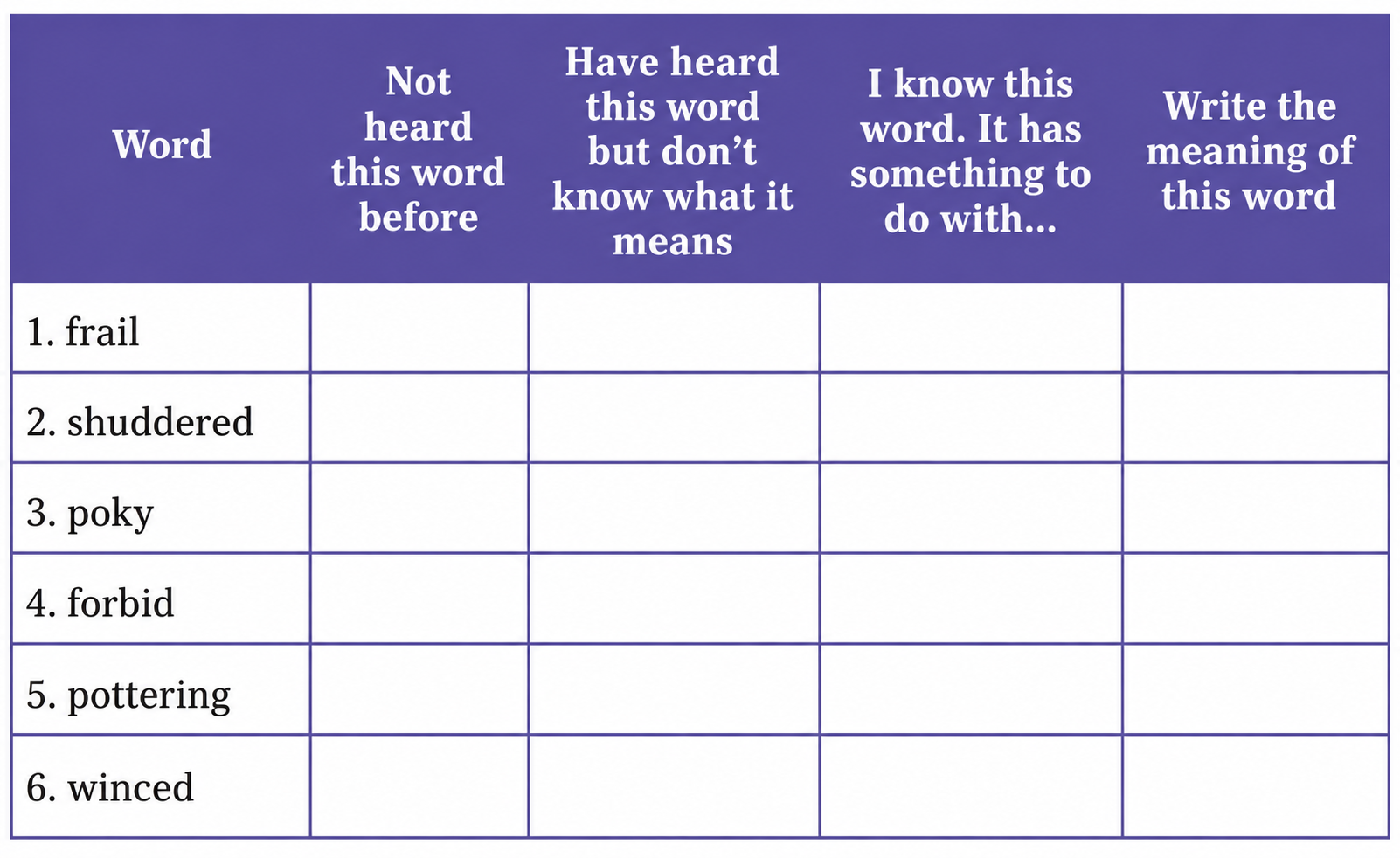
II. Fill in the table given below. You may check your answers with the help of a dictionary.
Answer:
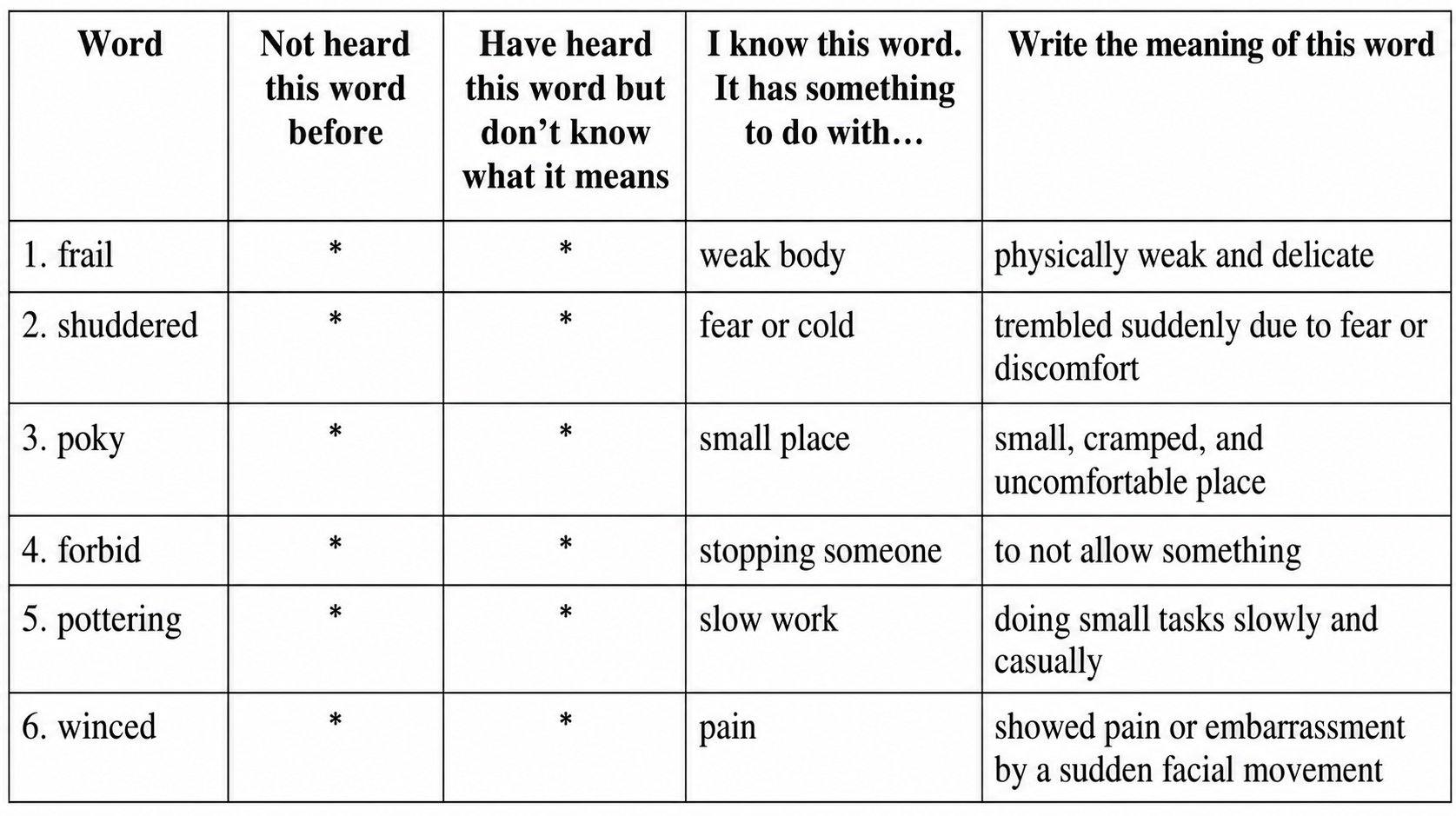
Students can complete the table by referring to the given words and checking their meanings, forms, or usage with the help of a dictionary.
III. Think of a tradition, story, or recipe passed down by grandparents or an elderly relative in your family. What does it mean to you? How does it connect you to your growing-up years? Share with your classmates and teacher.
Answer: One tradition passed down by my grandparents is listening to bedtime stories about honesty, kindness, and courage. These stories make me feel close to them and help me understand the values they followed in life.
They also connect me to my growing-up years because I remember sitting beside them and listening with curiosity. These stories still guide me and remind me that the lessons taught by elders remain useful throughout life.
Check Your Understanding
I. Why did Grandpa dislike living in the city with his daughter?
Answer: Grandpa disliked living in the city because it was noisy, crowded, and uncomfortable for him. He missed the peace, open space, and freedom of his own house. The small city made him feel restricted and dependent on others.
II. Why did Vidya not want her father to go out alone?
Answer: Vidya did not want her father to go out alone because he was old, physically weak, and sometimes forgetful. She was afraid that he might lose his way, fall, or meet with an accident.
III. Was Ravi in favour of his mother treating Grandpa like a child? How can you say so?
Answer: No, Ravi was not in favour of his mother treating Grandpa like a child. He understood that Grandpa was old, but he also felt that Grandpa deserved respect, dignity, and some freedom.
Ravi’s sympathy for Grandpa shows that he did not agree with treating him as helpless or incapable.
IV. Would Ravi be able to keep up his promise to his mother?
Answer: Ravi found it difficult to keep his promise to his mother because he understood Grandpa’s wish to go out independently. He cared for Grandpa’s safety, but he also respected his need for freedom.
Therefore, Ravi chose to follow Grandpa secretly instead of stopping him completely.
Check Your Understanding
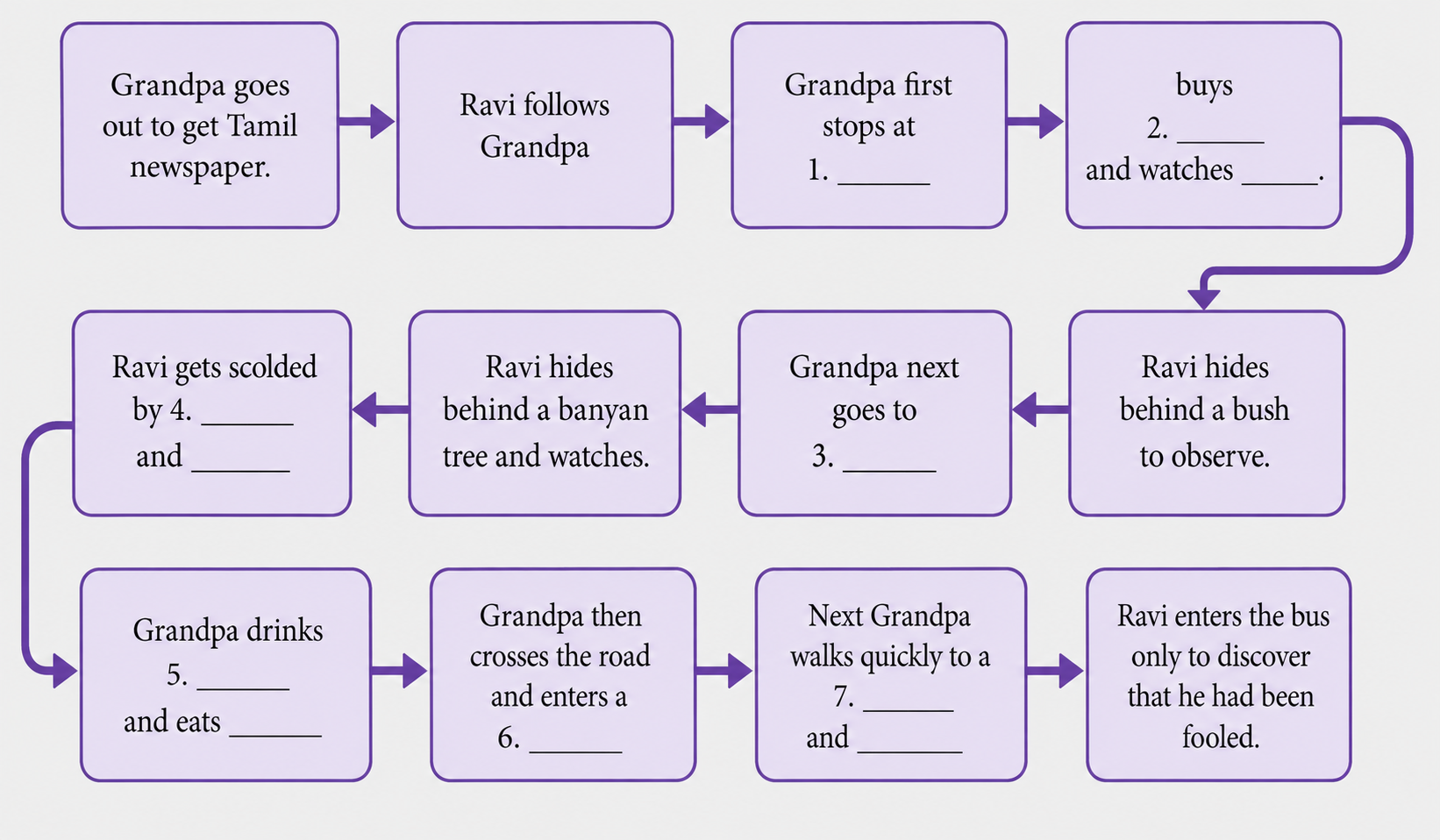
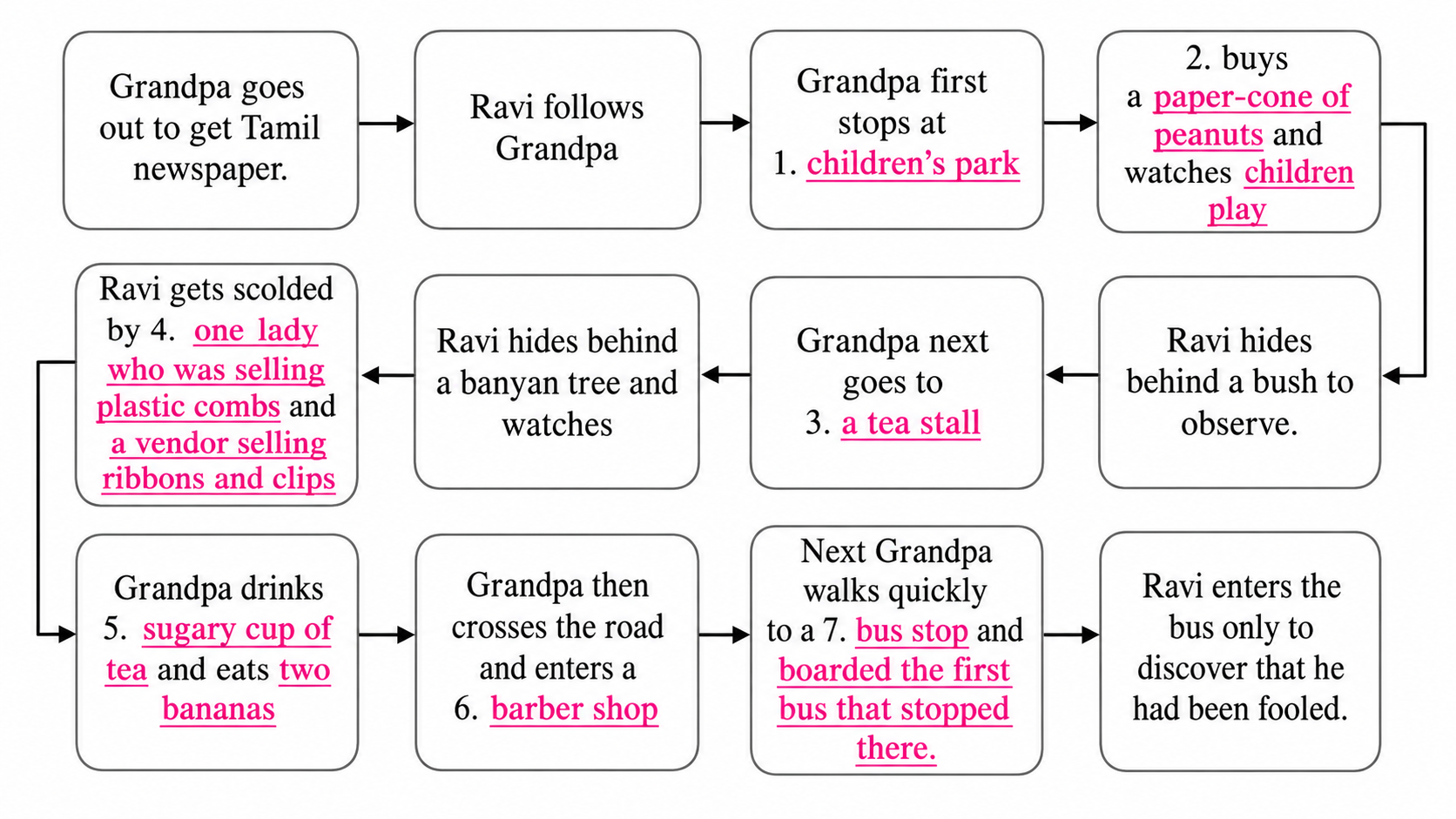
I. Complete the flow chart by describing Grandpa’s day out.
Answer:
II. Was Grandpa lost as feared by Ravi’s mother?
Answer: No, Grandpa was not lost as Ravi’s mother had feared. He returned home safely and comfortably, showing that he was more alert and capable than others thought.
III. How would Ravi feel after seeing Grandpa?
Answer: Ravi would feel relieved, happy, and relaxed after seeing Grandpa safely back at home. His fear and worry would disappear because Grandpa had returned without any harm.
IV. Do you think Ravi’s mother will get to know about what had happened?
Answer: Ravi’s mother would not know about what had happened unless Ravi or Grandpa told her. Since Grandpa returned safely, the incident might remain a secret between Ravi and Grandpa.
Check Your Understanding
I. Describe how Ravi’s emotional reaction upon finding Grandpa safe at home reveals his feelings towards his grandfather.
Answer: When Ravi finds Grandpa safe at home, he feels greatly relieved. His fear, anxiety, and tension disappear at once. This shows that Ravi deeply loves and cares for his grandfather.
Although Ravi allowed Grandpa to go out, he remained worried about his safety throughout the day. His emotional reaction proves that he feels responsible for Grandpa and is strongly attached to him.
II. What might be the significance of Grandpa’s habit of giving gifts to everyone on his birthday rather than receiving them?
Answer: Grandpa’s habit of giving gifts on his birthday shows his generosity, affection, and self-respect. Instead of expecting attention from others, he enjoys making the children in the house happy.
This habit also shows that Grandpa does not see himself as weak or dependent. He still wants to give joy to others and remain an active, loving member of the family.
III. Why do you think Grandpa gave Ravi a detective story book as a gift? What might this suggest about Grandpa’s awareness of Ravi’s actions earlier in the day?
Answer: Grandpa gave Ravi a detective story book because he knew that Ravi had secretly followed him throughout the day. The gift was a gentle and humorous way of showing that Grandpa had understood Ravi’s actions.
It suggests that Grandpa was aware, alert, and sharp-minded. He appreciated Ravi’s concern but also proved that he was not as unaware or helpless as others believed.
Critical Reflection
I. Read the extracts given below and answer the questions that follow.
1. Grandpa hated the noise and bustle of city life, and when they were on their own, he often spoke longingly of his small brick house in town, “Such a wonderful place…! With that big mango tree in the garden! It is so quiet that at dusk you can even hear a leaf fall!” But then Grandpa had slipped and fallen in the garden late one evening while he was pottering around and lain outside all night because there was no one at home to help him up.
(i) Choose the emotion displayed by the Grandfather.
A. regretful
B. apologetic
C. nostalgic
D. wistful
Answer: C. nostalgic
Grandpa feels nostalgic because he fondly remembers his peaceful home, garden, and the quiet life he once enjoyed.
(ii) Complete the following sentence with a reason.
Grandpa hated the busy and noisy city life because
Answer: Grandpa hated the busy and noisy city life because it was crowded, loud, and made him feel uncomfortable and restricted, unlike the calm and open life of his own home.
(iii) Why did Grandpa come to the city despite his dislike for city life?
Answer: Grandpa came to the city because his daughter was worried about his safety after he slipped and fell in the garden. Since there was no one to help him at that time, she wanted him to live with her so that he could be cared for properly.
(iv) Choose an expression similar in meaning to ‘you can even hear a leaf fall’.
A. end of one’s life
B. arrival of autumn
C. sign of good luck
D. pin drop silence
Answer: D. pin drop silence
(v) State one advantage and one disadvantage of the Grandfather living in the house in town.
Answer: Advantage: Grandpa enjoyed peace, quiet surroundings, freedom, and the comfort of his own home.
Disadvantage: He was alone there, so there was no one to help him immediately during an emergency or accident.
2. “I had a quiet morning, but I don’t know about Ravi. He just disappeared instead of staying at home to look after me like you told him to,” answered Grandpa coolly, while Ravi just looked confused and embarrassed.
Grandpa had another surprise for Ravi. A gift-wrapped parcel!
“But, Papa, Ravi’s birthday was three months ago. Have you forgotten?” exclaimed Ravi’s mother, impatiently.
(i) Choose the option that displays the tone of the Grandfather’s response.
A. apologetic
B. hurtful
C. calm
D. puzzled
Answer: C. calm
Grandpa speaks calmly and does not show anger or nervousness while answering.
(ii) Why was Ravi confused and embarrassed?
Answer: Ravi was confused and embarrassed because Grandpa said that Ravi had “disappeared” instead of staying at home to look after him. Ravi realised that Grandpa knew he had gone out and secretly followed him.
This made Ravi feel awkward because his actions had been noticed.
(iii) Complete the sentence with a suitable reason. Ravi’s mother was impatient because _________ .
Answer: Ravi’s mother was impatient because Grandpa gave Ravi a gift-wrapped parcel even though Ravi’s birthday had already passed three months ago.
(iv) State whether the following sentence is true or false.
Grandfather forgot that Ravi’s birthday was three months ago.
Answer: False.
Grandfather had not forgotten Ravi’s birthday. He gave Ravi a gift because it was Grandpa’s own birthday, and he had the habit of giving gifts to the children in the family on his birthday.
(v) Why did Grandpa say he didn’t know what kind of morning Ravi might have had?
Answer: Grandpa said this because he knew that Ravi had not actually stayed at home to look after him. Ravi had secretly followed him during his outing, and Grandpa indirectly hinted that he was aware of Ravi’s actions.
II. Answer the following questions
Question 1: Grandpa is portrayed as a person with failing memory in the beginning of the story. Give two evidences to disprove the statement.
Answer: Although Grandpa is shown as forgetful in some daily matters, two incidents prove that his memory and awareness are still strong.
First, he remembers details while playing chess and shows a sharp understanding of the game. This proves that his mind is active in areas that interest him.
Second, Grandpa goes out confidently, moves through familiar places, and returns home safely. He also knows that Ravi is following him and later gives him a detective story book. These incidents show that Grandpa is alert and aware, even if he sometimes appears forgetful.
Question 2: Give two characteristic traits of each of the following characters.
(i) Grandfather
Answer: Grandfather is independent and dignified. He dislikes being treated like a helpless child and wants the freedom to live life on his own terms.
He is also intelligent and observant. His love for chess, his successful outing, and his awareness of Ravi following him show that his mind is still sharp.
(ii) Ravi
Answer: Ravi is caring and sensitive. He understands Grandpa’s need for freedom and does not want him to feel insulted or controlled.
He is also responsible and alert. He follows Grandpa secretly to ensure his safety without hurting his dignity.
(iii) Ravi’s mother
Answer: Ravi’s mother, Vidya, is loving and concerned. She wants to protect her father because she worries about his health and safety.
However, she is also overprotective and anxious. Her fear makes her treat Grandpa like a child, sometimes ignoring his need for independence and self-respect.
Question 3: Why was Ravi worried about what Grandfather had at the tea stall?
Answer: Ravi was worried because Grandfather drank a sugary cup of tea at the tea stall, even though he was not allowed to have sugar at home. Ravi feared that it might affect Grandpa’s health.
Question 4: Do you think it was easy for Ravi to follow his Grandfather? If yes, why? If no, why not?
Answer: No, it was not easy for Ravi to follow his Grandfather. He had to keep enough distance so that Grandpa would not notice him, but he also had to stay close enough to watch him carefully.
Ravi was anxious about Grandpa’s safety throughout the outing. He had to remain alert, patient, and careful, which made the task difficult.
Question 5: ‘Ravi is a good detective’. Give one argument in favour of and against the given statement.
Answer: In favour: Ravi can be called a good detective because he follows his Grandfather quietly, observes his movements carefully, and tries to make sure he remains safe.
Against: Ravi is not a perfect detective because Grandpa already knows that Ravi is following him. Also, Ravi is emotionally worried, whereas a detective usually remains calm and detached.
Question 6: Was Grandfather aware that Ravi was following him? How do you know?
Answer: Yes, Grandfather was aware that Ravi was following him. This becomes clear when he gives Ravi a detective story book and advises him to pick up good tips on how to be a detective.
This shows that Grandpa had noticed Ravi’s actions and understood that Ravi had followed him throughout the outing.
Question 7: In your opinion, who needs Vitamin-M? And why?
Answer: In my opinion, elderly people need Vitamin-M, where “M” may stand for mental support, mindfulness, and meaningful care. Old age often brings physical weakness, loneliness, and dependence, but elderly people need more than medicines and safety.
They need love, respect, patience, freedom, and dignity. Vitamin-M symbolises the emotional care and understanding that can help elderly people feel valued and happy.
Question 8: Some people believe society shows bias based on age (being young or old). Give an example where you might have experienced or observed such discrimination, when opinions were disregarded because of age.
Answer: I have observed age-based bias during family discussions, where a young person’s opinion was ignored only because they were considered inexperienced. Even though the idea was useful, it was not taken seriously because of the person’s age.
A similar bias is seen in the story. Grandpa is treated like a child simply because he is old and forgetful at times. His wish to go out alone is not respected, even though he is still alert and capable. This shows how both young and old people may face unfair treatment because of age.
Vocabulary and Structures in Context
I. Classify the words given in the box on the next page into movement words in Column 1 and sound words in Column 2. One example has been done for you.
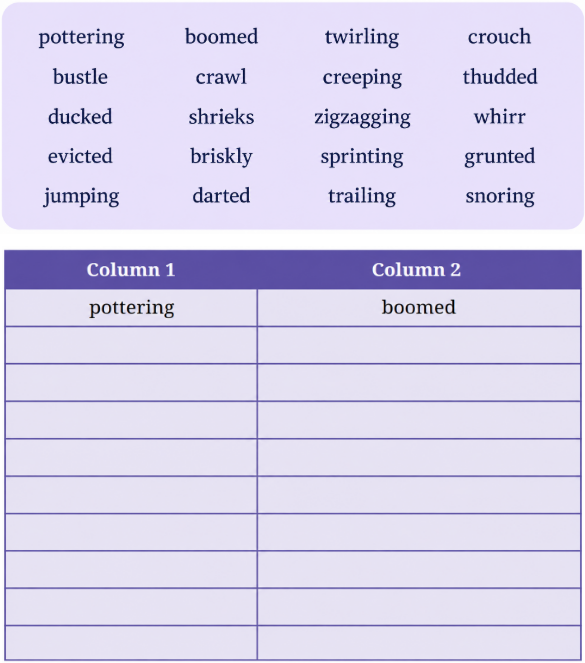
Answer:
Now, fill in the blanks with appropriate words from Column 1 or Column 2.
Detective Shankar, 1. _________ the mysterious suspect through the dimly lit side lanes, away from the 2. _________ of the city, quickened his pace 3. _________ . The suspect’s heavy footsteps 4. _________ across the street, unaware of the pursuit. Shankar 5. _________ his magnifying glass had to 6. _________ behind the market stalls, 7. _________ through the lanes to avoid being seen. Shankar 8. _________ when he hit himself against a pole. This alarmed the suspect and he 9 . _________ into the night leaving only the distant 10 . _________ of the sleeping city behind.
Answer: Detective Shankar, 1. trailing the mysterious suspect through the dimly lit side lanes, away from the 2. bustle of the city, quickened his pace 3. briskly. The suspect’s heavy footsteps 4. thudded across the street, unaware of the pursuit. Shankar, 5. twirling his magnifying glass, had to 6. crouch behind the market stalls, 7. zigzagging through the lanes to avoid being seen. Shankar 8. grunted when he hit himself against a pole. This alarmed the suspect and he 9. darted into the night, leaving only the distant 10. whirr of the sleeping city behind.
II. Study the highlighted word in the given sentence from the text and fill in the boxes with synonymous words. You may refer to a dictionary.
Off he went, twirling his walking stick jauntily, leaving Ravi in a dilemma.

Answer:

III. Fill in the table given below. Check your answers with the help of a dictionary.
Answer:
IV. Match the emotions / expressions in Column 1 with their meanings in Column 2. One meaning is extra.
Answer:
V. Read the highlighted words in the following phrases from the story. Now, revisit the story and underline the prepositions.
1. I’ll just walk across to the corner shop…
2. …he felt a shadow fall over him …
3. …the vendors sitting under the tree…
4. Ravi took a position behind a big banyan…
Prepositions are words used to show the relationship of a noun or pronoun to other words in a sentence, often indicating direction, location, time, or manner.
Now, fill in the blanks with appropriate prepositions.
I walked (i) _________ (through, between, against) the village, crossed a bridge (ii) _________ (over, under, beside) a brook, and found a quiet garden (iii) _________ (among, near, across), a cottage. Sitting on a bench (iv) _________ (on, at, in) the garden, I enjoyed the peaceful surroundings. Later, I strolled (v) _________ (beside, through, along) a riverbank, exploring the forest and heading (vi) _________ (into, towards, beyond) the unknown.
Answer:
I walked (i) through the village, crossed a bridge (ii) over a brook, and found a quiet garden (iii) near a cottage. Sitting on a bench (iv) in the garden, I enjoyed the peaceful surroundings. Later, I strolled (v) along a riverbank, exploring the forest and heading (vi) into the unknown.
VI. Read the following dialogues from the story.
“Shall we play chess or watch the cricket match on TV, Grandpa?” asked Ravi.
“Who are you?” said the little boy’s mother.
“What did you both do today?” asked Ravi’s mother.
“Have you forgotten?” countered Grandpa.
A small child came up to him and asked, “Are you playing hide and seek?”
Now, choose the correct answer.
A. The words in the quotes are (i) _________ (exclamatory/interrogative) sentences.
B. Sentences 1,4 and 5 are (ii) _________ (Wh-/ Yes, No type) interrogative sentences.
C. Sentences 2 and 3 are (iii) _________ (Wh-/Yes, No type) interrogative sentences.
So, there are (iv) _________ (two/three) types of interrogative sentences.
Answer:
A. The words in the quotes are (i) interrogative sentences.
B. Sentences 1, 4 and 5 are (ii) Yes, No type interrogative sentences.
C. Sentences 2 and 3 are (iii) Wh-type interrogative sentences.
So, there are (iv) two types of interrogative sentences.
The words in quotes are the exact words of the speaker, hence known as direct speech. In indirect speech or reported speech, somebody else reports these words at some other time and at some other place.
D. Let us have a quick glance at a few guidelines to remind you of the changes while transforming from direct form of speech to indirect. You can ask your teacher for more inputs.
VII. Read the following conversation.
ARVIND: Do you help in taking care of your grandparents at home?
PRIYA: Yes, I do. We take turns making sure they’re alright. Do you have grandparents living with you?
ARVIND: No. My parents and I visit my grandpa every weekend. How do you manage your grandparents’ medical needs?
PRIYA: We have a schedule for giving medications and visits to the doctor.
Now, complete the following sentences in reported speech.
Arvind asked Priya if she 1. _________ for which Priya replied in the affirmative and said that they 2. _________ .
Priya further asked Arvind 3. _________ .
Arvind replied in the negative and said that 4. _________ every weekend.
He further enquired 5. _________ .
Priya responded by saying that they 6 . _________ .
Answer:
helped in taking care of her grandparents at home
took turns making sure they were alright
If he had grandparents living with him
his parents and he visited his grandpa
How she managed her grandparents’ medical needs
had a schedule for giving medications and visits to the doctor
Listen and Respond
I. You will listen to a podcast on meditation. As you listen, complete the sentences with not more than three exact words that you hear. (Transcript for teacher on page 266).
1. Meditation is a form of yoga that usually refreshes the mind and helps with _________ .
Answer: Meditation is a form of yoga that usually refreshes the mind and helps with stress management.
2. Meditation leads to a better health condition both _________ .
Answer: Meditation leads to a better health condition both physically and emotionally.
3. Meditation also aids in lessening undesirable feelings and improving _________ .
Answer: Meditation also aids in lessening undesirable feelings and improving self-awareness.
4. It is advised that we meditate every day so that it becomes a _________ .
Answer:
It is advised that we meditate every day so that it becomes a routine.
5. Meditating on a daily basis is beneficial in comfortably tackling _________ .
Answer: Meditating on a daily basis is beneficial in comfortably tackling exam-related pressure.
Speaking Activity
I. Intonation refers to the pitch of the voice while speaking. In questions, intonation can indicate the sentiment or the expected response.
For example:
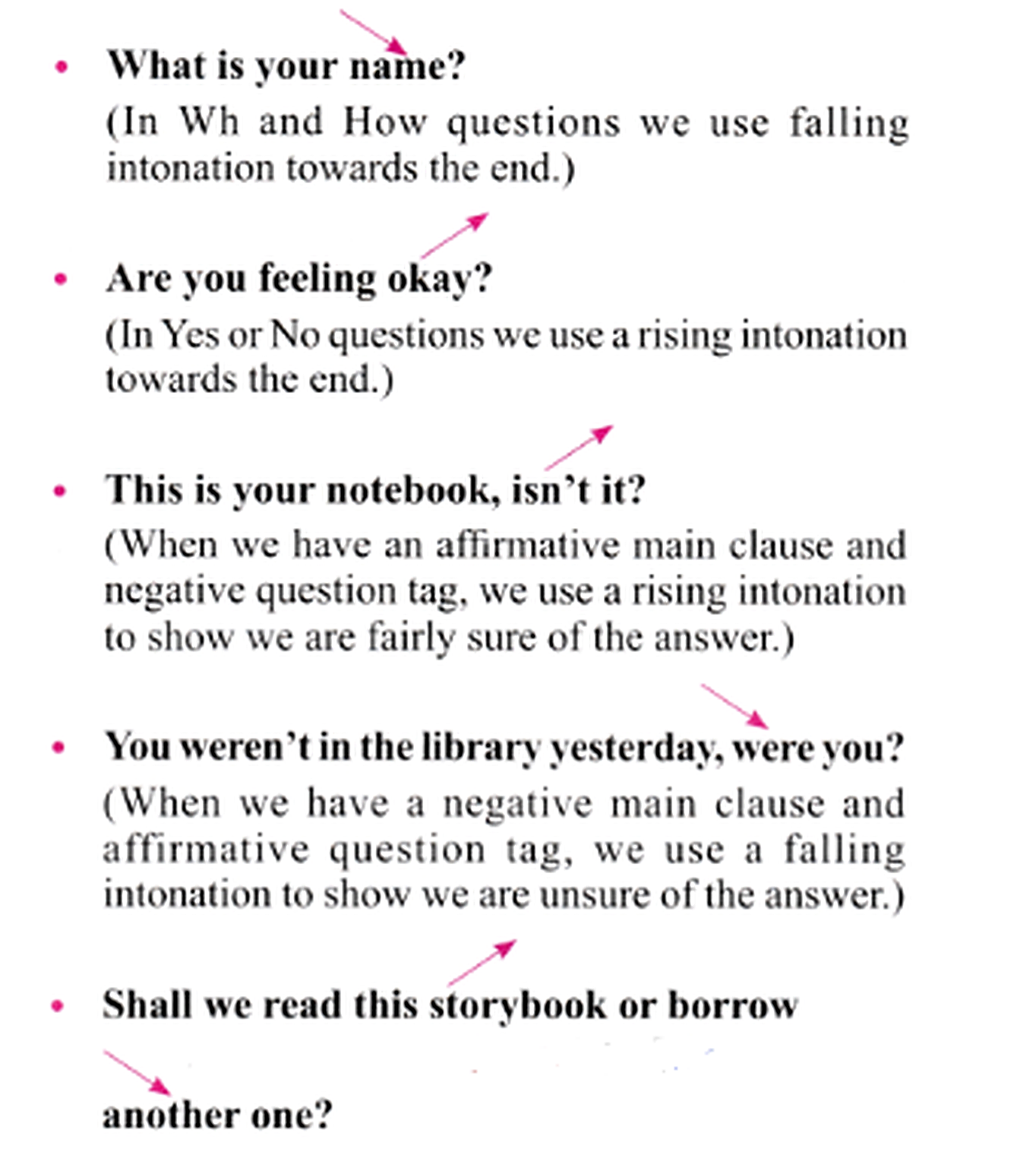
Now, revisit the story and select different questions. Work in pairs and practise speaking them aloud according to the examples shared.
Answer:
Students can practise the following questions with suitable intonation:
Why did Grandpa come to live with Ravi’s family?
Wh-question – falling intonationIs Grandpa allowed to go out alone?
Yes/No question – rising intonationGrandpa plays chess very well, doesn’t he?
Tag question – rising intonation if asking for confirmationRavi didn’t let Grandpa go alone, did he?
Tag question – falling intonation if the speaker is fairly sureShall we play chess or watch the cricket match?
Choice question – rising and falling intonation
II. Make a presentation about a brief personal experience related to taking care of an older person. For example, mention a specific individual you cared for or an occasion when you provided assistance to that person.
You may use the following prompts to structure your narration.
Background of your experience
The person I had the privilege of taking care of was…
I found myself in a caregiving role for…
I took on the responsibility of caring for…
Reflect on what you learned about yourself during this caregiving experience.
Did you discover any new qualities or strengths in yourself?
How did this experience contribute to your personal growth?
Caring for someone taught me valuable lessons about myself, including…
In this role, I learned that I possess the ability to…
One significant realisation about me during this experience was…
Discuss what you learned about the older person you were caring for.
What insights did you gain into their needs, preferences, or challenges?
How did your understanding of aging evolve through this experience?
Understanding the needs and preferences of the older person, I learned that…
Their challenges offered insights into the difficulties of aging, such as…
Caring for them deepened my understanding of the aging process, particularly…
Answer:
A Personal Experience of Caring for an Older Person
The person I had the privilege of taking care of was my grandmother. I found myself in a caregiving role when she fell ill and needed help with her daily activities. I took on the responsibility of reminding her to take medicines on time, helping her walk, and spending time talking to her.
Caring for someone taught me valuable lessons about patience, responsibility, and kindness. In this role, I learned that I possess the ability to stay calm and supportive in difficult situations. This experience helped me grow emotionally and made me more sensitive towards the needs of elderly people.
Understanding the needs and preferences of the older person, I learned that elderly people value independence, respect, and companionship. Their challenges offered insights into the difficulties of ageing, such as weak memory, physical discomfort, and loneliness. Caring for my grandmother deepened my understanding of the ageing process and taught me the importance of love, dignity, and patience.
Writing Task
I. As you read in the story, we have a lot to learn from our elderly. Based on the lessons learned from them, write an article for your school magazine on the topic ‘Our Inspiring Elderly’.
Organise the article in the manner given below.
Follow the steps given below to write an article about your skills and passions.
Write the title at the top and your name and grade below it.
Paragraph 1: Give a brief introduction to the topic. Focus on the main idea, but do not give any details.
Paragraph 2: Give details to support the main idea-how the elderly inspire. Include examples, facts, and quotations.
Paragraph 3: Elaborate on how they overcame challenges and the inspiring impact on you.
Paragraph 4: Conclude with a final comment on the topic and leave the reader with the most important ideas to think about.
Answer:
Our Inspiring Elderly
By Shikha, Grade IX
The elderly hold a special place in our families and society. They are the living storehouses of experience, wisdom, and values. Though age may slow them physically, their guidance and life lessons continue to inspire younger generations.
Elderly people inspire us through their patience, resilience, and knowledge. They teach us the importance of hard work, honesty, kindness, and perseverance through their life stories. As the saying goes, “Experience is the best teacher,” and elderly people prove this through the lessons they share with us.
Many elderly people face health issues, loneliness, or dependence, yet they continue to remain hopeful and strong. Their ability to adjust to difficulties teaches us courage and gratitude. Watching them face challenges with dignity has inspired me to become more patient, responsible, and emotionally strong.
In conclusion, our elderly are a source of wisdom and inspiration. They deserve respect, love, and understanding from everyone. By listening to them and learning from their experiences, we preserve valuable life lessons and become better human beings.
Learning Beyond the Text
I. Revisit the story and choose the image that correctly displays Grandpa’s walking stick.

Answer: Image 2 correctly displays Grandpa’s walking stick.
II. A picture is worth a thousand words!
Explore and revisit memories.
Collect a few memorable photographs of yourself and your family. Make a slide show.
Mention the following:
When and where was it clicked?
Who are the people in the photograph?
Why is it memorable for you?
Answer: Students can complete this activity themselves by collecting family photographs and preparing a slideshow. They should mention when and where each photograph was taken, who is present in it, and why it is special or memorable.
III. You must have read stories about taking care of the family members of all age groups in English and also in your own language. Now, read the story given below. Discuss with your classmates and teacher.
Answer: Students can read the story given in the textbook and discuss its message with their classmates and teacher.
Class 9 English Kaveri Chapter 4 Vitamin-M Solutions
Vedantu provides NCERT Solutions for Class 9 English Kaveri Chapter 4 Vitamin-M for the 2026-27 academic session. The chapter presents a thoughtful story about an elderly grandfather who wants freedom, respect, and emotional understanding rather than being treated like a helpless child.
The solutions include clear answers for extract-based questions, short-answer questions, vocabulary tasks, grammar exercises, reported speech, prepositions, interrogative sentences, speaking activities, article writing, and learning-beyond-the-text activities. Students can use these solutions for classroom learning, homework support, quick revision, and exam preparation. The downloadable FREE PDF also helps students revise the complete chapter offline.
CBSE Class 9 English Kaveri Chapter 4 Study Materials
Students can use the Chapter 4 study materials below to revise the lesson, practise extra questions, and strengthen their understanding of the chapter’s themes and language exercises.
Explore More NCERT Solutions for Class 9 English Kaveri Chapters
The chapter-wise NCERT Solutions for Class 9 English Kaveri help students revise all lessons from the textbook in a structured way. These resources provide clear explanations and answers for textbook questions, grammar activities, vocabulary tasks, and writing exercises.
Related Study Material for Class 9 English
The following Class 9 English study materials support regular learning, grammar practice, writing improvement, and exam preparation. Students can use them along with the Kaveri textbook solutions for better understanding.
FAQs on NCERT Solutions for Class 9 English Kaveri Chapter 4 Vitamin-M - 2026-27 Free PDF Download (Sign-in Required)
1. What is Class 9 English Kaveri Chapter 4 Vitamin-M about?
Vitamin-M is about Ravi, his grandfather, and the emotional needs of elderly people. The chapter highlights care, respect, independence, ageing, family responsibility, and the importance of understanding the elderly with patience and dignity.
2. What is the main idea of Vitamin-M?
The main idea of Vitamin-M is that elderly people need more than physical care. They also need love, respect, emotional support, freedom, and dignity.
3. Why does Grandpa dislike living in the city?
Grandpa dislikes living in the city because it is noisy, crowded, and restrictive. He misses the peace, open space, and freedom of his own house.
4. Why does Vidya not want Grandpa to go out alone?
Vidya does not want Grandpa to go out alone because he is old, physically weak, and sometimes forgetful. She worries that he may get lost, fall down, or meet with an accident.
5. How does Ravi show care for Grandpa?
Ravi shows care by understanding Grandpa’s need for freedom and secretly following him to make sure he remains safe without hurting his dignity.
6. Was Grandpa aware that Ravi was following him?
Yes, Grandpa was aware that Ravi was following him. This is clear when he gives Ravi a detective story book and indirectly tells him to learn how to be a better detective.
7. What does Vitamin-M symbolise in the chapter?
Vitamin-M symbolises mental and emotional care. It represents love, patience, respect, dignity, and understanding, especially for elderly people.
8. What grammar topics are covered in Class 9 English Kaveri Chapter 4?
The chapter includes movement and sound words, synonyms, prepositions, interrogative sentences, direct and indirect speech, reported speech, and intonation practice.
9. How do NCERT Solutions for Vitamin-M help students?
These solutions help students understand the story, answer textbook questions clearly, revise grammar topics, improve vocabulary, practise writing tasks, and prepare for class tests and exams.
10. Where can students download Class 9 English Kaveri Chapter 4 solutions?
Students can download the FREE PDF of NCERT Solutions for Class 9 English Kaveri Chapter 4 Vitamin-M from Vedantu for homework, revision, and exam preparation.
