



Stepwise NCERT Answers & Important Diagrams for Life Processes in Animals
Question 1.
Cows keep chewing the food even when they are not actively grazing or eating anything. Why? (Page 127)
Answer:
Cows keep chewing even when they are not actively eating because they ruminate, or chew cud, which helps in digesting their food more efficiently. This process allows them to extract essential nutrients from tough plant material.
Question 2.
Is the process of respiration the same in all animals? (Page 128)
Answer: No, respiration is not the same in all animals. It varies based on factors such as their size, habitat, and level of complexity.
Question 1.
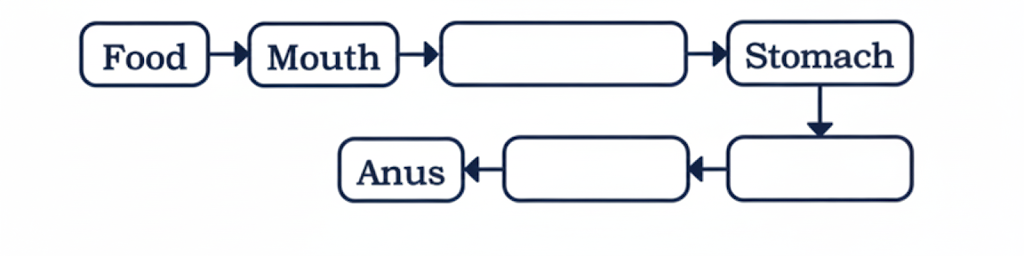
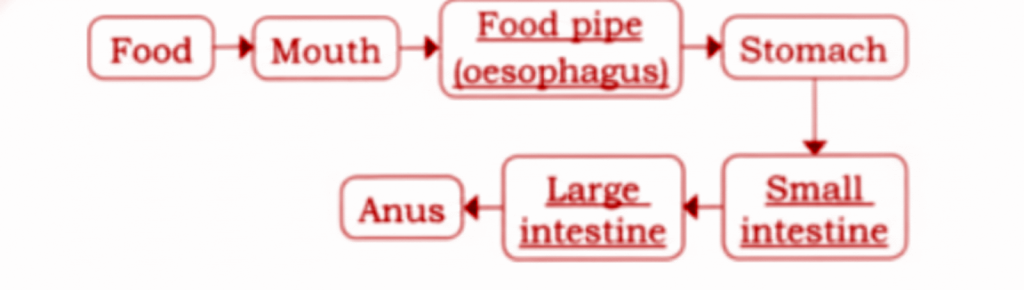
Complete the journey of food through the alimentary canal by filling up the boxes with appropriate parts
Answer:
Question 2.
Sahil placed some pices of chapati in test tube A. Neha placed chewed chapati in test tube B, and Santushti took boiled and mashed potato in test tube C. All of them added a few drops of iodine solution to their test tubes A, B, and C, respectively. What would be their observations? Give reasons.
Answer:
The observations can be explained by the given table:
Question 3.
What is the role of diaphragm in breathing?
(i) To filter the air
(ii) To produce sound
(iii) To hep in inhalation and exhalation
(iv) To absorb oxygen
Answer:
(iii) To help in inhalation and exhalation
Question 4.
Answer:
Question 5.
Anil claims to his friend Sanvi that respiration and breathing are the same process. What question(s) Sanvi ask him to make him understand that he is not correct?
Answer:
Sanvi can ask Anil the following questions to help him understand that breathing and respiration are different processes:
Do plants breathe? How do they obtain oxygen?
Does the carbon dioxide we breathe out come from breathing or from respiration?
Is it possible to carry out respiration without breathing for a short period?
Can you think of an example where breathing occurs but respiration does not?
Question 6.
Which of the following statement is correct and why?
Anu: We inhale air.
Shanu: We inhale oxygen.
Tanu: We inhale air rich in oxygen.
Answer: Tanu’s statement is correct. We inhale air that is rich in oxygen—about 21% of the air we breathe in is oxygen. The air we exhale contains a higher amount of carbon dioxide compared to the air we inhale.
Question 7.
We often sneeze when we inhale a lot of dust¬laden air. What can be possible explanations for this?
Answer: When we breathe in air containing a lot of dust, the dust particles are trapped by the tiny hairs inside the nasal cavity. These particles irritate the lining of the nose, triggering a sneeze. Sneezing helps push out the dust and other foreign particles, allowing cleaner air to enter the body.
Question 8.
Paridhi and Anusha of Grade 7 started running for their morning workout. After they completed their running, they counted their breaths per minute. Anusha was breating faster than Paridhi. Provide at least two possible explanations for why Anusha was breathing faster than Paridhi.
Answer: Two possible reasons are:
Anusha may not be physically fit, which could make her lungs work less efficiently.
She may be suffering from asthma or a cold, causing difficulty in getting enough oxygen.
Question 9.
Yadu conducted an experiment to test his idea. He took two test tubes, A and B, and added a pinch of rich flour to the test tubes half-filled with water and stirred them properly. To test tube B, he added a few drops of saliva. He left the two test tubes for 35-45 min. After that, he added iodine solution into both the test tubes. Experimental results are as shown in Fig. 9.15. What do you think he wants to test?
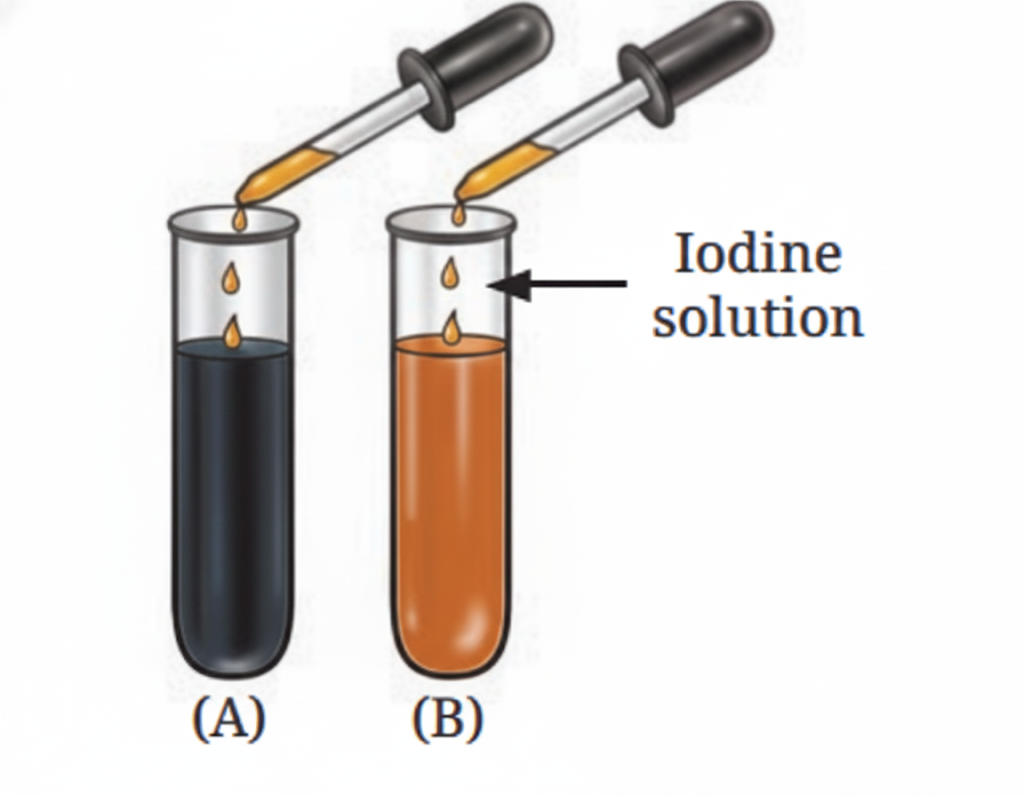
Fig. Experimental results
Answer: Yadu wants to check whether starch is present in both test tubes.
Question 10.
Rakshita designed an experiment taking two clean test tubes, A and B and filled them with lime water as shown in the figure. In test tube A, the surrounding air that we inhale was passed on by sucking air from the pipe, and in test tube B, the exhaled air was blown through the pipe (Fig. 9.16). What do you think she is trying to investigate? How can she confirm her findings?
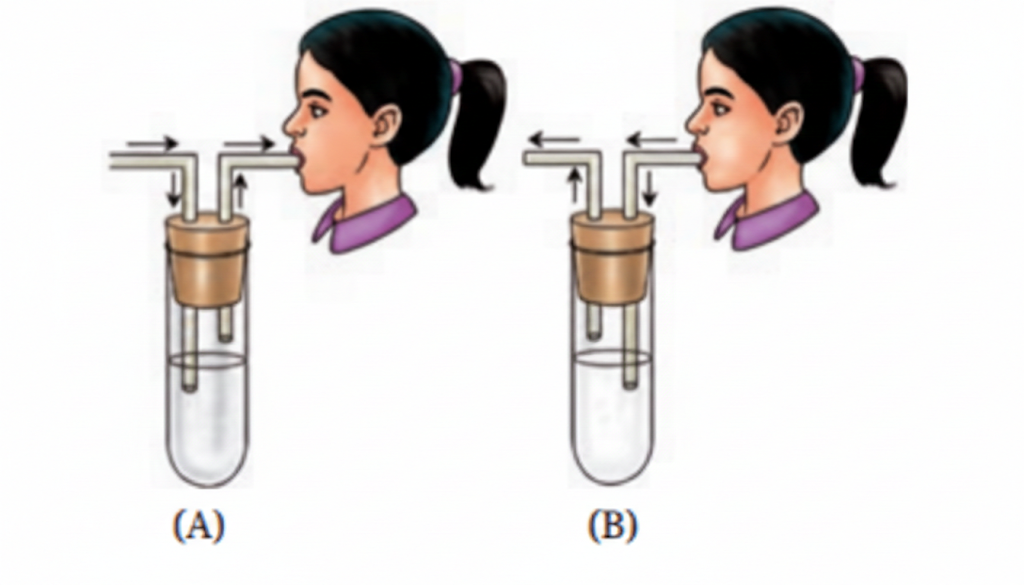
Fig. Experimental set-up
Answer:
Rakshita is investigating the gases involved in breathing. The lime water in test tube B turned milky, while the lime water in test tube A showed no change. Since lime water becomes milky in the presence of carbon dioxide, this shows that exhaled air contains more carbon dioxide than inhaled air.
Activity 9.1: Let Us Investigate (Page 123)
Table 9.1: Action of saliva on starch
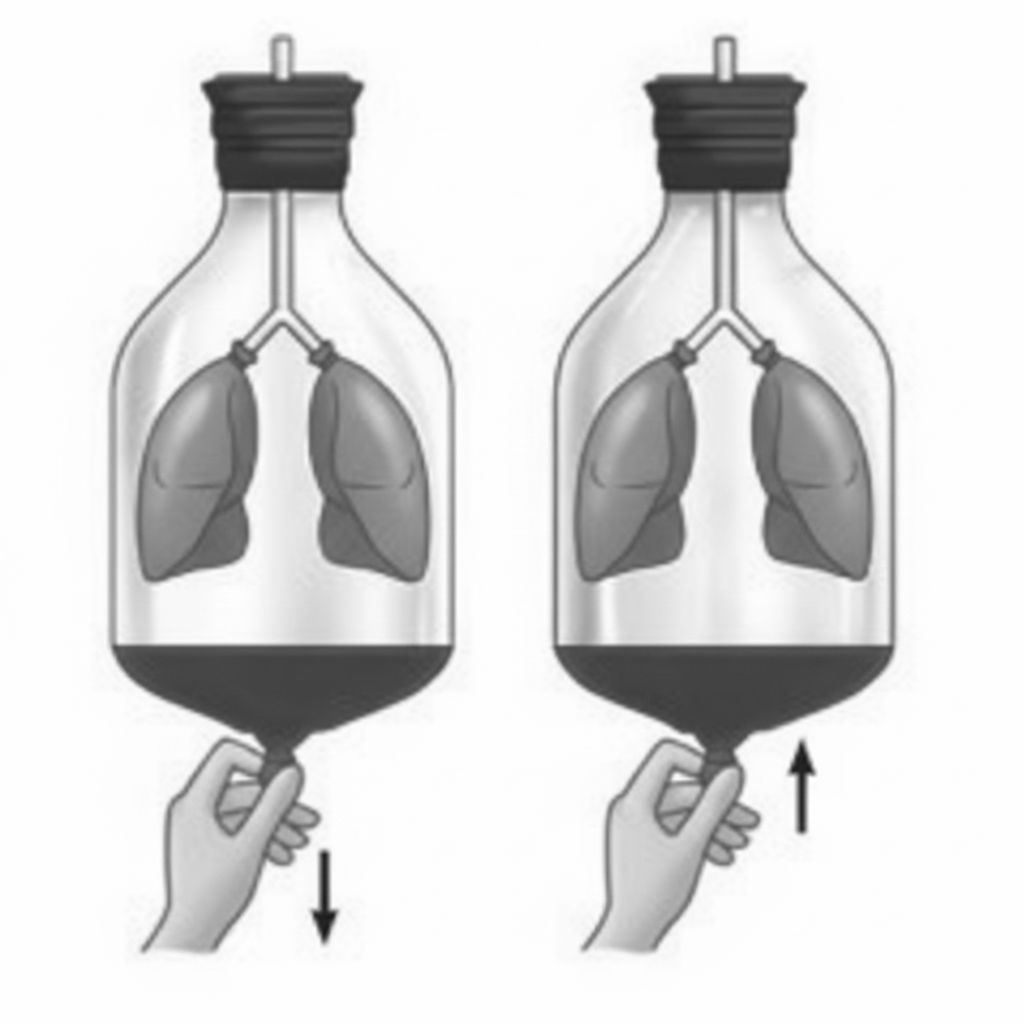
Activity 9.2: Let Us Make a Model (Page 130)
Observation and Conclusion:
This experiment demonstrates how inhalation and exhalation take place during breathing. When the rubber sheet at the bottom of the bottle is pulled downward, the space inside the bottle increases. This causes air to enter the balloon, making it inflate, similar to how the lungs fill with air during inhalation. It shows that when the diaphragm moves downward, it creates more space in the chest cavity, allowing air to flow into the lungs.
When the rubber sheet is pushed upward, the space inside the bottle decreases and the pressure inside increases. As a result, air is forced out of the balloon. This represents exhalation, during which the diaphragm relaxes and moves upward, reducing the chest cavity space and pushing air out of the lungs.
Activity 9.3: Let Us Explore (Page 131)
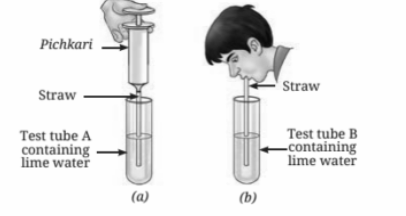
Fig. (a) Air is passed into lime water with a pichkari/syringe
(b) Air is exhaled into lime water
Observation:
The lime water in test tube B turns milky when it receives exhaled air, while the lime water in test tube A shows no change.
Conclusion:
This shows that exhaled air contains carbon dioxide. Lime water reacts with carbon dioxide to form calcium carbonate, which gives it a milky appearance. Since the change occurs only in test tube B, it confirms that the air we breathe out has more carbon dioxide than the air we breathe in.
Life Processes in Animals: Class 7 Science Chapter 9 Overview
Understanding life processes such as nutrition, circulation, respiration, excretion, and reproduction is essential for scoring high in exams. Mastering these concepts will help you grasp the vital processes that ensure the survival of humans and other animals.
Chapters like digestive system and breathing mechanism introduce important terms such as alimentary canal, small intestine, and gills. Focus on differences between physical and chemical processes like breathing and respiration for conceptual clarity.
Review chapter highlights and diagrams to boost understanding. Regular revision of NCERT topics and exercise questions will ensure you retain facts and score well in your Class 7 Science tests.
FAQs on NCERT Solutions For Class 7 Science Chapter 9 Life Processes In Animals - 2026-27 Free PDF Download (Sign-in Required)
1. What are life processes in animals Class 7?
Life processes in animals refer to the essential functions that help animals survive and grow. In Class 7 Science Chapter 9, the main life processes discussed include:
- Nutrition (how animals get their food)
- Respiration (how animals breathe and release energy)
- Transportation (movement of substances within the body)
- Excretion (removal of waste)
- Reproduction (producing new individuals)
Understanding these processes is important for CBSE exams and builds a base for higher classes.
2. How to write stepwise NCERT answers to score full marks?
To score full marks in NCERT Class 7 Science Chapter 9 answers, always follow a stepwise approach. Key tips include:
- Start with a direct answer or definition.
- Break down explanations into logical steps or points.
- Use diagrams where necessary, label them neatly.
- Include important keywords from the textbook.
- Conclude with a final summary sentence if the question is long answer type.
This method matches the CBSE marking scheme and maximises your marks.
3. Which questions are likely from this chapter in school exams?
Questions commonly asked from Class 7 Science Chapter 9: Life Processes in Animals include:
- Definitions of life processes like nutrition, respiration, excretion
- Processes such as how digestion occurs in humans
- Labelled diagrams (e.g., human digestive system)
- Differences between aerobic and anaerobic respiration
- Short notes on important terms like saliva, enzymes, etc.
Preparing all exercises and important diagrams will help you excel in CBSE 2026–27 exams.
4. Are diagrams or definitions mandatory in answers?
Diagrams and definitions are highly recommended in CBSE Science answers for Chapter 9. They:
- Make answers clearer and more structured
- Help you earn step marks
- Fulfill the marking scheme’s requirements
- Are often specifically asked in board and school exams
Always include diagrams for questions on organs, processes, or systems, and provide textbook-style definitions for key terms.
5. How can I download the solutions PDF for Class 7 Science Chapter 9?
You can download the NCERT Solutions PDF for Class 7 Science Chapter 9: Life Processes in Animals from trusted educational platforms. Look for a free, clear download link that offers:
- Step-by-step solutions
- Diagrams and structured answers
- CBSE 2026–27 syllabus coverage
- Offline readability and printability
Always check for the latest version for best exam preparation.
6. What are the most important topics from Life Processes in Animals Class 7?
The most important topics from Chapter 9: Life Processes in Animals include:
- Types of nutrition in animals (holozoic, saprophytic)
- Digestive system structure and function
- Respiration (aerobic and anaerobic)
- Transportation (blood, heart, blood vessels)
- Excretion (organs and process of waste removal)
These topics frequently appear in class tests and CBSE exams.
7. How should I structure long answers for full marks in Class 7 Science?
To get full marks for long answers in Class 7 Science Chapter 9, use the following structure:
- Begin with a definition or direct answer
- Organise explanation into sequential steps or paragraphs
- Insert diagrams with correct labels wherever relevant
- Highlight key terms and headings in your answer
- Finish with a conclusion or real-life example
This systematic approach impresses examiners and aligns with CBSE marking scheme.
8. Do examiners award partial marks for correct steps even if the final answer is wrong?
Yes, in CBSE Science exams, examiners generally give partial marks for correct steps, labelled diagrams, or partial explanations, even if the final answer has an error. To maximise marks:
- Show every logical step
- Write clear steps even if unsure about the final result
- Use correct scientific terms and definitions
Stepwise presentation helps you avoid zero marks for partially correct answers.
9. How to learn diagrams/maps for Class 7 Science Chapter 9?
For diagrams in Class 7 Science Chapter 9:
- Practice drawing and labelling key diagrams like the digestive system, respiratory system, and excretory system
- Follow neatness and correct label placement
- Use NCERT textbook diagrams for reference
- Revise diagram-based questions from past CBSE papers
Regular practice ensures diagram-based answers are accurate in exams.
10. Are NCERT Solutions enough for Class 7 Science exams?
NCERT Solutions for Class 7 Science provide detailed answers covering all intext and exercise questions. They are typically enough for scoring well in CBSE exams because:
- They follow the exact syllabus and marking schemes
- Include stepwise explanations, definitions, and diagrams
- Are reviewed by subject experts
To score full marks, combine NCERT solutions with revision of important questions and diagrams.
