



How to Write Full Mark Answers for Acidic, Basic, and Neutral Substances?
Question 1.
What are these red and blue litmus paper strips made of? Why do they change colour when drops of some samples are put on them? (Page 10)
Answer:
Red and blue litmus paper strips are prepared by soaking paper in an extract obtained from lichens. These strips change colour when they come into contact with acidic or basic substances. Acids turn blue litmus paper red, while bases change red litmus paper to blue.
Question 2.
Do you find lichens on trees in your neighbourhood? (Page 10)
Answer: Yes, lichens commonly grow on trees, particularly in regions with clean air and sufficient rainfall.
Question 3.
If litmus is not available, are there some other natural substances that can serve as acid- base indicators? (Page 11)
Answer: Yes, several natural substances can act as acid–base indicators, including red cabbage juice, turmeric, and rose extract. These materials show colour changes when they come into contact with acidic or basic substances.
Question 4.
Are there any substances whose odours change on adding acidic or basic substances? (Page 16)
Answer: Yes, substances such as onion and vanilla extract, whose smells change when they are exposed to acidic or basic substances, are called olfactory indicators.
Question 5.
What remedies do people use to treat ant bites in your region? (Page 18)
Answer: People commonly use natural remedies, such as applying a paste made of baking soda and water or placing a cold compress, to relieve pain and reduce swelling caused by ant bites.
Question 6.
If the factory waste is acidic in nature, what could be done to save the fish in the lake? (Page 19)
Answer: To protect the fish in the lake, the acidic waste can be neutralised by adding a base such as lime before it is released into the water. This helps bring the water back to a neutral state, making it safer for aquatic life.
Question 7.
Do you think that one possibility could be using a turmeric solution for the spraying liquid and a soap solution for writing on the paper? (Page 19)
Answer: Yes, a turmeric solution can be used as a spraying indicator because it changes from yellow to red in the presence of a basic solution. A soap solution, being basic in nature, can be used for writing on the paper.
Let Us Enhance Our Learning
Question 1.
A solution turns the red litmus paper to blue. Excess addition of which of the following solutions would reverse the change?
(i) Lime water
(ii) Baking soda
(iii) Vinegar
(iv) Common salt solution
Answer:
(iii) If the solution changes from red to blue, it indicates that it is basic. To reverse this change, an acidic substance is required. Lime water and baking soda are bases, and a common salt solution is neutral, so they cannot reverse the colour change. Vinegar, being acidic, will turn the solution back to red.
Question 2.
You are provided with three unknown solutions labelled A, B, and C, but you do not know which of these are acidic, basic, or neutral. Upon adding a few drops of red litmus solution to solution A, it turns blue. When a few drops of turmeric solution are added to solution B, it turns red. Finally, after adding a few drops of red rose extract to solution C, it turns green.
Based on the observations, which of the following is the correct sequence for the nature of solutions A, B, and C?
(i) Acidic, acidic, and acidic
(ii) Neutral, basic, and basic
(iii) Basic, basic, and acidic
(iv) Basic, basic, and basic
Answer: (iv) Solution A changes red litmus paper to blue, showing that it is basic in nature. Solution B turns the turmeric solution red, which also indicates a basic nature. Solution C changes rose extract to green, confirming that it is basic as well. Therefore, the correct nature of solutions A, B, and C is basic, basic, and basic.
Question 3.
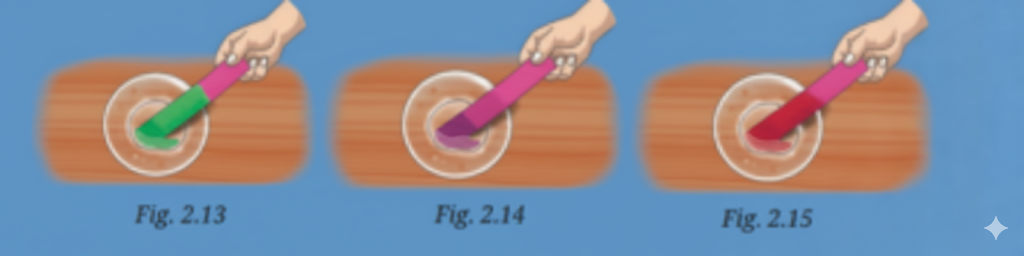
Observe and analyse Figs. 2.13, 2.14, and 2.15, in which red rose extract paper strips are used. Label the nature of solutions present in each of the containers.
Answer:
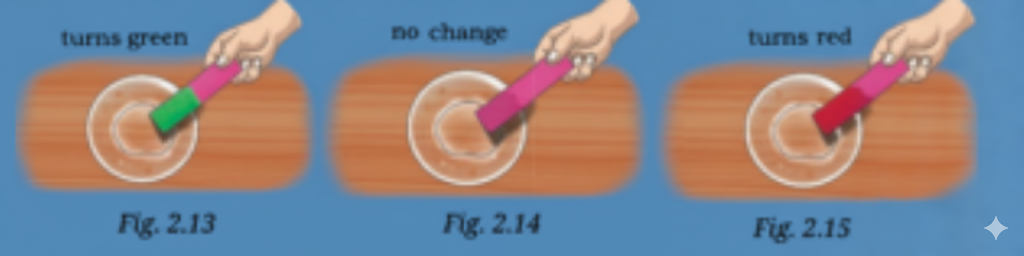
Red rose extract appears red in acidic solutions and turns green in basic solutions. In Fig. 2.13, the rose extract paper strip changes to green, showing that the solution is basic. In Fig. 2.14, the strip shows no colour change, which indicates a neutral solution. In Fig. 2.15, the strip turns red, confirming that the solution is acidic in nature.
Question 4.
A liquid sample from the laboratory was tested using various indicators:
Answer:
The given liquid sample is acidic in nature. It does not cause any change in red litmus paper but turns blue litmus paper red, which indicates acidity. Additionally, there is no colour change in the turmeric indicator, further confirming that the sample is acidic.
Question 5.
Manya is blindfolded. She is given two unknown solutions to test and determine whether they are acidic or basic. Which indicator should Manya use to test the solutions and why?
Answer: Manya should use an olfactory indicator to test the solutions, as these indicators change their smell in acidic or basic conditions. For instance, substances like onion give a strong smell in a basic solution and a faint smell in an acidic solution.
Question 6.
Could you suggest various materials which can be used for writing the message on the white sheet of paper (given at the beginning of the chapter) and what could be in the spray bottle? Make a table of various possible combinations and the colour of the writing obtained.
Answer:
The colour that appears in the writing depends on whether the writing substance is acidic or basic and on the nature of the solution used for spraying. Different combinations produce different colour changes, as shown in the table below.
Question 7.
Grape juice was mixed with red rose extract; the mixture got a tint of red colour. What will happen if baking soda is added to this mixture? Justify your answer.
Answer: When baking soda, which is a base, is added to the mixture of grape juice and red rose extract, it increases the basic nature of the mixture. In a basic medium, red rose extract changes its colour to green. Therefore, after adding baking soda, the mixture will turn green.
Question 8.
Keerthi wrote a secret message to her grandmother on her birthday using orange juice. Can you assist her grandmother in revealing the message? Which indicator would you use to make it visible?
Answer: Keerthi’s grandmother can uncover the hidden message by using acid–base indicators, since orange juice is acidic in nature. She may use rose extract or beetroot juice, which will turn red, or Indian blackberry extract, which will turn pink, to make the message visible.
Question 9.
How can natural indicators be prepared? Explain by giving an example.
Answer: Natural indicators can be prepared from plant materials that contain pigments which change colour in acidic or basic conditions. For instance, red rose extract can be made as follows:
Wash and crush fresh rose petals.
Put them in a glass tumbler and pour hot water over them.
Allow the mixture to stand for 5–10 minutes, then filter it.
The obtained liquid acts as a natural indicator, turning red in acidic solutions and green in basic solutions.
Question 10.
Three liquids are given to you. One is vinegar, another is a baking soda solution, and the third is a sugar solution. Can you identify them only using turmeric paper? Explain.
Answer: Turmeric paper can be used to detect a basic solution, but it cannot distinguish between acidic and neutral solutions. When a baking soda solution, which is basic, is tested, the turmeric paper changes from yellow to red. However, vinegar (acidic) and sugar solution (neutral) do not cause any colour change and the paper remains yellow. Hence, turmeric paper is useful only for identifying basic solutions.
Question 11.
The extract of red rose turns the liquid X to green. What will the nature of liquid X be? What will happen when excess of amla juice is added to liquid X?
Answer:
If red rose extract changes the colour of liquid X to green, it shows that liquid X is basic in nature. Red rose extract works as an indicator by turning red in acidic solutions and green in basic ones. When an excess amount of amla juice, which is acidic, is added to liquid X, it neutralises the base. As the solution becomes acidic, the green colour changes to red.
Question 12.
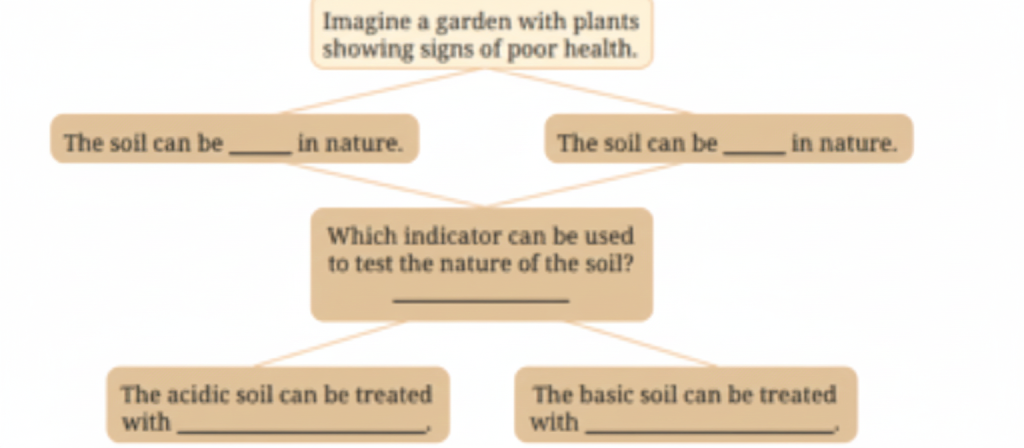
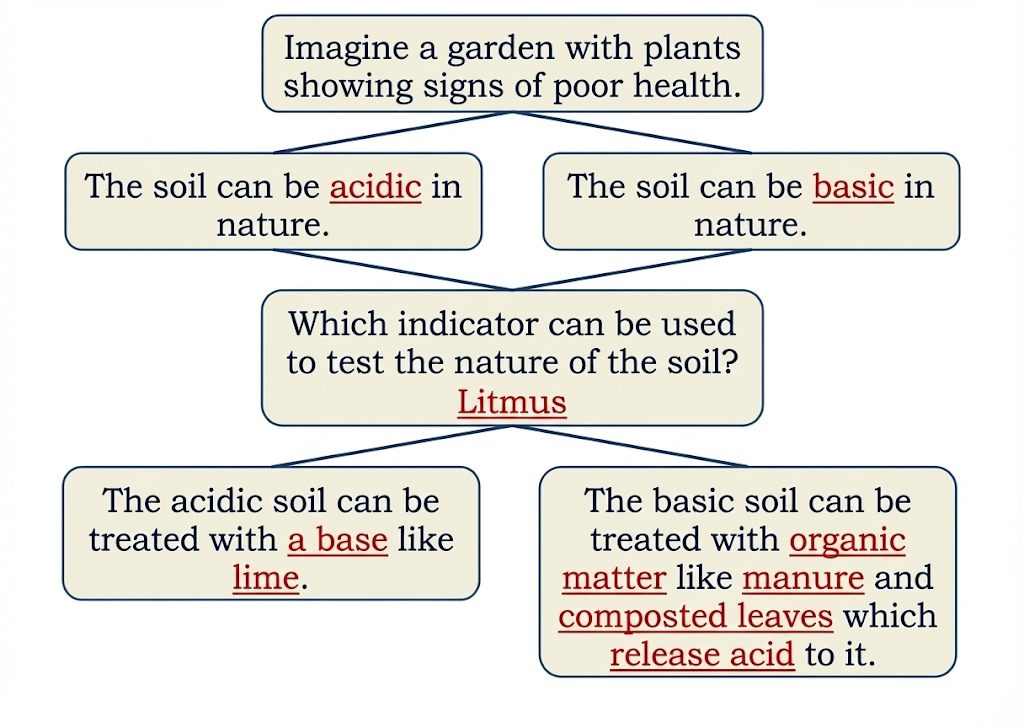
Observe and analyse the information given in the following flowchart. Complete the missing information
Answer:
The complete flowchart is as follows:
Activity 2.1: Let Us Explore (Page 8-9)
Table 2.1: Testing the nature of samples with blue and red litmus papers
Table 2.2: Grouping of samples tested in Table 2.1
Observation and conclusion: Substances in Group A, like lemon juice and vinegar, are acidic as they turn blue litmus paper red. Group B substances, like soap and baking soda, are basic as they turn red litmus paper blue. Group C substances, like tap water and sugar solution, are neutral because they do not change the litmus paper colour.
Activity 2.2: Let Us Relate and explore (Page 11)
All the substances in Group A – lemon juice, amla juice, tamarind water, vinegar and orange juice are edible. They all have a sour taste because they contain acids and are acidic in nature. The common acids found in these substances are:
Lemon: Citric acid
Curd: Lactic acid
Tamarind: Tartaric acid
Vinegar: Acetic acid
Activity 2.3: Let Us Prepare (Page 12)
Answer:
Students should do it by themselves.
Activity 2.4: Let Us Find out (Pages 12-13)
Table 2.3: Testing the nature of samples with red rose extract
Observation and conclusion: The rose extract gives a red colour in an acidic solution and a green colour in a basic solution.
Activity 2.5: Let Us Prepare (Pages 14-15)
Table 2.4: Testing the nature of samples with turmeric paper
Observation and conclusion: Turmeric paper changes colour from yellow to red in a basic solution but shows no change in acidic or neutral solutions.
Activity 2.6: Let Us Investigate (Page 16)
Answer:
Students should do it by themselves.
Activity 2.7: Let Us Experiment (Page 17)
Answer:
Students should do it by themselves.
Understanding Acids, Bases, and Neutrals: Class 7 Science Chapter 2
Dive into Class 7 Science Chapter 2: Exploring Substances: Acidic, Basic, and Neutral to discover how indicators like turmeric and litmus paper can make chemistry fun and relatable in real life. Observing colour changes brings science concepts alive!
Learning about acid, base, and neutral substances prepares you for practical situations—like neutralising ant bites or treating acidic soils. Practice the chapter’s activities to build strong conceptual understanding and confidence for exams.
Revise the NCERT questions regularly and use examples from daily life to remember key reactions. Consistent review and hands-on experiments are great strategies to excel in Class 7 Science Chapter 2 for 2026-27.
FAQs on NCERT Solutions For Class 7 Science Chapter 2 Exploring Substances Acidic, Basic, And Neutral - 2026-27 Free PDF Download (Login Required)
1. What are acids, bases and neutrals in Class 7 Science?
Acids, bases, and neutrals are three main categories of substances discussed in Class 7 Science Chapter 2.
- Acids: Substances that taste sour and turn blue litmus red (e.g., lemon juice, vinegar).
- Bases: Substances that feel soapy and turn red litmus blue (e.g., soap solution, baking soda).
- Neutral Substances: Substances that do not affect litmus paper (e.g., water, salt solution).
- Indicators like litmus help identify whether a substance is acidic, basic, or neutral.
- This concept is essential for understanding chemical reactions, everyday applications, and exam questions in the CBSE Class 7 syllabus.
2. How to prepare for Class 7 Science Chapter 2?
To prepare well for Class 7 Science Chapter 2: Exploring Substances: Acidic, Basic, and Neutral, follow these steps:
- Read the NCERT textbook thoroughly and highlight key definitions (acid, base, neutral, indicators).
- Practice stepwise NCERT Solutions and back exercise questions.
- Study diagrams showing litmus test procedures and label them properly.
- Revise with flash notes and important formulae lists.
- Attempt sample papers and previous year questions.
- Download the free, CBSE-aligned solutions PDF for revision.
- Focus on common marking schemes and use keywords in your answers.
3. Which are the important questions of Chapter 2 Science Class 7?
Important exam questions from Chapter 2 often include:
- Definitions of acids, bases, neutrals, and indicators.
- Differences between acids and bases with examples.
- Experiments using litmus paper or turmeric as an indicator.
- Diagram-based questions (e.g., identifying substances using indicators).
- MCQs or reasoning about everyday acidic/basic items.
- Practising exercise and intext questions from NCERT is vital to score full marks in CBSE exams.
4. How to write stepwise NCERT answers to score full marks?
Writing stepwise NCERT answers for Class 7 Science maximises marks in CBSE exams:
- Start with a clear definition or concept statement.
- Use bullets or steps for explanations or processes.
- Include examples for clarity.
- Label diagrams wherever required and refer to them in your answer.
- Highlight important terms and keywords from the question.
- Keep answers structured: introduction, main body (steps), and conclusion.
- Follow CBSE marking scheme and answer length guidelines.
5. Are diagrams or definitions mandatory in answers?
In CBSE Class 7 Science exams, diagrams and definitions are often required for full marks:
- Definitions of terms like acid, base, and indicator are essential when asked directly.
- Diagrams (e.g., showing a litmus paper test) are compulsory if the question mentions ‘draw’ or ‘explain with diagram’.
- Properly labelled diagrams and accurate definitions help score stepwise marks and reduce chances of missing out on key points.
- Always check the question instructions and CBSE marking scheme for requirements.
6. Where can I download the chapter’s solutions PDF?
Students can download the free PDF of NCERT Solutions for Class 7 Science Chapter 2 from leading educational platforms that offer CBSE content:
- Search for “Class 7 Science Chapter 2 Solutions PDF download”.
- Look for CBSE syllabus-aligned, teacher-reviewed resources.
- Ensure the PDF includes stepwise answers, diagrams, and exam-keyword focus.
- Use the downloaded PDF offline for revision, practice, and last-minute exam prep.
7. Do examiners award partial marks for correct steps even if the final answer is wrong?
Yes, in CBSE exams, examiners usually award partial marks for correct steps:
- Step marking is used for long and multi-step questions in Class 7 Science.
- If you write some correct steps but make a calculation or conclusion error, you can still earn marks for the correct procedure.
- Always show all steps clearly and use scientific terms and definitions.
- Following the NCERT Solutions stepwise method increases your chances of earning maximum possible marks.
8. What are the most important topics from this chapter?
The most important topics from Class 7 Science Chapter 2: Exploring Substances: Acidic, Basic, and Neutral are:
- Definitions and examples of acids, bases, and neutral substances.
- Acid-base indicators (litmus, turmeric, china rose) and their uses.
- Neutralisation reactions and their everyday relevance.
- Experiment-based questions involving household items.
- Diagram labelling and stepwise explanations.
- Understanding how to use and interpret indicators is key for exams.
9. How to learn diagrams/maps for this chapter?
To master diagrams for Class 7 Science Chapter 2:
- Practice drawing key experiment setups (e.g., litmus test apparatus).
- Follow CBSE conventions: draw neatly, use a pencil, and label every part clearly.
- Study diagram labelling tips in NCERT Solutions and exam guides.
- Revise using flashcards or practice sheets focused on commonly asked diagrams.
- Refer to NCERT textbook and solution images for correct format.
- Diagrams should be simple, accurate, and labelled to match answer keywords.
10. Are NCERT Solutions enough for Class 7 Science exams?
NCERT Solutions provide a strong foundation for scoring well in Class 7 Science exams:
- They cover all NCERT exercise and intext questions aligned with CBSE marking schemes.
- Stepwise explanations, diagrams, and key definitions help secure full marks.
- For advanced preparation, also practice exemplar questions and MCQs.
- Use revision notes and sample papers to test understanding and speed.
- NCERT Solutions are essential for everyday study and final exam revision.
