



Stepwise Answers, Important Questions & PDF for The World of Metals and Non-metals
Question 1.
Can you give some examples of metal sheets? (Page 43)
Answer:
Some examples of metal sheets include silver foil and aluminium foil.
Question 2.
Can you name some metals that are used for making cooking vessels? (Page 46)
Answer: Metals such as aluminium, copper, and stainless steel are widely used to make cooking utensils.
Question 3.
Have you ever seen an electrician using a screwdriver? What type of material is used for making its handle? (Page 47)
Answer: Yes. The handle of a screwdriver is usually made of plastic or rubber.
Question 1.
Which metal is commonly used to make food packaging materials as it is cheaper, and its thin sheets can be folded easily into any shape?
(i) Aluminium
(ii) Copper
(iii) Iron
(iv) Gold
(i) Aluminium
Question 2.
Which of the following metal catches fire when it comes in contact with water?
(i) Copper
(ii) Aluminium
(iii) Zinc
(iv) Sodium
(v) Sodium
Question 3.
State with reason(s) whether the following statements are True [T] or False [F].
(i) Aluminium and copper are examples of non-metals used for making utensils and statues.
(ii) Metals form oxides when combined with oxygen, the solution of which turns blue litmus paper to red.
(iii) Oxygen is a non-metal essential for respiration.
(iv) Copper vessels are used for boiling water because they are good conductors of electricity.
Answer:
[F] Aluminium and copper are metals, not non-metals.
[F] Metal oxides are basic in nature and change red litmus paper to blue.
[T] Oxygen is non-metal and is necessary for respiration.
[F] Copper vessels are used for boiling water because copper conducts heat efficiently.
Question 4.
Why are only a few metals suitable for making jewellery?
Answer: Only certain metals are used to make jewellery because they have a bright, shiny appearance. These metals are easy to mold into different shapes since they are not very hard. They also resist reactions with air and water, which helps them retain their shine without corroding or tarnishing over time.
Question 5.
Match the uses of metals and non-metals given in Column I with the jumbled names of metals and non-metals given in Column II.
Answer:
Question 6.
What happens when oxygen reacts with magnesium and sulphur. What are the main differences in the nature of products formed?
Answer:
When magnesium reacts with oxygen, it produces magnesium oxide, a basic oxide that changes red litmus paper to blue. In contrast, when sulphur combines with oxygen, it forms sulphur dioxide, an acidic oxide that turns blue litmus paper red.
Question 7.
Complete the following flowchart:
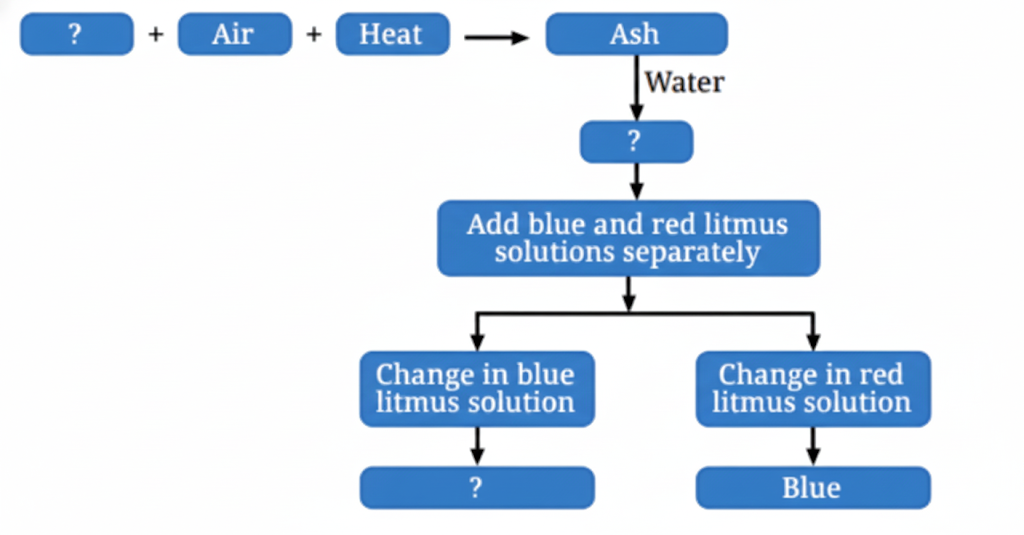
Answer:
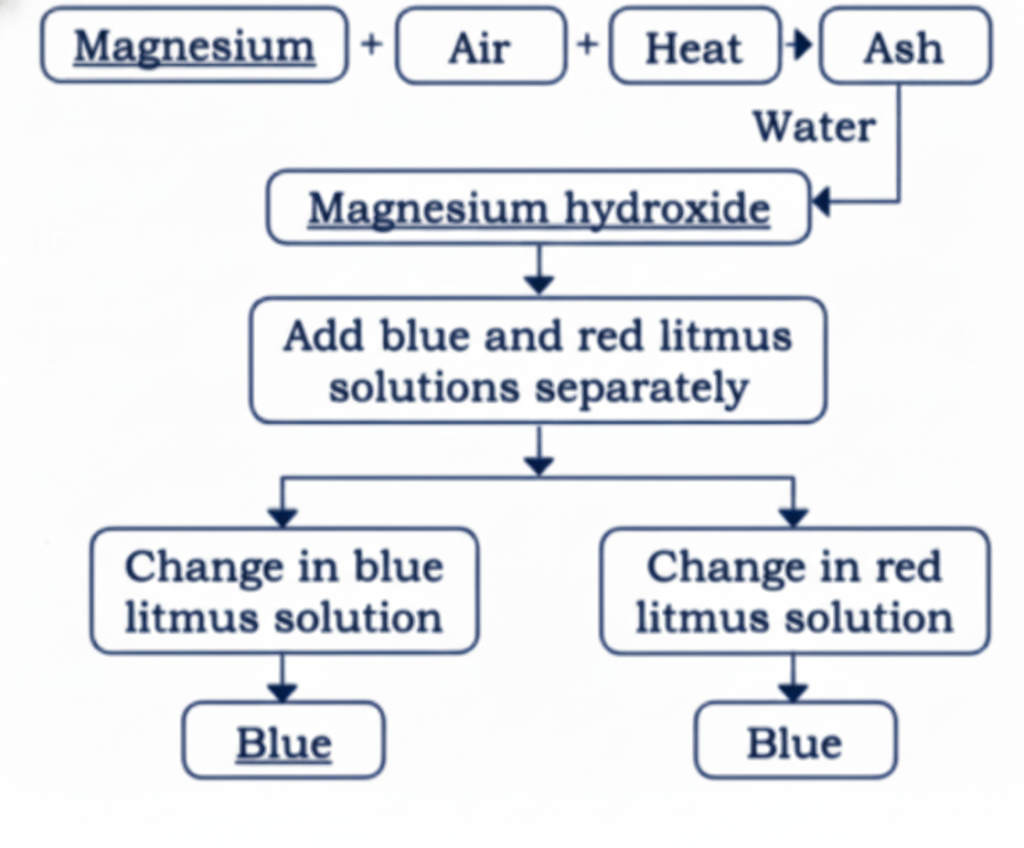
Question 8.
You are provided with the following materials. Discuss which material would be your choice to make a pan that is most suitable for boiling water and why?
Answer:
To boil water, the pan should be made from a material that conducts heat efficiently. Among the given options, iron and copper are metals and both conduct heat well. However, copper is the better choice because it is more resistant to rust than iron. Hence, a copper pan is the most suitable option for boiling water.
Question 9.
You are provided with three iron nails, each dipped in oil, water and vinegar. Which iron nail will not rust, and why?
Answer: An iron nail immersed in oil does not rust because the oil creates a protective coating over the metal. This layer blocks air and moisture from reaching the iron surface, thereby preventing the process of rust formation.
Question 10.
How do the different properties of metals and non-metals determine their uses in everyday life?
Answer:
Metals and non-metals possess different characteristics that determine how they are used in daily life.
Metals:
Metals can be beaten into thin sheets (malleable); for instance, aluminium is used to make foil for food wrapping.
They can be drawn into thin wires (ductile), which is why copper and aluminium are commonly used in electrical wiring.
Metals produce a ringing sound when struck, a property known as sonority.
Since they transfer heat efficiently, metals are widely used for making cooking utensils.
Metals also allow electric current to pass through easily, making them suitable for electrical applications.
Non-metals:
Most non-metals do not conduct heat or electricity well; materials like sulphur and carbon are used as insulators to prevent the flow of heat or current.
Non-metals are generally brittle; substances such as sulphur and phosphorus break easily and are therefore used in matchsticks due to their reactive nature.
Many non-metals exist as gases at room temperature, such as oxygen, which is vital for respiration.
Non-metals usually lack shine; carbon in the form of graphite is used in pencils and dry cell batteries despite being non-lustrous.
Question 11.
One of the methods of protecting iron from getting rusted is to put a thin coating of zinc metal over it. Since sulphur does not react with water, can it be used for this purpose? Justify your answer.
Answer: No, sulphur cannot be used to protect iron from rusting. Although sulphur does not react with water, it does not form a protective coating on iron as zinc does. As a result, sulphur is unable to block air and moisture from reaching the iron surface, so it cannot prevent rusting.
Question 12.
An ironsmith heats iron before making tools. Why is heating necessary in this process?
Answer: To make tools, an ironsmith first heats a piece of iron until it becomes red-hot. Heating softens the iron, making it more malleable and easier to bend, hammer, and shape into the required form.
Activity 4.1: Let Us Explore (Pages 42-43)
Observation:
Table 4.1: Appearance, hardness, and effect of hammering on different objects or materials
Conclusion:
Materials such as copper, aluminium, and iron have a shiny appearance, are hard, and can be hammered into thin sheets.
Materials like coal and sulphur are dull in appearance, soft, and break easily into pieces, while wood is neither malleable nor brittle.
Activity 4.2: Let Us Investigate (Pages 45 – 46)
Observation: Metal spoon and metal coin produce a ringing sound. On the other hand, coal and wood produce dull sounds.
Conclusion: Metals are sonorous, they produce a ringing sound.
Activity 4.3: Let us Investigate (Pages 46-47)
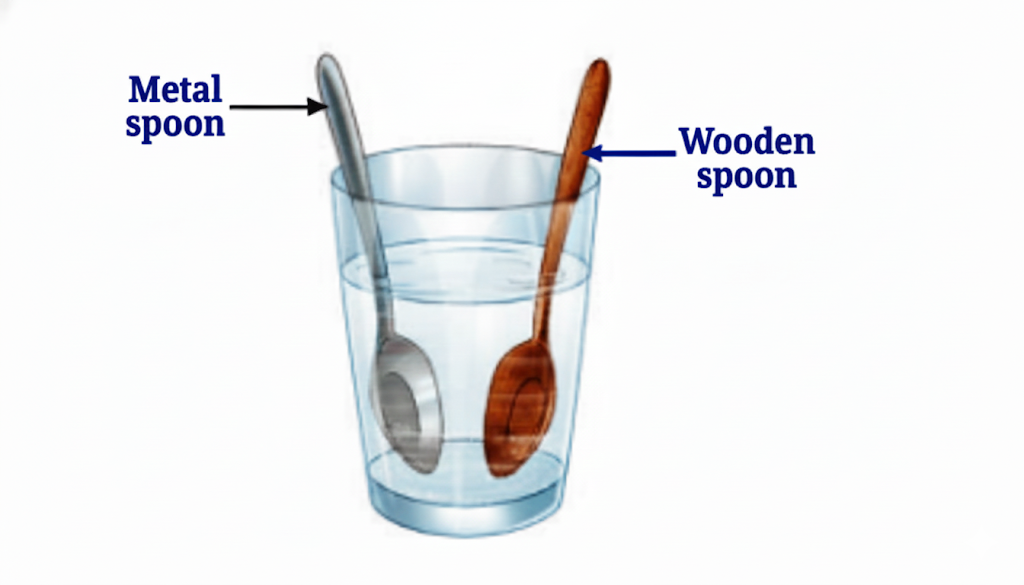
Observation: Metal spoon is hotter to touch than wooden spoon.
Conclusion: Heat transfers through the metal spoon easily, making it hotter. While heat transfers through the wooden spoon poorly. Hence, metals are good conductors of heat, but wood is a poor conductor of heat.
Activity 4.4: Let Us Design And Create (Pages 47-48)
Observation: Table 4.2: Conduction of electricity by different objects or materials
Conclusion:
Materials such as aluminium, iron, and copper permit the flow of electric current and are therefore good conductors of electricity.
Materials like sulphur, coal, dry wood, stone, eraser, and nylon do not allow electric current to pass through them and are thus poor conductors of electricity.
Activity 4.5: Let Us Experiment (Pages 49-50)
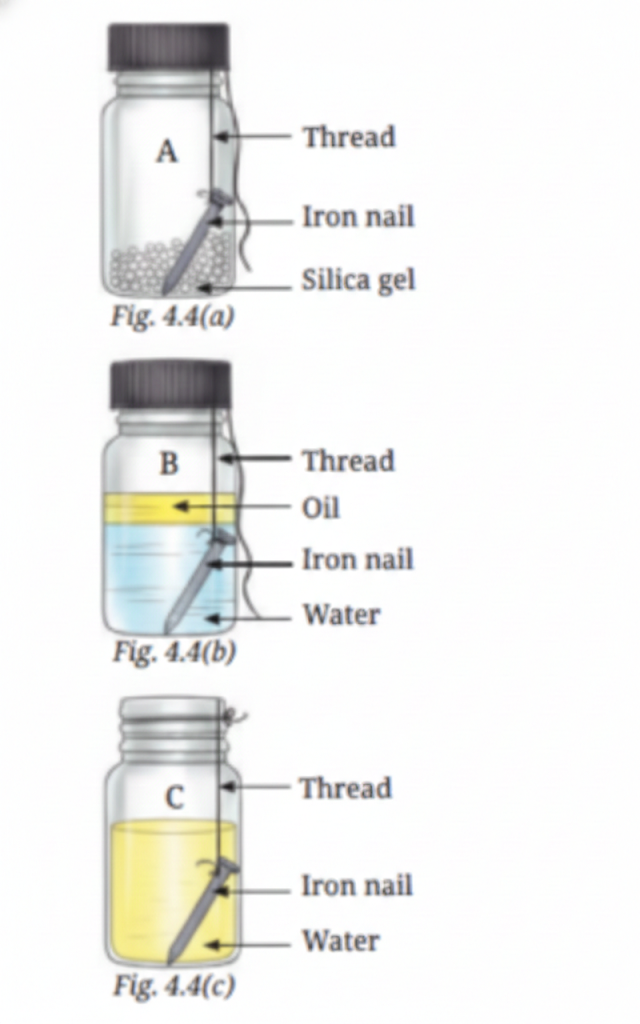
Observation: Table 4.3: Formation of brown deposit on iron nails
Conclusion: The presence of both air and water is essential for the brown deposit to be formed on iron (rusting of iron).
Activity 4.6: Let Us Investigate (demonstration activity) (Page 51)
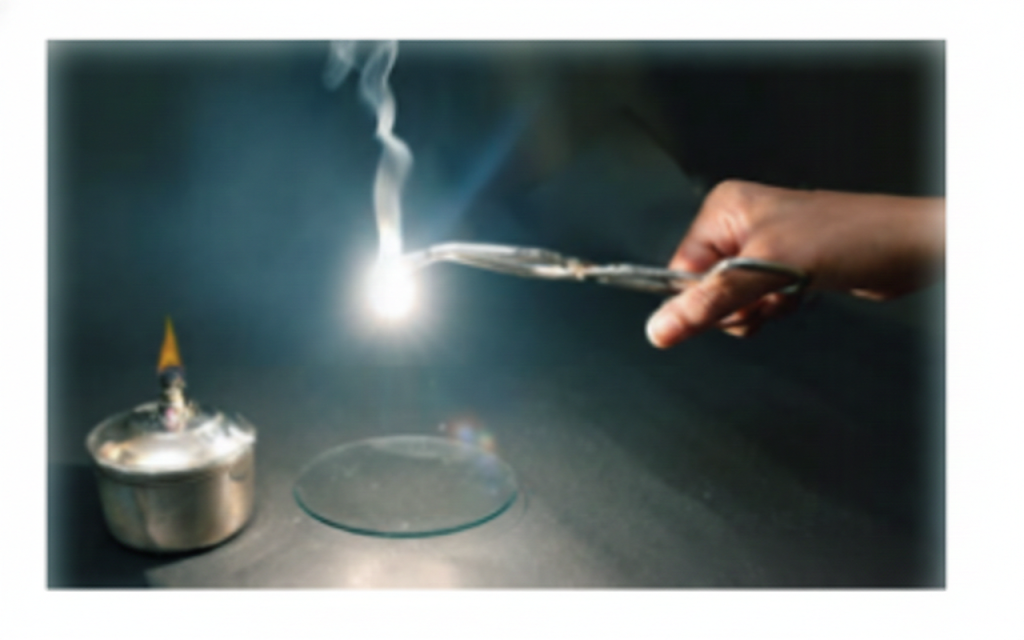
Observation:
When magnesium ribbon is burned, it produces a bright white flame and forms a white powdery ash.
The resulting solution turns red litmus paper blue.
Conclusion:
Magnesium reacts with oxygen present in the air to form magnesium oxide.
Metal oxides are usually basic in nature.
Activity 4.7: Let Us Experiment (demonstration activity) (Pages 52-53)
Observation: The solution obtained after the addition of water to the glass jar turns blue litmus paper to red.
Conclusion:
• Sulphur burns with oxygen in the air and produces sulphur dioxide gas.
• On dissolving sulphur dioxide gas in water, sulphurous acid is formed, which turns blue litmus paper to red. Thus, oxides of non-metals are acidic in nature.
Activity 4.8: Let Us Explore (Page 53)
Observation: When sulphur is placed in water, no reaction occurs.
Conclusion: Sulphur does not react with water.
Class 7 Science Chapter 4: The World of Metals and Non-metals (2026-27 NCERT Solutions)
Explore the vital differences between metals and non-metals with these Class 7 Science NCERT Solutions. Our easy explanations help students understand topics like properties of metals, non-metal uses, and the science behind rusting, making exam preparation effortless.
Mastering the key concepts—like malleability, ductility, sonority, and conductivity—is simple with our well-structured answers. Focused study on Class 7 Science Chapter 4 ensures you remember how common metals and non-metals are used in daily life.
Regular revision with these NCERT Solutions for Class 7 Science Curiosity Chapter 4 sharpens your knowledge, boosts confidence, and prepares you for school exams and quizzes. Make learning science easier and more enjoyable, one chapter at a time!
FAQs on NCERT Solutions For Class 7 Science Curiosity Chapter 4 The World Of Metals And Non-Metals - 2026-27 Free PDF Download (Sign-in Required)
1. What are NCERT Solutions for Class 7 Science Curiosity Chapter 4: The World of Metals 4 and Non-metals?
NCERT Solutions for Class 7 Science Curiosity Chapter 4 provide exam-focused, stepwise answers to all intext and back exercise questions from The World of Metals 4 and Non-metals as per the CBSE 2026–27 syllabus.
Key features include:
- Clear, pointwise solutions matching the NCERT textbook
- Easy-to-understand definitions and diagram tips
- Marks-oriented structuring and keywords to help you score full marks
- Supports quick revision and doubt solving for CBSE exams
2. How should I write stepwise NCERT answers to score full marks in Class 7 Science Chapter 4?
To score full marks in NCERT Class 7 Science Chapter 4, structure your answers stepwise using important keywords.
Follow this format:
- Start with a clear, one-line definition or concept
- List steps in logical order (numbered or bulleted)
- Use key terms from the chapter
- Illustrate with neat, labelled diagrams if asked
- Keep answers within the required word count as per CBSE marking scheme
3. Which questions are most important from Chapter 4: The World of Metals and Non-metals for school exams?
The most important questions from Chapter 4 often cover definitions, differences, uses, and simple reactions involving metals and non-metals.
Focus on:
- Properties and examples of metals vs. non-metals
- Key definitions (ductility, malleability, etc.)
- Short notes on uses/applications
- Fill-in-the-blanks, true/false, and diagrams from the textbook
- Long answer questions explaining physical or chemical properties
4. Are diagrams or definitions mandatory in NCERT Science answers?
Including diagrams and definitions is crucial to scoring well in NCERT Science Class 7 Chapter 4.
Tips:
- Draw neat, labelled diagrams when a question mentions 'explain with diagram'
- Start with short, accurate definitions for all asked terms
- Use diagrams to support explanations, as they often carry marks in CBSE exams
5. How do I structure long answers in Class 7 Science exams to match the CBSE marking scheme?
For long answers in CBSE Class 7 Science:
Structure your response as follows:
- Write an introduction briefly stating the topic
- Break the answer into logical steps or paragraphs
- Use subheadings (like 'Physical Properties', 'Uses', etc.)
- Insert key words and terms from the chapter
- Conclude with a summary line
6. Where can I download the PDF of NCERT Solutions for Class 7 Science Chapter 4?
You can download the free PDF of Class 7 Science Chapter 4 NCERT Solutions directly from trusted educational websites like Vedantu.
Benefits of the download:
- Offline study and revision
- Printable format for practice
- Access to stepwise, exam-focused solutions
7. How can I revise Chapter 4 The World of Metals and Non-metals quickly before exams?
To revise Chapter 4 quickly:
Follow these tips:
- Go through key definitions and properties of metals and non-metals
- Use flash notes and revision planners (1-day, 3-day, 7-day)
- Practice diagrams and important questions provided in NCERT Solutions
- Attempt objective and MCQ questions for quick recall
8. What are the most common mistakes students make in Science Chapter 4 metals and non-metals?
Common mistakes to avoid in this chapter:
- Confusing properties of metals and non-metals (e.g., stating metals are non-malleable)
- Missing keywords in definitions or answers
- Not labelling diagrams clearly
- Leaving out examples or uses
- Writing over-lengthy or off-topic answers
9. Do examiners award partial marks for correct steps even if the final answer is wrong in CBSE Science Class 7 exams?
Yes, CBSE examiners often give partial marks if your answer shows correct steps or relevant reasoning, even if the final answer is wrong.
- Write all steps clearly
- Highlight your approach, especially in diagram-based or multi-step questions
10. Are NCERT Solutions enough for Class 7 Science exams?
NCERT Solutions are usually sufficient for Class 7 Science exams as they cover all chapter concepts, exercises, and marking scheme insights.
To score higher:
- Revise all solved examples and intext questions
- Practice some extra questions from Exemplar and worksheets
- Use revision notes for quick preparation
11. What are the key definitions to remember from The World of Metals and Non-metals?
Key definitions for this chapter include:
- Metals: Elements that are generally hard, lustrous, malleable, and conduct heat/electricity
- Non-metals: Elements that are usually non-lustrous, non-malleable, and poor conductors
- Malleability: The property of being hammered into sheets
- Ductility: The property of being drawn into wires
12. How do I learn and label diagrams for Chapter 4 easily?
To learn diagrams in Chapter 4:
- Practice drawing each diagram 2–3 times
- Use sharp pencils and clear labelling for neatness
- Memorise common labels given in NCERT Solutions
- Revise with a checklist of diagram conventions (arrow marks, heading, etc.)
