



Stepwise Answers, Diagrams, and Exam Tips for Class 7 Science Earth, Moon, and Sun
Question 1.
How day and night occur on the Earth due to its rotation? (Page 172)
Answer:
Day and night occur due to the rotation of the Earth on its axis from west to east. As the Earth rotates, the side facing the Sun has daytime, while the side turned away from the Sun experiences night.
Question 2.
Since the Earth is rotating, shouldn’t the stars also appears to move in the sky like the Sun? (Page 1 74)
Answer: Yes, because the Earth rotates from west to east, stars seem to move across the sky from east to west, similar to the Sun. This motion is only apparent and occurs due to the Earth’s rotation on its axis.
Question 3.
Why do different stars appear in the night sky over the course of a year? (Page 175)
Answer: We observe different stars at night at various times of the year because the Earth revolves around the Sun. As the Earth moves along its orbit, the portion of the sky visible at night changes, allowing different stars and constellations to be seen in different months.
Question 4.
We go through a cycle of seasons every year. Is it related to the revolution of the Earth around the Sun in some way? (Page 1 77)
Answer: Yes, the change of seasons is linked to the Earth’s revolution around the Sun. As the Earth moves around the Sun, its tilted axis causes different regions to receive varying amounts of sunlight at different times of the year, which leads to the formation of seasons.
Question 5.
Why days are longer in summer than in winter? (Page 177)
Answer: Days are longer in summer than in winter because of the tilt of the Earth’s axis. During summer, a region of the Earth is tilted toward the Sun, allowing it to receive sunlight for a longer duration each day.
Question 6.
Could the light from the Sun get blocked by the two planets which are revolving between the
Earth and the Sun? (Page 1 79)
Answer: No, sunlight is not usually blocked by Mercury or Venus because both planets are very small compared to the Sun and are located far from the Earth. Although they sometimes pass between the Earth and the Sun, they cover only a tiny portion of the Sun’s light, which is hardly noticeable from Earth.
Let Us Enhance Our Learning
Question 1.
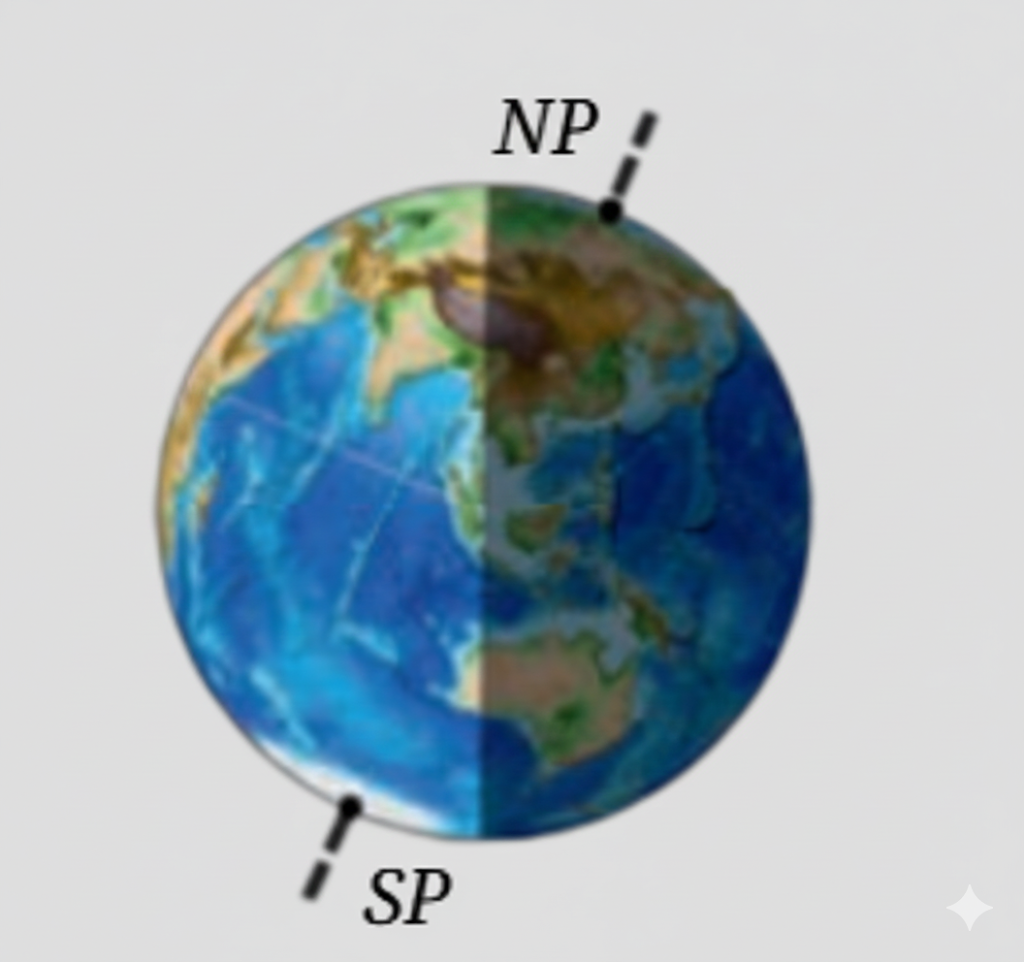
In Fig. 12.17, how many hours of sunlight do the North Pole and the South Pole receive during one rotation of the Earth?
Answer:
In the given figure, the North Pole is shown in darkness, indicating winter in the Northern Hemisphere. At this time, the North Pole receives no sunlight, while the South Pole, which is experiencing summer, receives sunlight for 24 hours during one full rotation of the Earth. This happens because of the tilt of the Earth’s axis.
Question 2.
Fill in the blanks
(i) Stars rise in the ______ and set in the _______.
Answer:
east, west
(ii) Day and night are caused by the Earth’s _______
Answer:
rotation
(iii) When the Moon fully covers the Sun from our view, it is called a _______ solar eclipse.
Answer:
total
Question 3.
State whether True or False
(i) Lunar eclipse occurs when the Sun comes between the Earth and the Moon.
Answer:
False
(ii) Sunrise happens earlier in Gujarat than in Jharkhand.
Answer:
False
(iii) In Chennai, the longest day occurs on the summer solstice.
Answer:
False
(iv) We should watch the solar eclipse directly with our naked eye spherical shape.
Answer:
False
(vi) The Earth’s revolution around the Sun causes day and night.
Answer:
False
Question 4.
Padmashree saw the Orion constellation nearly overhead at 8 pm yesterday. When will she see Orion overhead today?
Answer:
Padmashree will observe the Orion constellation about 4 minutes earlier each day because of the Earth’s revolution. If she saw it at 8:00 pm yesterday, she will see it at approximately 7:56 pm today.
Question 5.
Nandhini saw a group of stars rising at midnight on 21 June. When will she see the same group of stars rising at midnight next
year?
Answer: Stars rise roughly 4 minutes earlier each day due to the Earth’s revolution around the Sun. Over the course of a year, this small daily shift adds up to about 24 hours. As a result, Nandhini will observe the same stars rising at midnight on 20 June next year, since their rising time moves one day earlier on the calendar each year.
Question 6.
Abhay noticed that when it was daytime in India, his uncle who was in the USA was generally sleeping as it was night-time there. What is the reason behind this difference?
Answer: The rotation of the Earth results in different time zones across the world. India is ahead of the USA in time, so when it is daytime in India, it is night in the USA, and Abhay’s uncle would be asleep.
Question 7.
Four friends used the following ways to see the solar eclipse. Who among them was being careless?
(i) Ravikiran used a solar eclipse goggle.
(ii) Jyothi used a mirror to project the Sun’s image.
(iii) Adithya saw the Sun directly with his eyes.
(iv) Aruna attended a programme arranged by a planetarium.
Answer: (iii) Adithya was careless because he looked directly at the Sun, which can harm the eyes. Safe ways to observe a solar eclipse include using certified solar eclipse glasses, indirect viewing methods, or watching it through guided programmes.
Question 8.
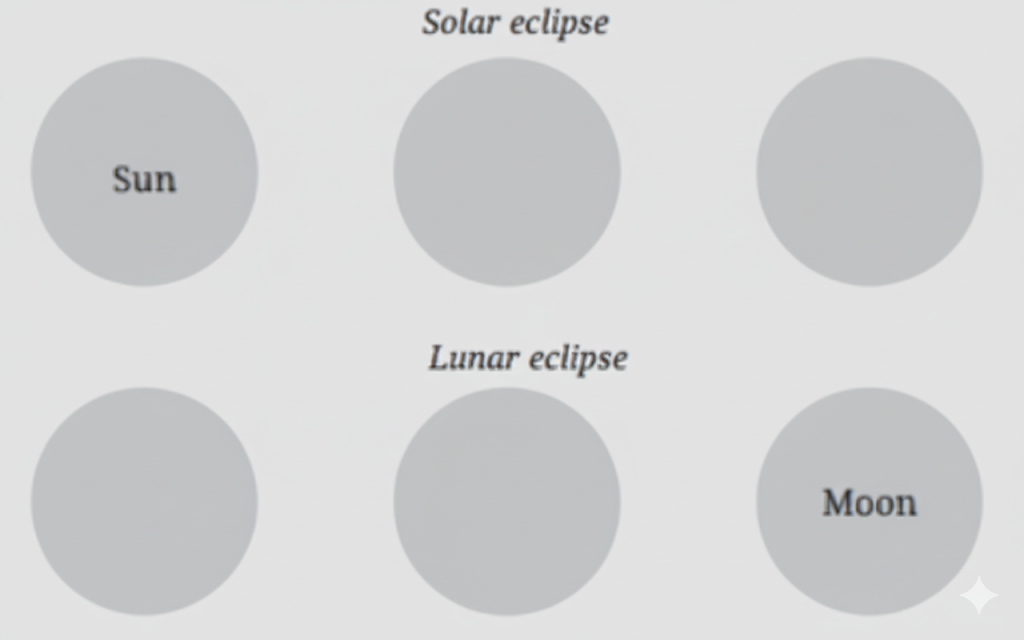
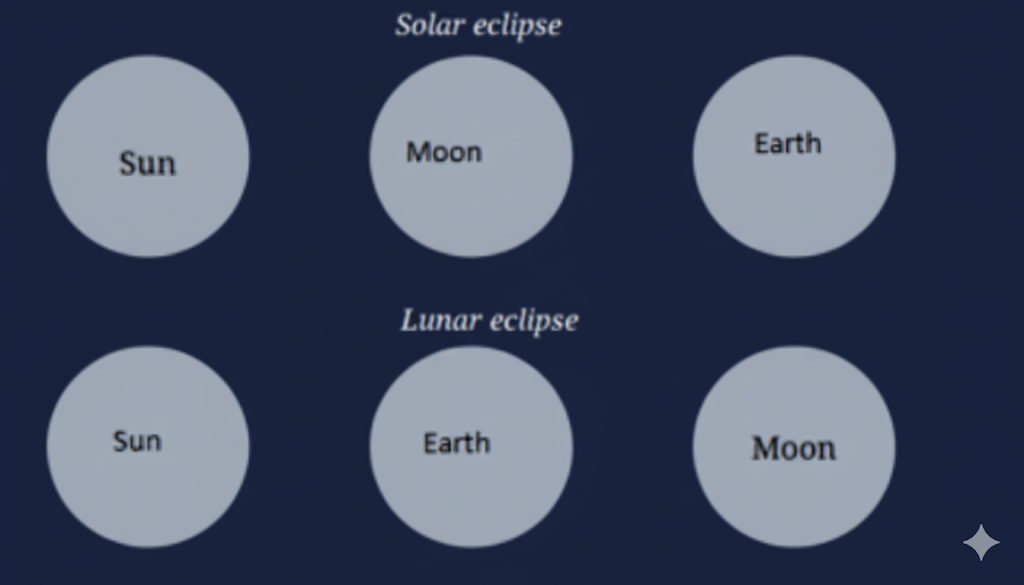
Fill in the circles in Fig. 12.18 appropriately with one of the following: Sun, Moon, Earth.
Answer:
Question 9.
The Moon is much smaller than the Sun, yet it can block the Sun completely from our view during a total solar eclipse. Why is it possible?
Answer:
The Moon and the Sun appear nearly the same size when seen from Earth, even though the Moon is much smaller. This is because the Moon is much closer to the Earth than the Sun. As a result, the Moon can fully cover the Sun during a total solar eclipse.
Question 10.
The Indian cricket team matches in Australia are often held in December. Should they pack winter or summer clothes for their trip?
Answer: They should carry summer clothing for their trip. In Australia, December is a summer month because it lies in the Southern Hemisphere, where seasons are opposite to those in India. Therefore, when it is winter in India in December, Australia experiences summer.
Question 11.
Why do you think lunar eclipses can be seen from a large part of the Earth when they happen, but total solar eclipse can be seen by only a small part of the Earth?
Answer: A lunar eclipse can be observed from a large area of the Earth because the Earth’s shadow is large and covers the Moon for a longer duration, allowing everyone on the night side of the Earth to see it. In contrast, a total solar eclipse is visible only for a few minutes and from a limited region, since the Moon’s shadow is small and moves rapidly across the Earth due to the Moon’s motion and the Earth’s rotation.
Question 12.
If the Earth’s axis were not tilted with respect to the axis of revolution, explain what would be the effect on seasons?
Answer: If the Earth’s axis were not tilted, seasons would not exist. All regions of the Earth would receive nearly the same amount of sunlight throughout the year, causing the weather to remain almost constant. There would be no summer, winter, spring, or autumn, and the length of day and night would stay nearly equal every day.
Activity 12.1: Let us Explore (Page 170)
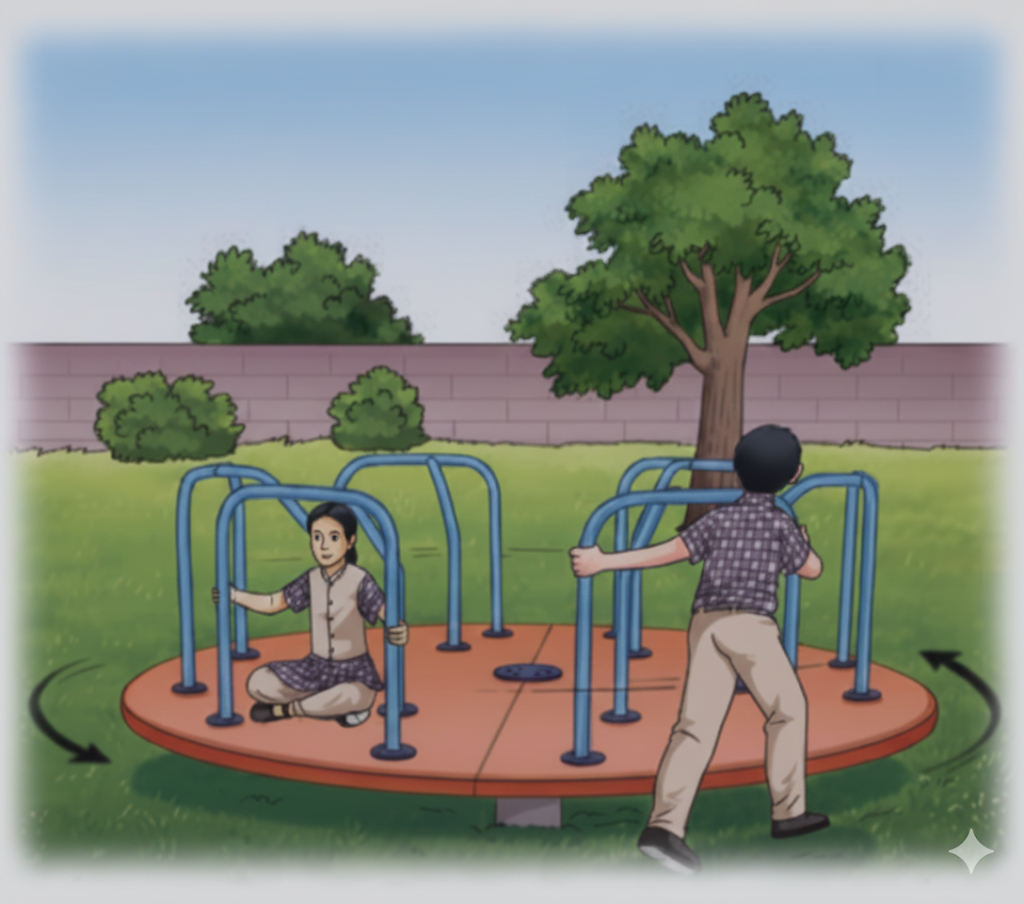
Fig. A girl observing objects around her while riding a merry-go-round
Observation and conclusion:
• When we are on a rotating object, such as a merry-go-round, the surroundings appear to move in the opposite direction.
• If we focus our eyes on a particular tree, it seems to move around us in the opposite, or clockwise, direction.
• Similarly, as the Earth rotates from west to east, the Sun appears to move from east to west. Thus, the apparent motion of the Sun is actually due to the Earth’s rotation.
Activity 12.2: Let Us Explore (Pages 171-172)
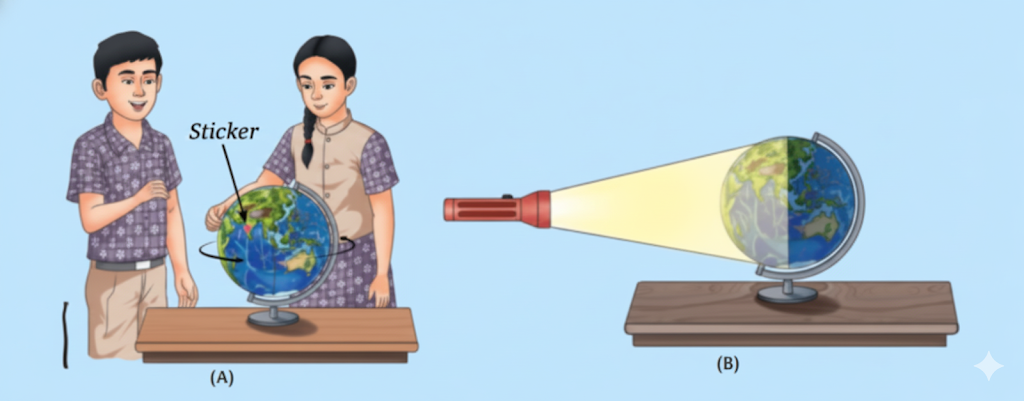
Fig. (a): Using a globe to understand rotation of the Earth, (b): Using a globe and a torchlight to understand day and night
Observation and conclusion:
This activity helps explain how the Earth’s rotation from west to east leads to day and night. As the Earth turns, different regions come into sunlight, experiencing day, and then move into darkness, experiencing night. The Sun seems to rise in the east, travel across the sky, and set in the west, showing that this apparent movement of the Sun is actually caused by the Earth’s rotation.
Activity 12.3: Let Us Explore (Page 174)
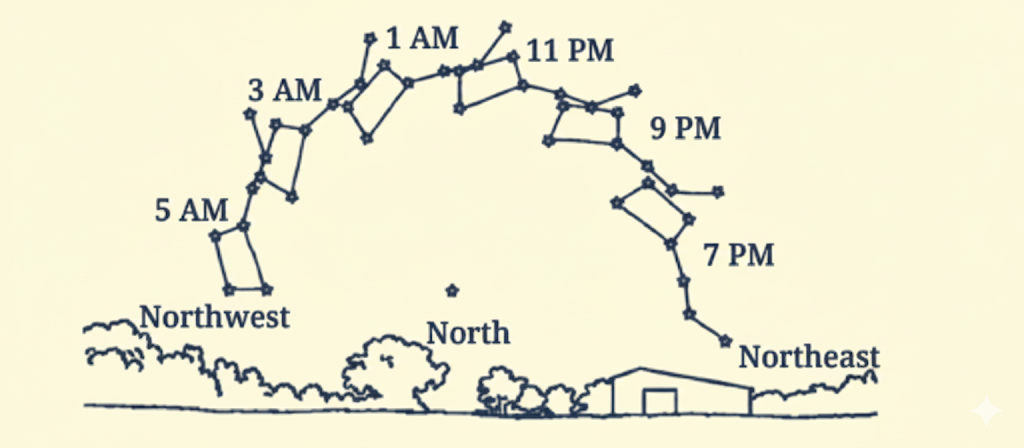
Observation and Conclusion:
This activity demonstrates that stars seem to move across the night sky due to the Earth’s rotation from west to east. The Pole Star appears almost stationary because it lies close to the Earth’s axis, while the Big Dipper seems to rotate around it. This apparent motion helps explain how the night sky changes over time as a result of the Earth’s rotation.
Activity 12.4: Let Us Explore (Page 180)
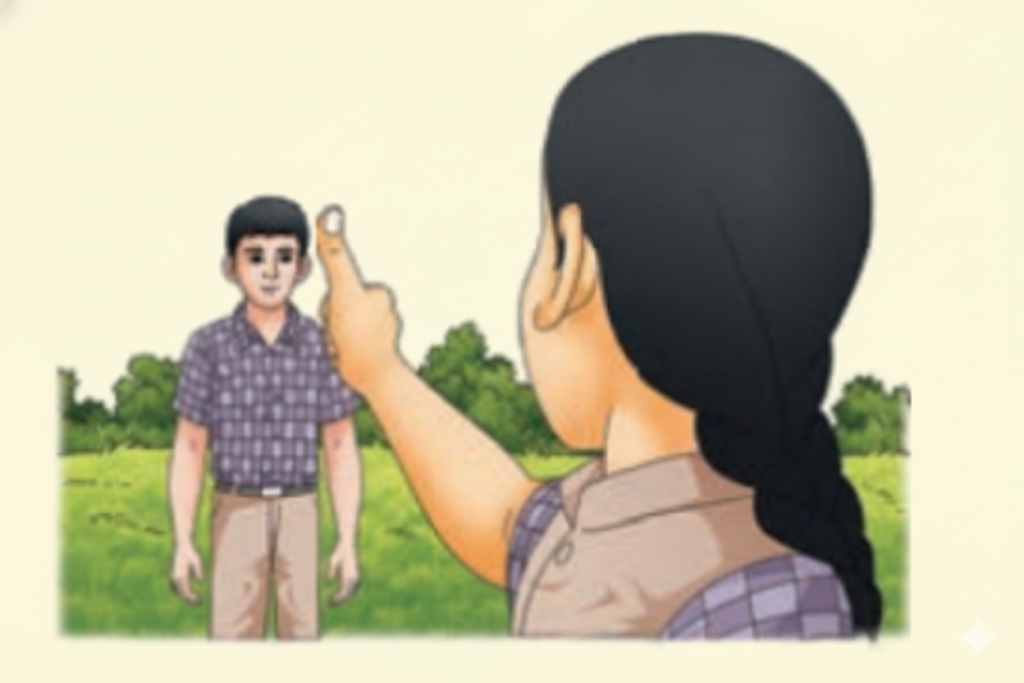
Fig. Trying to cover a friend’s head with the thumb
Observation and conclusion:
This activity demonstrates that the apparent size of an object depends on both its real size and its distance from the observer. Although the Sun is much larger than the Moon, they appear almost the same size from Earth because the Moon is much closer to us. This is why the Moon can completely cover the Sun during a solar eclipse.
Earth, Moon, and the Sun – Key Concepts for Class 7
Class 7 Science Chapter 12, Earth, Moon, and the Sun, explains how the Earth's rotation causes the Sun to appear to move across the sky. Understanding these NCERT concepts builds a strong foundation for higher classes.
Remember, phenomena like sunrise and sunset are due to Earth's west-to-east rotation. Reviewing real-life examples, such as how shadows change, makes it easier to connect textbook learning with daily experiences.
Practice exercise solutions regularly and notice the world around you. Not only will this improve exam scores for the 2026-27 NCERT Solutions, but it will also help you develop scientific observation skills easily.
FAQs on NCERT Solutions For Class 7 Science Chapter 12 Earth, Moon, And The Sun - 2026-27 Free PDF Download (Sign-in Required)
1. What are NCERT Solutions for Class 7 Science Chapter 12: Earth, Moon, and the Sun?
NCERT Solutions for Class 7 Science Chapter 12 provide detailed, step-by-step answers to all textbook exercises on the Earth, Moon, and the Sun for CBSE 2026–27.
- They cover intext and back exercise questions.
- Answers follow the CBSE marking scheme and often include diagrams, definitions, and examples.
- Helpful for concept clarity, exam practice, and revision.
2. How can I score full marks in Class 7 Science Chapter 12 Earth, Moon, and the Sun?
To score full marks in Class 7 Science Chapter 12, use stepwise solutions, clear diagrams, and accurate definitions.
- Write answers in points or steps as per CBSE marking scheme.
- Label all diagrams neatly and use correct scientific terms.
- Include key definitions where asked.
- Revise regularly using NCERT Solutions and important questions.
3. Are diagrams and definitions important for Class 7 Science Chapter 12 answers?
Yes, including diagrams and precise definitions is essential for scoring well in Class 7 Science Chapter 12: Earth, Moon, and the Sun.
- Neat, labelled diagrams often carry separate marks.
- Definitions enhance clarity and help gain full points.
4. Where can I download free PDF solutions for Class 7 Science Chapter 12?
You can download a free PDF of NCERT Solutions for Class 7 Science Chapter 12 for offline study from trusted educational platforms.
- These PDFs contain exercise-wise, stepwise answers with diagrams and important notes.
- Useful for revision, homework, and exam preparation.
5. What are the key topics covered in Class 7 Science Chapter 12: Earth, Moon, and the Sun?
Class 7 Science Chapter 12 covers the basic features and movements of the Earth, Moon, and Sun.
- Phases of the moon
- Revolution and rotation of the Earth
- Eclipses (solar and lunar)
- Solar system facts
- Diagrams and labelling related to each topic
6. How should I structure long answers for Class 7 Science to score better marks?
For long answers in Class 7 Science, structure your response using stepwise points and include diagrams, definitions, and keywords.
- Start with a brief introduction.
- Divide the answer into sub-points or steps.
- Add a neat, labelled diagram if relevant.
- End with a summary statement or conclusion.
7. Which questions are important from Earth, Moon, and the Sun chapter for exams?
Important questions from this chapter include those on phases of the Moon, types of eclipses, Earth's motions, and labelled diagrams.
- Practice all back exercise and intext questions.
- Focus on questions about diagrams, definitions, and real-life examples.
8. Are NCERT Solutions enough to prepare for Class 7 Science Chapter 12?
NCERT Solutions for Class 7 Science Chapter 12 are usually sufficient for exam preparation, but extra questions help in gaining confidence.
- Cover all NCERT textbook exercises first.
- Practice extra questions, diagrams and revision notes for thorough preparation.
9. How can I memorise diagrams and labelling for Class 7 Science Chapter 12?
To memorise diagrams for Chapter 12, practice drawing and labelling regularly.
- Refer to NCERT Solutions and notes for correct diagrams.
- Copy diagrams neatly in your notebook.
- Label each part clearly and learn their functions.
10. How do examiners give marks for stepwise answers in Class 7 Science?
Examiners award marks for each correct step, point, definition, and properly drawn diagram as per the CBSE marking scheme.
- Even if the final answer is partially wrong, correct steps may fetch marks.
- Ensure each step and keyword is clearly written for maximum scoring.
