



Stepwise Answers & PDF for Class 7 Science Chapter 6: Adolescence
Question 1.
Adolescents, especially girls, may sometimes suffer from blood-related health problems (s) because of a deficiency of iron or vitamin B12 in the body. (Page 80)
(i) Find out about such health problem(s).
[ii] How can we manage iron deficiency in our body?
(iii) Find out about government schemes aimed to prevent such deficiencies.
Answer:
(i) A common blood-related disorder caused by a lack of iron or vitamin B12 is anaemia. In this condition, the level of haemoglobin in the blood decreases. Since haemoglobin is responsible for carrying oxygen, a low level means that insufficient oxygen reaches different parts of the body. This can lead to symptoms such as tiredness, weakness, and dizziness.
(ii) Iron deficiency can be reduced by including iron-rich foods in the diet, such as green leafy vegetables, beans, lentils, fortified cereals, and meat.
(iii) Some government schemes that address anaemia include:
(a) National Iron Plus Initiative (NIPI) – for the control of iron deficiency anaemia
(b) Mid-Day Meal Scheme
(c) Anaemia Mukt Bharat (AMB)
Question 2.
Discuss the sources of vitamin B12 with your teacher. (Page 80)
Answer: Vitamin B12 is mainly obtained from animal-based foods like milk, meat, fish, poultry, eggs, and other dairy products. It plays a vital role in the production of red blood cells, proper nervous system function, and DNA formation.
Let Us Enhance Our Learning
Question 1.
Ramesh, an 11 year old boy, developed a few pimples on his face. His mother told him that this is because of ongoing biological changes in his body.
(i) What could be the possible reasons for the development of these pimples on his face?
(ii) What can he do to get some relief from these pimples?
Answer:
(i) The pimples on Ramesh’s face are likely caused by hormonal changes that occur during puberty. During this stage, increased hormone levels stimulate the skin’s oil glands to produce excess oil. This extra oil can block pores and result in pimples or acne.
(ii) Ramesh can reduce pimples by following these steps:
Clean his face regularly using a mild cleanser
Drink plenty of water
Maintain a healthy and balanced diet
Avoid touching, squeezing, or picking pimples, as this can make the condition worse
Question 2.
Which of the following food groups would be a better option for adolescents and why?
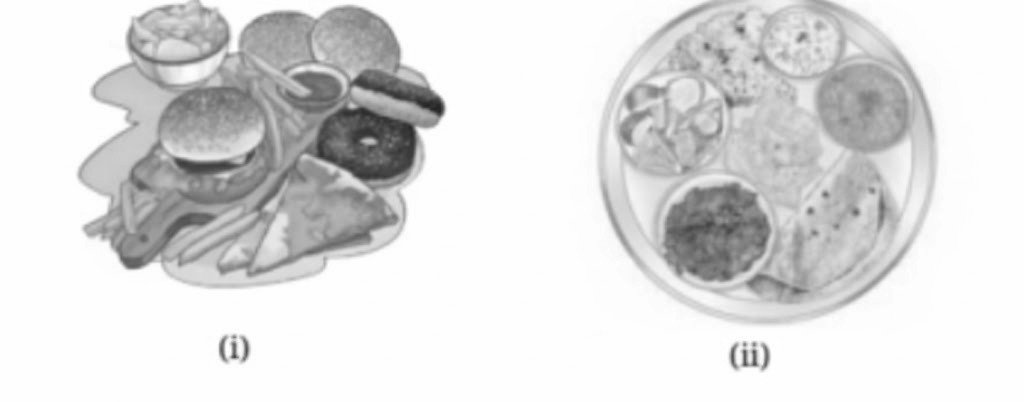
Answer:
Food group (ii) is a better choice for adolescents because it includes vegetables, grains, dairy products, and similar foods. These provide essential nutrients such as proteins, carbohydrates, vitamins, and minerals, which are necessary for proper growth, development, and good health during adolescence.
Question 3.
Unscramble the underlined word in the following sentences:
(i) The discharge of blood in adolescent girls which generally occurs every 28-30 days is nstmnoiaretu.
(ii) The hoarseness in the voice of adolescent boys is due to enlarged iceov xob.
(iii) Secondary sexual characteristics are natural signs that the body is preparing for adulthood and mark the onset of urtvpeb.
(iv) We should say NO to lahoclo and srugd as they are addictive.
Answer:
nstmnoiaretu-menstruation
iceov xob-voice box
urtypeb-puberty
lahoclo and srugd-alcohol and drugs
Question 4.
Shalu told her friend, “Adolescence brings only physical changes, like growing taller or developing body hair. ” Is she correct? What would you change in this description of adolescence?
Answer:
Shalu is not entirely correct. Adolescence is not limited to physical changes such as an increase in height or the growth of body hair. It also involves the development of reproductive abilities along with emotional and behavioural changes.
Question 5.
During a discussion in the class, some of the students raised the following points. What questions would you ask them to check the correctness of these points?
(i) Adolescents do not need to worry about behavioural changes.
(ii) If someone tries a harmful substance once, they can stop anytime they want.
Answer:
The following questions can be raised to examine the correctness of point (i):
(a) Why do you feel that behavioural changes during adolescence are a matter of concern?
(b) Why is it important for adolescents to accept these changes positively instead of worrying about them?
The following questions can be posed to check the correctness of point (ii):
(a) What makes you believe that a person can stop using a harmful substance whenever they choose?
(b) Are you familiar with the idea of addiction, and how even a single use of a substance might make quitting difficult?
(c) Do you know of any studies or evidence that show it is easy to stop using harmful substances after trying them just once?
Question 6.
Adolescents sometimes experience mood swings. On some days, they feel very energetic and happy, while on other days, they may feel low. What other behavioural changes are associated with this age?
Answer:
Adolescents experience a variety of behavioural changes, such as:
Strong emotions that can shift rapidly
A growing need for independence and making their own decisions
Influence from peers and a desire to fit in with social groups
Exploration of personal identity, including sexual identity
Greater involvement with technology, including mobile phones and social media
Question 7.
While using a toilet, Mohini noticed that used sanitary pads were scattered near the bin. She got upset and shared her feelings with her friends. They discussed the importance of menstrual hygiene and healthy sanitary habits. What menstrual hygiene and sanitary habits would you suggest to your friends?
Answer: Good menstrual hygiene and sanitary practices include:
Using sanitary pads or clean, reusable cloth pads during menstruation
Changing sanitary pads regularly, usually every 4–5 hours or as needed
Cleaning the genital area properly to maintain hygiene and prevent infections
Disposing of used sanitary pads by wrapping them in paper before placing them in a dustbin
Washing hands thoroughly with soap and water before and after handling sanitary pads to avoid the spread of germs
Question 8.
Mary and Manoj were classmates and good friends. On turning 11, Mary developed a little bulge on the front of her neck. She visited the doctor who gave her medication and asked to take iodine-rich diet. Similarly, a bump developed on the front of Manoj’s neck when he turned 12. However, the doctor told him that it was a part of growing up. According to you, what could be the possible reason for advising Mary and Manoj differently?
Answer: The doctor advised Mary and Manoj differently because the causes of the bulge on their necks were not the same. Mary’s neck swelling was likely due to goitre, a condition caused by a lack of iodine in the diet. Iodine is necessary for the normal functioning of the thyroid gland, and its deficiency can lead to enlargement of the gland, resulting in a visible bulge. Hence, Mary was advised to consume an iodine-rich diet.
In contrast, Manoj’s neck bulge was due to the growth of his voice box during puberty. This natural change, commonly known as the Adam’s apple, occurs as the voice box enlarges and changes shape, often causing a prominent bump in the throat and a temporary hoarseness in the voice.
Question 9.
During adolescence, the boys and girls undergo certain physical changes, a few of which are given below.
(i) Change in voice
(ii) Development of breasts
(iii) Growth of moustache
(iv) Growth of facial hair
(v) Pimples on the face
(vi) Growth of hair in the pubic region
(vii) Growth of hair in armpits
Categorise these changes in the table given below:
Answer:
Question 10.
Prepare a poster mentioning the tips for adolescents to live a healthy lifestyle.
Answer:
Students should do it by themselves.
Activity 6.1: Let Us Discuss (Pages 74-75)
Answer:
Students should do it by themselves.
Activity 6.2: Let Us List (page 78)
Table 6.2: Emotional changes, their probable effects on behaviour, and ways for positive growth and development
Activity 6.3: Let Us List (Page 79)
Table 6.3: Food sources, nutrients present in them, and functions of these nutrients
Activity 6.4: Let Us Spread Awareness (Page 83)
Table 6.4: Dos and don’ts to be followed on social media
Understanding Adolescence: A Stage of Growth and Change
Grasping the main concepts of adolescence helps students know why this stage is so unique. This chapter explains rapid growth and development during ages 10–19, guiding students to understand physical, emotional, and social changes.
Key topics include the role of hormones, importance of personal hygiene, and healthy lifestyle tips for adolescents. Mastering these points not only boosts exam scores but also builds real-life awareness on handling changes responsibly.
Practice answering NCERT-based questions and review highlighted sections for better retention. Focusing on balanced diet, personal hygiene, and positive activities ensures success both in exams and in everyday life as an adolescent.
FAQs on NCERT Solutions For Class 7 Science Chapter 6 Adolescence: A Stage of Growth and Change - 2026-27 Free PDF Download (Login Required)
1. What are the main points of Chapter 6 Class 7 Science?
Class 7 Science Chapter 6: Adolescence: A Stage of Growth and Change focuses on physical and emotional changes in adolescents. Main points include:
- Definition and phases of adolescence
- Hormonal changes and puberty
- Changes in body shape and size
- Secondary sexual characteristics
- Importance of nutrition and hygiene during adolescence
- Mental and social development
NCERT Solutions for Class 7 Science Chapter 6 help cover all these topics with stepwise answers for exams.
2. How should I write NCERT Solutions for Class 7 Science Chapter 6 to score full marks?
To score full marks in Class 7 Science Chapter 6, present your NCERT answers as follows:
- Follow a stepwise structure for all solutions (introduction, explanation, conclusion)
- Use keywords like: adolescence, hormone, puberty, secondary sexual characteristics
- Include labeled diagrams where relevant
- Start long answers with a summary point
- Use bullet points or numbered lists for clarity
- Revise definitions and write in your own words
3. Are diagrams or definitions mandatory in answers for Science Chapter 6?
Diagrams and definitions are often required in Class 7 Science Chapter 6 answers to score full marks.
- Definitions help clarify key concepts (adolescence, hormone, puberty).
- Diagrams (like male/female physical changes charts) are important for visual questions.
- Label diagrams neatly and use appropriate scientific conventions.
4. Which questions from Class 7 Science Chapter 6 are important for exams?
Frequently asked/important questions from NCERT Class 7 Science Chapter 6 include:
- Define adolescence and list its characteristics
- Explain secondary sexual characteristics
- Describe physical and emotional changes during adolescence
- Why is nutrition important for adolescents?
- Draw and label diagrams showing physical changes in boys and girls
Practising exercise-wise solutions and exemplars boosts your exam preparation.
5. Is revision important for NCERT Class 7 Science Chapter 6?
Regular revision of Science Chapter 6 is crucial for clear understanding and better marks.
- Revise key definitions and diagrams
- Use quick notes and flashcards for last-minute revision
- Download the free PDF of NCERT Solutions to revise offline
6. How to diagram adolescence changes?
To draw diagrams for adolescence changes in Class 7 Science:
- Use simple outlines to represent boys and girls
- Label features like height, shoulders, hips, facial hair (boys)
- Show common changes with arrows and labels
- Write neat, legible labels in pencil
- Practise from NCERT examples and solution PDFs
7. Where can I download the Class 7 Science Chapter 6 NCERT Solutions PDF?
You can download the free PDF of NCERT Solutions for Class 7 Science Chapter 6 from trusted educational platforms. Simply:
- Visit the chapter-specific solutions page
- Click on 'Download PDF' for offline study
- Use the PDF for last-minute revision and exam preparation
8. How to present long answers for Science Class 7 Chapter 6 to match the CBSE marking scheme?
For scoring in long answers on Science Class 7 Chapter 6:
- Begin with a direct summary statement
- Structure answer in logical steps: introduction, explanation with examples, conclusion
- Use bullet points or numbered lists for processes or features
- Include diagrams where applicable and label them
- Underline key terms (adolescence, hormone, puberty, secondary sexual characteristics)
9. What are the most important topics from Chapter 6 Class 7 Science for CBSE exams?
The most important topics in Class 7 Science Chapter 6: Adolescence are:
- Definition and features of adolescence
- Changes at puberty (physical and mental)
- Hormones and the endocrine system
- Nutritional needs during adolescence
- Personal hygiene and health during teenage
10. Do examiners award partial marks for correct steps even if the final answer is wrong?
Yes, CBSE examiners may give partial marks in Science Class 7 if correct steps or explanations are shown, even if the final answer is incorrect.
- Stepwise marking is followed for most Science answers
- Including diagrams, correct reasoning, and key terms can earn you partial credit
- It's important to attempt and clearly explain your steps
11. Are NCERT Solutions enough for Class 7 Science exams?
NCERT Solutions are the best and most sufficient source for Class 7 Science Chapter 6 exam preparation since:
- They cover all NCERT textbook exercises and intext questions
- Most school exams are strictly based on NCERT content
- Stepwise answers improve concept clarity and scoring ability
12. Are references to textbook page numbers useful during revision?
Yes, using textbook page numbers during revision helps you quickly locate key concepts in Class 7 Science Chapter 6.
- It speeds up last-minute studies
- Helps cross-check your written answers with textbook explanations
- Improves retention of definitions, diagrams, and intext solutions
