



How to Write Stepwise Answers for Life Processes in Plants (Class 7 Science)
Question 1.
How does sunlight contribute in the production of starch in plants? (Page 141)
Answer:
Sunlight plays a vital role in photosynthesis, the process through which plants prepare their food. Chlorophyll in the leaves absorbs sunlight. Using this light energy along with carbon dioxide and water, plants produce glucose during photosynthesis. The glucose formed is later stored in the plant in the form of starch.
Question 2.
Which gas from the air is essential in the process of food preparation in plants? (Page 143)
Answer: Carbon dioxide is necessary for plants to prepare their food.
Let Us Enhance Our Learning
Question 1.
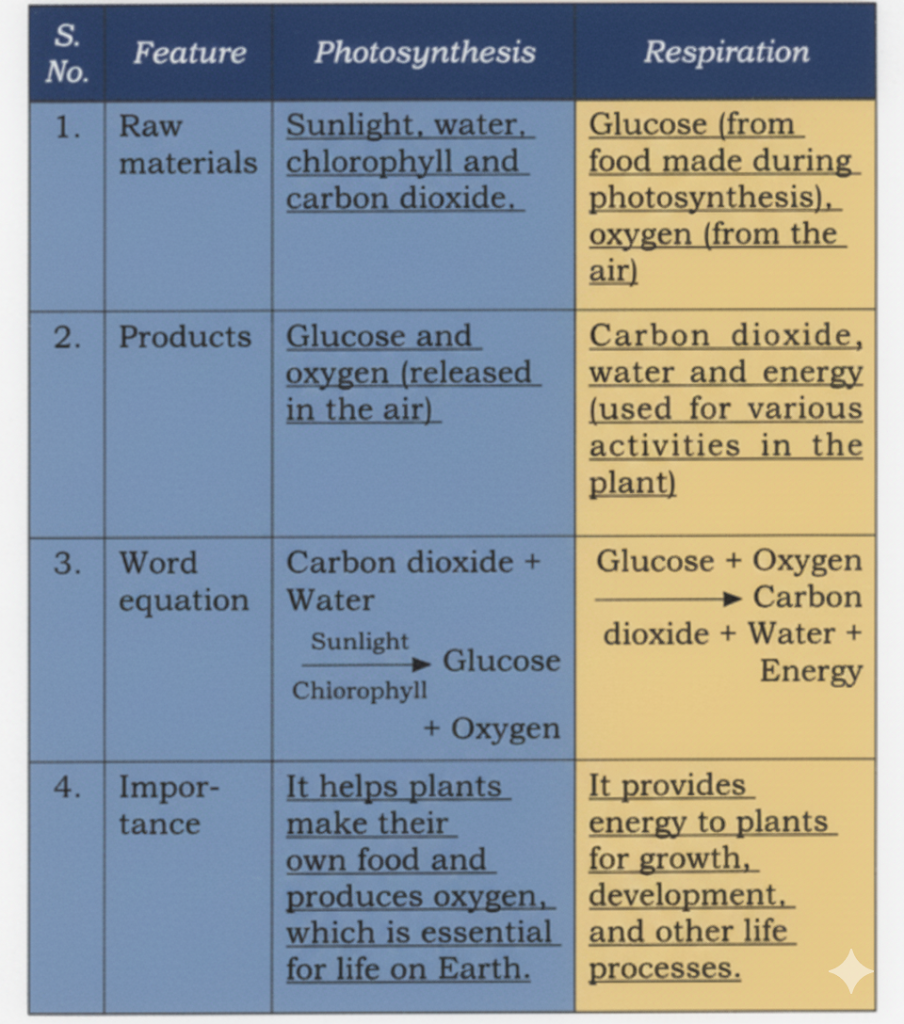
Complete the following table.
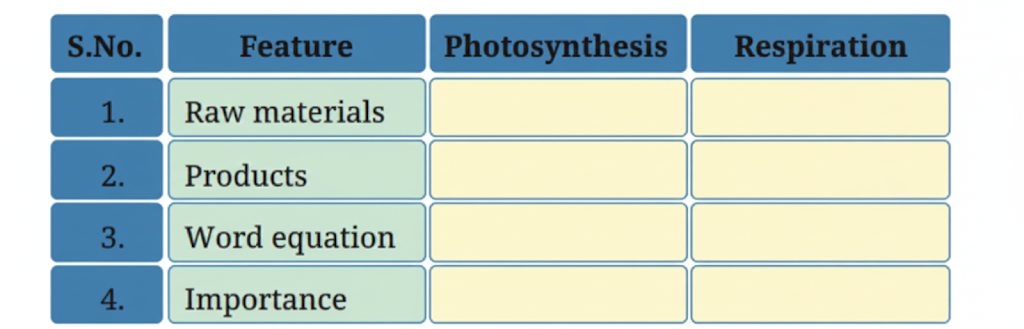
Answer:
Question 2.
Imagine a situation where all the organisms that carry out photosynthesis on the earth have disappeared. What would be the impact of this on living organisms?
Answer: If all organisms that perform photosynthesis were to disappear, there would be no production of food or oxygen for other living beings. This would break the food chain, since plants supply food to herbivores and oxygen needed for respiration. Without these organisms, life on Earth could not survive.
Question 3.
A potato slice shows the presence of starch with iodine solution. Where does the starch in potatoes come from? Where is the food synthesised in the plant, and how does it reach the potato?
Answer: The starch present in potatoes is formed from glucose made in the leaves during photosynthesis. Photosynthesis takes place in the leaves, where glucose is produced as food. This glucose is then carried to the potato through the plant and stored there in the form of starch.
Question 4.
Does the broad and flat structure of leaves make plants more efficient for photosynthesis? Justify your answer.
Answer: Yes, the broad and flat shape of leaves helps plants carry out photosynthesis more efficiently. This structure provides a larger surface area for chlorophyll to absorb more sunlight. It also supports better gas exchange through the stomata, which further improves the process of photosynthesis.
Question 5.
X is broken down using Y to release carbon dioxide, Z, and energy.
X + Y → Carbon dioxide + Z + Energy
X, Y, and Z are three different components of the process. What do X, Y, and Z stand for?
Answer:
X – Glucose
Y – Oxygen
Z – Water
Question 6.
Krishna set-up an experiment with two potted plants of same size and placed one of them in sunlight and the other in a dark room, as shown in Fig. 10.10.
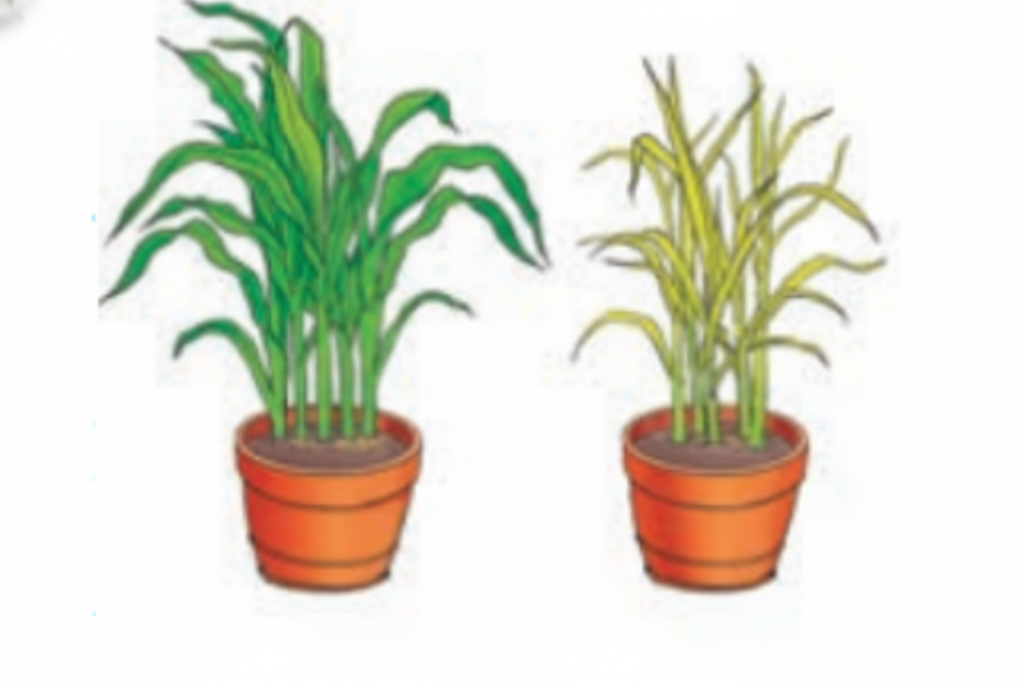
Fig. Experimental pots, (a) Sunlight (b) Complete dark
Answer the following questions.
(i) What idea might she be testing through this experiment?
Answer:
Through this experiment, she is checking whether sunlight is essential for photosynthesis in plants.
(ii) What are the visible differences in plants in both the conditions?
Answer: The plant kept in sunlight appears healthy and green because it can carry out photosynthesis. In contrast, the plant kept in a dark room looks weak, pale, and yellowish since it is unable to perform photosynthesis effectively.
(iii) According to you, leaves of which plants confirm the iodine test for the presence of starch?
Answer: The leaves of the plant kept in sunlight will give a positive result in the iodine test, confirming the presence of starch.
Question 7.
Vani believes that ‘carbon dioxide is essential for photosynthesis’. She puts an experimental set-up, as shown in Fig. 10.11, to collect evidence to support or reject her idea.
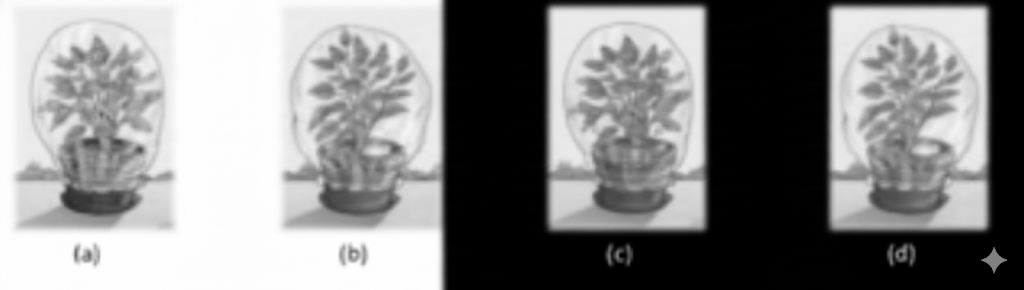
Fig. A potted plant with sufficient water is placed under the prescribed conditions.
(a) Sunlight with carbon dioxide
(b) Sunlight without carbon dioxide
(a) Dark with
(b) Dark without carbon dioxide carbon dioxide
Answer the following questions.
(i) In which plant(s) in the above set-up(s) will starch be formed?
Answer:
Starch will be formed only in the plant that is kept in sunlight and has access to carbon dioxide.
(ii) In which plant(s) in the above set-up(s) will starch not be formed?
Answer:
In all plants except the one kept in sunlight with carbon dioxide, starch is not formed.
(iii) In which plant(s) in the above set-up(s) will oxygen be generated?
Answer: Oxygen will be released only by the plant kept in sunlight with carbon dioxide.
(iv) In which plant(s) in the above set-up(s) will oxygen not be generated?
Answer: Oxygen will not be produced in any of the plants except the one kept in sunlight with carbon dioxide.
Question 8.
Ananya took four test tubes and filled three- fourth of each test tube with water. She labelled them A, B, C, and D (Fig. 10.12). In test tube A, she kept a snail; in test tube B, she kept a water plant; in test tube C, she kept both a snail and a plant. In test tube D, she kept only water. Ananya added a carbon dioxide indicator to all the test tubes. She recorded the initial colour of water and observed if there are any colour changes in the test tubes after 2-3 hours. What do you think she wants to find out? How will she know if she is correct?
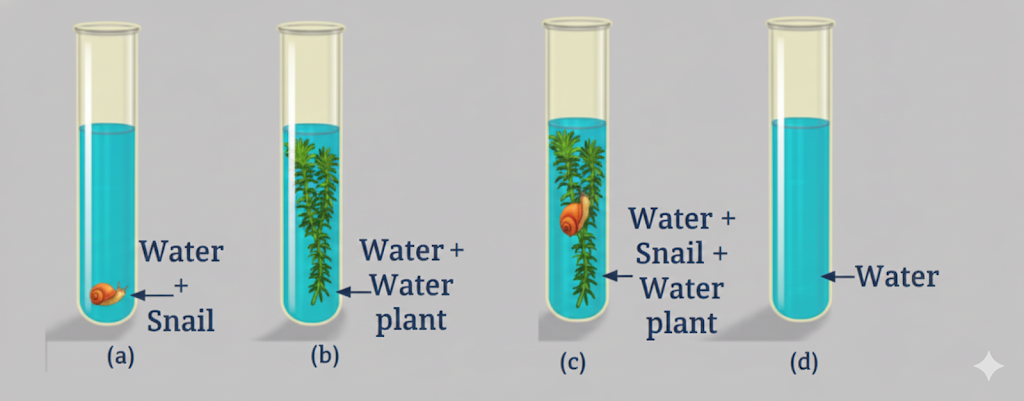
Fig. Experimental set-up
Answer: Ananya wants to investigate how plants and animals influence the level of carbon dioxide in water by studying the processes of respiration and photosynthesis. She uses a carbon dioxide indicator that changes colour based on the amount of carbon dioxide present.
Ananya can confirm her observations by noting the colour changes in each test tube:
Test Tube A (Snail only): The indicator will turn yellow or orange, indicating an increase in carbon dioxide due to the snail’s respiration.
Test Tube B (Plant only): The indicator will turn blue or purple, showing a decrease in carbon dioxide as the plant uses it for photosynthesis.
Test Tube C (Snail and Plant): The colour may remain neutral or become slightly blue, indicating a balance where the carbon dioxide released by the snail is used by the plant.
Test Tube D (Only water): The indicator will show no colour change because there is no living organism to either release or absorb carbon dioxide.
Question 9.
Design an experiment to observe if water transportation in plants is quicker in warm or cold conditions.
Answer: To find out whether water transport in plants happens faster in warm or cold conditions, take two similar potted plants. Keep one plant in a warm place, such as near sunlight or a heater, and place the other in a cooler area, like a shaded spot. Add a few drops of food colouring to the water and water both plants equally. After a few hours, observe how far the coloured water has moved up the stem and into the leaves. The plant kept in warm conditions will show quicker movement of coloured water because higher temperatures increase evaporation and speed up water transport within the plant.
Question 10.
Photosynthesis and respiration are essential to maintain balance in nature. Discuss.
Answer: Photosynthesis and respiration work together to maintain the balance of gases in the environment. In photosynthesis, plants use sunlight, water, and carbon dioxide to prepare food and give off oxygen. During respiration, both plants and animals use oxygen to release energy from food and produce carbon dioxide. This continuous exchange of gases helps keep oxygen and carbon dioxide levels balanced, making life on Earth possible.
Activity 10.1: Let Us Test Some Explanations (Pages 138-139)
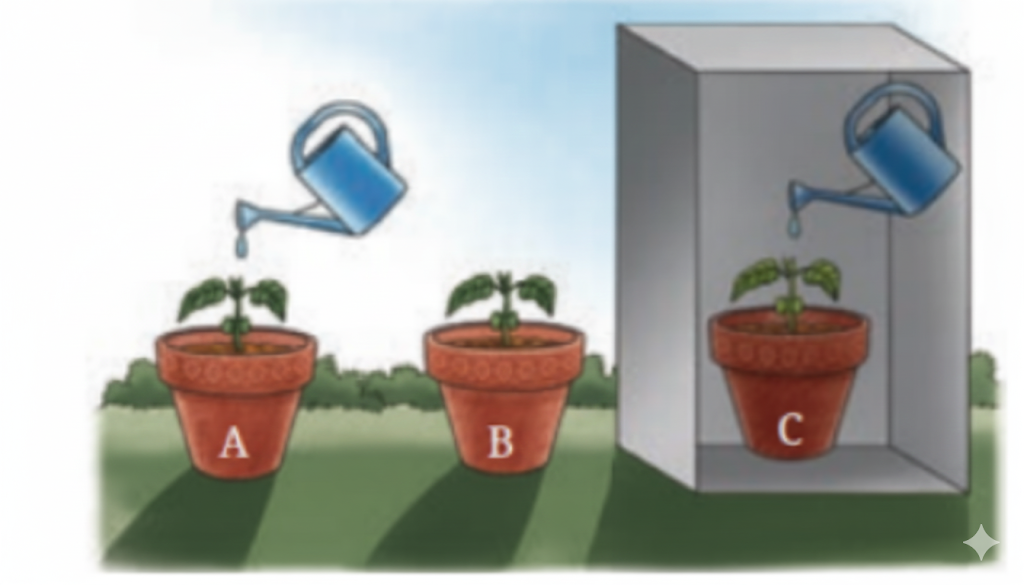
Fig. Experimental set-up to understand the role of sunlight and water in plant growth
(a) Pot A kept in direct sunlight, with water
(b) Pot B kept in direct sunlight, without water
(c) Pot C kept in dark with water
Table 10.1: Effects of sunlight and water on plant growth
Observation and Conclusion: The following points can be noted:
(i) What differences did you observe between the plants in the three pots?
Answer:
After two weeks, clear differences were observed among the plants in the three pots.
Pot A, which was given both sunlight and water, showed the best growth. It grew the tallest, developed the maximum number of leaves, and remained green, indicating healthy growth.
Pot B, which received sunlight but no water, showed poor growth with fewer leaves and yellowing, as the plant suffered from lack of water.
Pot C, which was watered but kept in darkness, showed only limited growth. Its leaves appeared pale yellow with very few new leaves, showing that light is necessary for plants to grow well and remain green.
(ii) Which pot has the plant with the maximum growth?
Answer:
Pot A
(iii) Which pot has the plant with the least growth?
Answer:
Pot C
Activity 10.2: Let Us Check (Demonstration Activity) (Pages 140-141)
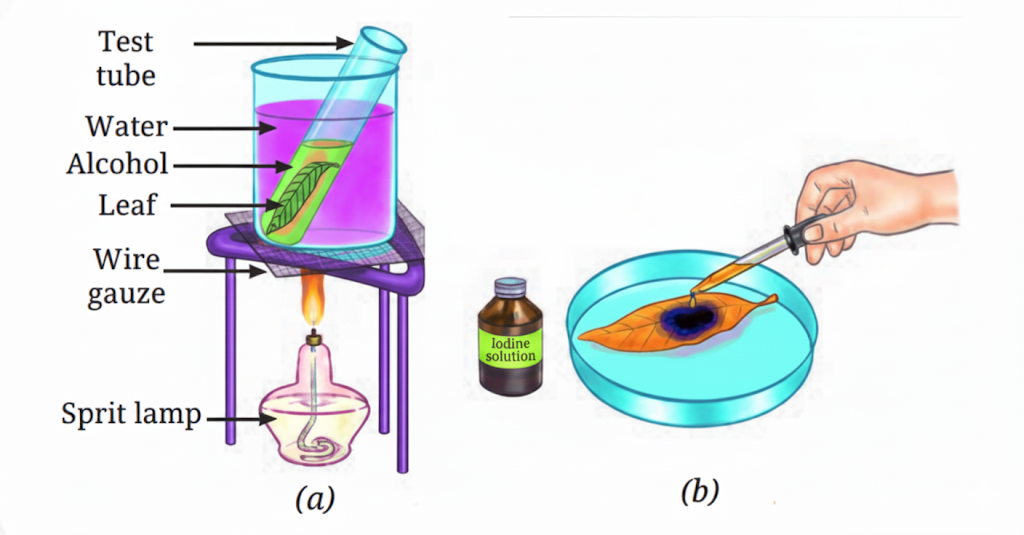
Fig. Starch test in a leaf, (a) Boiling set-up (b) Iodine test
Observation and Conclusion: If the colour of the leaf changes to blue-black, we can conclude that starch is present in the leaf.
Activity 10.3: Let Us Check (Pages 141-142)
Table 10.2: Presence of starch in green and non-green parts of the leaves of plants
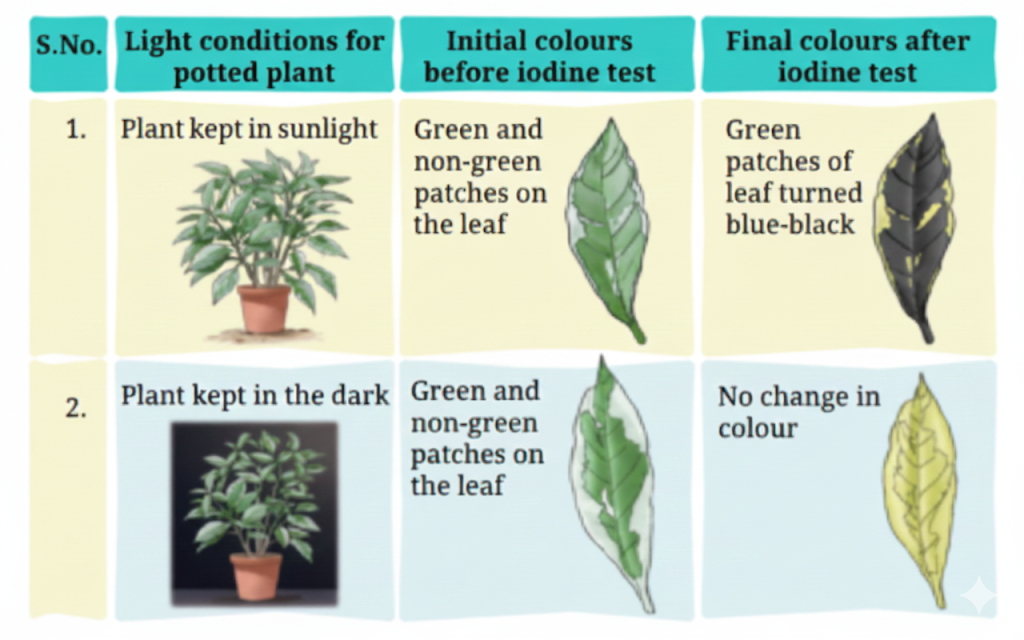
Observation and Conclusion:
• Photosynthesis and starch formation take place only in the green regions of the leaf because they contain chlorophyll.
• Sunlight is essential for photosynthesis, and without it, starch cannot be produced in the leaves.
Activity 10.4: Let us Experiment (Demonstration Activity) (Pages 143-144)
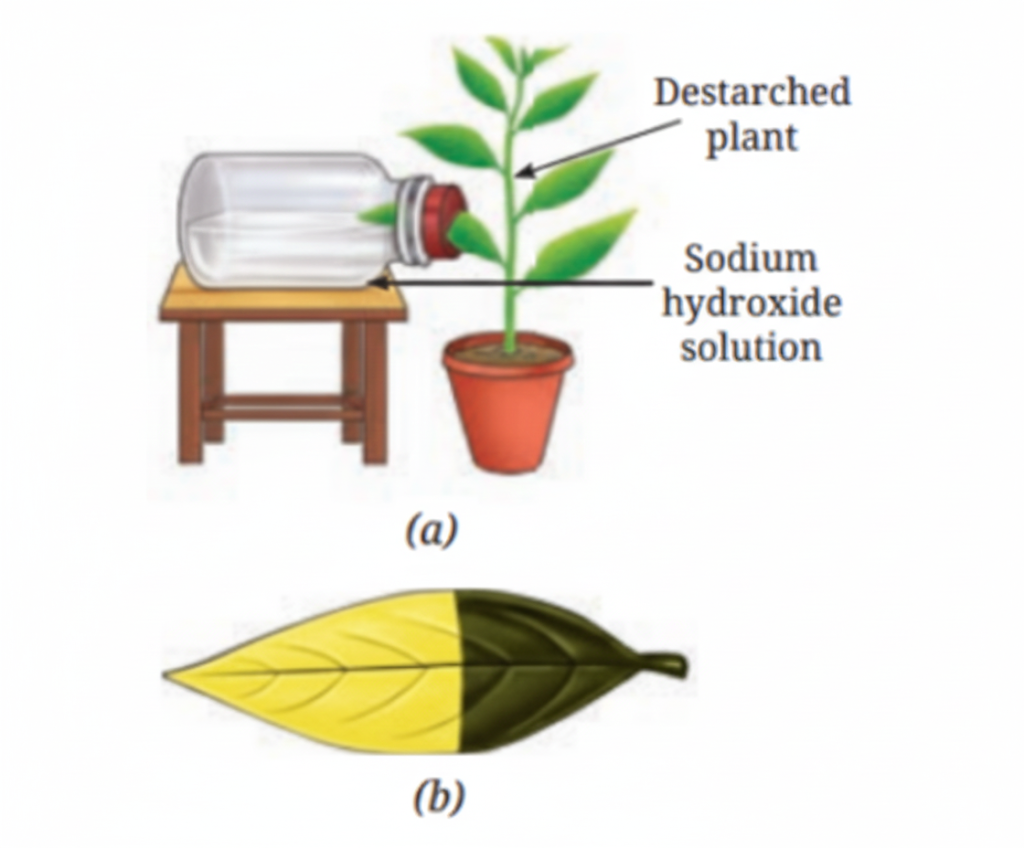
Fig. Testing the role of chlorophyll and air, (a) The set-up (b) Iodine test on the leaf
Observation and Conclusion:
• The portion of the leaf kept inside the bottle containing caustic soda (sodium hydroxide) did not turn blue-black when tested with iodine. This indicates that starch was not formed because caustic soda absorbed the carbon dioxide required for photosynthesis.
• The part of the leaf outside the bottle turned blue-black, confirming the presence of starch. This happened because that part received carbon dioxide and was able to carry out photosynthesis. The experiment clearly demonstrates that carbon dioxide is essential for starch formation in plants.
Activity 10.5: Let Us Explore (Page 145)
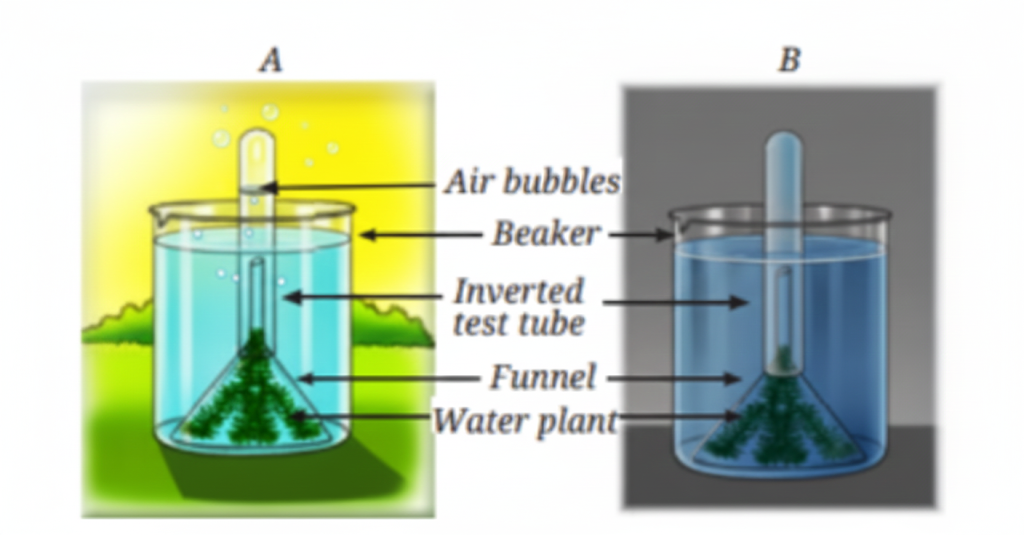
Fig. Activity showing the release of oxygen during photosynthesis
(i) What difference do you observe in the two set ups?
Answer:
In set-up A, which is placed in sunlight, bubbles are observed in the inverted test tube. In contrast, set-up B, kept in the dark, shows no formation of bubbles.
(ii) Do you observe air bubbles emerging in the inverted test tube in set-up A?
Answer: Yes, air bubbles can be seen rising and getting collected in the inverted test tube in set-up A.
(iii) The gas produced in this set-up caused bubbles to emerge and get accumulated in the inverted test tube. Which gas is this?
Answer: The gas released during the process of photosynthesis is oxygen.
Observation and Conclusion:
• When the test tube is removed from the set-up and a glowing or lit matchstick is introduced into it, the flame burns more brightly, confirming that oxygen gas is produced during photosynthesis.
Activity 10.6: Let Us Examine (demonstration activity) (Page 147)
Observation
(i) What do you observe?
Answer:
Tiny pores on the peel of the leaf.
(ii) Do you notice tiny pores on the peel?
Answer:
Yes
Conclusion:
• These tiny openings are called stomata. They are present on the surface of leaves and help in the exchange of gases.
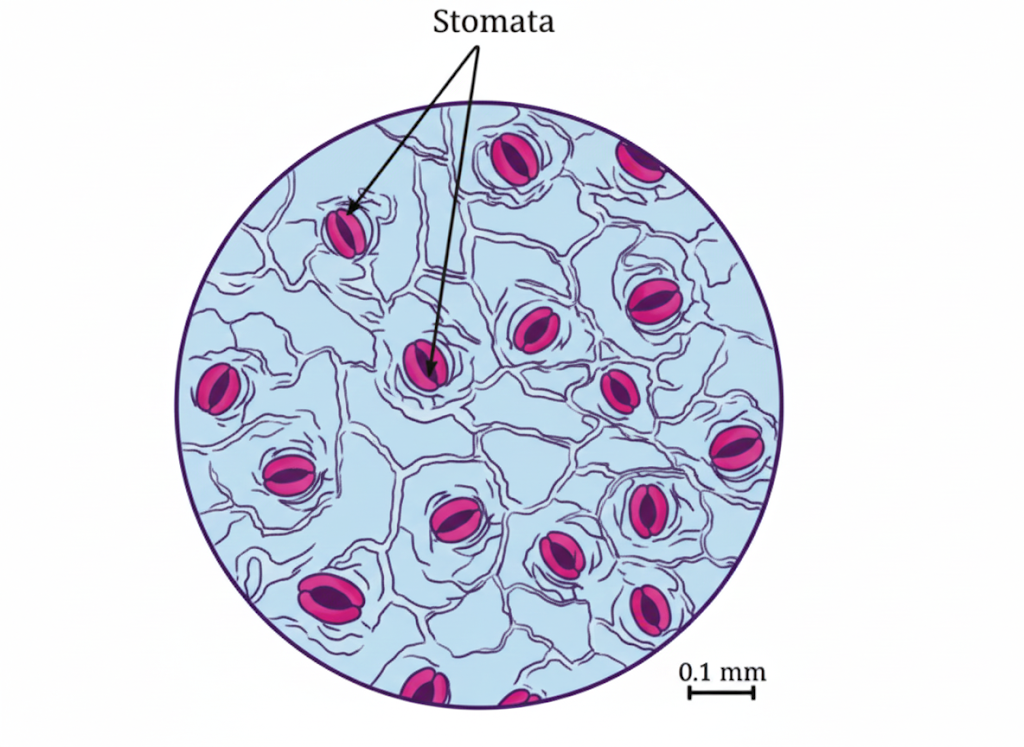
Fig. Stomata on the lower surface of a rhoeo leaf
Activity 10.7: Let Us Experiment (Page 148)
(a) With water (b) With coloured water plant twigs placed in water with different treatments
Fig. 10.7: Experiment to check for water transportation in plants
Observation and Conclusion:
• The experiment demonstrates that water and minerals move through the xylem in plants. Xylem consists of thin, tube-like structures present in the roots, stem, branches, and leaves, which transport water and minerals from the roots to the rest of the plant.
Activity 10.8: Let Us Find Out (Demonstration Activity) (Page 149)
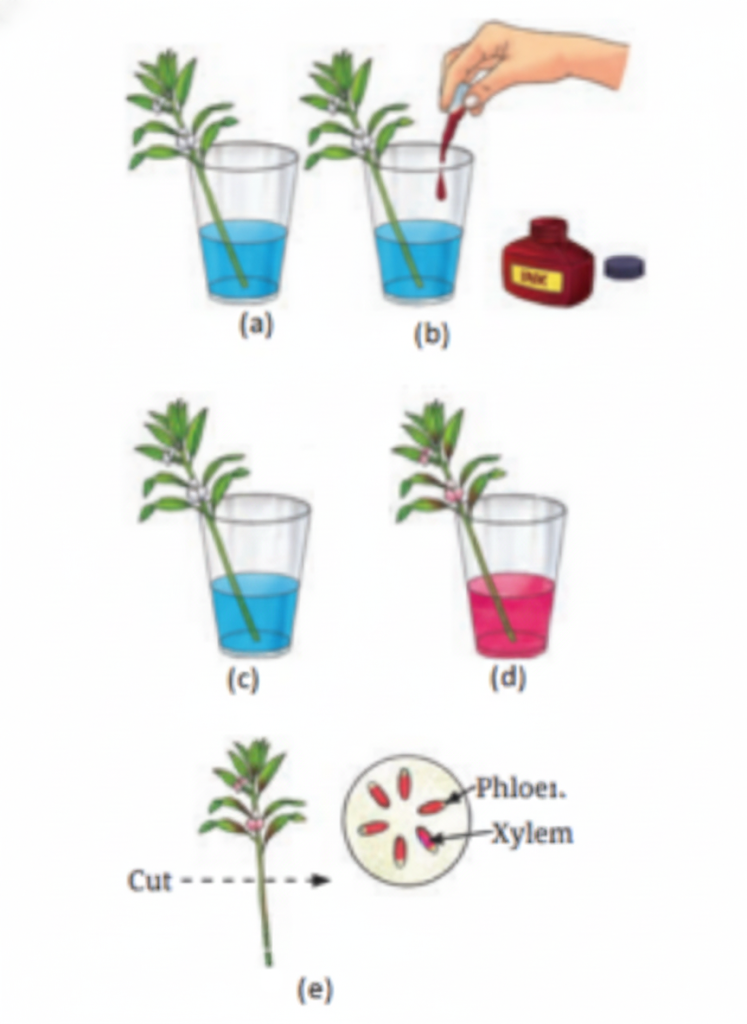
Fig. Experiment to check for water transportation in plants
(a) With water
(b) With coloured water, plant twigs placed in water with different treatments
(c) With water
(d) With coloured water, plant twigs after one day
(e) Enlarged view of cut end of the twig
Observation and Conclusion:
• The experiment confirms that water and minerals are transported in plants through the xylem. Xylem is a network of thin, tube-like structures present in the stem, branches, and leaves, which carry water and minerals from the roots to every part of the plant.
Activity 10.8: Let Us Find Out (Demonstration Activity) (Page 149)
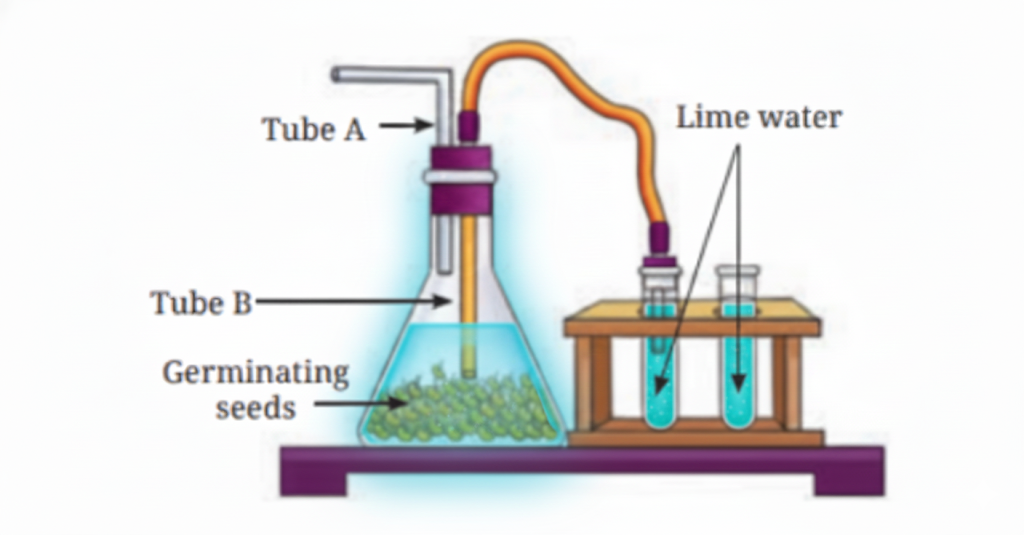
Fig. Set-up to test respiration in plants
(i) Does the lime water turn milky in both the test tubes?
Answer:
The lime water turns milky only in the test tube that is connected to the flask.
(ii) Why does the lime water turn milky in the test tube connected to the flask?
Answer: Lime water becomes milky because of the presence of carbon dioxide, which is released by the seeds during respiration.
Observation and Conclusion:
Plants, like humans, also respire and give out carbon dioxide.
Key Life Processes in Plants: Photosynthesis, Transport, Respiration
Understanding life processes in plants helps students master topics like photosynthesis, transport of water, and respiration. Focusing on these processes strengthens your basics for Class 7 Science Chapter 10 and prepares you for exams with confidence.
Mastering photosynthesis and how plants get nutrients is crucial for after-class quizzes and tests. Always practice diagrams and key terms like xylem, phloem, and chlorophyll to make your answers stand out.
Practice NCERT Chapter 10 regularly and review transport in plants and plant respiration to boost your marks. Staying consistent with revision ensures you cover the most important concepts for the NCERT 2026-27 exam.
FAQs on NCERT Solutions For Class 7 Science Chapter 10 Life Processes In Plants - 2026-27 Free PDF Download (Login Required)
1. What are the important topics in life processes in plants?
The most important topics in Class 7 Science Chapter 10 Life Processes in Plants include various processes essential for plant survival and growth. Key topics are:
- Photosynthesis: The process by which plants make their food
- Transpiration: Loss of water through leaves
- Respiration in plants: How plants exchange gases
- Transport of water and nutrients: Role of xylem and phloem
- Structure and function of stomata
- Role of sunlight, water, and carbon dioxide
2. How to write stepwise NCERT answers to score full marks?
To score full marks with NCERT Solutions for Class 7 Science Chapter 10 Life Processes in Plants, follow these steps:
- Start with a clear introduction or definition related to the question.
- Use stepwise points to logically explain the concept or process.
- Include key scientific keywords and terms.
- Draw neat, labeled diagrams if required by the question.
- Underline important points for emphasis.
- Follow the CBSE marking scheme for word count and structure.
3. Are diagrams or definitions mandatory in answers?
Providing diagrams and correct definitions is often necessary for full marks in Class 7 Science Chapter 10 answers. Diagrams help explain processes like photosynthesis and transpiration clearly. Key points:
- Label all parts of diagrams neatly.
- Include definitions of major terms such as stomata, xylem, phloem, etc.
- CBSE examiners look for diagram accuracy and proper terminology.
4. Which questions are likely from this chapter in school exams?
Frequently asked questions from Class 7 Science Chapter 10: Life Processes in Plants in exams include:
- Explain photosynthesis with a labeled diagram.
- What is transpiration? State its significance.
- How do plants respire?
- Define xylem and phloem. Differentiate between them.
- Describe the process of water transport in plants.
- Name the factors required for photosynthesis.
5. How do I structure long answers for better marks?
Structuring long answers in Class 7 Science Chapter 10 for full marks involves:
- Begin with a brief introduction or definition.
- Break the answer into logical steps or paragraphs covering each point.
- Include diagrams and examples where relevant.
- Conclude by summarising the main points.
- Maintain neatness and correct scientific language.
6. How to solve NCERT Class 7 Science Chapter 10?
To solve NCERT Class 7 Science Chapter 10 Life Processes in Plants effectively, follow this method:
- Read the chapter carefully and highlight important terms and definitions.
- Practice diagrams and memorize key labels.
- Write stepwise solutions for each NCERT exercise and intext question.
- Revise with sample papers and previous year questions.
- Use free downloadable PDFs for revision and offline practice.
7. Are NCERT Solutions enough for Class 7 Science exams?
NCERT Solutions for Class 7 Science provide a solid foundation for exam preparation. They are usually sufficient for:
- Understanding all textbook concepts and exercises
- Scoring well in school and CBSE exams
- Learning correct answer structure as per CBSE marking scheme
8. Where can I download the chapter’s solutions PDF?
You can download the free PDF for Class 7 Science Chapter 10: Life Processes in Plants from reputable educational websites. Steps:
- Visit a trusted platform offering NCERT Solutions PDF downloads
- Look for the Chapter 10 Science Solutions PDF
- Click the download button for offline use
9. Do examiners award partial marks for correct steps even if the final answer is wrong?
Yes, in CBSE marking, partial marks are awarded for correct steps, diagrams, and definitions even if the final answer is incorrect. Ensure you:
- Attempt all steps clearly
- Show diagrams and label them accurately
- Write correct scientific terms even if unsure of the whole answer
10. What are the most important definitions and diagrams for this chapter?
Key definitions and diagrams in Class 7 Science Chapter 10: Life Processes in Plants include:
- Photosynthesis: Definition and labeled diagram showing process
- Stomata: Structure and function
- Xylem and Phloem: Diagrams and differences
- Transpiration: Process description and diagram
11. How to learn diagrams/maps for this chapter?
To memorise and draw diagrams for Class 7 Science Chapter 10 effectively:
- Practice each diagram multiple times
- Label all parts clearly using a pencil for neatness
- Refer to NCERT textbook and trusted solutions PDF for model diagrams
- Review previous year exam papers to know commonly asked diagrams
12. How to revise Class 7 Science Chapter 10 quickly before exams?
Quick revision tips for Chapter 10: Life Processes in Plants:
- Go through flash notes and summaries
- Revise all diagrams and labels
- Practice previous year and sample questions
- Review important definitions and formulae
- Use a 1-day or 3-day revision planner to cover all topics efficiently
