



Exercise-wise Stepwise Answers for Class 7 Science Chapter 8
Question 1.
How was time measured when there were no clocks and watches? (Page 106)
Answer:
Before clocks and watches were invented, people measured time using devices such as sundials, water clocks, hourglasses, and candle clocks.
Question 2.
For races covering the same distance, we can tell who was faster by measuring time. But how can we tell that when comparing races for different distances? (Page 112)
Answer: If two racers cover the same distance, the one who takes less time is considered faster.
Question 3.
I once watched a part of marathon on a straight road stretch. I noticed that some people seemed to be running at the same speed during that distance while some people would speed up or slow down. How were their motion different? (Page 116)
Answer: People moving at a constant speed show uniform motion, while those whose speed increases or decreases have non-uniform motion.
Speed = 25 m/s
Distance = 360 km = 3,60,000 m
Time taken = \(\dfrac{\text { Distance }}{\text { Speed }}\) = \(\dfrac{3,60,0000 \mathrm{~m}}{25 \mathrm{~m} / \mathrm{s}}\)
= 14,400s
⇒ 240 mins
⇒ 4 hours
Question 4.
A train travels 180 km in 3 h. Find its speed in:
(i) km/h
(ii) m/s
(iii) What distance will it travel in 4h if it maintains the same speed throughout the journey?
Answer:
Distance = 180 km, time = 3h
(i) Speed = \(\dfrac{\text { Distance }}{\text { Time }}=\dfrac{180 \mathrm{~km}}{3 \mathrm{~h}}\) = 60 Km/h
(ii) Speed in m/s= 60 × \(\dfrac{5}{18}\) = 16.677 m/s
(iii) Time = 4h, Speed = 60 km/h
Distance = Speed × Time
= 60 × 4 = 240 km
Question 5.
The fastest galloping horse can reach the speed of approximately 18 m/s. How does this compare to the speed of a train moving at 72 km/h?
Speed of horse = 18 m/s
Speed of train = 72 km/h = 72 × \(\dfrac{5}{18}\) = 20 m/s
The train is faster by 2 rn/s than the fastest galloping horse.
Question 6.
Distinguish between uniform and non-uniform motion using the example of a car moving on a straight highway with no traffic and a car moving in city traffic.
Answer:
Uniform motion:
An object is said to be in uniform motion if it covers equal distances in equal intervals of time. For example, a car moving smoothly on a straight highway without traffic shows uniform motion.
Non-uniform motion:
An object is said to be in non-uniform motion if it covers unequal distances in equal intervals of time. For instance, a car moving through traffic shows non-uniform motion.
Question 7.
Data for an object covering distances in different intervals of time are given in the following table. If the object is in uniform motion, fill in the gaps in the table.
Answer:
In uniform motion, an object covers equal distances in equal intervals of time. Therefore, its speed remains constant throughout the motion.
From the table, the object travels 8 metres every 10 seconds, which means its speed remains constant at 0.8 m/s during the entire motion.
Question 8.
A car covers 60 km in the first hour, 70 km in the second hour, and 50 km in the third hour. Is the motion uniform? Justify your Answer:
Find the average speed of the car.
The car covers different distances in each hour. Hence, the motion of the car is nonuniform.
Total distance = 60 km + 70 km + 50 km = 180 km
Total time = 3 hours
Average speed = \(\dfrac{\text { Total distance travelled }}{\text { Total time taken }}\)
= \(\dfrac{180 \mathrm{~km}}{3 \mathrm{~h}}\) = 60 km/h.
Hence, the average speed of the car is 60 km/h.
Question 9.
Which type of motion is more common in daily life—uniform or non-uniform? Provide three examples from your experience to support your answer.
Answer:
In everyday life, most motions are non-uniform because objects do not move at a constant speed all the time. Their speed keeps changing due to reasons such as traffic, uneven or rough roads, and various obstacles.
Examples:
Travelling in a bus on an uneven road
Playing cricket
Walking through a crowded market
Question 10.
Data for the motion of an object are given in the following table. State whether the speed of the object is uniform or non-uniform. Find the average speed.
The object exhibits non-uniform motion, because it covers unequal distances in equal time intervals.
Total distance travelled = 60 m
Total time taken = 100 s
Average speed = \(\dfrac{Total distance}{Total time taken}\)
= \(\dfrac{60}{100}\)
= 0.6 m/s
Question 11.
A vehicle moves along a straight line and covers a distance of 2 km. In the first 500 m, it moves with a speed of 10 m/s and in the next 500 m, it moves with a speed of 5 m/s. With what speed should it move the remaining distance so that the journey is complete in 200 s? What is the average speed of the vehicle for the entire journey?
Answer:
Given
Total distance = 2 km = 2000 m,
Total time = 200
Step 1: Time taken to cover the first 500 m
Time = \(\dfrac{\text { Distance }}{\text { Speed }}\) = \(\dfrac{500}{10}\) = 50 s
Step 2: Time taken to cover the next 500 m
Time = \(\dfrac{500}{10}\) = 100 s
Step 3: Remaining distance = 2000 – 1000 = 1000 m
Remaining time = 200 – 150 = 50 s
Step 4: Speed required to cover the remaining 1000 m
Speed = \(\dfrac{1000}{50}\) = 20 m/s
Step 5: Average speed = \(\dfrac{Total distance}{Total time taken }\) = \(\dfrac{2000}{200}\) = 10 m/s
Activity 8.1: Let Us Construct (Page 107)
Answer:
Students should do it by themselves.
Activity 8.2: Let us Experiment (Pages 109-110)
Answer:
Students should do it by themselves.
Activity 8.3: Let Us Identify (Page 112)
Look at the wall clock shown in Fig. 8.9 carefully. What is the smallest interval of time you can measure with it?
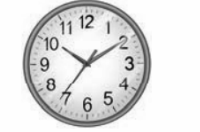
One second is the smallest interval of time that we can measure using this clock.
Activity 8.4: Let Us Calculate (Pages 114-115)
Table 8.2: Finding the speed of trains Name of the railway station nearest to your place of stay Delhi.
Understanding Measurement of Time and Motion in Science Class 7
Mastering the Measurement of Time and Motion is essential for building a strong foundation in Class 7 Science. Knowing about devices like pendulum clocks and sundials helps you understand how humans have tracked time through history.
Remember that the SI unit of time is the second and for speed, it is meter per second. Focusing on key concepts like speed and types of motion can make your exam preparation much easier and more effective.
Stay curious like Prerna and practice the exercise questions from NCERT. Regular revision and real-life examples will help you gain confidence and score high marks in Science Chapter 8 for the 2026-27 session.
FAQs on NCERT Solutions For Class 7 Science Chapter 8 Measurement Of Time And Motion - 2026-27 Free PDF Download (Login Required)
1. What are important topics in class 7 science chapter 8?
Class 7 Science Chapter 8: Measurement of Time and Motion focuses on key exam topics to help students score high marks. Important topics include:
• Need for measurement of time and motion
• Standard units of measurement (SI units)
• Instruments used for time and motion, like clocks and stopwatches
• Uniform and non-uniform motion
• Calculation of speed (Speed = Distance/Time)
• Interpretation of simple graphs for motion
• Practical examples and applications of measurement
Focusing on concepts, definitions, diagrams, and solved exercises will help you prepare thoroughly for CBSE exams.
2. Are diagrams needed in measurement of time and motion answers?
Including clear and neatly labelled diagrams is highly recommended in Class 7 Science answers, especially when questions ask about instruments or types of motion. Diagrams help you:
• Earn extra marks according to the CBSE marking scheme
• Clarify explanations, especially for devices like clocks, stopwatches, or speed graphs
• Show understanding of motion, such as types of paths (straight, circular, random)
Always label all parts, use a pencil and ruler, and keep diagrams neat for the best results.
3. How do you write definitions in science exams?
Writing clear, precise definitions is crucial for scoring full marks. To write definitions in science exams:
• Use the exact textbook wording if possible
• Be concise and avoid unnecessary details
• Begin with the term, followed by the definition
• Underline or highlight key terms like Speed, Motion, Uniform Motion, Measurement, etc.
For example: "Motion refers to the change in position of an object over time."
Definitions must be accurate and to the point for best results.
4. How to write stepwise NCERT answers to score full marks?
Following a step-by-step format helps earn full marks as per the CBSE marking scheme for Class 7 Science Chapter 8.
• Read the question carefully and underline important keywords
• Start your answer with a direct response
• Break down explanations into points or steps
• Add diagrams or examples when asked
• Use bullet points or number your steps
• Highlight important definitions or formulae (like Speed = Distance/Time)
This approach aligns with how CBSE examiners award marks, so always structure your answer logically and neatly.
5. Where can I download the chapter’s solutions PDF?
You can easily download the NCERT Solutions for Class 7 Science Chapter 8 PDF from trusted educational sites that provide free study resources for CBSE students. Usually, a dedicated download button or link is given at the top or the end of the solutions page. Always check that the PDF matches the CBSE 2026–27 syllabus for reliable preparation.
6. How do I structure long answers for better marks?
To score better in long answers, follow these steps as per CBSE guidelines:
• Start with a short introduction that states your understanding
• Break the main explanation into logical steps or paragraphs
• Use headings, bullet points, or numbering
• Include important definitions, formulae, and relevant diagrams
• Conclude with a summary sentence
This method makes your answer readable and helps examiners find each marking point.
7. What are the most important topics from Measurement of Time and Motion in Class 7 Science?
The most important topics from Class 7 Science Chapter 8 for exams are:
• Definition and need for measurement
• Units of time and motion (SI units)
• Types of motion (uniform, non-uniform)
• Devices to measure time: clock, stopwatch, sundial
• Calculating speed and related numerical questions
• Interpreting and drawing simple motion graphs
These areas frequently appear in CBSE tests and should be revised thoroughly.
8. Is it necessary to memorise formulae and definitions from Class 7 Science Chapter 8?
Yes, memorising key formulae and definitions from Chapter 8 is essential to score well in CBSE exams. Important formulae include:
• Speed = Distance / Time
• Definitions of motion, speed, time, uniform motion, etc.
These are often directly asked or form the basis for numerical problems and short answers.
9. Do examiners award partial marks for correct steps even if the final answer is wrong?
Yes, CBSE marking scheme gives partial marks for correct steps, even if the final answer is incorrect (especially in calculations or reasoning). To maximise your score:
• Show all steps clearly
• Write units for every measurement
• Use scientific method and reasoning
This is why writing stepwise answers is vital for Class 7 Science Chapter 8.
10. Where to get chapterwise solutions PDF for offline study?
Chapterwise solutions PDF for Class 7 Science can be downloaded from top educational portals that support the latest CBSE syllabus. Look for a free PDF download option for Class 7 Science NCERT Solutions, and make sure it's updated for the 2026–27 CBSE session for accurate study use.
11. How do I learn and remember diagrams for Measurement of Time and Motion?
To learn and remember diagrams for Class 7 Science Chapter 8, follow these tips:
• Practice drawing each diagram by hand with labels (e.g., clocks, path of motion)
• Revise diagram-based questions from the NCERT back exercises
• Use flashcards or quick sketches as revision aids
• Label all necessary parts and highlight unique features
Neat diagrams fetch easy marks on CBSE exams.
12. Are NCERT Solutions enough for Class 7 Science exams?
NCERT Solutions are sufficient for most Class 7 Science exams as they cover the entire CBSE syllabus and typical question patterns. For best results:
• Revise all intext and back exercise questions
• Practice writing answers in the NCERT stepwise method
• Supplement with exemplar and previous year questions for higher accuracy
This approach ensures you are well-prepared for all types of questions.
