



Stepwise Answers & Diagrams for NCERT Class 7 Science Chapter 11
Question 1.
What happens when an opaque object blocks the path of light? (Page 157)
Answer: When light strikes an opaque object, it is blocked from passing through, resulting in the formation of a dark area called a shadow on the surface or screen behind the object.
Question 2.
When the opaque object was a shiny object like a polished steel plate, I got a shadow on the screen, but I also saw that there was a bright spot of light on the wall on the opposite side. Why was it so? (Page 159)
Answer: A polished opaque object, such as a shiny plate, produces a bright spot because it reflects light.
Question 3.
In a mirror, I can also see my face. Is that also due to the reflection of light? (Page 160)
Answer: Yes, we can see our face in a mirror due to the reflection of light.
Question 4.
Oh! Now I realise why ECNALUBMA is written on an ambulance. It reads ‘AMBULANCE’ when viewed from the rear-view mirrors of the vehicle ahead of the ambulance. (Page 162)
Answer: The word “AMBULANCE” is written in a reversed (mirror-image) form on the front of an ambulance so that it appears normal in the rear-view mirror of vehicles ahead. This occurs because mirrors cause lateral inversion.
Question 5.
Can we see an image of an object only in a mirror or are there some other ways as well? (Page 162)
Answer: We can observe the image of an object on a screen, through transparent materials, or using devices such as a pinhole camera.
Let Us Enhance Our Learning
Question 1.
Which of the following are luminous objects?
Mars, Moon, Pole Star, Sun, Venus, Mirror
Answer: The Sun and the Pole Star are luminous objects because they produce their own light. In contrast, Venus, Mars, the Moon, and a mirror are non-luminous objects, as they do not emit light on their own.
Question 2.
Match the items in Column A with those in Column B.
Answer:
Question 3.
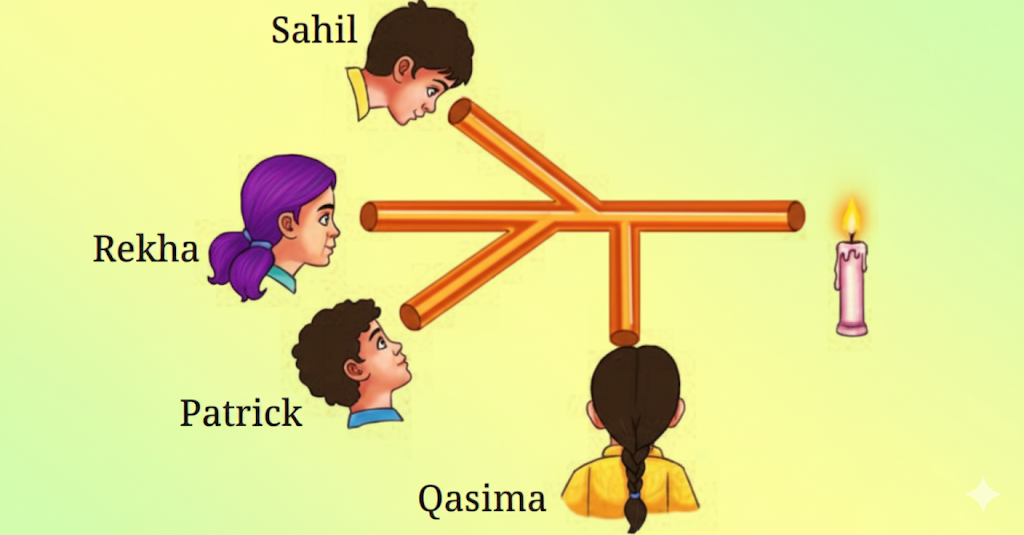
Sahil, Rekha, Patrick, and Qasima are trying to observe the candle flame through the pipe as shown in Fig. 11.16. Who can see the flame?
Answer:
Only Rekha is able to see the candle flame because light travels in a straight line and her line of sight is directly aligned with the flame. The others cannot see it because they are not positioned along the straight path of the pipe through which the flame is visible.
Question 4.
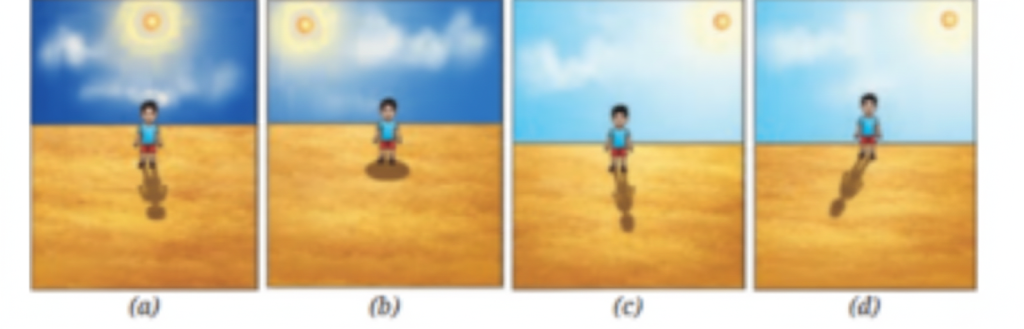
Look at the images shown in Fig. 11.17 and select the correct image showing the shadow formation of the boy.
Answer:
The position of the boy’s shadow depends on the direction of the light source. When the light comes from above, the shadow forms below the boy. If the light is from the side, the shadow appears in the opposite direction. Therefore, option (d) correctly represents the shadow formed by the boy.
Question 5.
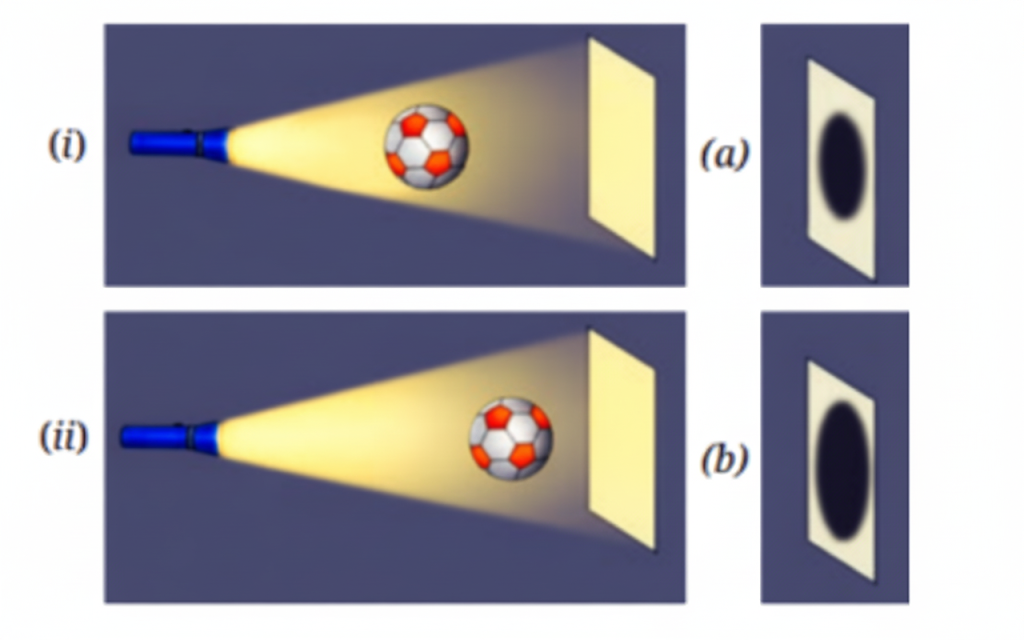
The shadow of a ball is formed on a wall by placing the ball in front of a fixed torch as shown in Fig. 11.18. In scenario (i) the ball is closer to the torch, while in scenario (ii) the ball is closer to the wall. Choose the most accurate representation of the shadows formed in both scenarios from the options provided (a and b).
Answer:
In scenario (i), the ball is placed closer to the torch and farther from the wall, so it forms a large and blurred shadow on the wall. Therefore, option (b) correctly represents scenario (i).
In scenario (ii), the ball is closer to the wall and farther from the torch, resulting in a small and sharp shadow. Hence, option (a) is the correct representation for scenario (ii).
Question 6.
Based on Fig. 11.18, match the position of the torch in Column A with the characteristics of the ball’s shadow in Column B.
Answer:
Question 7.
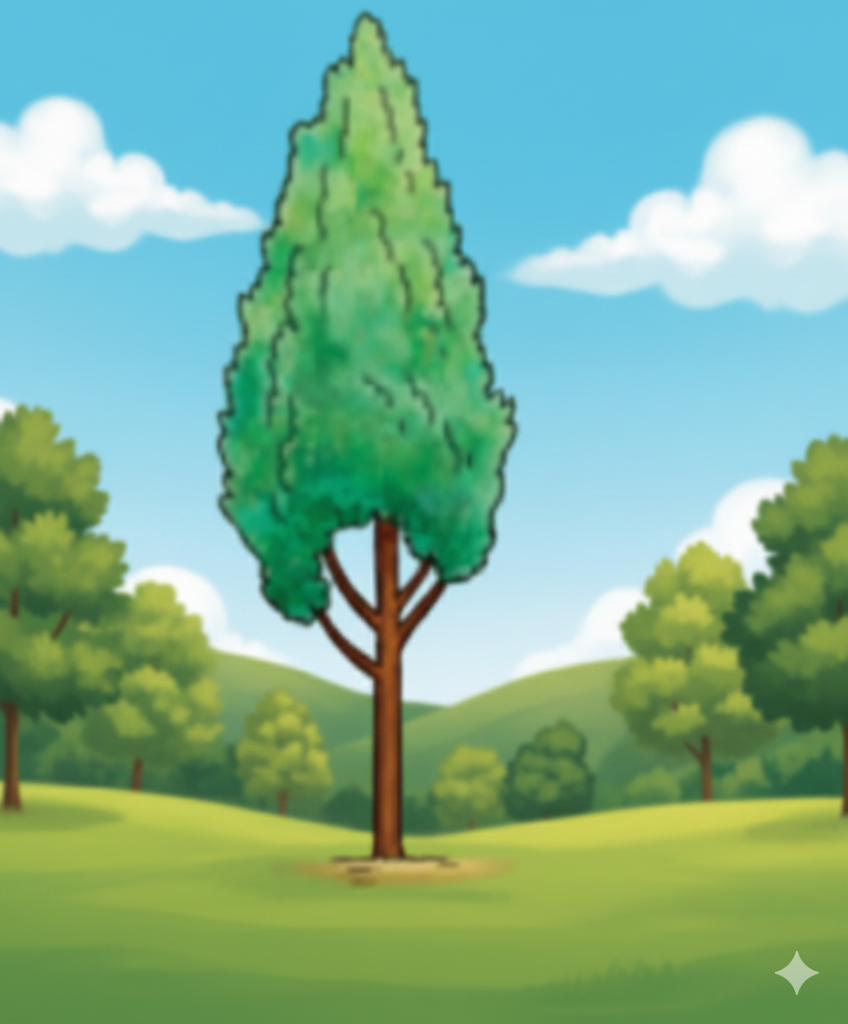
Suppose you view the tree shown in Fig. 11.19 through a pinhole camera. Sketch the outline of the image of the tree formed in the pinhole camera.
Answer: The image formation of the tree in a pinhole camera is shown.
Question 8.
Write your name on a piece of paper and hold it in front of a plane mirror such that the paper is parallel to the mirror. Sketch the image. What difference do you notice? Explain the reason for the difference.
Answer: When you view the paper in a plane mirror, the image appears laterally inverted, meaning it is flipped horizontally. As a result, the letters of your name look reversed because the mirror switches left and right.
Question 9.
Measure the length of your shadow at 9 AM, 12 PM, and 4 PM with the help of your friend. Write down your observations:
(i) At which of the given times is your shadow the shortest?
(ii) Why do you think this happens?
Answer: (i) The shadow will be the shortest at 12 PM because the Sun is almost directly overhead at that time.
(ii) This occurs because at 12 PM the Sun is at its highest position in the sky, making the angle between the Sun’s rays and the ground nearly 90 degrees, which results in a very short shadow.
Question 10.
On the basis of following statements, choose the correct option.
Statement A: Image formed by a plane mirror is laterally inverted.
Statement B: Images of alphabets T and O appear identical to themselves in a plane mirror.
(i) Both statements are true
(ii) Both statements are false
(iii) Statement A is true, but statement B is false
(iv) Statement A is false, but statement B is true
Answer: (i) Both statements are correct. A plane mirror produces a laterally inverted image, where left and right are reversed, and certain letters such as T and O appear unchanged in a plane mirror.
Question 11.
Suppose you are given a tube of the shape shown in the Fig. 11.20 and two plane mirrors smaller than the diameter of the tube. Can this tube be used to make a periscope? If yes, mark where you will fix the plane mirrors.
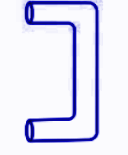
Answer:
Yes, the tube can be used to make a periscope. Two mirrors should be fixed inside the tube at an angle of 45° to each other so that light is reflected along the tube, allowing you to see over or around obstacles.
Question 12.
We do not see the shadow on the ground of a bird flying high in the sky. However, the shadow is seen on the ground when the bird swoops near the ground. Think and explain why it is so.
Answer:
This happens because when the bird is flying high, the Sun’s rays fall at a steep angle, producing a very small and faint shadow. When the bird comes closer to the ground, the angle of sunlight causes the shadow to become larger and more clearly visible on the ground.
Activity 11.1: Let Us Investigate (Page 155)
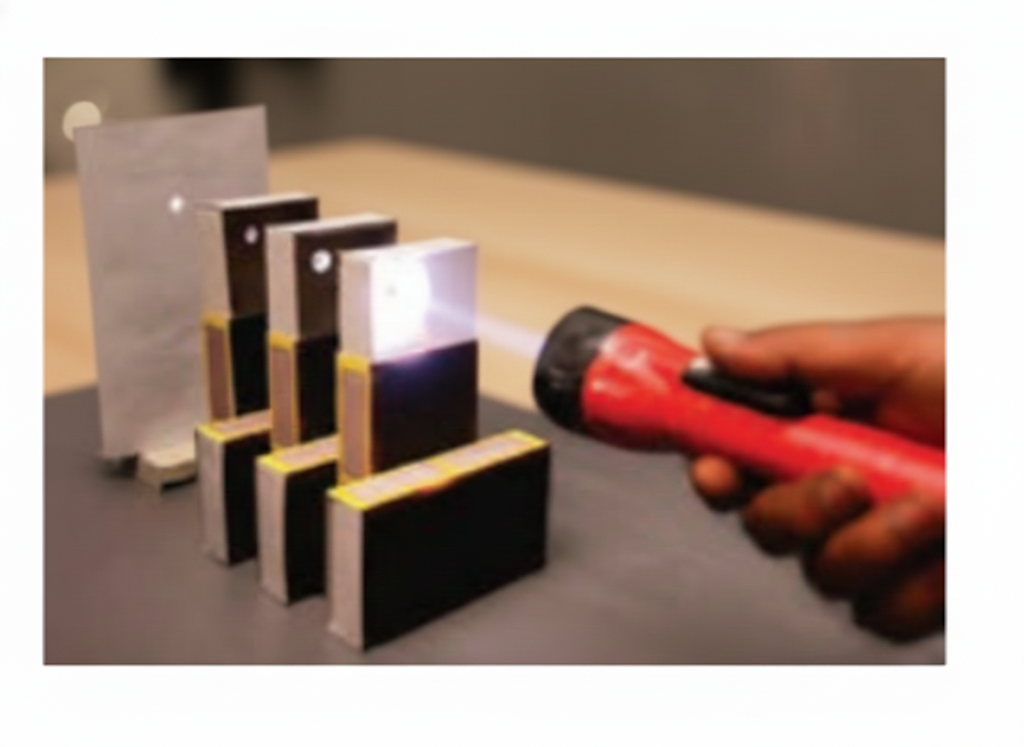
Fig. 11.4: Matchbox activity light through holes
Observation and Conclusion:
When all three matchboxes are arranged in a straight line with their holes at the same height and properly aligned, light from the torch passes through all the holes and forms a bright spot on the screen placed on the other side. This shows that light travels in a straight line. However, when the holes are not aligned in a straight line, the light cannot pass through them, and no bright spot is seen on the screen.
Activity 11.2: Let Us Explore (Page 155)
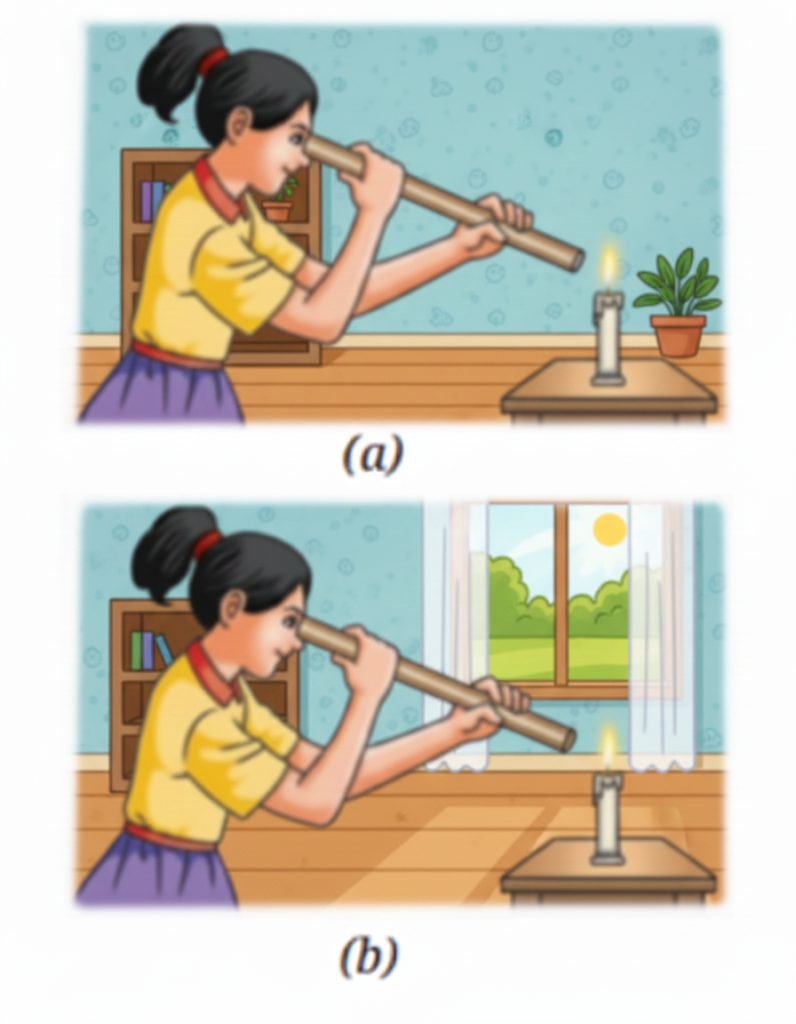
Fig. Viewing candle flame through, (a) a straight pipe (b) a bent pipe
Observation and conclusion:
We can see the candle flame through a straight pipe, as shown in Fig. 11.5(a), but not through a bent pipe, as shown in Fig. 11.5(b), because light travels in straight lines.
Activity 11.3: Let Us Experiment (pages 156-157)
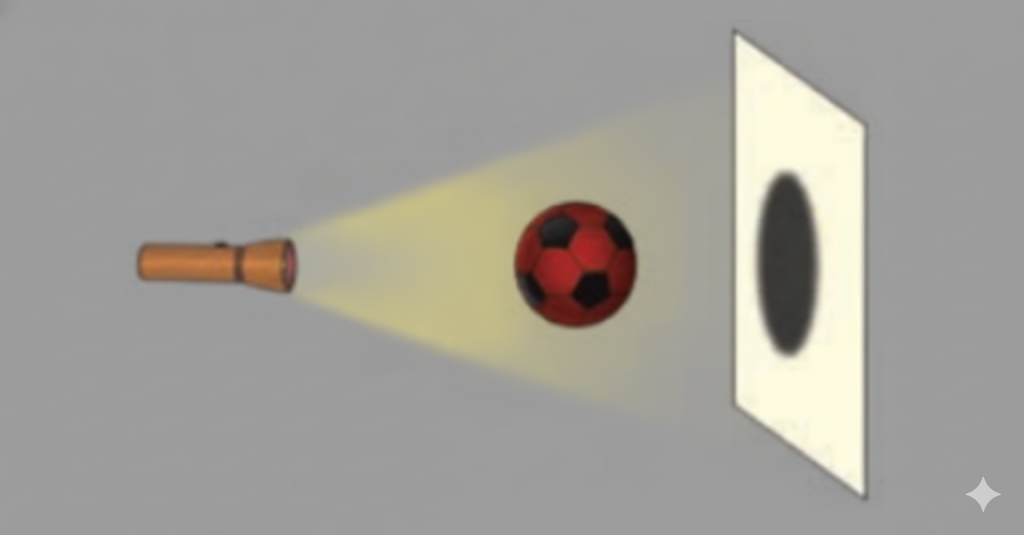
Fig. Passing light through different materials
Table 11.1: Light through different materials
Observation and conclusion:
Transparent materials let light pass through completely, allowing us to see objects clearly. Translucent materials permit only some light to pass through, so objects appear blurred. Opaque materials do not allow light to pass through at all, which is why we cannot see through them.
Activity 11.4: Let Us Explore (Pages 158-159)
Table 11.2: Observation of shadows
Observation and conclusion:
A shadow is formed when an opaque object obstructs the path of light. For a shadow to form, a light source, an opaque object, and a screen are required. The colour of the object does not change the colour of the shadow. However, the position of the object influences the size and shape of the shadow:
When the object is moved closer to the screen, the shadow becomes smaller.
When the object is brought nearer to the light source, the shadow becomes larger.
Changing the tilt of the object alters the shape of the shadow.
Activity 11.5: Let Us Investigate (Pages 159-160)
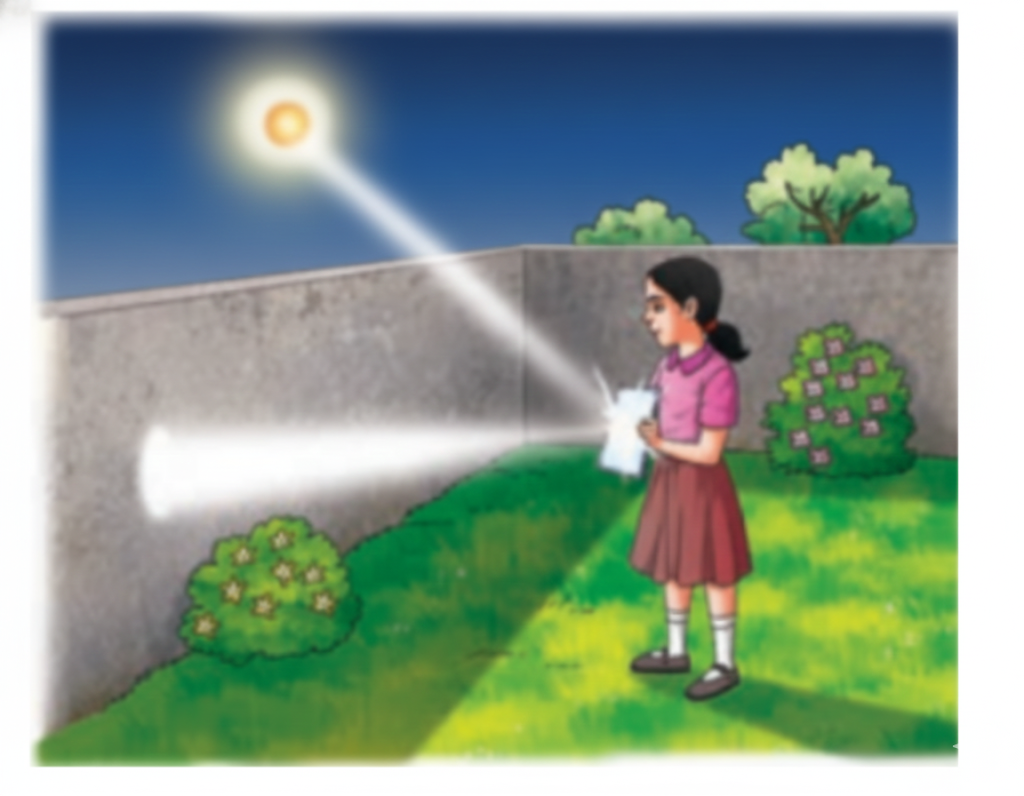
Fig. Using a mirror to redirect sunlight on a wall.
Observation and conclusion:
When a shiny, flat steel plate or a mirror is tilted in different directions, a bright spot of light can be seen on a wall or nearby surface.
As the angle of the mirror or plate is changed, the direction of the light spot also changes. This occurs because the shiny surface or mirror redirects the light falling on it. This change in the direction of light caused by a mirror or polished surface is called reflection of light.
Activity 11.6: Let Us Experiment (Page 160)
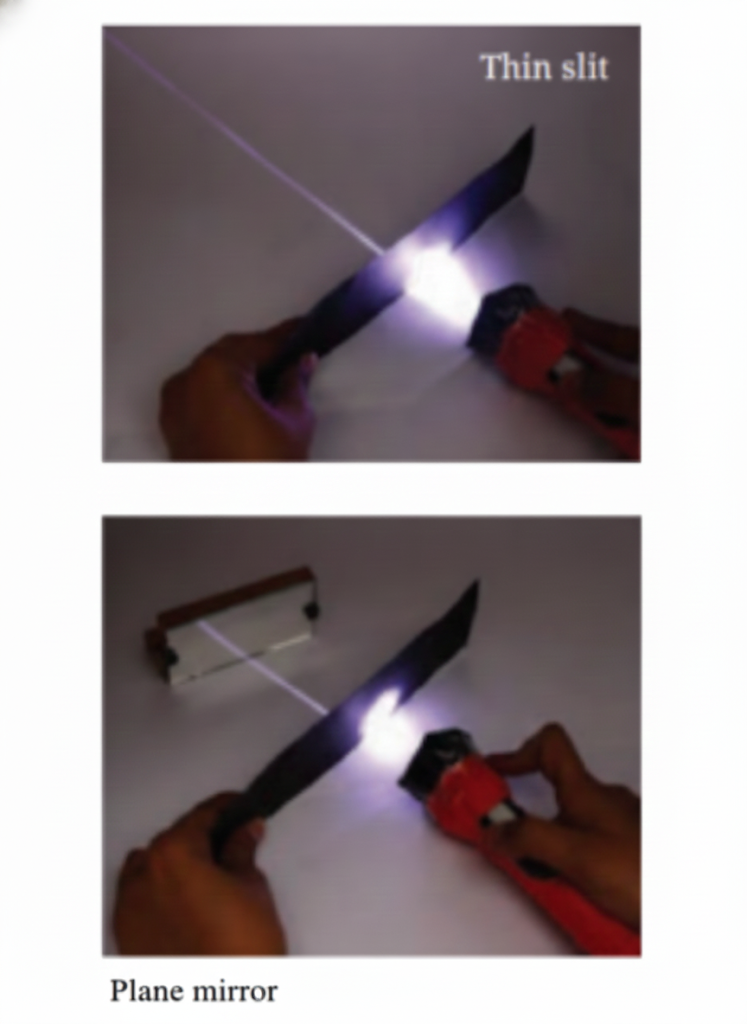
Fig. (a) A light beam (b) Reflection of light in a plane mirror.
Observation and conclusion:
When a thin beam of light passes through a narrow slit and falls on a white screen, it moves in a straight line, as shown in Fig. (a). However, if a plane mirror is placed in the path of the light beam, its direction changes, as shown in Fig. (b). This change in the direction of light when it strikes a shiny surface such as a mirror is known as the reflection of light.
Activity 11.7: Let Us Experiment (Page 161)
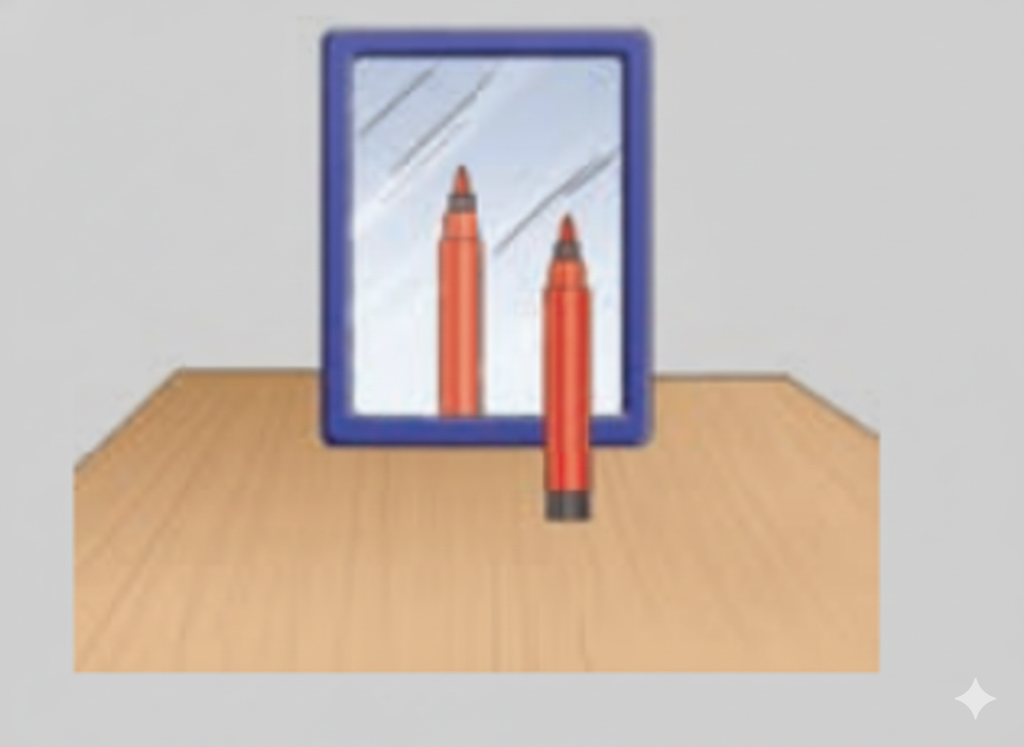
Fig. Image of a pen in a plane mirror.
Observation and conclusion: In a plane mirror, the image is formed behind the mirror and is the same size as the object. The image is always erect (upright). However, the image produced by a plane mirror cannot be captured on a screen.
Activity 11.8: Let Us Experiment (Pages 161-162)
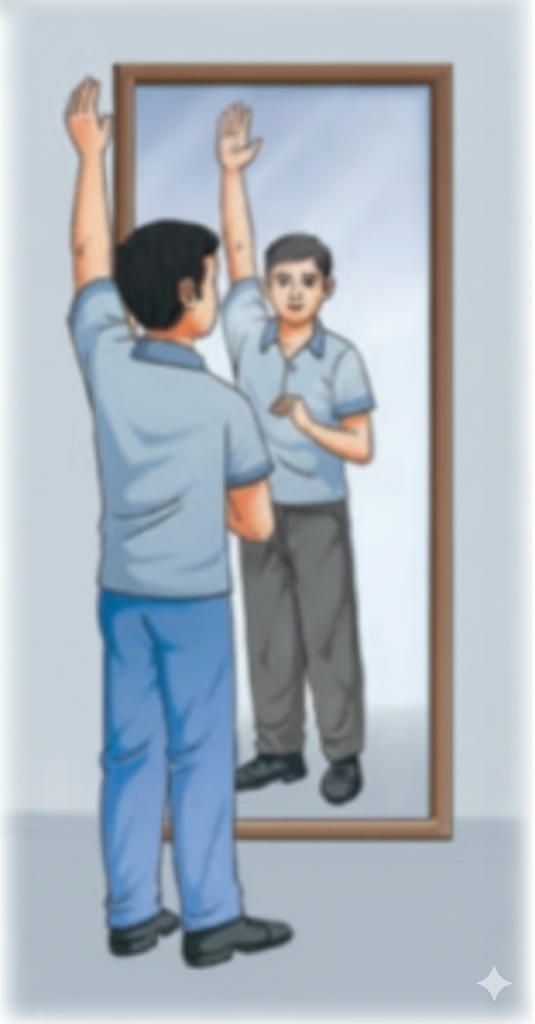
Fig. Observing one’s own image in a mirror.
Observation and conclusion:
In a plane mirror, the image is formed at the same distance behind the mirror as the object is placed in front of it. When the object moves closer to the mirror, the image also moves closer, and when the object is placed farther away, the image appears farther as well. A plane mirror also causes lateral inversion, in which the right side appears as left and the left side appears as right.
Activity 11.9: Let Us Explore (Page 163)
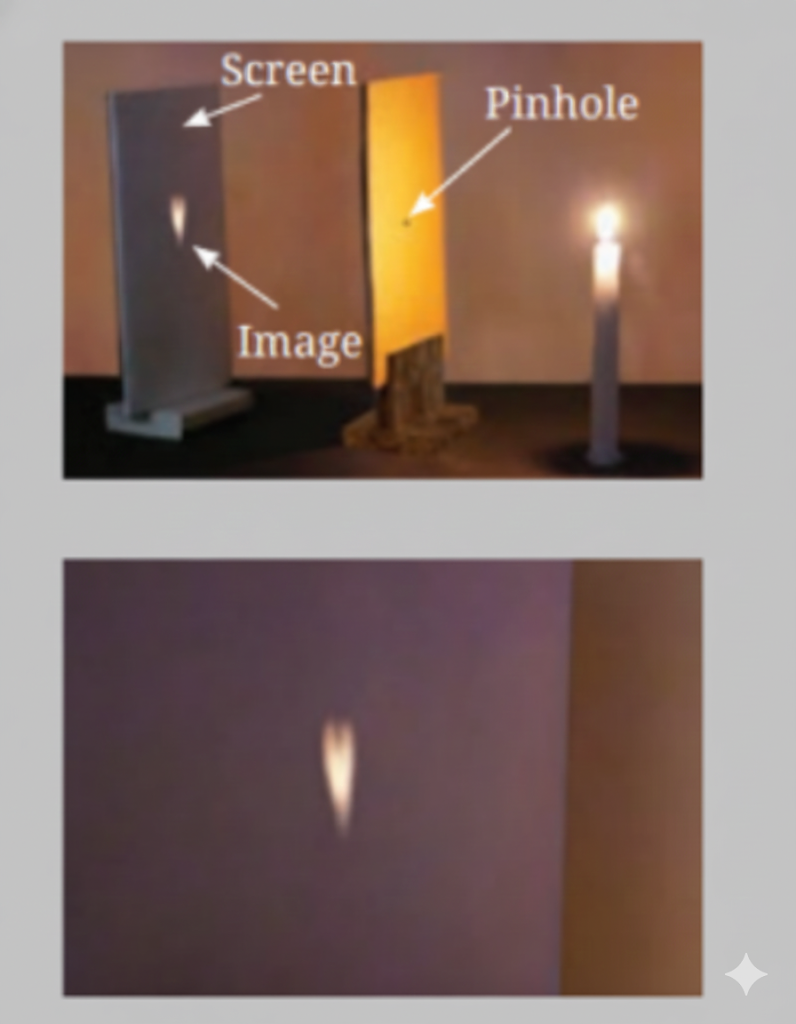
Fig. (a) A simple pinhole camera (b) Image of a candle flame on screen.
Observation and conclusion:
When a lighted candle is placed in front of a cardboard sheet with a small hole, as shown in Fig.
(a), light from the flame passes through the hole and produces an inverted (upside-down) image of the candle on the screen behind the cardboard, as shown in Fig. (b).
Activity 11.10: Let Us Construct (Page 163)
Students should do it by themselves.
Key Concepts of Light: Shadows and Reflections 11
Mastering Light: Shadows and Reflections 11 is crucial for Class 7 Science. From understanding how light travels in a straight line to identifying luminous and non-luminous objects, every topic builds a foundation for senior classes and real-life applications.
This chapter explores fascinating phenomena like the sources of light, the importance of the Sun, and how fireflies communicate using their own light. Regular practice helps students clarify key concepts and easily tackle exam questions based on NCERT Class 7 Science Chapter 11.
To boost your score, focus on examples from daily life and revise definitions of luminous and non-luminous objects. Smart revision and real-life observations make this chapter memorable and exam-ready.
FAQs on NCERT Solutions For Class 7 Science Chapter 11 Light Shadows And Reflections - 2026-27 Free PDF Download (Login Required)
1. What is a shadow?
A shadow is formed when an opaque object blocks the path of light, creating a dark area on the opposite side.
Key points:
- Shadows form only when light is blocked by opaque objects.
- The shape of the shadow resembles the shape of the obstructing object.
- Light travels in straight lines — this is why sharp shadows are formed.
- This concept is central in Class 7 Science Chapter 11: Light: Shadows and Reflections.
2. How do you draw ray diagrams in chapter 11?
To draw ray diagrams in Chapter 11, use straight lines and follow proper scientific conventions.
Steps:
- Draw the source of light (like a candle or torch).
- Draw the opaque object in the path of light.
- Use straight lines (rays) to show the direction of light from source to object, and from object to screen.
- Indicate the shadow area on the screen behind the object.
- Label all important parts: source, object, screen, shadow, and direction of rays.
3. Are NCERT solutions enough for class 7 science?
NCERT Solutions for Class 7 Science are usually enough for most school and CBSE exams.
Additional points:
- They cover all textbook exercises and key definitions.
- Well-structured, stepwise answers match the CBSE marking scheme.
- For deeper understanding or higher-order questions, practice from NCERT Exemplar and revision notes is helpful.
4. Which questions are likely from this chapter in school exams?
Common exam questions from Class 7 Science Chapter 11 include:
- Define shadow; explain how it is formed.
- Draw and label a ray diagram to show shadow formation.
- Differentiate between transparent, translucent, and opaque objects (with examples).
- Why does a shadow change size?
- Explain reflection and draw related diagrams.
- Diagram-based or definition-based short answers.
5. Do diagrams or definitions need to be included in answers for Class 7 Science Chapter 11?
Yes, including diagrams and definitions in your answers helps you score full marks.
- Draw neat, labelled diagrams for shadow and reflection questions.
- Write precise definitions for terms like shadow, reflection, opaque, etc.
- Use correct scientific terms as per the CBSE syllabus.
- Follow stepwise presentation as shown in NCERT Solutions for Class 7 Science Chapter 11.
6. How to present long answers to match CBSE marking?
To score full marks, present long answers by following key steps:
- Start with a definition or concept explanation.
- Include stepwise points and bullet lists.
- Add neat diagrams with proper labels when required.
- Highlight keywords and underline main terms.
- Conclude with a brief summary if needed.
7. Where can I download the chapter’s solutions PDF?
You can download the Class 7 Science Chapter 11: Light: Shadows and Reflections NCERT Solutions PDF from trusted educational websites.
Benefits of PDF download:
- Free and accessible offline anytime.
- Helps with fast revision before exams.
- Includes stepwise solutions and diagrams for better understanding.
8. What are the most important topics from Class 7 Science Chapter 11: Light: Shadows and Reflections?
The most important topics include:
- Shadow formation: definition, diagram, and reasoning
- Differences between transparent, opaque, and translucent objects
- Reflection of light and use of mirrors
- Drawing and labelling ray diagrams
- Daily life applications of shadows and reflections
9. How to learn diagrams or maps for Class 7 Science Chapter 11 effectively?
To learn diagrams for Chapter 11 effectively:
- Practice drawing shadow and mirror diagrams using a pencil and ruler for neatness.
- Always label parts: object, source, screen, shadow, and light rays.
- Revise common diagrams shown in NCERT Solutions.
- Use revision notes or flashcards for quick recall.
10. What is the CBSE marking scheme for Class 7 Science Chapter 11?
The CBSE marking scheme for Chapter 11 awards marks for:
- Stepwise answers (1 mark per correct step)
- Correct usage of keywords like shadow, opaque, reflection
- Neat, labelled diagrams where required
- Accurate definitions and clearly structured points
Partial marks are given for partially correct answers as per step marking.
