









An Overview of the New Profit-Sharing Ratio
How to discover a new profit-sharing ratio is the percentage of future earnings and losses each current partner will be expected to contribute to the firm in the future. New partners in existing partnerships get little incentives.
He may safeguard his financial interest via past partners. Existing partners forgo some earnings to welcome a new partner. If no alternative method is stated, the new associate partner gets his share from the existing partners in the same way as in the gain (profit) sharing ratio. Current partners and potential associate partners decide on a new partner's share and how to acquire it from existing partners. Associate partners must set a new profit-sharing ratio.

New Profit-Sharing Structure
The Purpose of A New Business Ratio
The Objective of Introducing a New Profit Ratio
When a new ratio is required in a company, the need might arise from various contexts. When any of the following conditions are met, the company will have its new ratio:
If the partners choose to adjust the current ratio of profit sharing without adding any new members or removing any existing ones.
When a new partner is brought into a company.
At the moment of the passing of an older spouse or upon that partner's retirement.
Calculation of new profit sharing ratio: Nevertheless, in retirement, the new profit sharing ratio is calculated by excluding the retiring person's portion from the total. Under these circumstances, the gaining ratio of the members staying on will be equal to the retiring person's share multiplied by the acquisition ratio.
Sacrifice Ratio
A sacrifice ratio is a rate at which current shareholders give up a percentage of their earnings to welcome new investors. Existing partners, either individually or collectively, often make this sacrifice by transferring their share to new partners. It is also important to know that current partners might choose to renounce shares in exchange for the new admittance in a predetermined ratio.
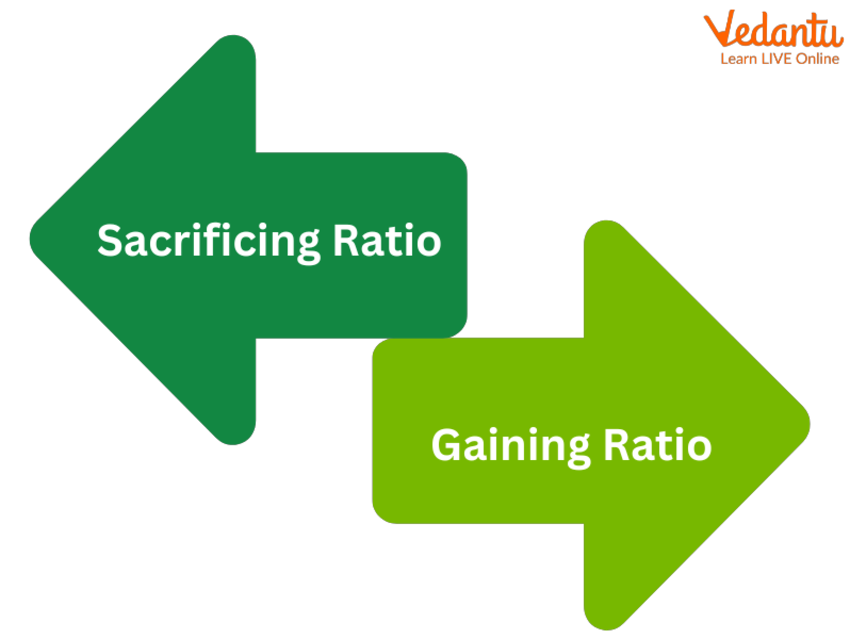
The Latest Sacrifice Ratio
The sacrifice ratio is the difference between their former and current ratio. We can alternatively write the formula for the sacrifice ratio as:
1. Sacrificing ratio = Old profit sharing ratio – New profit sharing ratio
This ratio is important for a partnership to calculate. It's useful for calculating how much new investors would have to pay to appease existing investors who take a financial hit. Such payments are often made based on a predetermined quantity of goodwill.
One thing to remember is that sacrificial partners are those whose profit share falls due to a change in the profit-sharing ratio. Instead, a gaining partner is one whose profit share increases due to a change in the profit-sharing ratio.
Conclusion
In this article, we have extensively discussed the Profit Sharing Ratio. New profit-sharing ratio, estimates of the "new profit-sharing ratio," methods for calculating the "new profit-sharing ratio," some worked-out examples involving the Profit Sharing Ratio and some frequently asked questions about the topic are all included in this article. Reading each chapter with maximum attentiveness is recommended for students to acquire information.
FAQs on New Profit Sharing Ratio: Explained
1. What is meant by the New Profit Sharing Ratio in a partnership?
The New Profit Sharing Ratio (NPSR) is the specific ratio in which all partners, including any newly admitted or remaining partners, agree to share the future profits and losses of the business. This ratio is established whenever the structure of the partnership changes.
2. In which situations is it necessary to calculate a New Profit Sharing Ratio?
A firm must calculate a New Profit Sharing Ratio whenever the partnership is reconstituted. The most common situations are:
- When a new partner is admitted to the firm.
- When an existing partner retires from the firm.
- In the event of the death of a partner.
- When existing partners mutually decide to change their current profit-sharing ratio.
3. How is the New Profit Sharing Ratio typically calculated when a new partner joins?
When a new partner joins, you first determine the share of profit remaining for the original partners after allocating the new partner's share. This remaining portion is then divided among the old partners according to their original profit-sharing ratio. The new share for an old partner is found by: Old Share × Remaining Share.
4. Why is calculating the New Profit Sharing Ratio important for a business?
Calculating the NPSR is crucial because it provides legal and financial clarity. It ensures that future profits and losses are divided fairly as per the new agreement, which helps prevent disputes. It also serves as the basis for adjusting partner capital accounts and calculating goodwill contributions or payouts.
5. What is the main difference between the Old Profit Sharing Ratio and the New Profit Sharing Ratio?
The Old Profit Sharing Ratio is the proportion in which partners shared profits before any change in the partnership occurred. The New Profit Sharing Ratio is the revised proportion agreed upon after an event like the admission or retirement of a partner. The old ratio applies to past profits, while the new one applies to all future profits.
6. Can you explain how to find the New Profit Sharing Ratio with a simple example?
Of course. Imagine partners X and Y share profits in a 2:1 ratio. They admit Z for a 1/4th share. Here's how to calculate the NPSR:
- Total share of the firm is 1.
- Z's share = 1/4.
- The remaining share for X and Y = 1 - 1/4 = 3/4.
- X's new share will be 2/3 of the remaining 3/4, which is (2/3) × (3/4) = 6/12.
- Y's new share will be 1/3 of the remaining 3/4, which is (1/3) × (3/4) = 3/12.
- The New Profit Sharing Ratio for X, Y, and Z is 6:3:3, which simplifies to 2:1:1.
7. How is the calculation of the New Profit Sharing Ratio related to the Sacrificing Ratio?
They are directly related. The Sacrificing Ratio shows the proportion in which the old partners have given up their share of profit to the new partner. It is calculated by subtracting the new ratio from the old ratio (Old Ratio - New Ratio). The NPSR must be known before you can determine how much each original partner has sacrificed.
8. Does the calculation method for the New Profit Sharing Ratio change if a partner retires instead of joins?
Yes, the approach is different. On admission, a new share is created by reducing the old partners' shares. On retirement, the outgoing partner's share is distributed among the remaining partners, increasing their shares. The new share of a remaining partner is calculated by adding their portion of the retired partner's share to their old share (Old Share + Gained Share).
