



Class 12 Geography Chapter 1 Human Geography: Nature and Scope Important Questions with Answers PDF
The Class 12 Geography Chapter 1 Human Geography: Nature and Scope Question Answer section includes 15 solved questions across MCQs, very short, short and long answers. Students can explore human-environment relationships, compare geographical theories and understand textbook examples such as Benda and Kari.
Class 12 Geography Chapter 1 MCQ with Answers
Q1. A community depends on forests for food, follows seasonal changes and has limited technology. Which geographical concept best explains its relationship with nature?
(a) Possibilism
(b) Environmental determinism
(c) Quantitative revolution
(d) Post-modernism
Answer: (b) Environmental determinism
Explanation: Environmental determinism describes a situation in which human activities are strongly influenced by the physical environment. At a low level of technological development, people adapt to natural conditions rather than significantly modifying them.
Q2. Which geographer introduced the concept of neo-determinism, also called stop-and-go determinism?
(a) Friedrich Ratzel
(b) Ellen C. Semple
(c) Griffith Taylor
(d) Paul Vidal de la Blache
Answer: (c) Griffith Taylor
Explanation: Griffith Taylor introduced neo-determinism as a middle path between environmental determinism and possibilism. It suggests that humans can pursue development while respecting environmental limits.
Q3. During which period did human geography experience the quantitative revolution, with increased use of computers and statistical methods?
(a) Early colonial period
(b) 1930s
(c) Late 1950s to late 1960s
(d) 1990s
Answer: (c) Late 1950s to late 1960s
Explanation: During this period, geographers increasingly used statistical tools and computers to study the spatial organisation of human activities and identify geographical patterns.
Q4. Which school of thought in human geography focuses on people's perceptions, lived experiences and understanding of space?
(a) Radical school
(b) Behavioural school
(c) Welfare school
(d) Regional analysis
Answer: (b) Behavioural school
Explanation: The behavioural school gives importance to how different social groups experience and perceive geographical space. It considers human behaviour rather than relying only on measurable spatial patterns.
Class 12 Geography Chapter 1 Very Short Answer Questions
Q5. Define human geography and name one geographer associated with its definition.
Answer: Human geography studies the relationships between human societies and the physical environment, along with the spatial distribution of human activities.
Friedrich Ratzel described human geography as a synthetic study of the relationship between human societies and the earth's surface.
His definition emphasises the close connection between people and their environment.
Q6. What is meant by the naturalisation of humans?
Answer: Naturalisation of humans refers to the stage when human beings were strongly influenced by nature because of limited technological and social development.
People depended directly on natural resources and adapted their activities to environmental conditions. This relationship is associated with environmental determinism.
Q7. Name any four sub-fields of human geography and their related disciplines.
Answer:
These examples show that human geography is closely connected with different social sciences and other fields of study.
Class 12 Geography Chapter 1 Short Answer Questions
Q8. Differentiate between environmental determinism, possibilism and neo-determinism.
Answer:
Explanation: These approaches show how geographical thought has changed over time. Environmental determinism highlights nature's influence, possibilism emphasises human abilities, and neo-determinism seeks a balance between development and environmental protection.
Q9. Read the following situations and identify whether they represent naturalisation of humans or humanisation of nature. Give reasons.
Situation A: A community living in a forest depends on wild plants, water streams and shifting cultivation. Its members have a deep relationship with the natural environment.
Situation B: People living in a cold town use heated buildings, special winter tyres, imported food and advanced transport to manage difficult climatic conditions.
Answer:
Situation A – Naturalisation of Humans
This situation represents naturalisation of humans because the community depends directly on forest resources and adjusts its lifestyle according to nature.
The example is similar to Benda, described in the NCERT chapter. Benda's life in the Abujh Maad region shows the close relationship between people and natural surroundings.
Situation B – Humanisation of Nature
This situation represents humanisation of nature because technology enables people to modify their surroundings and reduce the restrictions imposed by climate.
The example is similar to Kari, who lives in Trondheim. Heated buildings, special tyres, transport and imported food make life possible despite harsh winter conditions.
Key Difference: Naturalisation of humans highlights adaptation to nature, while humanisation of nature highlights the increasing ability of humans to change their surroundings through technology.
Q10. Explain the contribution of Friedrich Ratzel, Ellen C. Semple and Paul Vidal de la Blache to the definition of human geography.
Answer:
Explanation: The definitions differ in emphasis, but all three recognise the connection between humans and the environment. Ratzel stresses synthesis, Semple highlights change, and Vidal de la Blache focuses on understanding interrelationships.
Q11. How did the approaches used in human geography change from the colonial period to the 1990s?
Answer: The approaches used in human geography changed as geographical knowledge, technology and methods of research developed.
Explanation: Human geography developed from mainly descriptive studies towards quantitative research and approaches that considered social experiences, inequalities and differences between places.
Class 12 Geography Chapter 1 Long Answer Questions
Q12. Explain the relationship between nature, human beings and technology. How does technology influence the humanisation of nature?
Answer: Human beings and the physical environment continuously influence each other. Nature provides resources such as land, water, minerals and vegetation, while humans use knowledge and technology to fulfil their needs and create cultural landscapes.
1. Dependence on Nature
In the early stages of human development, people had limited technology. They depended directly on the environment for food, shelter and other basic needs.
For example, forest communities used naturally available plants, water and land for survival.
2. Development of Technology
As people developed a better understanding of natural laws, they created tools and techniques to modify their surroundings.
The NCERT chapter provides examples such as understanding friction and heat, genetics, and aerodynamics to explain how knowledge of nature supports technological progress.
3. Humanisation of Nature
With technological development, human beings began constructing roads, buildings, ports, industries, farms and other elements of the cultural landscape.
They were increasingly able to reduce natural restrictions on their activities.
4. Need for Environmental Balance
Technology creates new opportunities, but development can also damage the environment. Neo-determinism therefore emphasises using resources within natural limits.
Visual: Interaction Between Nature, Humans and Technology
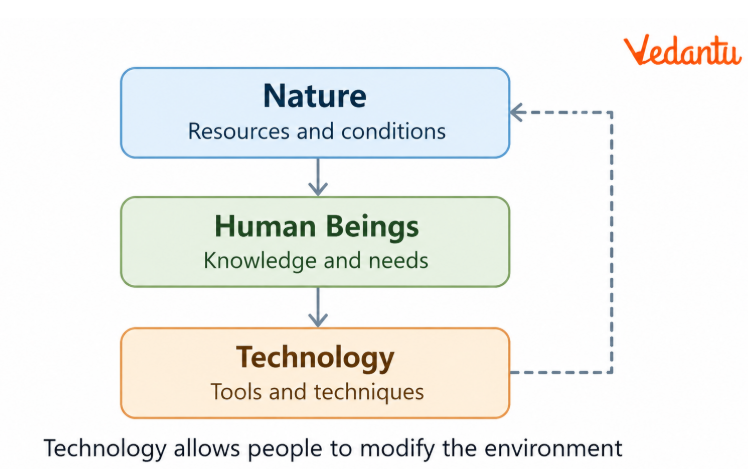
Conclusion: Technology strengthens people's ability to use and modify nature. However, human development remains dependent on natural resources and should respect environmental limits.
Q13. Compare the textbook examples of Benda and Kari to explain naturalisation of humans and humanisation of nature.
Answer: The NCERT book Fundamentals of Human Geography uses the experiences of Benda and Kari to demonstrate contrasting relationships between people and their physical environment.
Part A: Benda – Naturalisation of Humans
Benda lives in the Abujh Maad region of central India. His community has a close relationship with forests and other natural resources.
Important features of his lifestyle include:
Practising shifting cultivation by clearing small forest patches.
Depending on streams, plants and forest resources.
Gathering useful herbs and other natural products.
Maintaining beliefs and practices closely connected with nature.
Using traditional knowledge to locate and obtain resources.
Benda's lifestyle illustrates strong dependence on the physical environment, a feature associated with environmental determinism.
Part B: Kari – Humanisation of Nature
Kari lives in Trondheim, where winters are harsh, and daylight is limited.
Her lifestyle is supported by technology in several ways:
Special tyres help her travel during winter.
Artificial heating maintains comfortable indoor temperatures.
Protected buildings reduce the impact of snow and cold.
Transport networks make food from warmer regions available.
Modern communication systems connect her with people in distant places.
Kari's lifestyle demonstrates how technology makes it possible to overcome many environmental restrictions.
Part C: Comparison
Conclusion: Benda and Kari represent different ways in which societies interact with nature. Their examples show how technological and social development can change human-environment relationships.
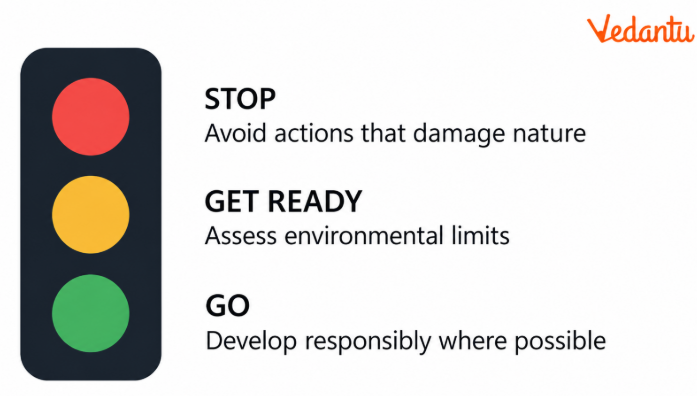
Q14. Explain neo-determinism or stop-and-go determinism. How does Griffith Taylor's concept provide a middle path between environmental determinism and possibilism?
Answer: Neo-determinism is a geographical concept introduced by Griffith Taylor. It suggests that human beings can develop and modify their environment, but they must respect the limits set by nature.
It is also known as stop-and-go determinism.
Part A: The Two Extreme Views
Environmental determinism suggests that nature strongly controls human activities, especially when technology is limited.
Possibilism suggests that human beings can use knowledge and technology to create opportunities and modify the environment.
Griffith Taylor's concept provides a middle path by recognising both human abilities and environmental restrictions.
Part B: Traffic Light Analogy
The NCERT chapter explains neo-determinism using a traffic signal.
Part C: Meaning of the Signals
Red – Stop: Development should not proceed when it causes serious environmental damage.
Amber – Get Ready: Human beings should assess environmental conditions and plan suitable activities.
Green – Go: Development can proceed when environmental conditions permit.
Part D: Importance of Neo-determinism
It recognises that human beings have the ability to use technology.
It accepts that nature places limits on human activities.
It encourages careful use of natural resources.
It highlights the need to avoid environmental degradation.
It offers a balanced understanding of the human-environment relationship.
Conclusion: Neo-determinism rejects both complete environmental control and unlimited human freedom. It supports development that works within the limits of nature.
Q15. Discuss the scope of human geography. Explain its major fields and their relationships with other social sciences.
Answer: The scope of human geography is wide because it studies different aspects of human life in relation to geographical space.
It examines where people live, how they use resources, how settlements and economic activities develop, and how societies interact with their physical surroundings.
Part A: Major Fields of Human Geography
1. Social Geography
Social geography studies the spatial aspects of society, including cultural practices, behaviour, social well-being and differences between communities.
Its sub-fields include behavioural geography, cultural geography, gender geography and medical geography.
2. Urban Geography
Urban geography focuses on towns, cities, urban development and the spatial organisation of urban activities.
It connects closely with urban studies and planning.
3. Political Geography
Political geography studies the geographical dimensions of political activities, territorial organisation and related phenomena.
Its sub-fields include electoral geography and military geography.
4. Population Geography
Population geography examines population distribution and related characteristics.
It is closely connected with demography.
5. Settlement Geography
Settlement geography studies the location, distribution and patterns of human settlements.
It connects with rural and urban planning.
6. Economic Geography
Economic geography studies the spatial organisation of economic activities such as agriculture, industries, marketing, tourism and international trade.
Part B: Relationship with Other Social Sciences
Part C: Why Is Human Geography Interdisciplinary?
Human geography is interdisciplinary because human activities cannot be understood through geographical location alone.
For example:
Population patterns are studied with the help of demography.
Social behaviour is understood through psychology and sociology.
Economic activities are examined through economics.
Historical changes are explored through history.
Settlement development is studied with the help of planning.
Conclusion: Human geography connects geographical space with social, cultural, political and economic life. Its interdisciplinary nature helps explain the different ways human societies organise and transform the earth's surface.
Why Practise Class 12 Geography Chapter 1 Important Questions with Vedantu?
Vedantu's Class 12 Geography Chapter 1 Important Questions help students understand human-environment relationships through solved questions on determinism, possibilism, neo-determinism and NCERT examples.
How to Prepare Class 12 Geography Chapter 1 Important Questions with Vedantu?
Compare theories: Practise differences between determinism, possibilism and neo-determinism.
Revise NCERT examples: Understand Benda and Kari's contrasting relationships with nature.
Remember key geographers: Connect Ratzel, Semple, Vidal de la Blache and Griffith Taylor with their ideas.
Practise long answers: Explain the evolution and scope of human geography using clear points and examples.
Important Study Material Links for Class 12 Geography Chapter 1
CBSE Class 12 Geography other books Important Questions and Study Resources
Chapter-Wise Important Questions for Class 12 Geography – Fundamentals of Human Geography
Students can use the Class 12 Fundamentals of Human Geography Chapter 1 Question Answer resources to revise key concepts before exploring important questions from the remaining chapters of the book.
Important Study Materials for Class 12 Geography
FAQs on Important Questions and Answers for Class 12 Geography Chapter 1 Human Geography: Nature and Scope(Fundamentals of Human Geography) | 2026-27
1. What is the main focus of Human Geography: Nature and Scope in Class 12?
The chapter explains how human societies interact with the physical environment. It covers environmental determinism, possibilism, neo-determinism, the changing approaches used in human geography and its connections with other social sciences.
2. What is the difference between environmental determinism and possibilism?
Environmental determinism emphasises how natural conditions influence human activities, particularly in societies with limited technology. Possibilism highlights the ability of human beings to use knowledge and technology to create opportunities and modify their surroundings.
3. Why did Griffith Taylor describe neo-determinism as stop-and-go determinism?
Griffith Taylor compared development with traffic signals. Human beings can move forward when conditions permit, but they must stop or adjust their activities when environmental limits are reached. This approach balances human development with respect for nature.
4. How does Benda's lifestyle explain naturalisation of humans?
Benda lives in the forested Abujh Maad region and depends on natural resources for cultivation, water and other needs. His lifestyle illustrates how human activities can be closely controlled by and adapted to the physical environment.
5. How does Kari's life in Trondheim explain humanisation of nature?
Kari uses heated buildings, winter transport facilities and modern communication technology to live comfortably in harsh climatic conditions. Her lifestyle shows how technological development reduces some restrictions imposed by nature.
6. Why is technology important in the relationship between humans and the environment?
Technology helps people use natural resources, develop infrastructure and modify their surroundings. It grows through a better understanding of natural laws. However, technology does not completely remove environmental limitations.
7. What are the major schools of thought that emerged in human geography during the 1970s?
The major schools were humanistic or welfare, radical and behavioural geography. Humanistic geography focused on social well-being, radical geography examined poverty and inequality, and behavioural geography studied people's perceptions and experiences of space.
8. Which topics should I focus on for Class 12 Geography Chapter 1 Human Geography: Nature and Scope question-answer practice?
Focus on definitions of human geography, naturalisation of humans, humanisation of nature, environmental determinism, possibilism, neo-determinism, major geographers, historical approaches and the fields of human geography. Practise both comparison questions and textbook-based examples.
9. How should I answer long questions on the nature and scope of human geography?
Begin with a clear definition, organise the main points under suitable headings and include examples from the NCERT chapter. For questions about geographical approaches, explain their differences and use the examples of Benda, Kari or Griffith Taylor's traffic signal analogy where relevant.
10. Where can I get Class 12 Geography Chapter 1 important questions and answers in PDF format?
Students searching for Class 12 Geography Fundamentals of Human Geography Chapter 1 Important Questions can use this page to practise MCQs and descriptive questions. The chapter-specific question-answer PDF can be downloaded once it is published on the page.
