



Class 12 Geography Chapter 4 Primary Activities Important Questions with Answers PDF
The Class 12 Geography Chapter 4 Primary Activities Question Answers section contains 18 solved questions, including five MCQs, four very short answers, five short answers and four long answers. Students can practise questions on shifting cultivation, transhumance, plantation agriculture, mixed farming, co-operative farming and mining methods. Each answer uses relevant NCERT concepts and examples to make revision easier.
Class 12 Geography Chapter 4 MCQs with Answers
Q1. A farmer clears a forest patch, burns the vegetation, grows crops for a few years and then moves to another area. Which type of farming is this?
(a) Mixed farming
(b) Shifting cultivation
(c) Plantation agriculture
(d) Commercial grain farming
Answer: (b) Shifting cultivation.
Explanation: Shifting cultivation is also called slash-and-burn agriculture. Farmers clear vegetation, use the ash to improve soil fertility temporarily and move to another plot when the soil becomes less productive.
Q2. Which farming practice is known as transhumance?
(a) Rearing livestock on permanent ranches
(b) Seasonal movement of herders between plains and mountain pastures
(c) Growing vegetables near urban markets
(d) Cultivating one commercial crop on a large estate
Answer: (b) Seasonal movement of herders between plains and mountain pastures.
Explanation: In the Himalayas, communities such as Gujjars, Bakarwals, Gaddis and Bhotiyas move towards higher pastures in summer and return to lower areas in winter.
Q3. Which country is identified in NCERT as an important example of successful co-operative farming?
(a) Mongolia (b) Denmark (c) Brazil (d) Argentina
Answer: (b) Denmark.
Explanation: Co-operative farming is highly successful in Denmark. Farmers voluntarily work together to obtain agricultural inputs, process products and market their produce while retaining individual farms.
Q4. Why does extensive commercial grain farming have high output per worker?
(a) It is carried out on very small farms
(b) All farm operations depend on manual labour
(c) Large farms use machinery for cultivation and harvesting (d) It mainly produces crops for family consumption
Answer: (c) Large farms use machinery for cultivation and harvesting.
Explanation: Extensive commercial grain farming uses large machines over vast farms. As a result, fewer workers can cultivate and harvest large areas, giving high output per person.
Q5. Which mining method is generally used when minerals occur close to the earth's surface?
(a) Shaft mining (b) Underground mining (c) Open-cast mining (d) Deep tunnel mining
Answer: (c) Open-cast mining.
Explanation: Open-cast mining is a surface mining method. It is usually easier and cheaper for deposits located near the surface than underground mining.
Class 12 Geography Chapter 4 Very Short Answer Questions
Q6. What are primary economic activities? Give four examples.
Answer: Primary economic activities involve the direct use of natural resources.
Examples include agriculture, fishing, forestry and mining. Hunting, gathering and pastoralism are also primary activities.
Q7. Why are people engaged in primary activities called red-collar workers?
Answer: They are called red-collar workers because their activities are mainly carried out outdoors and involve direct contact with the natural environment.
Q8. Name four animals associated with nomadic herding in different regions of the world.
Answer:
Camels – Sahara and Asiatic deserts.
Yaks – Mountainous areas of Tibet.
Llamas – Andes Mountains.
Reindeer – Arctic and sub-Arctic regions.
Q9. What is truck farming?
Answer: Truck farming is a specialised form of market gardening in which farmers grow vegetables for urban markets.
The distance between the farms and markets is related to how far trucks can travel overnight to deliver fresh produce.
Class 12 Geography Chapter 4 Short Answer Questions
Q10. Differentiate between nomadic herding and commercial livestock rearing.
Answer: Both activities involve rearing animals, but their organisation and purposes differ.
Explanation: Nomadic herding depends on the availability of natural pasture and water. Commercial livestock rearing uses organised ranches and scientific methods to produce animal products for different markets.
Q11. Why does intensive subsistence agriculture dominated by wet paddy cultivation require a large amount of labour?
Answer: Wet paddy cultivation is common in densely populated parts of monsoon Asia.
Its important features are:
Landholdings are small because population density is high.
Farmers mainly depend on family labour.
Many agricultural operations are carried out manually.
Machinery is used to a limited extent.
Farmyard manure is used to maintain soil fertility.
Important Point: The yield per unit area is high, but productivity per worker is relatively low because many people work on small farms.
Q12. Explain why plantation agriculture is an important form of commercial farming. Give examples of plantation crops and regions.
Answer: Plantation agriculture is a large-scale commercial farming system introduced by Europeans in tropical colonies.
Its main features are:
Large estates devoted mainly to one crop.
High capital investment.
Scientific methods of cultivation.
Technical and managerial support.
Large labour requirements.
Good transport links connecting plantations with factories and markets.
Examples:
Plantation agriculture is commercial because the crops are grown mainly for processing, trade and export.
Q13. A farm grows wheat, barley and fodder crops while rearing cattle, sheep and poultry. Identify the type of farming and explain its main features.
Answer: This is an example of mixed farming.
In mixed farming, crop cultivation and animal husbandry are both important.
Main Features:
Farms are generally moderate in size.
Crops include wheat, barley, oats, maize, fodder and root crops.
Animals such as cattle, sheep, pigs and poultry provide income.
Crop rotation and intercropping help maintain soil fertility.
Farm machinery and scientific agricultural methods are widely used.
NCERT Regions: North-western Europe, eastern North America and parts of Eurasia.
Q14. Differentiate between open-cast mining and underground mining.
Answer:
Explanation: Open-cast mining is suitable for mineral deposits close to the surface. Underground mining is necessary for deeper deposits and requires more complex safety arrangements.
Class 12 Geography Chapter 4 Long Answer Questions
Q15. Explain primitive and intensive subsistence agriculture. How are the two farming systems different?
Answer: Subsistence agriculture is a system in which all or nearly all agricultural produce is consumed locally.
NCERT divides it into primitive subsistence agriculture and intensive subsistence agriculture.
1. Primitive Subsistence Agriculture
This includes shifting cultivation, also known as slash-and-burn agriculture.
Farmers clear vegetation, burn it and cultivate crops on a small plot using simple tools.
After about three to five years, the soil may lose fertility, and farmers move to another plot.
Regional Names:
2. Intensive Subsistence Agriculture
This is common in densely populated parts of monsoon Asia.
It is divided into two types:
Wet paddy-dominated agriculture: Rice is the main crop. Farms are small, and cultivation requires considerable family labour.
Agriculture dominated by crops other than paddy: Wheat, soybean, barley, sorghum and millets are cultivated in regions where geographical conditions are less suitable for rice.
3. Comparison
Conclusion: Both farming systems serve local needs, but they differ in the use of land, cultivation practices and population pressure.
Q16. Compare plantation agriculture, extensive commercial grain farming, Mediterranean agriculture and market gardening.
Answer: These are specialised forms of commercial agriculture. However, their crops, geographical locations and farming methods differ.
Plantation Agriculture: Large estates use substantial investment and organised labour to produce commercial crops.
Extensive Commercial Grain Farming: Large agricultural areas are cultivated using machines. Wheat is the principal crop, and output per worker is high.
Mediterranean Agriculture: This system specialises in valuable fruits and vegetables. Grape cultivation, known as viticulture, is especially important.
Market Gardening: Farmers grow high-value produce for urban consumers. Transport facilities and proximity to markets are important.
Conclusion: Climate, available land, technology and demand determine which commercial farming system develops in a region.
Q17. Explain co-operative farming and collective farming. How do they differ in ownership and organisation?
Answer: Both farming systems involve people working together, but they have different forms of ownership and management.
1. Co-operative Farming
Farmers voluntarily form a co-operative society to improve efficiency and profitability.
They may work together to:
Purchase agricultural inputs.
Process agricultural produce.
Market crops on favourable terms.
Reduce the costs of essential services.
Individual farms remain intact.
NCERT Example: Denmark is an important example of successful co-operative farming.
2. Collective Farming
Collective farming is based on social ownership and collective labour.
In the former Soviet Union, the Kolkhoz system pooled resources such as land, livestock, and labour.
Farmers could keep very small plots to meet household needs.
Comparison:
Conclusion: Co-operative farming allows farmers to benefit from working together while keeping their individual farms. Collective farming involves shared agricultural resources and labour.
Q18. Discuss the physical and economic factors affecting mining. Explain how these factors influence the choice of mining method.
Answer: Mining involves extracting mineral resources from the earth. Its profitability depends on physical and economic factors.
1. Physical Factors
Important physical factors are:
Size of the mineral deposit.
Grade or quality of the ore.
Mode of occurrence and depth of the deposit.
A large, high-quality deposit may be more profitable to mine than a small, low-grade deposit.
2. Economic Factors
Important economic factors include:
Demand for the mineral.
Available technology.
Capital investment.
Labour costs.
Transport costs.
These determine whether extraction and transportation can be carried out economically.
3. Open-cast Mining
Open-cast mining is generally used when mineral deposits occur close to the surface.
It is usually less expensive, and mineral extraction can take place quickly.
4. Underground Mining
Underground or shaft mining is used when minerals occur deep below the surface.
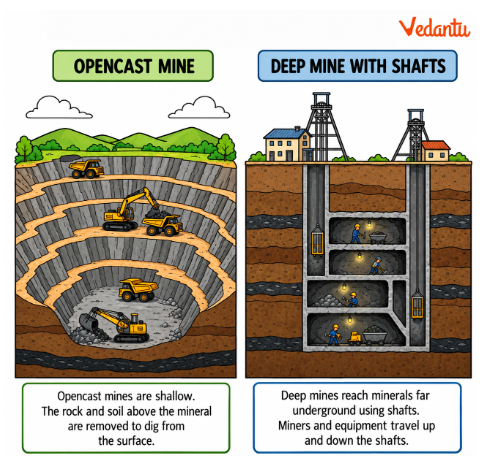
Vertical shafts and galleries are constructed, with specialised lifts, drills, haulage equipment and ventilation systems.
5. Mining Safety
Underground workers may face risks from poisonous gases, fires, floods and collapsing rock.
Conclusion: Mining methods depend on the location of mineral deposits, while costs, technology and demand affect the profitability of mining operations.
Why Practise Class 12 Geography Chapter 4 Important Questions with Vedantu?
Vedantu's Primary Activities Class 12 Important Questions help students revise how natural resources, climate, technology and markets influence economic activities. Students can practise comparisons between farming systems, understand important pastoral regions and review mining methods through chapter-specific questions and explanations.
How to Prepare Class 12 Geography Chapter 4 Important Questions with Vedantu?
Compare farming systems: Learn their main crops, regions and methods.
Remember geographical examples: Revise the Prairies, Pampas, Mediterranean region and major pastoral regions.
Practise differences: Focus on nomadic herding versus commercial livestock rearing and co-operative versus collective farming.
Revise the NCERT exercises: Pay particular attention to plantation agriculture, market gardening and livestock rearing.
Study the mining diagram: Understand why surface and underground deposits require different methods.
Important Study Material Links for Class 12 Geography Chapter 4
CBSE Class 12 Geography other books Important Questions and Study Resources
Chapter-Wise Important Questions for Class 12 Geography – Fundamentals of Human Geography
Important Study Materials for Class 12 Geography
FAQs on Important Questions and Answers for Class 12 Geography Chapter 4 – Primary Activities (Fundamentals of Human Geography) | 2026-27
1. What are the primary activities covered in Class 12 Geography Chapter 4?
The chapter covers hunting and gathering, pastoralism, farming, fishing, forestry and mining. These activities depend directly on natural resources.
2. Why is shifting cultivation also called slash-and-burn agriculture?
Farmers cut and burn vegetation before cultivation. The ash adds nutrients to the soil temporarily, but farmers shift to another plot when fertility decreases.
3. Why is the future of shifting cultivation considered uncertain?
The cultivation cycle is becoming shorter in many areas, which gives the soil less time to recover its fertility. This makes the practice difficult to sustain.
4. What is the difference between nomadic herding and commercial livestock rearing?
Nomadic herders move with animals in search of pastures, while commercial livestock rearing takes place on permanent, organised ranches for market production.
5. Why is extensive commercial grain farming highly mechanised?
The farms are very large, and machines are used for activities such as ploughing and harvesting. This allows fewer workers to cultivate large areas.
6. Why is dairy farming commonly practised near urban centres?
Urban centres provide nearby markets for milk and dairy products. Transport, refrigeration and preservation facilities also support dairy farming.
7. What is Mediterranean agriculture known for?
Mediterranean agriculture is known for producing grapes, olives, figs, citrus fruits and other valuable crops. Viticulture, or grape cultivation, is one of its specialities.
8. Why is market gardening located near cities?
Market gardening supplies fresh vegetables, fruits and flowers to urban consumers. Nearby markets help farmers transport perishable produce quickly.
9. What is the difference between co-operative farming and collective farming?
Co-operative farmers work together while keeping individual farms. Collective farming involves pooling major agricultural resources and labour.
10. Which topics are most important for Class 12 Geography Chapter 4 exam preparation?
Focus on types of farming, regional examples, transhumance, commercial livestock rearing, plantation features, co-operative and collective farming, and mining methods.
