




The most common carrier of communicable disease is
(a)Ant
(b)Housefly
(c)Dragonfly
(d)Spider
Answer
 Verified
588.2k+ views
Hint: The scientific name of the insect is Musca domestica. A communicable disease is a disease, which spreads from one person to another person or from a living organism to a person. It is also known as infectious or contagious diseases.
Complete answer:
The housefly is the major factor in contributing communicable diseases. It is the most common fly species found in our houses. Housefly feeds and meets waste products and eatables. When it flies from wastes to eatables, it transports the pathogenic bacterial agents from wastes to eatables. Due to the consumption of such eatables, the person is infected with microbes of various diseases and gets sick.
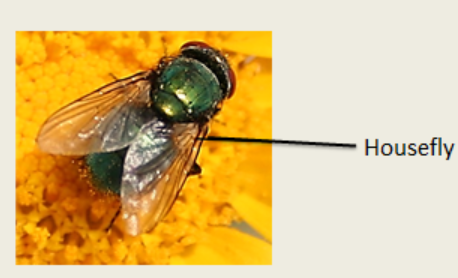
Additional Information: -A vector is an organism that does not cause disease itself but which spreads infection by conveying the pathogens from one host to another.
-The housefly is probably the widest distributed insect in the world.
-A single female housefly can lay up to 500 eggs in her lifetime, in several batches of about 75 to 150.
-Houseflies play an important ecological role in breaking down and recycling the organic matter.
-The houseflies can fly for several kilometers from their breeding places, carrying a wide variety of organisms on their hairs, mouthparts, vomits, and feces.
-Parasites carried by the houseflies include cysts of Entamoeba histolytica and Giardia lamblia and eggs Ascaris lumbricoides, Trichuris trichiura, Hymenolepis nana, and Enterobius vermicularis
So, the correct answer is, ‘Housefly.’
Note: House flies are called pests because they can carry pathogens on their bodies and in their feces, contaminate food, and contribute to the transfer of food-borne illnesses, while, in large numbers, they can be physically annoying.
Complete answer:
The housefly is the major factor in contributing communicable diseases. It is the most common fly species found in our houses. Housefly feeds and meets waste products and eatables. When it flies from wastes to eatables, it transports the pathogenic bacterial agents from wastes to eatables. Due to the consumption of such eatables, the person is infected with microbes of various diseases and gets sick.
Additional Information: -A vector is an organism that does not cause disease itself but which spreads infection by conveying the pathogens from one host to another.
-The housefly is probably the widest distributed insect in the world.
-A single female housefly can lay up to 500 eggs in her lifetime, in several batches of about 75 to 150.
-Houseflies play an important ecological role in breaking down and recycling the organic matter.
-The houseflies can fly for several kilometers from their breeding places, carrying a wide variety of organisms on their hairs, mouthparts, vomits, and feces.
-Parasites carried by the houseflies include cysts of Entamoeba histolytica and Giardia lamblia and eggs Ascaris lumbricoides, Trichuris trichiura, Hymenolepis nana, and Enterobius vermicularis
So, the correct answer is, ‘Housefly.’
Note: House flies are called pests because they can carry pathogens on their bodies and in their feces, contaminate food, and contribute to the transfer of food-borne illnesses, while, in large numbers, they can be physically annoying.
Recently Updated Pages
Master Class 12 Economics: Engaging Questions & Answers for Success

Master Class 12 Social Science: Engaging Questions & Answers for Success
Master Class 12 English: Engaging Questions & Answers for Success
Master Class 12 Maths: Engaging Questions & Answers for Success
Master Class 12 Physics: Engaging Questions & Answers for Success
Master Class 12 Biology: Engaging Questions & Answers for Success
Trending doubts
Draw a labelled sketch of the human eye class 12 physics CBSE
Which are the Top 10 Largest Countries of the World?
Draw ray diagrams each showing i myopic eye and ii class 12 physics CBSE
Which is the correct genotypic ratio of mendel dihybrid class 12 biology CBSE
Differentiate between homogeneous and heterogeneous class 12 chemistry CBSE
Which animal never drinks water in its entire life class 12 biology CBSE