
Courses
Courses for Kids
Free study material
Offline Centres
More
Store Icon
Store

NEET 2026 Physics Exam Pattern, Total No. of Questions, and Marking Scheme

ffImage
banner

What Is the NEET Physics Pattern 2026? Complete Marks Distribution and Question Breakdown

Many NEET aspirants find Physics to be the toughest subject in the exam. That is why understanding the NEET 2026 physics exam pattern is essential before starting your preparation. When students know the question format, mark distribution, and marking scheme, it becomes easier to plan their study strategy.
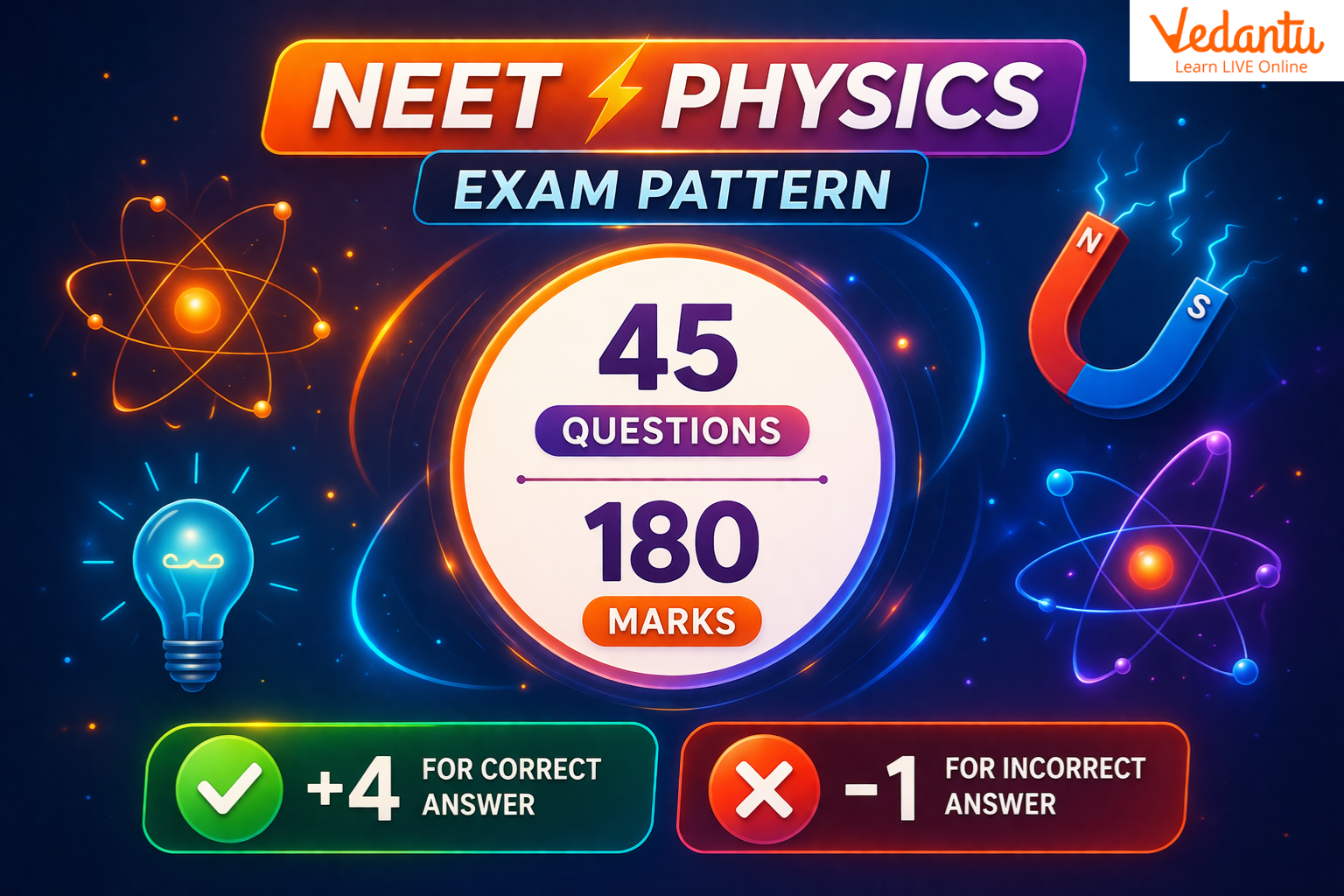

The NEET  Physics pattern includes 45 questions for 180 marks, where every correct answer gives +4 marks and every incorrect answer results in –1 mark. With the right preparation strategy and regular practice, Physics can become a scoring section in the NEET 2026 exam.


Also Visit: NEET Physics Syllabus 2026

Competitive Exams after 12th Science
tp-imag
bottom-arrow
tp-imag
bottom-arrow
tp-imag
bottom-arrow
tp-imag
bottom-arrow
tp-imag
bottom-arrow
tp-imag
bottom-arrow

NEET 2026 Physics Exam Pattern Overview

Understanding the NEET 2026 physics exam pattern helps aspirants clearly know how the Physics section is structured in the exam. The Physics part of NEET  follows a fixed format with multiple-choice questions, a standard marking scheme, and topics based mainly on the NCERT Class 11 and 12 syllabus. Knowing the NEET physics pattern allows students to prepare strategically and manage their time effectively during the exam.


NEET 2026 Physics Exam Pattern

Particulars

Details

Exam Name

National Eligibility cum Entrance Test (NEET -UG)

Section

Physics

Total Questions

45 Questions

Question Type

Multiple Choice Questions (MCQs)

Total Marks

180 Marks

Exam Mode

Offline (Pen and Paper)

Exam Duration

3 Hours (180 Minutes) for the entire NEET  paper

Subjects in Exam

Physics, Chemistry, Biology

Syllabus Coverage

Based on NCERT Class 11 and Class 12 Physics


Also Visit: NEET 2026 Exam Pattern


NEET Physics Question Pattern 2026 Key Highlights

The NEET physics question pattern focuses on conceptual understanding and numerical problem-solving. The section is designed to test students’ ability to apply formulas and physics principles.


Feature

Details

Total Physics Questions

45 (All compulsory)

Marks for Physics Section

180 Marks

Average Time Per Question

Around 1 minute

Difficulty Nature

Conceptual and numerical-based

Chapters Covered

Class 11 and Class 12 NCERT Physics

Major Topic Areas

Mechanics, Thermodynamics, Electrodynamics, Optics, Modern Physics


Physics NEET Chapter Wise Weightage Table


Important Note: The Physics chapter-wise weightage provided here is based on the analysis of previous years’ NEET  papers and exam trends. As the NEET  syllabus may change over time, students should always verify topics with the latest official syllabus and use this weightage only as a reference to understand important chapters.


Also Visit: NEET Physics Weightage 2026


NEET Physics Syllabus Focus Areas

Major Unit

Key Topics Included

Mechanics

Laws of Motion, Work, Energy, and Power, Rotational Motion

Thermodynamics

Heat, Thermodynamic Processes, Kinetic Theory

Electrodynamics

Electrostatics, Current Electricity, Magnetism

Optics

Ray Optics, Wave Optics

Modern Physics

Photoelectric Effect, Atomic Structure, Nuclear Physics


NEET Exam Pattern 2026 Marking Scheme

The NEET Physics pattern follows the same marking rules used across all subjects in the NEET exam. Accuracy is very important because incorrect answers lead to negative marking.


Response Type

Marks Awarded

Correct Answer

+4 Marks

Incorrect Answer

-1 Mark

Unanswered Question

0 Marks

Multiple Responses

-1 Mark


How Should Students Prepare for NEET 2026 Physics?

Preparing well for Physics requires understanding the NEET 2026 Physics exam pattern and practising questions based on the actual exam structure. Since Physics in NEET  focuses on conceptual clarity, numerical solving, and formula application, students should plan their preparation according to the NEET Physics pattern to improve both speed and accuracy.


  • Understand the exam structure first: Study the NEET 2026 Physics Exam pattern to know the number of questions, marks distribution, and marking scheme before starting your preparation.

  • Focus on NCERT concepts: Most questions in the NEET Physics question pattern are based on the NCERT Class 11 and 12 syllabus, so building strong fundamentals is essential.

  • Practice numerical problems regularly: Physics requires problem-solving skills, so practising numerical questions daily helps improve accuracy.

  • Solve previous year NEET  papers: Analysing past questions helps students understand the NEET  physics pattern and identify frequently tested concepts.

  • Create formula revision notes: Maintain a separate notebook for formulas, derivations, and important concepts for quick revision before the exam.

  • Take mock tests frequently: Full-length mock tests help students get familiar with the NEET  Physics question pattern and improve time management.

  • Strengthen conceptual clarity: Focus on understanding the logic behind formulas and physical principles instead of rote memorisation.


By preparing strategically and practising according to the exam structure, students can perform confidently and score well in the Physics section of NEET.


Essential Study Materials for NEET  UG Success

FAQs on NEET 2026 Physics Exam Pattern, Total No. of Questions, and Marking Scheme

1. What is the Physics portion of NEET 2026?

The Physics section in NEET 2026 is based on the NCERT syllabus of Class 11 and Class 12 and focuses on core concepts and numerical problem-solving. Major topics include Mechanics, Electromagnetism, Optics, Thermodynamics, and Modern Physics. Understanding the NEET 2026 physics exam pattern helps students know how questions are structured and which areas require strong conceptual clarity.

2. Which chapters are removed from NEET 2026 Physics?

Some introductory topics related to the scope of physics, nature of physical laws, physics and society, and basic measurement concepts, such as accuracy and precision of instruments, have been removed from the updated syllabus. Students should always check the latest official syllabus before preparing to ensure they are studying the correct topics.

3. How to score 170+ in Physics NEET 2026?

Scoring 170+ marks in Physics requires a combination of conceptual understanding and consistent practice. Students should:

  • Build strong fundamentals from NCERT Class 11 and 12 Physics

  • Practise previous year NEET  questions and mock tests

  • Focus on high-weightage chapters like Electrostatics, Current Electricity, Optics, and Modern Physics

  • Maintain a formula notebook and revise regularly

  • Analyse mistakes after solving practice papers

Preparing according to the NEET physics pattern helps students understand the level of questions and improve accuracy during the exam.

4. How many questions are asked in NEET  Physics 2026?

The Physics section in NEET  consists of 45 multiple-choice questions, carrying a total of 180 marks. Each correct answer gives +4 marks, while each incorrect answer leads to –1 mark.

5. What is the marking scheme for the NEET  Physics section?

The marking scheme follows the standard NEET  rule: +4 marks for correct answers, –1 mark for incorrect answers, and 0 marks for unanswered questions. This marking system applies to the entire exam.

6. Is Physics difficult in NEET 2026?

Physics is often considered the most challenging subject in NEET  because it involves numerical calculations and conceptual problem-solving. However, with regular practice and a clear understanding of formulas, many students find it manageable.

7. What are the most important topics in NEET Physics?

Some of the most frequently tested areas include Electrostatics, Current Electricity, Optics, Thermodynamics, and Modern Physics. These topics often carry multiple questions in the exam.

8. Is solving previous year papers enough for NEET Physics?

Practising previous year papers is very helpful because it allows students to understand the NEET Physics question pattern and identify recurring concepts. However, students should also revise theory and solve additional practice questions for complete preparation.
