








Kinematics: Basic and Advanced Concepts in Physics
Kinematics is the branch of physics that describes the motion of objects without discussing the forces that cause that motion. It focuses on measurable quantities such as position, displacement, distance, speed, velocity, acceleration, and time. In NEET Physics, kinematics is one of the most fundamental chapters because it forms the base for mechanics, laws of motion, work energy power, circular motion, and projectile motion.
Why is Kinematics Important for NEET?
Kinematics is important for NEET because many direct formula-based, graph-based, and concept-based questions are asked from this unit. A strong understanding of graphs, equations of motion, vectors, relative velocity, and projectile motion helps students solve both simple and advanced problems more accurately. The chapter also helps students build confidence in later topics of Physics. This page covers straight-line motion, motion in a plane, graphs, vectors, uniformly accelerated motion, relative velocity, projectile motion, and uniform circular motion in one place.
Frame of Reference
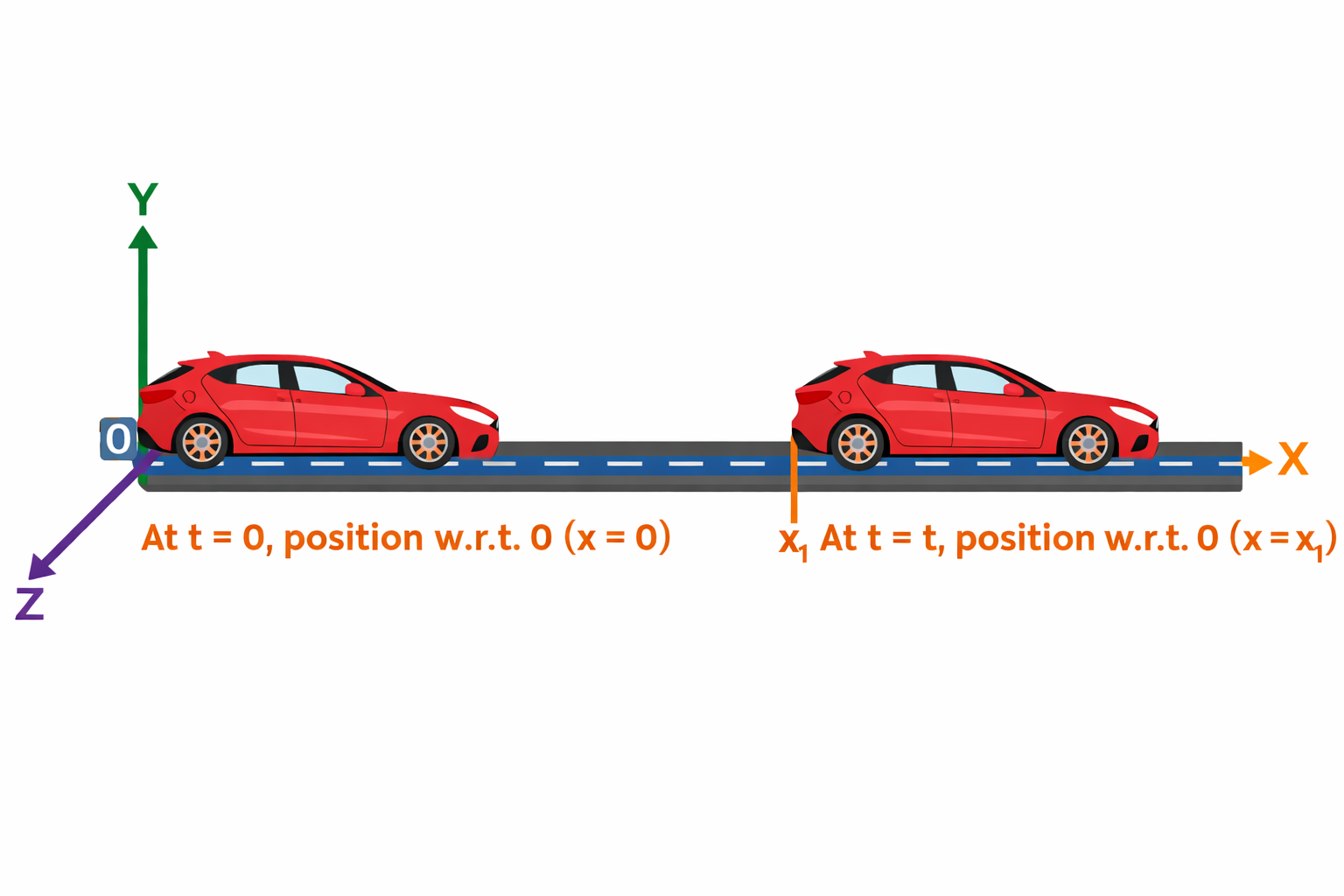
A frame of reference is a point or coordinate system with respect to which the position and motion of an object are described. Motion and rest are relative, which means the same object may appear at rest in one frame and in motion in another. For example, a passenger sitting in a moving bus is at rest with respect to the bus but in motion with respect to the road. In most basic NEET problems, the ground is taken as the standard frame of reference unless another frame is specified.
Rest and Motion
A body is said to be at rest if its position does not change with time with respect to a chosen frame of reference. A body is said to be in motion if its position changes with time. Since rest and motion depend on the observer’s frame of reference, both are relative terms.
Types of Motion
One-dimensional motion is motion along a straight line. In this case, the object moves only in one direction, such as a car moving on a straight road.
Two-dimensional motion is motion in a plane. In this type of motion, the object moves in two directions at the same time, such as projectile motion.
Three-dimensional motion is motion in space where the object can move in all three directions, such as the motion of an aeroplane.
Position and Position Vector
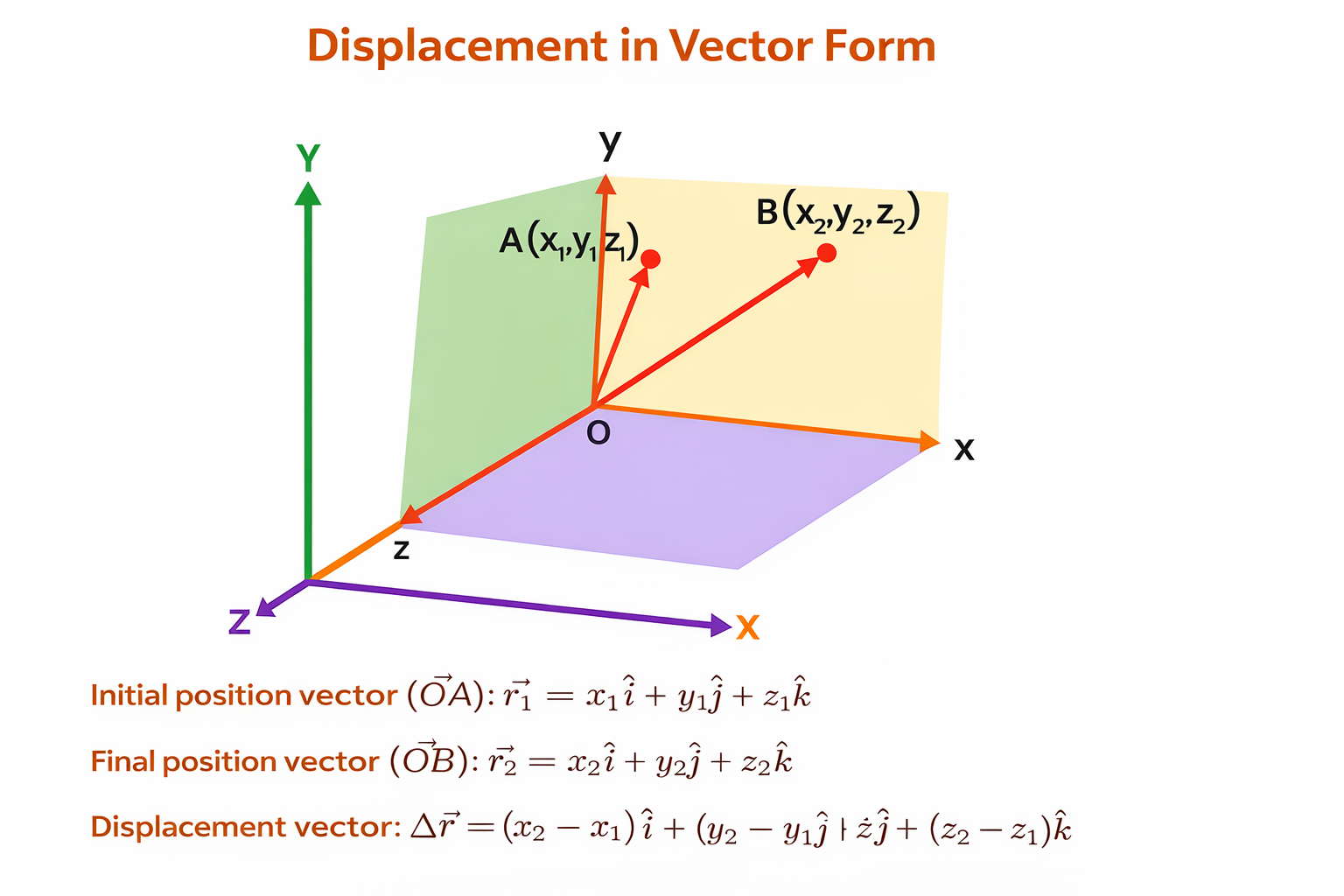
The position of a particle tells us where the object is located at a particular instant of time. When position is represented with direction from the origin, it is called the position vector. A position vector always points from the origin to the location of the particle. It is useful in vector treatment of motion, especially in motion in a plane and relative velocity problems.
Also Read: Addition of Vector
Motion in a Straight Line
Motion in a straight line is also called one-dimensional motion. Here, the object moves only along one axis, usually the x-axis. Many basic NEET questions are based on this form of motion because it introduces distance, displacement, speed, velocity, acceleration, equations of motion, and motion graphs in the simplest form.
Distance and Displacement
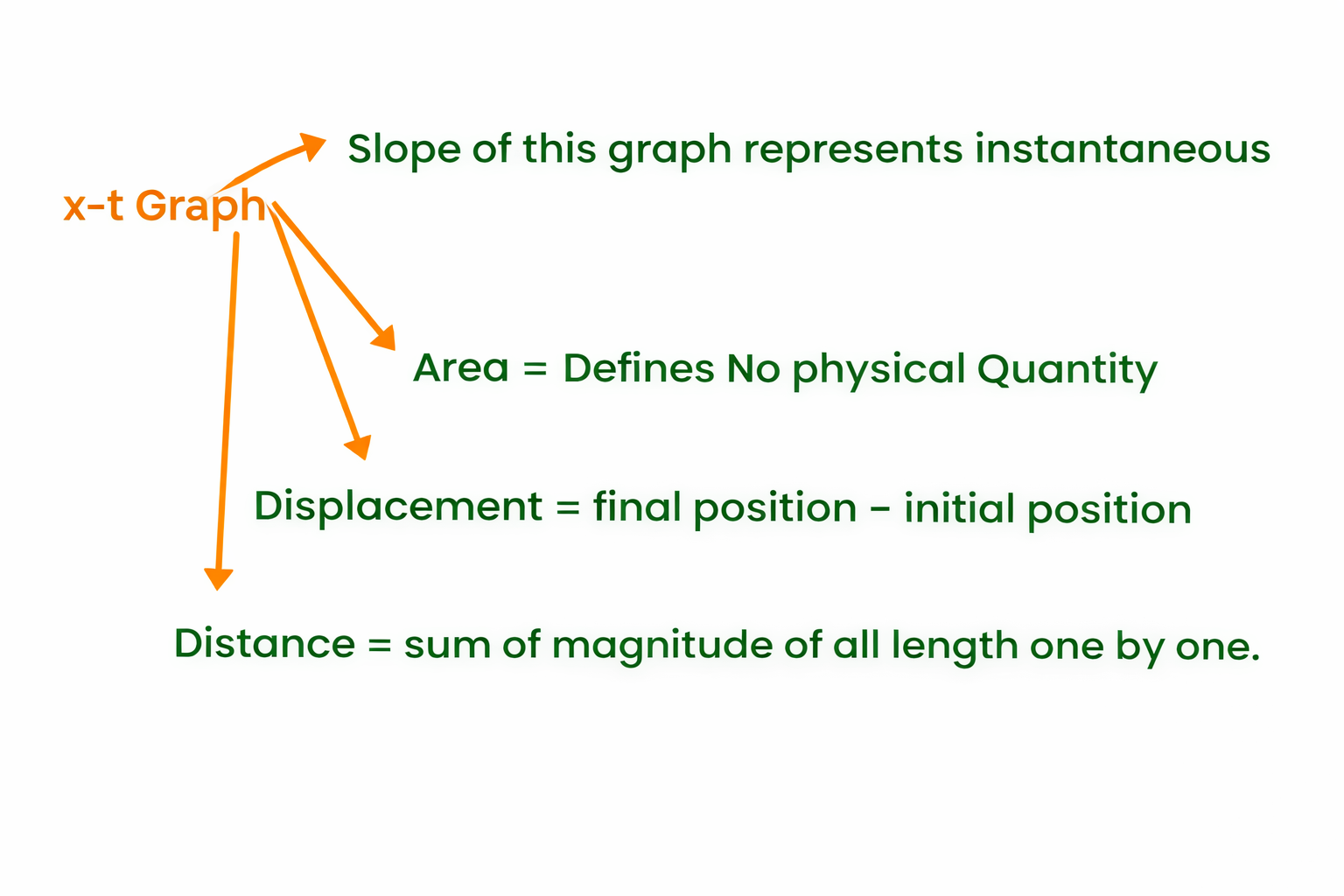
Distance is the total path length travelled by an object. It is a scalar quantity, so it has only magnitude and no direction. Distance depends on the actual path followed and is always positive.
Displacement is the shortest straight-line distance between the initial position and the final position of the object. It is a vector quantity, so it has both magnitude and direction. Displacement depends only on the starting point and ending point, not on the actual path followed. The magnitude of displacement is always less than or equal to distance.
Speed and Velocity
Speed is the rate of change of distance with time. Since distance is a scalar quantity, speed is also scalar. It tells how fast an object is moving but does not tell the direction of motion.
Velocity is the rate of change of displacement with time. Since displacement is a vector quantity, velocity is also vector. Velocity gives both speed and direction of motion. A body may have constant speed but changing velocity if its direction changes.
Uniform and Non-uniform Motion
If a body covers equal distances in equal intervals of time, it is said to be in uniform motion. In this case, the speed remains constant.
If a body covers unequal distances in equal intervals of time, or equal distances in unequal intervals of time, it is said to be in non-uniform motion. In this case, the speed changes with time.
Average Speed and Instantaneous Speed
Average speed is defined as the total distance travelled divided by the total time taken.
Average speed = Total distance / Total time
It is useful when the speed of an object changes during motion.
Instantaneous speed is the speed of a body at a particular instant of time. It is what a speedometer shows at any given moment.
Average Velocity and Instantaneous Velocity
Average velocity is defined as total displacement divided by total time taken.
Average velocity = Total displacement / Total time
The direction of average velocity is the same as the direction of displacement.
Instantaneous velocity is the velocity of a body at a particular instant of time. It can be found using the slope of the position-time graph at that point or by calculus in advanced treatment.
Acceleration
Acceleration is the rate of change of velocity with time. Since velocity is a vector quantity, acceleration is also a vector quantity.
Acceleration = Change in velocity / Time taken
Acceleration can occur when the speed changes, when the direction changes, or when both speed and direction change together. If acceleration acts opposite to velocity, the speed decreases and the motion is called retardation or deceleration.
Uniformly Accelerated Motion
When the acceleration of a body remains constant throughout the motion, the body is said to be in uniformly accelerated motion. This is one of the most important concepts in kinematics because the three standard equations of motion apply only in this case.
Relations for Uniformly Accelerated Motion
The three equations of motion for constant acceleration are:
v = u + at
s = ut + 1/2 at²
v² = u² + 2as
Here,
u = initial velocity
v = final velocity
a = acceleration
t = time
s = displacement
These equations are widely used in straight-line motion, free-fall motion, vertical motion, and basic projectile motion components.
Important Notes on Velocity and Acceleration
If velocity and acceleration are in the same direction, speed increases.
If velocity and acceleration are in opposite directions, speed decreases.
If velocity and acceleration are perpendicular to each other, the speed may remain constant but the direction changes. This idea becomes very important in circular motion.
Position-Time Graph
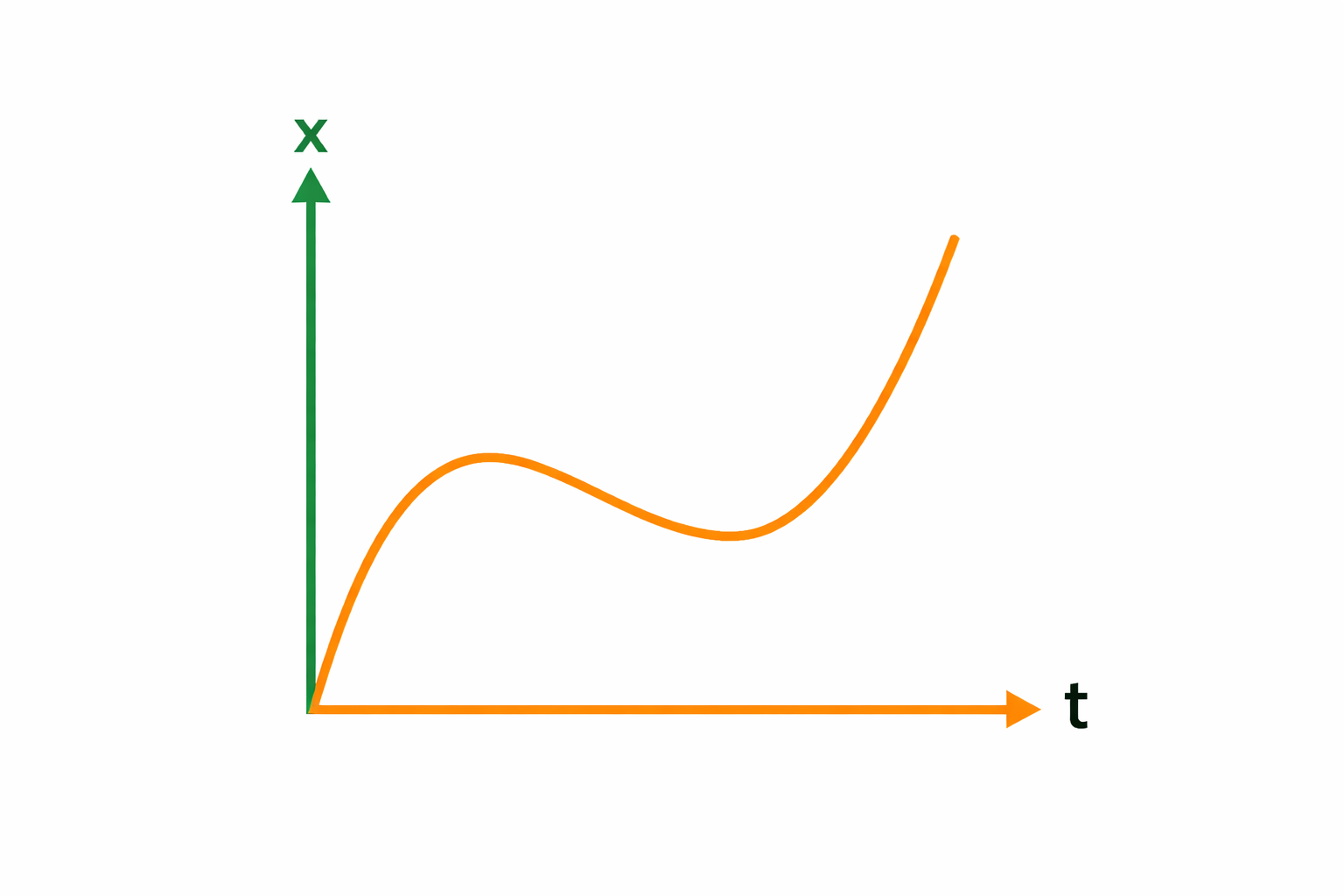
A position-time graph shows how the position of an object changes with time.
If the graph is a horizontal straight line, the object is at rest.
If the graph is a straight line with positive slope, the object is moving with constant positive velocity.If the graph is a straight line with negative slope, the object is moving with constant negative velocity.
If the graph is curved, the velocity is changing, so the motion is non-uniform.The slope of a position-time graph gives velocity. A steeper slope means greater velocity. This is one of the most common graphical ideas in NEET.
Velocity-Time Graph
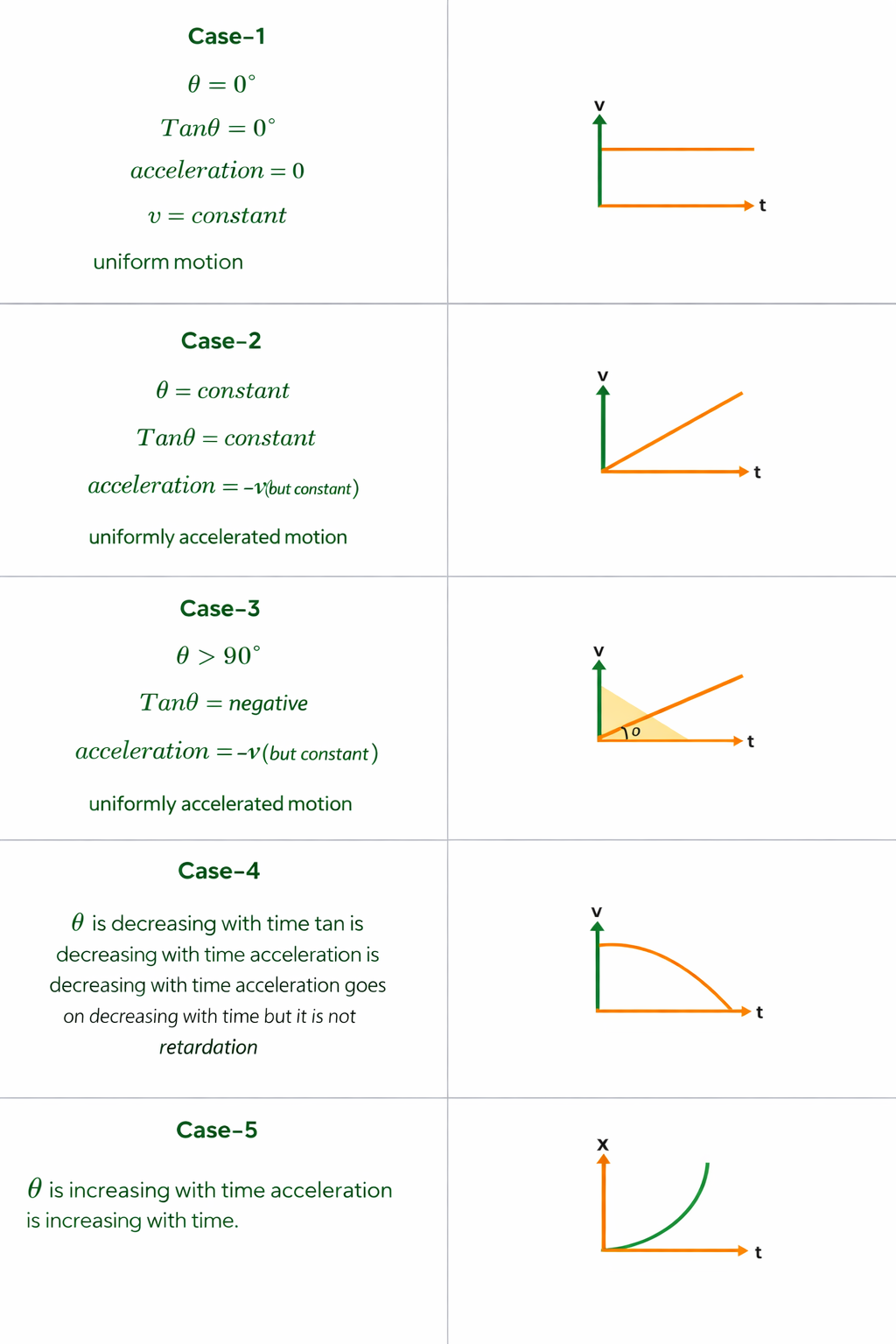
A velocity-time graph shows how velocity changes with time.
The slope of a velocity-time graph gives acceleration.
The area under a velocity-time graph gives displacement.If the graph is horizontal, the acceleration is zero and the motion is uniform.
If the graph is a straight line with positive slope, the body has uniform positive acceleration.
If the graph slopes downward, the body has negative acceleration or retardation.
Acceleration-Time Graph
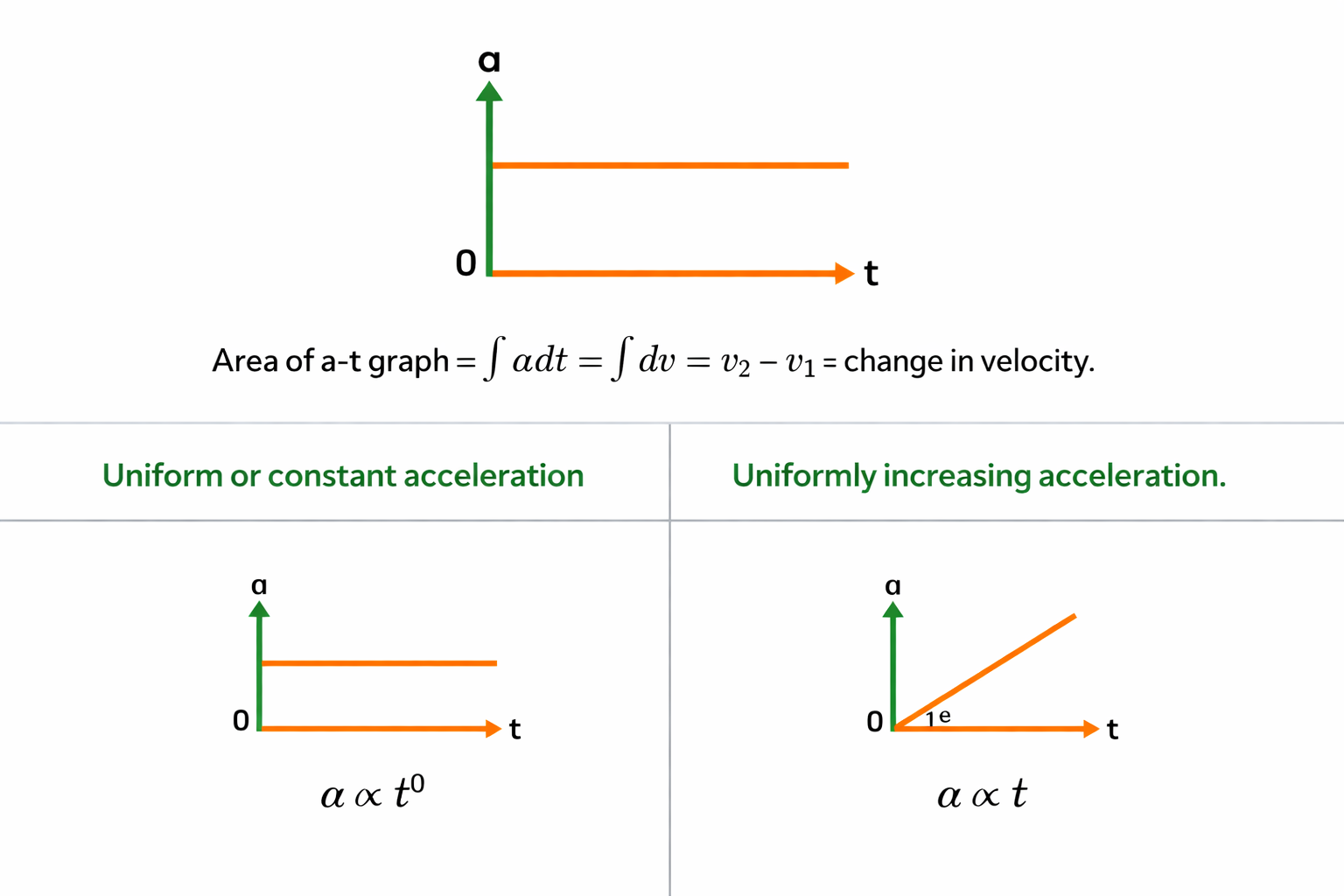
An acceleration-time graph shows how acceleration changes with time.
The area under the acceleration-time graph gives change in velocity.
If the graph is horizontal, the acceleration is constant.
If the graph changes with time, the acceleration is non-uniform.
Scalars and Vectors
A scalar quantity has only magnitude and no direction. Examples include mass, distance, speed, time, energy, and temperature.
A vector quantity has both magnitude and direction. Examples include displacement, velocity, acceleration, force, and momentum.
This distinction is extremely important in kinematics because speed is scalar but velocity is vector, and many NEET errors happen when students mix them up.
Vector Addition and Subtraction
Vectors can be added using the triangle law or parallelogram law. When two vectors act at an angle, their resultant is found by resolving them into components or by applying vector formulas.
Vector subtraction can be done by adding the negative of a vector. In simple terms, subtracting a vector means adding a vector of the same magnitude in the opposite direction.
Vector operations are required in motion in a plane, relative velocity, projectile motion, and circular motion.
Unit Vector
A unit vector is a vector that has magnitude equal to 1 and is used only to represent direction. It helps express a vector compactly in coordinate form.
For example, i cap is the unit vector along the x-axis and j cap is the unit vector along the y-axis.
If a vector A has magnitude A, then its unit vector is A vector divided by magnitude A.
Resolution of a Vector
Resolution of a vector means splitting a vector into components along chosen axes. In two dimensions, a vector is usually resolved into horizontal and vertical components.
If a vector A makes an angle theta with the x-axis, then
Ax = A cos theta
Ay = A sin theta
Resolution of vectors is essential for projectile motion, relative velocity, inclined motion, and many NEET numericals.
Scalar Product and Vector Product
The scalar product, also called dot product, of two vectors is
A dot B = AB cos theta
The result is a scalar quantity. It is useful in work, projection, and angle-based vector relations.
The vector product, also called cross product, of two vectors is
A cross B = AB sin theta
The result is a vector quantity. It is useful in rotational motion, torque, and angular momentum, though the basic concept should be understood during vector preparation.
Motion in a Plane
Motion in a plane is two-dimensional motion. In this type of motion, the object moves simultaneously along two perpendicular directions, usually the x-axis and y-axis. The greatest advantage in solving such problems is that the two motions can be studied independently.
For example, in projectile motion:
Horizontal motion is uniform because no horizontal acceleration acts.
Vertical motion is accelerated because gravity acts downward.
This idea makes projectile problems much easier to solve.
Projectile Motion
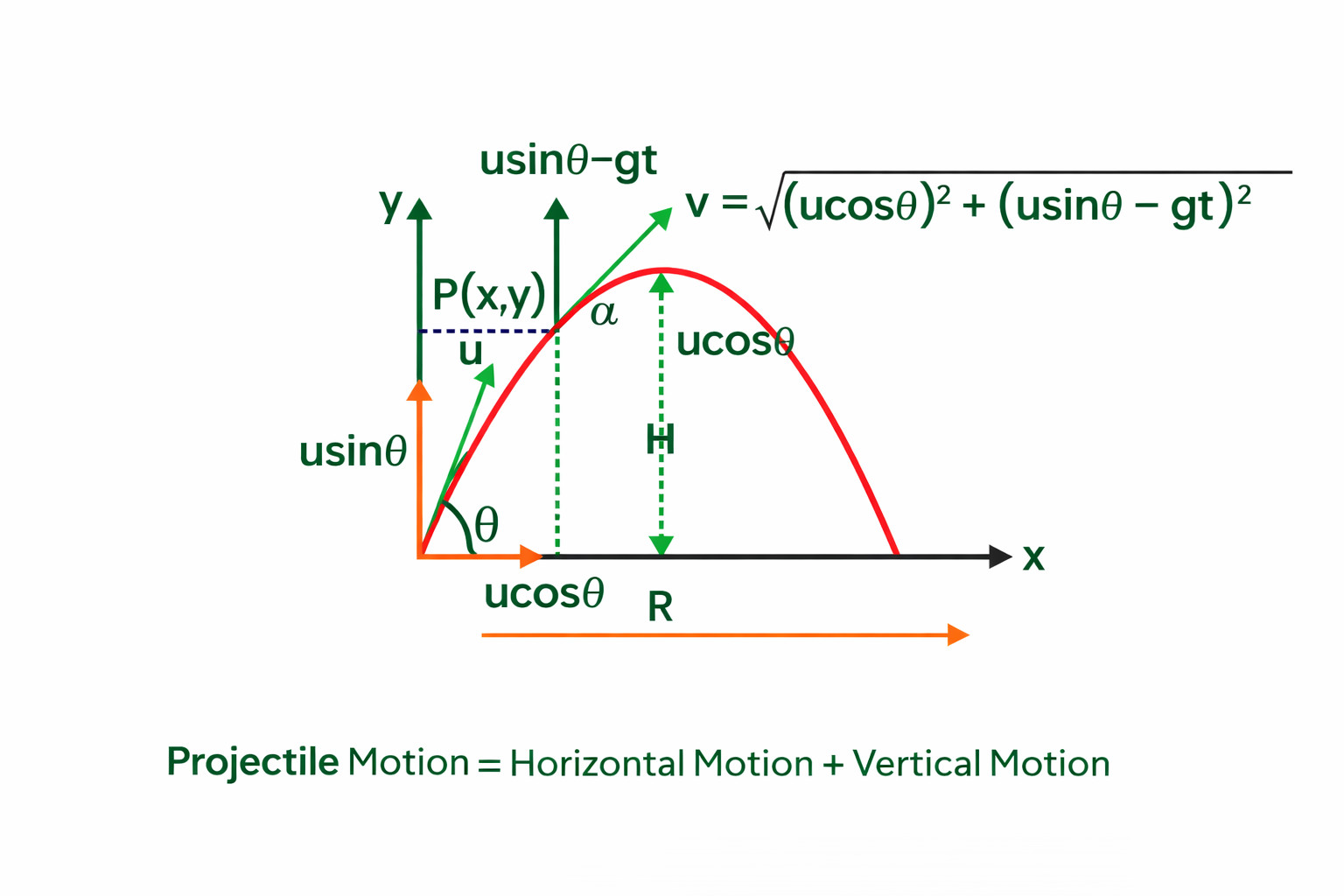
Projectile motion is the motion of a body projected into the air that moves under the influence of gravity alone. Its path is parabolic. In projectile motion, the initial velocity has both horizontal and vertical components, while acceleration acts only vertically downward due to gravity.
Components of Projectile Motion
Horizontal component of velocity = u cos theta
Vertical component of velocity = u sin theta
Horizontal acceleration = 0
Vertical acceleration = g downward
Horizontal displacement = u cos theta × t
Vertical displacement = u sin theta × t - 1/2 gt²
Projectile motion is best understood as the combination of uniform horizontal motion and uniformly accelerated vertical motion.
Important Results for Projectile Motion
Time of flight:
T = 2u sin theta / g
Maximum height:
H = u² sin² theta / 2g
Horizontal range:
R = u² sin 2theta / g
Maximum range occurs when theta = 45 degrees. These formulas are among the most important direct-result formulas for NEET.
Uniform Circular Motion
When an object moves along a circular path with constant speed, the motion is called uniform circular motion. Even though the speed remains constant, the velocity changes continuously because its direction keeps changing. Therefore, the object is accelerated.
The acceleration in uniform circular motion is called centripetal acceleration and always acts towards the centre of the circle.
Centripetal acceleration:
a = v² / r
Uniform circular motion is an important example that proves acceleration can exist even when speed remains constant.
Relative Velocity
Relative velocity is the velocity of one object as observed from another moving object. If the velocity of object A is vA and the velocity of object B is vB, then the velocity of A with respect to B is
vAB = vA - vB
If two objects move in the same direction, relative velocity is the difference of their speeds.
If two objects move in opposite directions, relative velocity is the sum of their speeds.
Relative velocity is very important in NEET because it appears in train problems, rain-man problems, and river-boat problems.
Rain-Man Concept
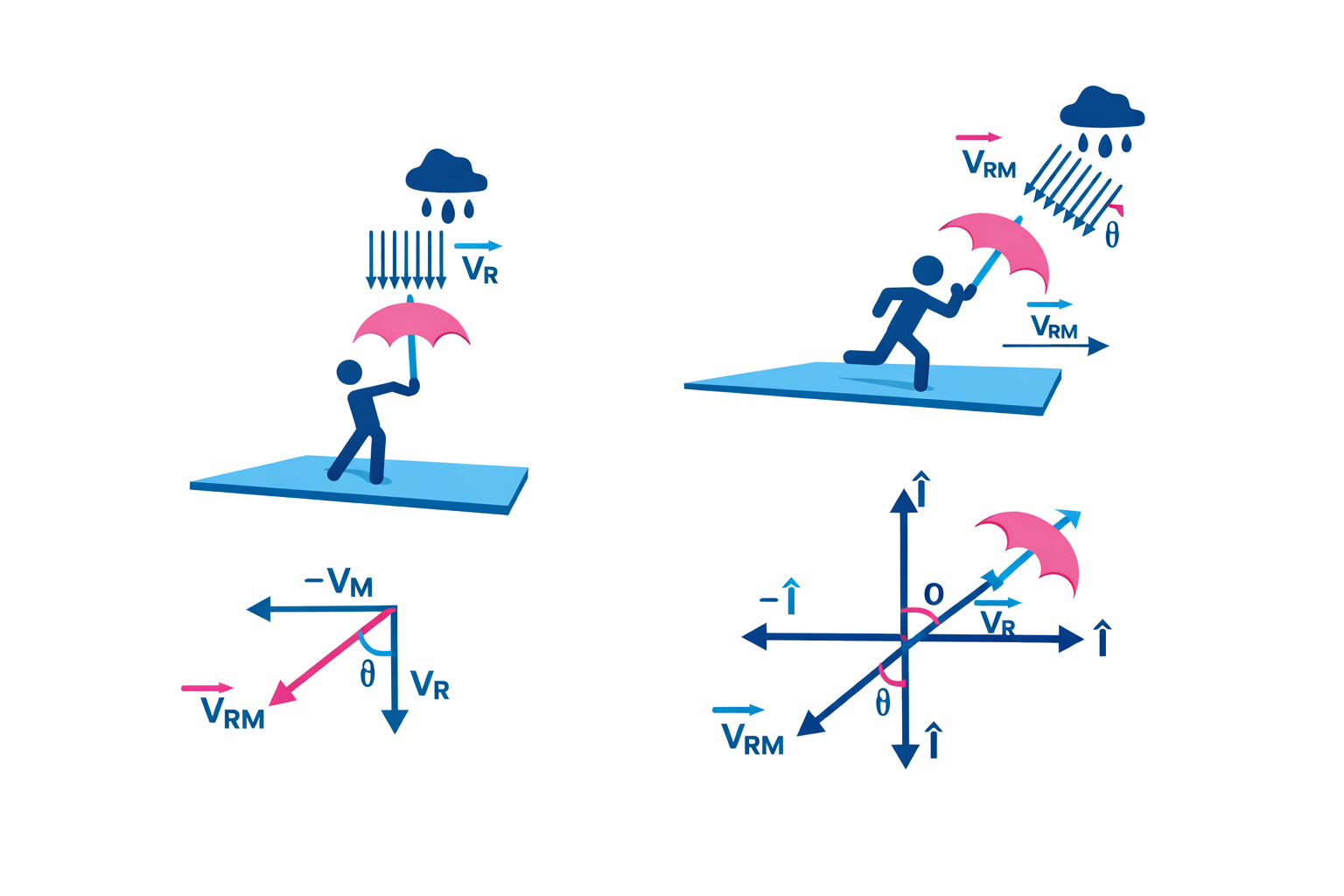
In rain-man problems, the apparent direction of rain changes for a moving observer. If rain falls vertically and the observer moves horizontally, then the rain appears to fall at an angle. This is a direct application of relative velocity.
These questions test both understanding of relative motion and vector subtraction.
River-Boat Problems
In river-boat problems, the swimmer or boatman has one velocity with respect to water, while the river current has another velocity with respect to the ground. The actual velocity of the swimmer or boat with respect to the ground is found by vector addition.
These problems are commonly asked in two forms:
minimum time to cross the river
shortest path across the river
Both depend on correct resolution of velocity components.
Motion Under Gravity
Motion under gravity is a special case of uniformly accelerated motion where acceleration is due to gravity alone.
For bodies moving vertically:
a = g downward
If upward is taken positive, then acceleration becomes negative.
If downward is taken positive, then acceleration becomes positive.
The equations of motion remain the same, but the sign convention must be used carefully. Free-fall, vertical upward projection, and body dropped from a height are all applications of this concept.
Vertical Motion Formula Highlights
For a body projected upward with initial velocity u:
v = u - gt
h = ut - 1/2 gt²
v² = u² - 2gh
Maximum height:
H = u² / 2g
Time to reach maximum height:
t = u / g
Total time of flight:
T = 2u / g
These results are frequently used in graph questions and one-mark formula questions.
Most Important Formulas from Kinematics for NEET
Average speed = total distance / total time
Average velocity = total displacement / total time
Acceleration = change in velocity / time
v = u + at
s = ut + 1/2 at²
v² = u² + 2asHorizontal range of projectile = u² sin 2theta / g
Maximum height of projectile = u² sin² theta / 2g
Time of flight of projectile = 2u sin theta / g
Centripetal acceleration = v² / r
Relative velocity = vA - vB
Solved Examples on Kinematics
Example 1: Average Speed in Straight Line Motion
A student walks 120 m in 2 minutes and then runs 180 m in 1 minute. Find the average speed for the entire journey.
Solution:
Total distance travelled = 120 + 180 = 300 m
Total time taken = 2 min + 1 min = 3 min = 180 s
Average speed = Total distance / Total time
= 300 / 180
= 1.67 m/s
Answer: The average speed is 1.67 m/s.
Example 2: Displacement and Distance
A particle moves 5 m east, then 12 m west. Find the distance travelled and displacement.
Solution:
Distance travelled = 5 + 12 = 17 m
For displacement, take east as positive:
Displacement = 5 - 12 = -7 m
The negative sign shows the final displacement is towards west.
Answer:
Distance = 17 m
Displacement = 7 m west
Example 3: Using Equations of Uniformly Accelerated Motion
A car starts from rest and accelerates uniformly at 2 m/s² for 5 seconds. Find:
Final velocity
Distance travelled
Solution:
Given:
u = 0
a = 2 m/s²
t = 5 s
Final velocity:
v = u + at
= 0 + 2 × 5
= 10 m/s
Distance travelled:
s = ut + 1/2 at²
= 0 + 1/2 × 2 × 5²
= 25 m
Answer:
Final velocity = 10 m/s
Distance travelled = 25 m
Also Read:
Common Mistakes Students Make in Kinematics
Students often confuse distance with displacement and speed with velocity.
They sometimes use equations of motion even when acceleration is not constant.
Many graph questions go wrong because slope and area interpretations are mixed up.
In projectile motion, students often forget that horizontal acceleration is zero.
In relative velocity problems, wrong sign convention or wrong vector direction leads to incorrect answers.
In vertical motion, choosing the wrong positive direction causes avoidable mistakes. These are recurring conceptual gaps visible in the reference material’s core topics, so a cleaner explanation helps reduce confusion.
Most Important NEET 2027 Topics Physics
FAQs on Kinematics for NEET: Definition, Formulas, Graphs, Motion in a Straight Line, Projectile Motion, Relative Velocity and Circular Motion
1. What is Kinematics?
Kinematics is the area of physics that explains how objects move without focusing on the forces responsible for that motion.
2. Define Rest and Motion.
Rest: A body is said to be at rest when its position remains unchanged with time.
3. What is a Position vector?
A position vector describes the location of a particle with respect to a fixed reference point, usually the origin. It is directed from the reference point to the particle and helps represent the particle’s exact position in space.
4. What is Displacement?
Displacement is the shortest straight-line separation between the starting point and the ending point of a particle, along with its direction.
5. What are the most important topics in Kinematics for NEET?
The most important topics in Kinematics for NEET include motion in a straight line, speed and velocity, acceleration, equations of motion, motion in a plane, projectile motion, relative velocity, vectors, and uniform circular motion.
6. Is Kinematics an easy chapter for NEET?
Kinematics is usually considered one of the easier and more scoring chapters in NEET Physics because it is formula-based and builds the base for many other mechanics chapters.
7. How many questions can come from Kinematics in NEET?
The number can vary each year, but students can generally expect one to three questions directly or indirectly from Kinematics and its connected vector concepts.
8. What is the difference between speed and velocity in Kinematics?
Speed tells how fast a body moves and has only magnitude, while velocity gives both magnitude and direction because it is based on displacement.
