






Maths Class 7 Chapter 13 Questions and Answers - Free PDF Download
Exercise 13.3
1. What cross-sections do you get when you are given the following solids?
(i) vertical cut
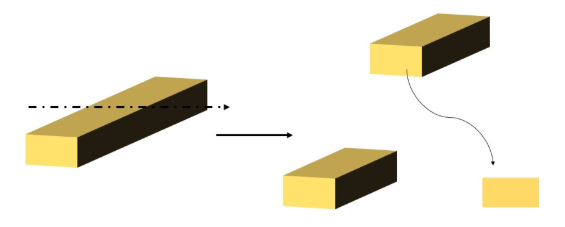
(a) A Brick
Ans: When a brick is cut vertically then, it is shown as below
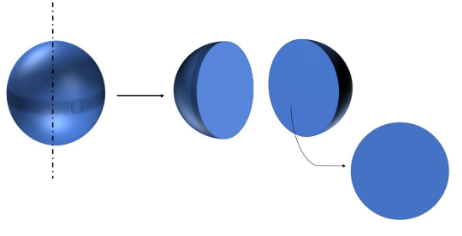
(b) A round apple
Ans: When a round apple is cut vertically then, it is shown as below
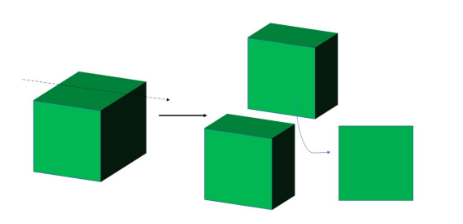
(c) A die
Ans: When a die is cut vertically then, it is shown as below
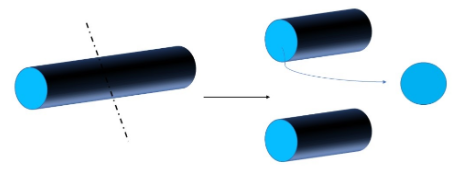
(d) A particular pipe
Ans: When a particular pipe is cut vertically then, it is shown as below
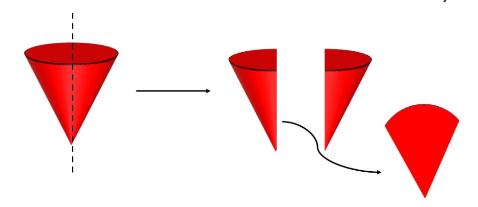
(e) An ice cream cone
Ans: When an ice cream cone is cut vertically then, it is shown as below
(ii) Horizontal cut
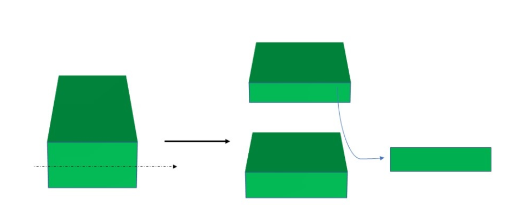
(a) A brick
Ans: When a brick cone is cut horizontally then, it is shown as below
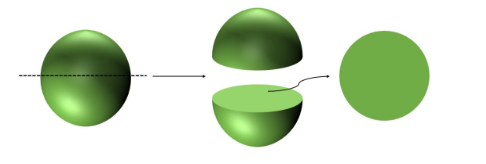
(b) A round apple
Ans: When a round apple cone is cut horizontally then, it is shown as below
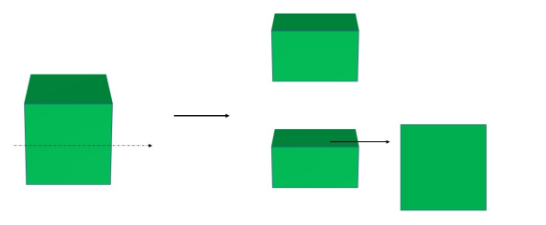
(c) A die
Ans: When a die is cut horizontally then, it is shown as below
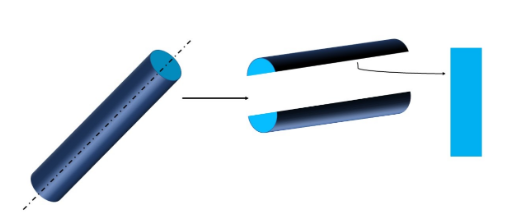
(d) A particular pipe
Ans: When a particular pipe is cut horizontally then, it is shown as below
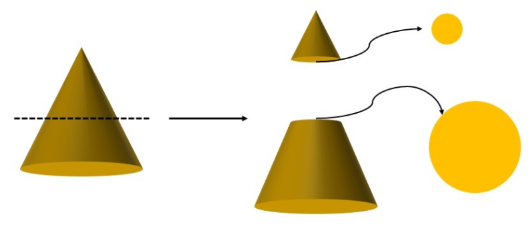
(e) An ice cream cone
Ans: When an ice cream cone is cut horizontally then, it is shown as below
NCERT Solutions for Class 7 Maths Chapter 13 Visualising Solid Shapes Exercise 13.3
Opting for the NCERT solutions for Ex 13.3 Class 7 Maths is considered as the best option for the CBSE students when it comes to exam preparation. This chapter consists of many exercises. Out of which we have provided the Exercise 13.3 Class 7 Maths NCERT solutions on this page in PDF format. You can download this solution as per your convenience or you can study it directly from our website/ app online.
Vedantu in-house subject matter experts have solved the problems/ questions from the exercise with the utmost care and by following all the guidelines by CBSE. Class 7 students who are thorough with all the concepts from the Subject Visualising Solid Shapes textbook and quite well-versed with all the problems from the exercises given in it, then any student can easily score the highest possible marks in the final exam. With the help of this Class 7 Maths Chapter 13 Exercise 13.3 solutions, students can easily understand the pattern of questions that can be asked in the exam from this chapter and also learn the marks weightage of the chapter. So that they can prepare themselves accordingly for the final exam.
Besides these NCERT solutions for Class 7 Maths Chapter 13 Exercise 13.3, there are plenty of exercises in this chapter which contain innumerable questions as well. All these questions are solved/answered by our in-house subject experts as mentioned earlier. Hence all of these are bound to be of superior quality and anyone can refer to these during the time of exam preparation. In order to score the best possible marks in the class, it is really important to understand all the concepts of the textbooks and solve the problems from the exercises given next to it.
Do not delay any more. Download the NCERT solutions for Class 7 Maths Chapter 13 Exercise 13.3 from Vedantu website now for better exam preparation. If you have the Vedantu app in your phone, you can download the same through the app as well. The best part of these solutions is these can be accessed both online and offline as well.
Class 7 Maths Chapter 13: Exercises Breakdown
CBSE Class 7 Maths Chapter 13 Other Study Materials
Chapter-Specific NCERT Solutions for Class 7 Maths
Given below are the chapter-wise NCERT Solutions for Class 7 Maths. Go through these chapter-wise solutions to be thoroughly familiar with the concepts.
Important Related Links for NCERT Class 7 Maths
Access these essential links for NCERT Class 7 Maths, offering comprehensive solutions, study guides, and additional resources to help students master language concepts and excel in their exams.

FAQs on NCERT Solutions For Class 7 Maths Chapter 13 Visualising Solid Shapes Exercise 13.3 - 2026-27 Free PDF Download (Sign-in Required)
1. Where can I find accurate, step-by-step NCERT Solutions for Class 7 Maths Chapter 13 for the 2025-26 session?
You can find detailed and accurate NCERT Solutions for Class 7 Maths Chapter 13, Visualising Solid Shapes, on Vedantu's platform. These solutions are prepared by subject matter experts and are fully aligned with the latest CBSE 2025-26 syllabus, providing step-by-step guidance for every question in the textbook exercises.
2. What is the correct method to identify the top, front, and side views of solid shapes as per the NCERT exercises?
The correct method to identify the different views of a solid shape involves imagining yourself looking at the object from specific positions:
- For the top view, you must look directly down at the object from above.
- For the front view, you must look at the object from the front.
- For the side view, you must look at the object from one of its sides (left or right).
3. How do you correctly draw 3D shapes on isometric dot paper as required in NCERT Class 7 Maths Chapter 13?
To correctly draw 3D shapes on isometric dot paper, you should follow the method outlined in the NCERT solutions. Start by drawing the front face of the object. Then, draw lines moving backwards and upwards from the vertices of the front face to represent the depth. The key is to keep the lines representing the length, breadth, and height aligned with the dots to maintain the correct proportions and create an accurate isometric sketch.
4. How is Euler's formula (F + V - E = 2) applied to solve problems in Chapter 13?
Euler's formula is applied to problems involving polyhedrons (solid shapes with flat faces). The step-by-step application is:
1. Identify the number of Faces (F), Vertices (V), and Edges (E) of the given solid.
2. Substitute the known values into the formula F + V - E = 2.
3. If one of the values is unknown, rearrange the formula to solve for it. For example, to find faces, you would use F = 2 - V + E. This formula is a reliable way to verify the properties of a polyhedron or find a missing value.
5. Why is it important to learn about the nets of solids in Chapter 13?
Understanding the net of a solid is fundamentally important because it connects 2D geometry with 3D shapes. A net is the 2D pattern that can be folded to form a 3D solid. This concept is not just for visualising the shape but is a crucial foundation for later chapters on Mensuration. By understanding how a shape unfolds into its net, you can more easily calculate its total surface area in higher classes.
6. Can Euler's formula be used for all 3D shapes? What are its limitations according to the NCERT syllabus?
No, Euler's formula cannot be used for all 3D shapes. A critical limitation highlighted in the NCERT syllabus is that the formula F + V - E = 2 is valid only for polyhedrons—which are solid shapes with flat polygonal faces, straight edges, and sharp corners (vertices). It does not apply to shapes with curved surfaces, such as spheres, cones, or cylinders, as these do not have faces, edges, and vertices in the same sense.
7. What is the difference between an isometric sketch and an oblique sketch, and why are both taught in this chapter?
The primary difference lies in their construction and appearance:
- An isometric sketch is drawn on isometric dot paper, and it shows the object's measurements proportionally. The angles between the axes appear as 120 degrees.
- An oblique sketch is drawn on squared paper. The front face is drawn true to size, but the depth lines are drawn at a 45-degree angle and are not necessarily proportional.
