



Step-by-Step NCERT Answers for Class 5 Maths Chapter 9 with Exam Tips
NCERT Textbook Page 119
Think and answer
Solution:
35 ÷ 1 = 35
Write the appropriate multiplication fact for the array shown below. Write two division facts that follow from the multiplication fact.
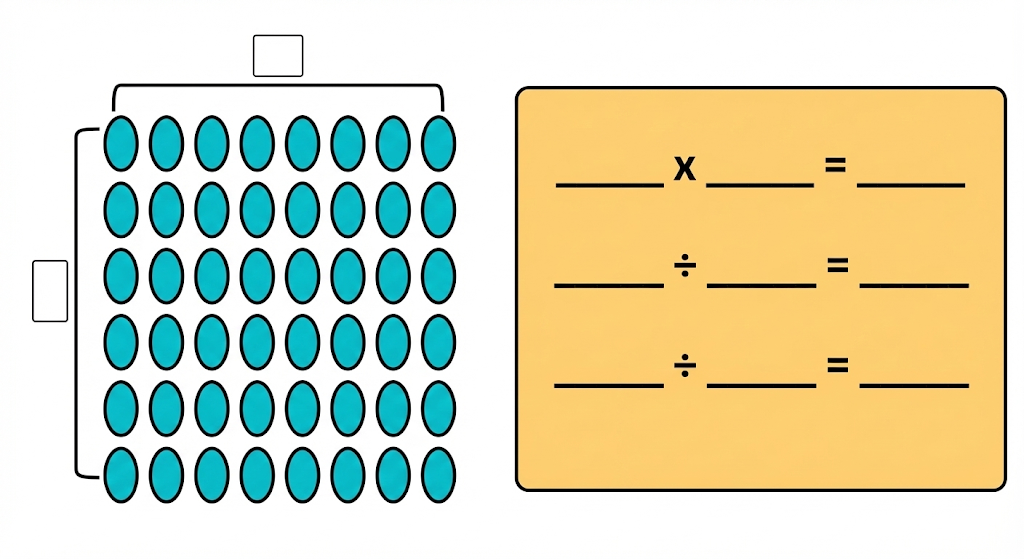
Solution:
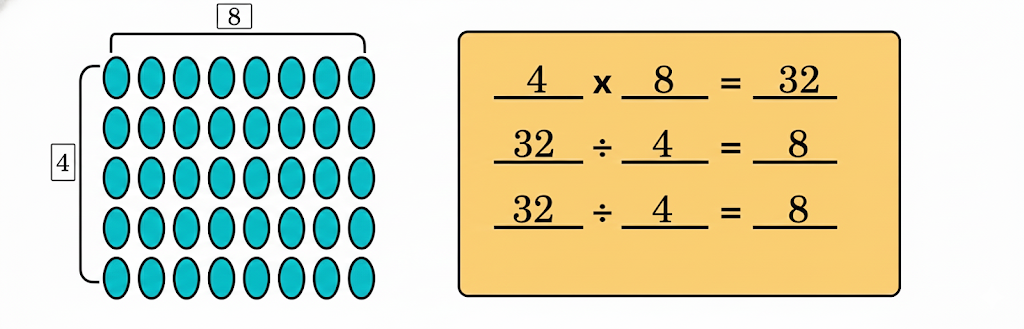
NCERT Textbook Page 120
Let us Play
Identify the numbers that can fill the circles such that the numbers in the squares are the products or the quotients of the numbers in the circles.
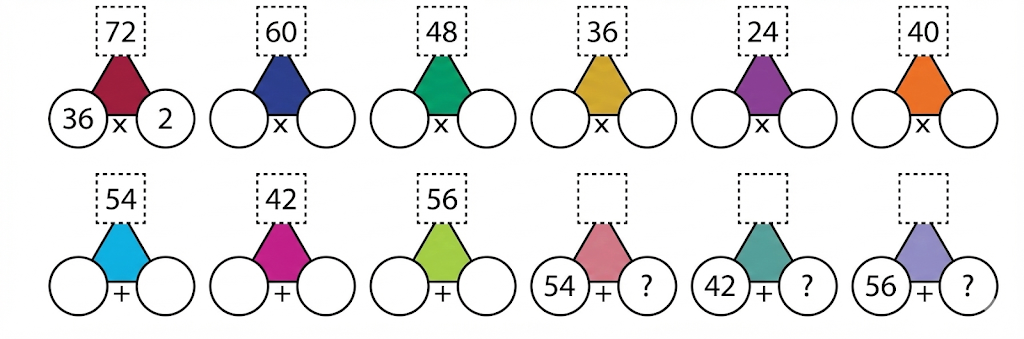
Solution:
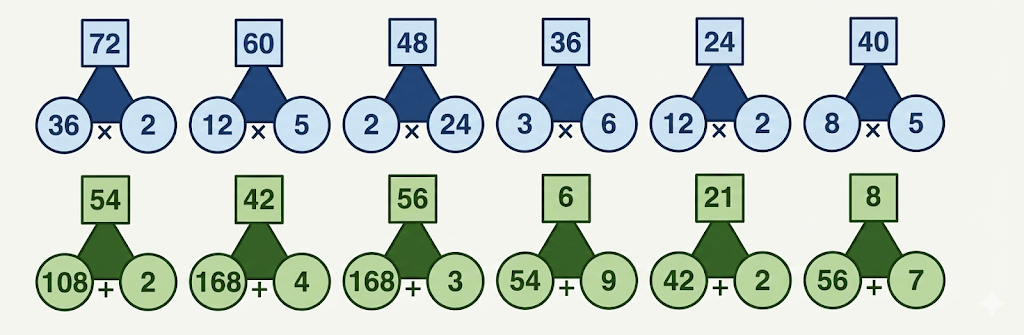
Answers might be different
NCERT Textbook Pages 120-121
Let Us Do
Question 1.
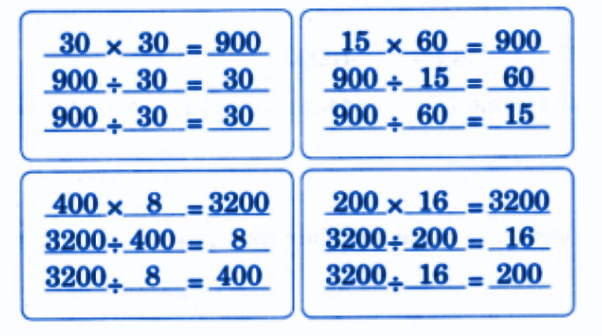
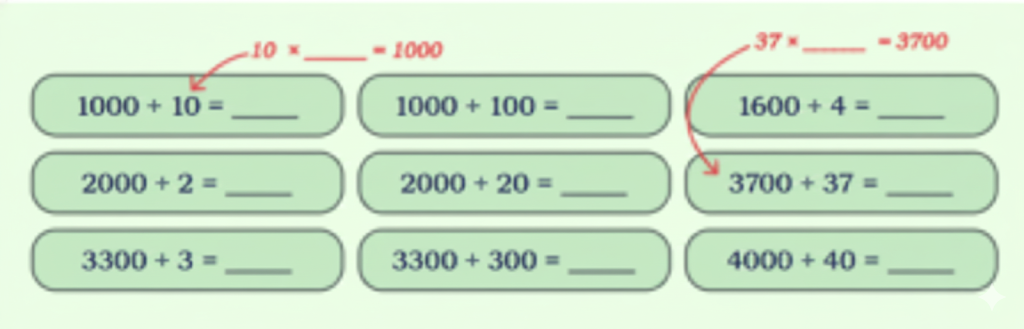
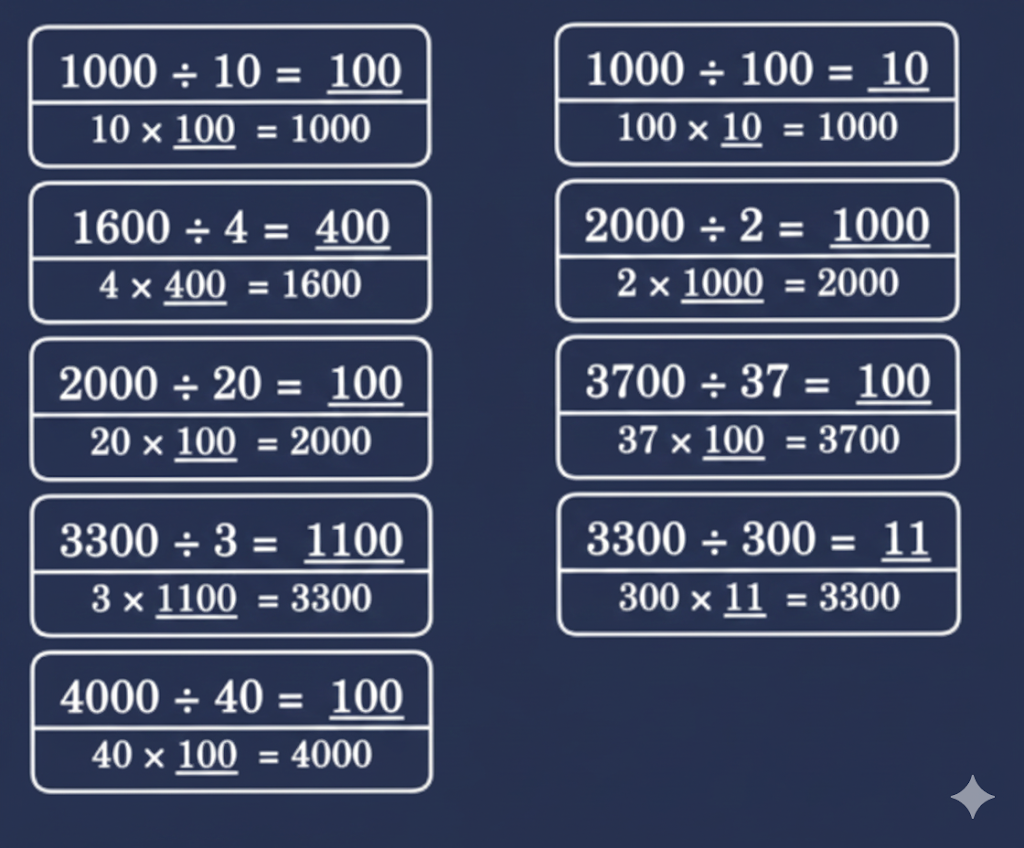
Solve the following multiplication problems. Write two division statements in each case.
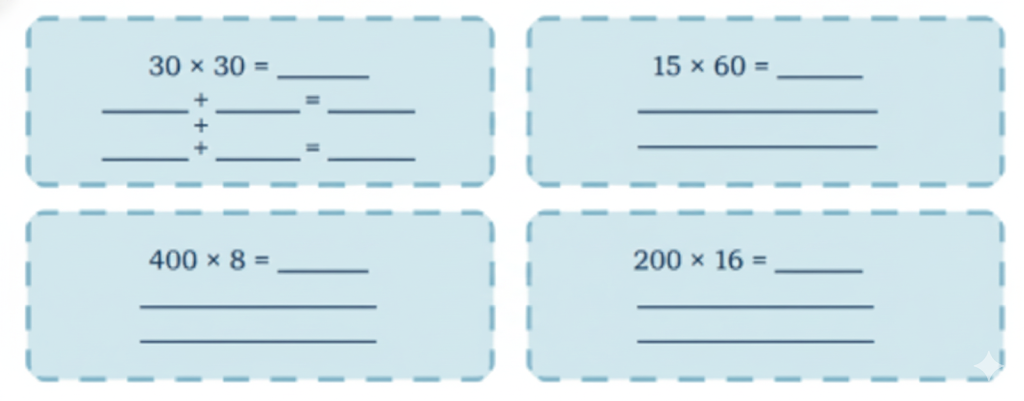
Solution:
Question 2.
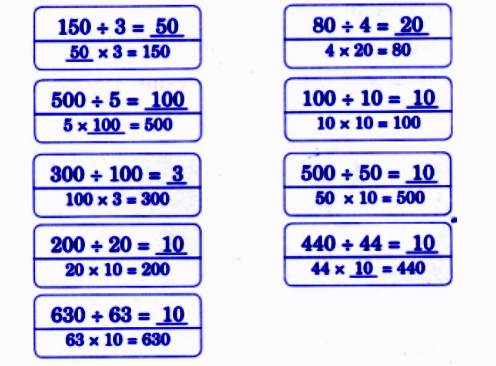
Solve the following division problems. Notice the patterns and discuss in class.
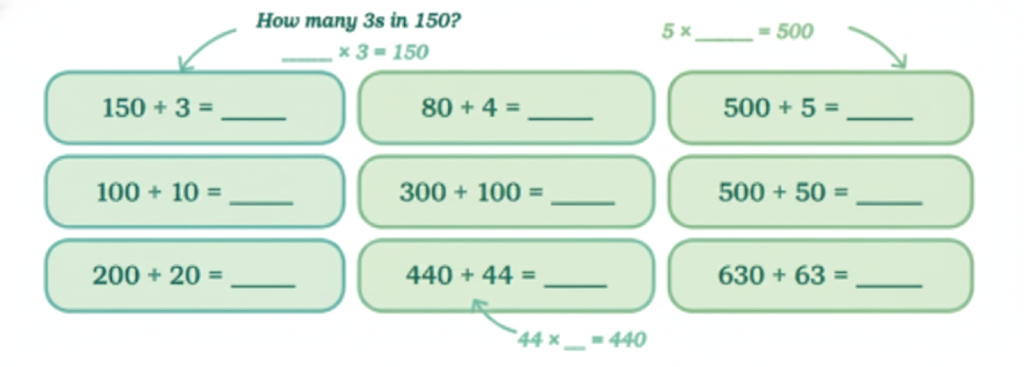
Solution:
NCERT Textbook Page 121
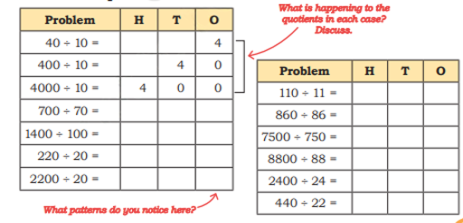
Patterns in Division and Place Value
Solution:
Now fill the place value chart.
Solution:
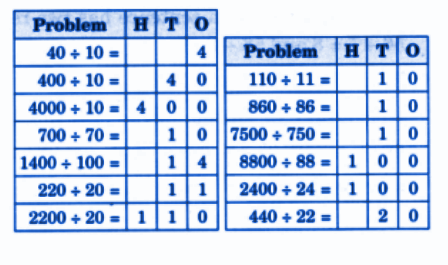
We notice that when the dividend becomes ten times larger, the quotient also increases by ten times.
NCERT Textbook Page 122
Let Us Do
Question 1.
Sabina cycles 160 km in 20 days and same distance each day. How many kilometres does she cycle each day?
Solution:
Sabina covers 160 km in 20 days.
To find the distance she cycles per day, divide the total distance by the number of days:
160 ÷ 20 = 8
So, Sabina cycles 8 km each day.
Question 2.
How many notes of ₹ 100 does Seema need to carry if she wants to buy coconuts worth ₹
4200?
Solution:
To determine how many ₹100 notes are needed, divide the total cost of the coconuts by 100:
4200 ÷ 100 = 42
Hence, Seema must carry 42 notes of ₹100.
Question 3.
The owner of an electric store has decided to distribute ?5500 equally amongst 5 of his employees as a Diwali gift. What amount will each employee get?
What will happen if he distributes the same amount of money among 10 employees? Will each employee get more or less? How much money would he have to distribute if everyone must get the same amount as earlier?
Solution:
If ₹5500 is shared equally among 5 employees, then each employee receives:
5500 ÷ 5 = ₹1100.
If the same amount is divided equally among 10 employees, then each employee gets:
5500 ÷ 10 = ₹550.
Since ₹550 is less than ₹1100, each employee receives a smaller amount in this case.
To find the total amount required so that 10 employees each receive ₹1100, we multiply:
1100 × 10 = ₹11,000.
Therefore, the required amount is ₹11,000.
Question 4.
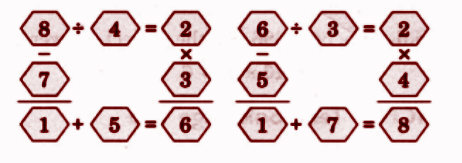
Place the numbers 1 to 8 in the following boxes so that all the four operations, division, multiplication, addition and subtraction are correct. No number must be repeated.
Is there more than one answer.
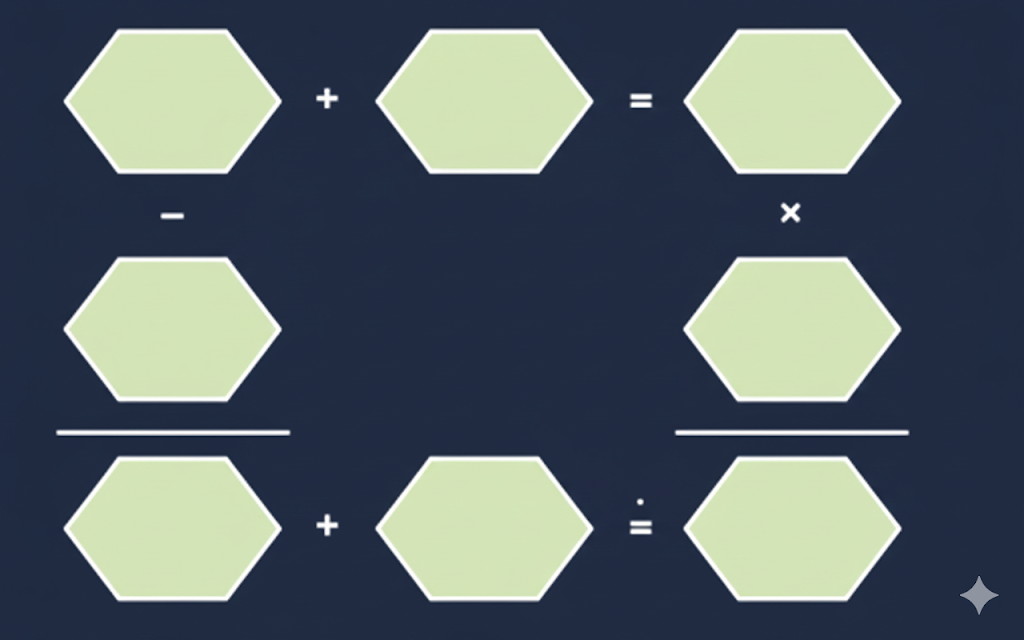
Solution:
There are two possible solutions.
Question 5.
Fill in the blanks
(a) _____ ÷ 18 = 100.
(b) _____ ÷ 10 = 610.
(c) _____ ÷ 100 = 72.
(d) _____ ÷ 100 = 10.
(e) 870 ÷ _____ = 87.
(f) _____ ÷ 100 = 70.
(g) 200 ÷ _____ = 2.
(h) 130 ÷ _____ = 13.
Solution:
(a) 1800 ÷ 18 = 100.
(b) 6100 ÷ 10 = 610.
(c) 7200 ÷ 100 = 72.
(d) 1000 ÷ 100 = 10.
(e) 870 ÷ 10 = 87.
(f) 7000 ÷ 100 = 70.
(g) 200 ÷ 100 = 2.
(h) 130 ÷ 10 = 13.
NCERT Textbook Page 123
Try It!
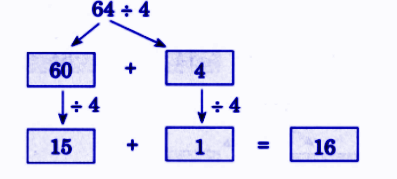
Question 1.
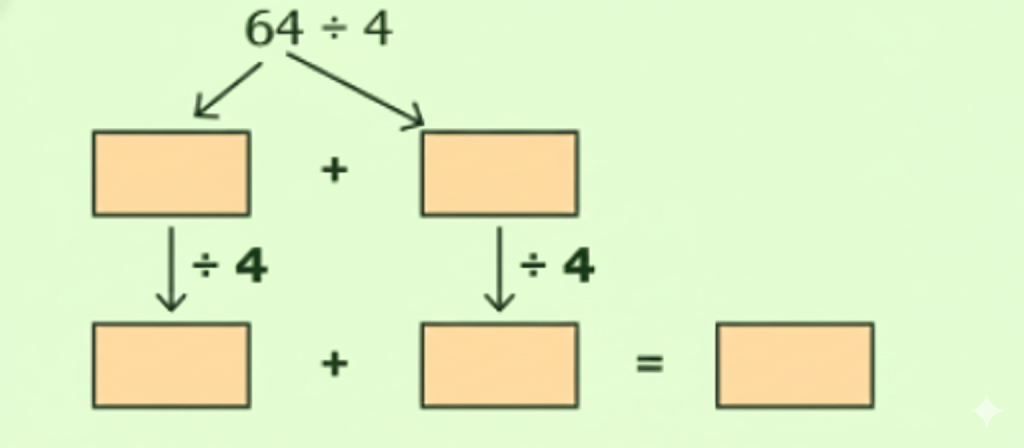
Solution:
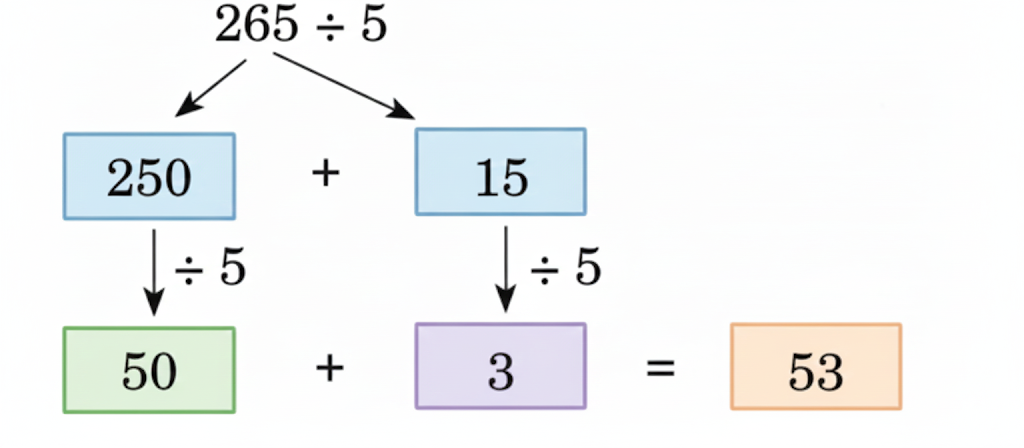
Question 2.
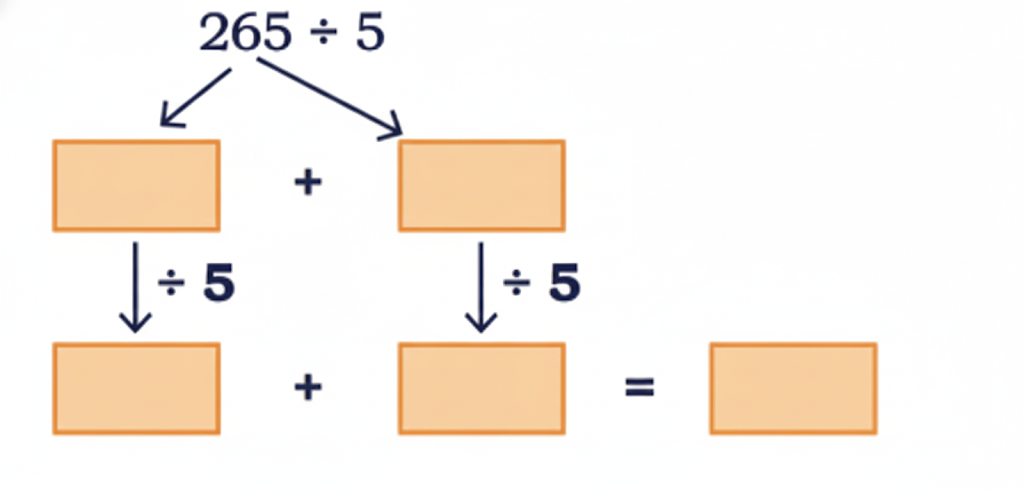
Solution:
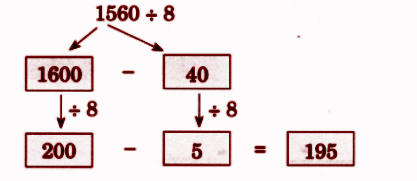
Question 3.
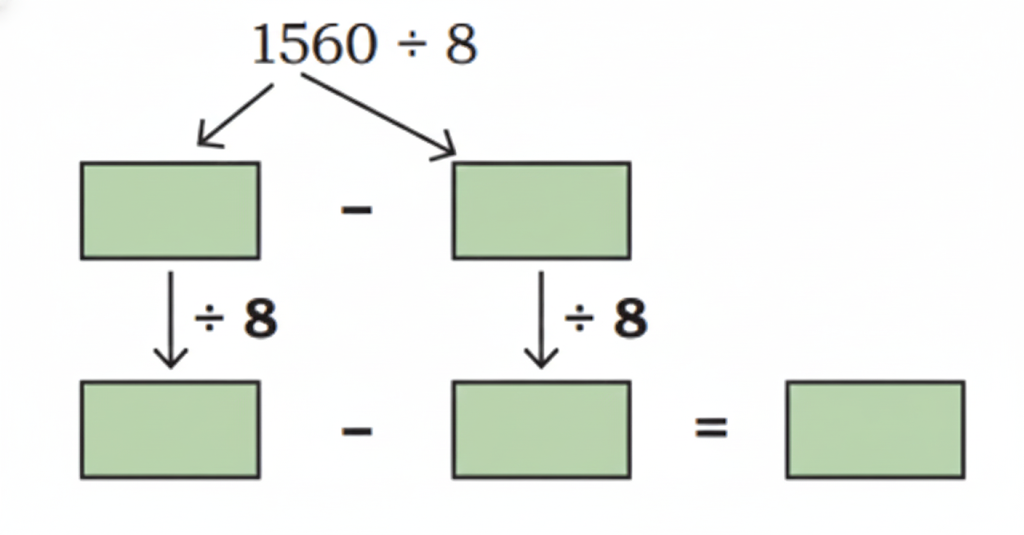
Solution:
Question 4.
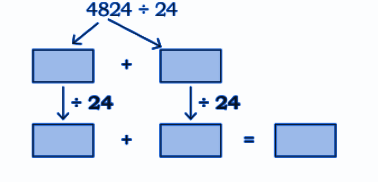
Solution:
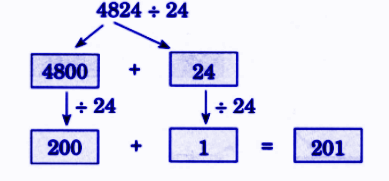
Question 5.

Solution:

Question 6.

NCERT Textbook Page 124
Let Us Solve
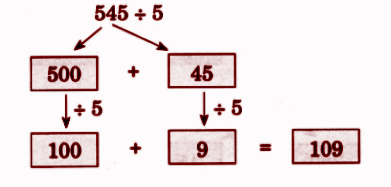
Solve the following problems using strategies used in the previous question.
Solution:
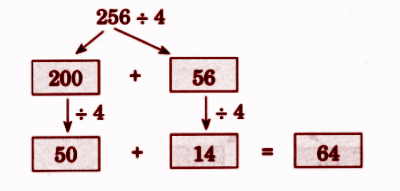
(b) 545 ÷ 5
Solution:
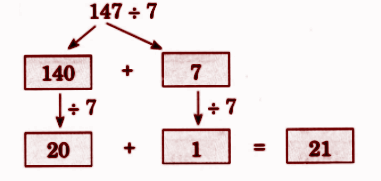
(c) 147 ÷ 7
Solution:
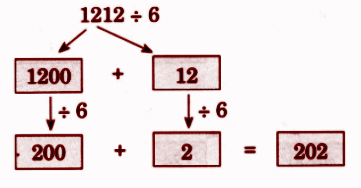
(d) 1212 ÷ 6
Solution:
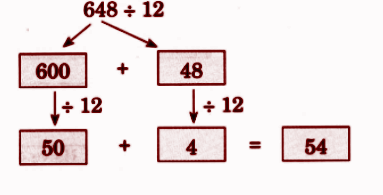
(e) 648 ÷ 12
Solution:
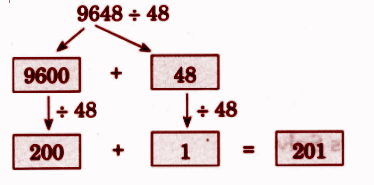
(f) 9648 ÷ 48
Solution:
(g) 775 ÷ 25
Solution:
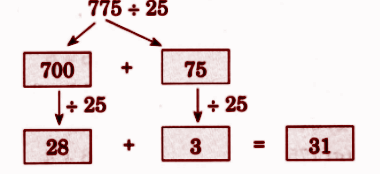
(h) 796 ÷ 4
Solution:
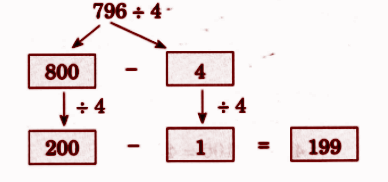
NCERT Textbook Page 125
Let Us Learn to Divide
726 ÷ 4
Solution:
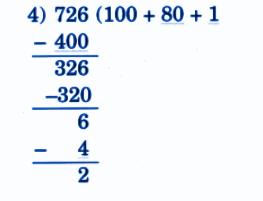
No, 200 cannot be used instead of 100, because
200 × 4 = 800, which is greater than 726.
902 ÷ 16
Solution:
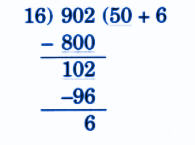
No, 16 cannot be multiplied by a tens number greater than 50, because
60 × 16 = 960, which is more than 902.
Is 726 = 4 × 181? Yes/No.
So, 726 = 4 × 181 + _______.
Solution:
4 × 181 = 724.
So, the correct answer is No.
726 = 4 × 181 + 2
Is 902 = 16 × 56? Yes/No.
So, 902 = 16 × 56 + _____.
Solution:
16 × 56 = 896.
So, the correct answer is No.
902 = 16 × 56 + 6
NCERT Textbook Page 126
Let Us Solve
Solve the following word problems
Question 1.
Rani is planning to host a party. She estimates that 250 guests will attend. She plans to serve one samosa to each guest. Samosas are available in packs of 6 or 8. Which pack should Rani buy? Explain your answer.
Solution:
Rani should select the packs so that the total number of samosas is at least 250 and as close to 250 as possible.
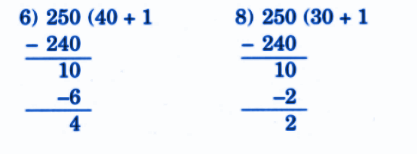
Thus, 42 packs of 6 samosas give 252 samosas, while 32 packs of 8 samosas give 256 samosas.
Since 252 is closer to 250, Rani should buy the packs of 6 samosas.
Question 2.
342 students from a school are going on a trip to the Science Park. Each bus can carry a maximum of 41 students. How many buses does the school need to arrange?
Solution:
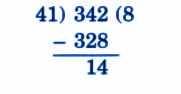
The number of buses required is found by dividing 342 by 41.
This gives 8 buses, with 14 students left over.
So, one additional bus is needed to accommodate the remaining students.
Therefore, 9 buses must be arranged.
Question 3.
Sofia has only ₹ 50 and ₹ 20 notes. She needs to pay ₹ 520 using these notes. How many ₹ 50 and ₹ 20 notes does she need to make ₹ 520? Find out the different possible combinations.
Solution:
Let us explore a few combinations using division.
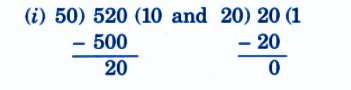
10 × ₹50 + 1 × ₹20 = ₹520.
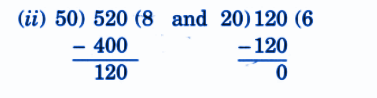
8 × ₹50 + 6 × ₹20 = ₹520.
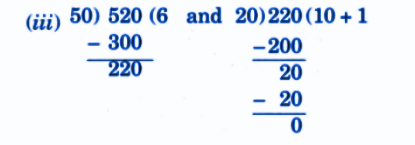
Thus, 6 × ₹50 + 11 × ₹20 = ₹520.
So, Sofia can make the payment using ten ₹50 notes and one ₹20 note, eight ₹50 notes and six ₹20 notes, or six ₹50 notes and eleven ₹20 notes.
Other combinations are also possible.
Question 4.
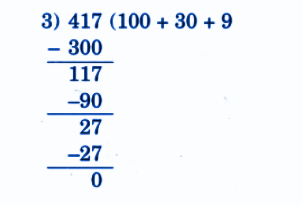
Three friends decide to split the money spent on their picnic equally. They buy snacks and sweets for ₹ 157, juice and fruits for ₹ 124 and pulav and paratha for ₹ 136. How much should each person pay to share the cost equally?
Solution:
The total amount spent is ₹157 + ₹124 + ₹136 = ₹417.
When this amount is divided equally among 3 people, each person pays:
417 ÷ 3 = ₹139
Question 5.
Identify the remainder, if any. Check if N = D × Q + R.
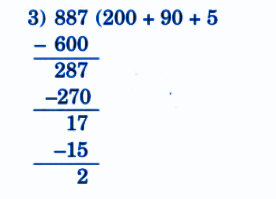
(a) 887 ÷ 3
Solution:
Here, N = 887, D = 3, Q = 295, R = 2
Since, 3 × 295 + 2 = 885 + 2 = 887
Therefore, N = D × Q + R
(b) 283 ÷ 8
Solution:
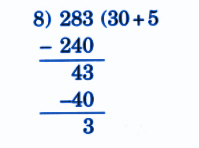
Here, N = 283, D = 8, Q = 35, R = 3
Since, 8 × 35 + 3 = 280 + 3 = 283
Therefore, N = D × Q + R
(c) 745 ÷ 5
Solution:
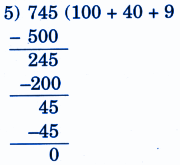
Here, N = 745, D = 5, Q = 149, R = 0
Since, 5 × 149 + 0 = 745 + 0 = 745
Therefore, N = D × Q + R
(d) 767 ÷ 26
Solution:
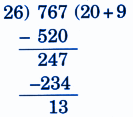
Here, N = 767, D = 26, Q = 29, R = 13
Since, 26 × 29 + 13 = 754 + 13 = 767
Therefore, N = D × Q + R
(e) 530 ÷ 41
Solution:
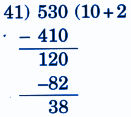
Here, N = 530, D = 41, Q = 12, R = 38
Since, 41 × 12 + 38 = 492 + 38 = 530
Therefore, N = D × Q + R
(f) 888 ÷ 67
Solution:
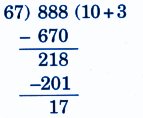
Since, 67 × 13 + 17 = 871 + 17 = 888
Therefore, N = D × Q + R
NCERT Textbook Pages 126-128
Kalpavruksha Coconut Oil
Question 1.
In a particular year, Susie an Sunitha used 4376 coconuts for extracting coconut oil. They can extract 1 l of oil from 8 coconuts. What quantity of oil were they able to extract? They would get 4376 + 8 litres of coconut oil.
How much will they earn if they sell the oil at ₹ 175 for 11?
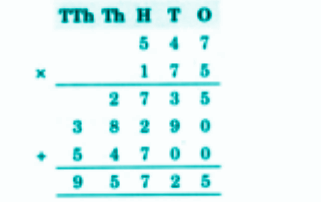
They will earn ₹ 547 × 175. Find out.
Solution:
Question 2.
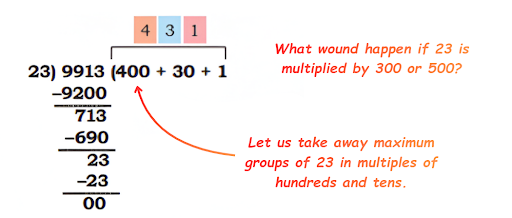
Coconut husk is used for making coir. Coir is a natural fibre used in gardening, farming, boat making, and making decorative items. Susie and Sunitha’s farm sells coconut husk at ₹23 per kilogram. They earned ₹ 9913 from the sale of husk in May. What quantity of husk did they sell in May?
Solution:
The quantity of husk sold in May is 9913 ÷ 23 kg
Question 3.
In the hot summer months, tender coconuts are sold for ₹ 35. Ibrahim earns ₹ 8890 in a week. How many tender coconuts did he sell? The number of tender coconuts sold by Ibrahim is 8890 ÷ 35.
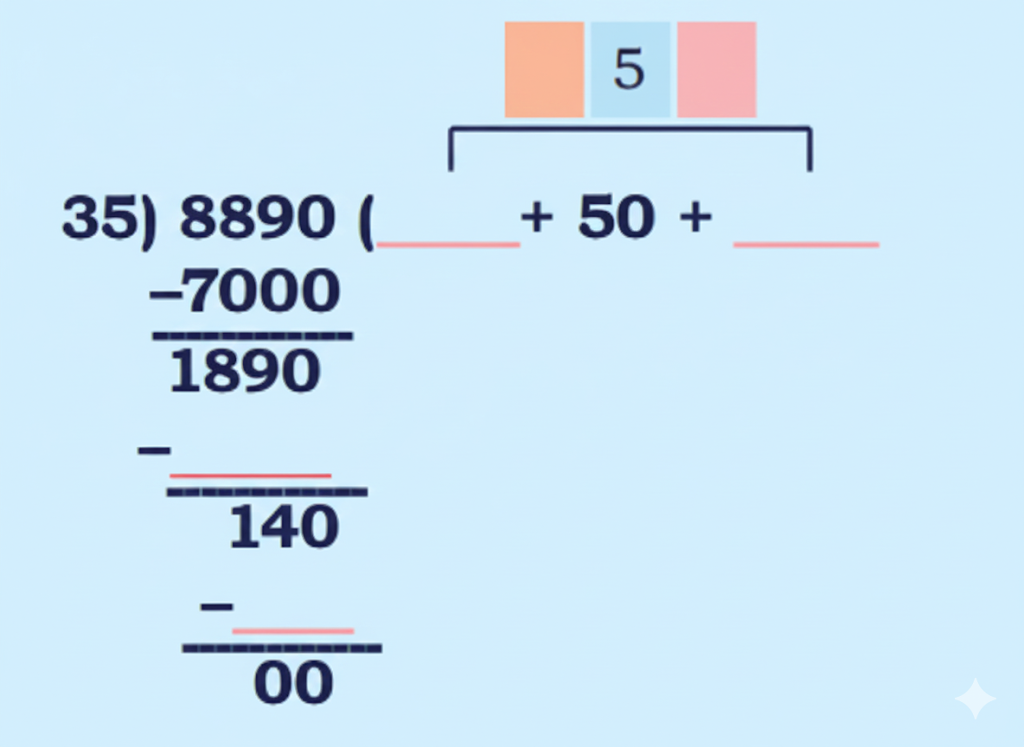
Ibrahim sold ______ tender coconuts.
Solution:
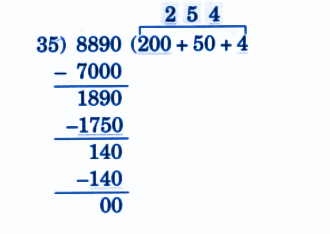
Ibrahim sold 254 tender coconuts.
Ibrahim had bought the tender coconuts for ₹ 20 each. How much extra money did he earn by selling the coconuts at ₹ 35?
Solution:
The total cost of 254 coconuts at ₹20 each is:
254 × 20 = ₹5080.
The total amount received from selling them is ₹8890.
So, the additional profit earned is:
₹8890 − ₹5080 = ₹3810.
NCERT Textbook Pages 130-131
Let Us Divide
(a) 7,032 ÷ 6
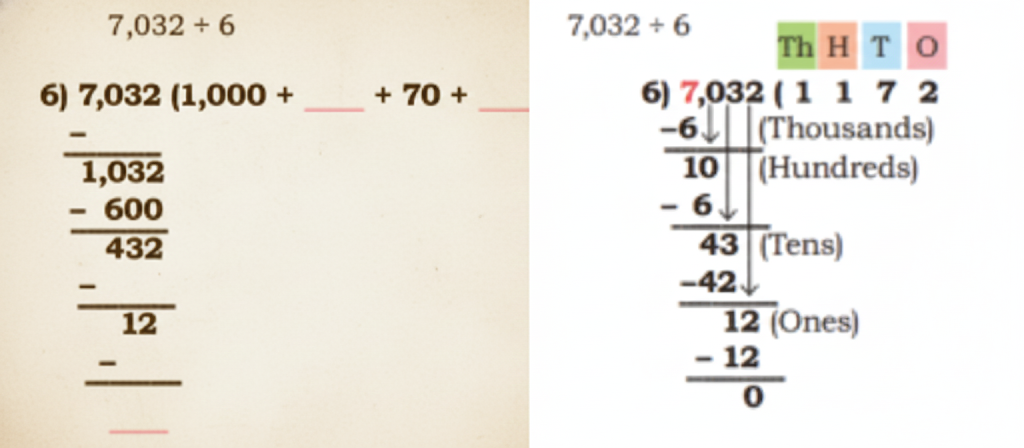
Solution:
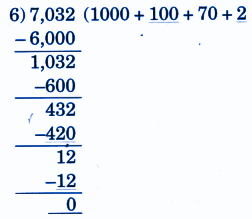
7,032 ÷ 6
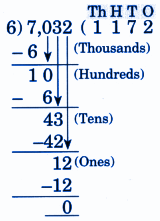
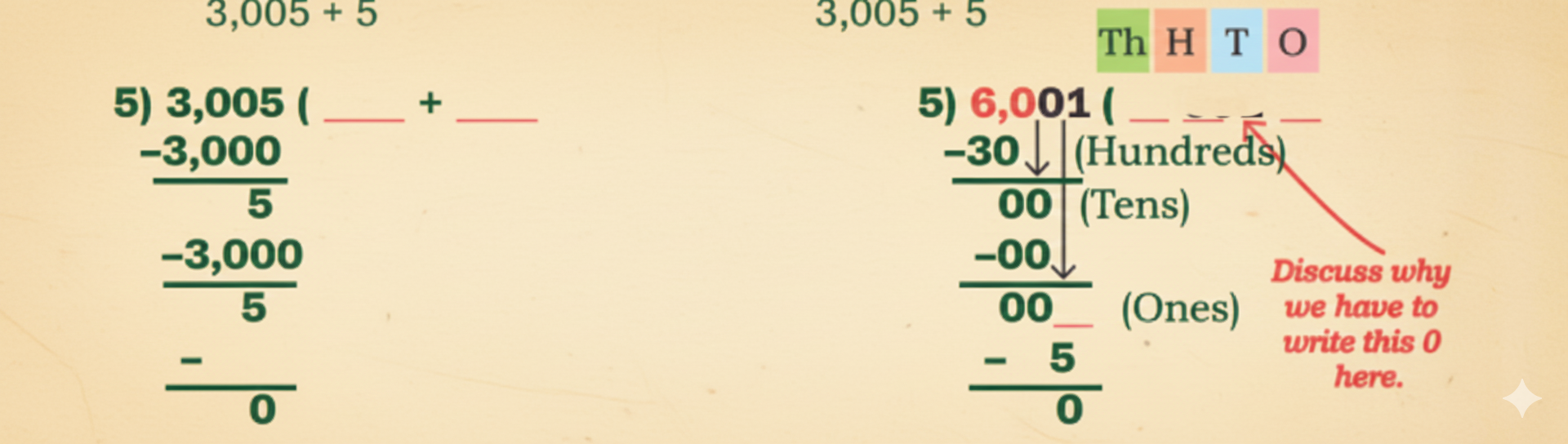
(b) 3,005 ÷ 5
Solution:
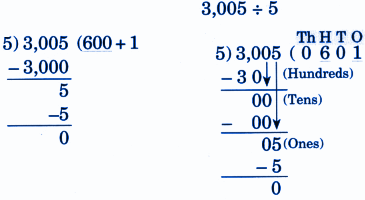
3005 = 3 Thousands + 0 hundreds + 0 tens + 5 ones.
3 Thousands ÷ 5 → not possible without regrouping
Regroup 3 thousands into hundreds.
30 hundreds
30 hundreds ÷ 5 = 6 hundreds
0 tens ÷ 5 = 0 tens
5 ones ÷ 5 = 1 ones
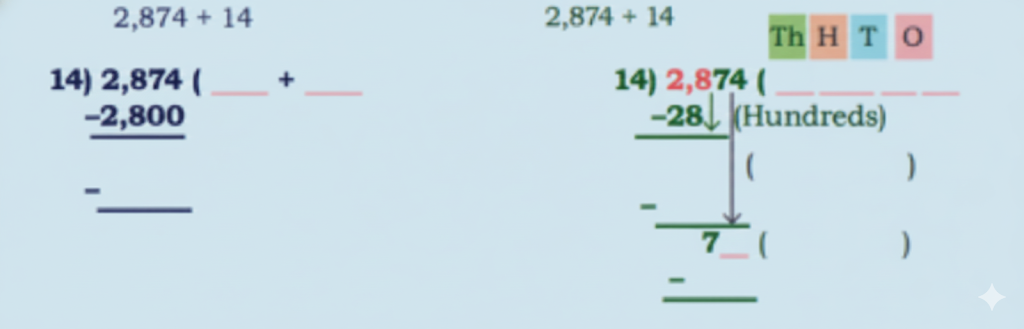
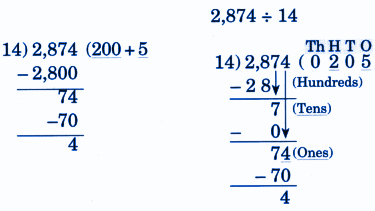
(c) 2,874 ÷ 14
Solution:
(d) 9,805 ÷ 32
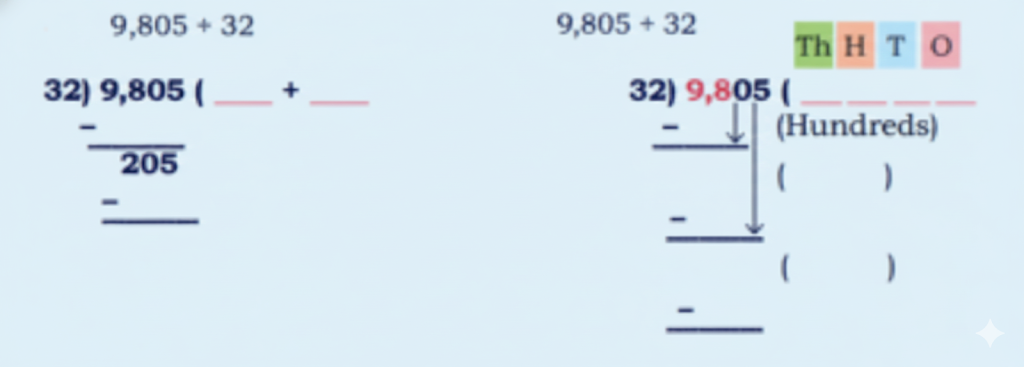
Solution:
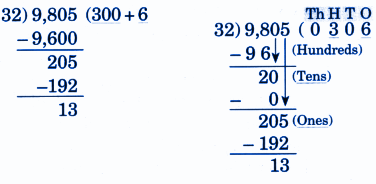
NCERT Textbook Page 131
Let Us Do
Question 1.
Find the missing numbers such that there is no remainder. Remember, there could be more than one solution.
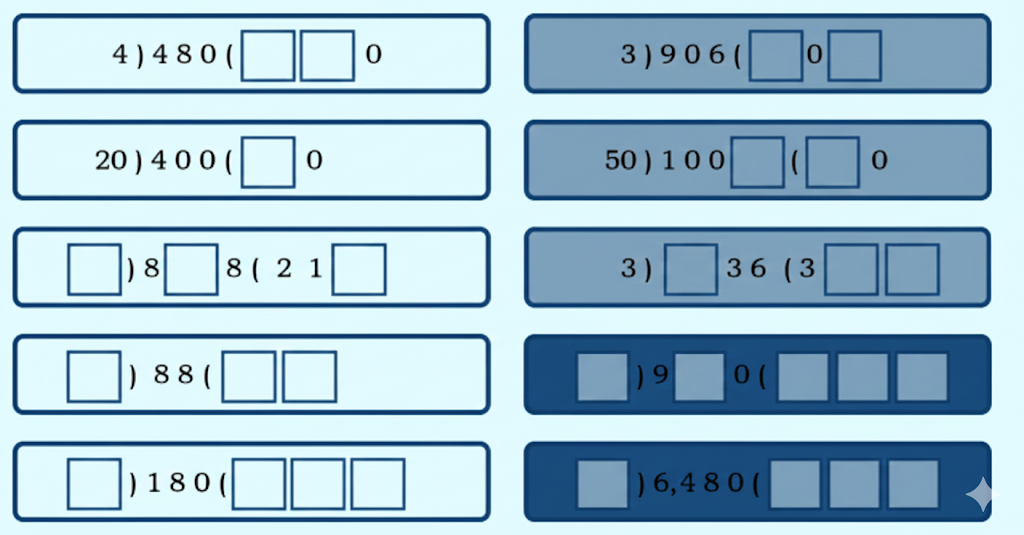
I am a 3-digit number.
If you divide me by 5, you get 42.
If you multiply me by 2, you get 420. What number am I?
Solution:
210.
As, 210 + 5 = 42
210 × 2 = 420
NCERT Textbook Pages 132-133
Let Us Solve
Question 1.
A theatre company can accommodate 45 people during one show.
(a) A total of 475 people bought tickets for a puppet show. How many shows are needed to seat all the people who bought tickets?
(b) There are 2 shows in a day. How many days will be needed to accommodate all the people?
Solution:
(a) The number of shows required for 475 people
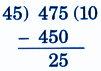
= 475 ÷ 45
Ten shows will accommodate 450 people and one more show will accommodate for the remaining 25 people.
Therefore, 11 shows are needed to seat all the people who bought tickets.
(b) From part (a) number of shows required is 11.
If there are 2 shows in a day, then in 5 days there will be 10 shows, and on 6th day the 11th show will be held.
Thus, 6 days are needed to accommodate all the people.
Question 2.
Naina bought 5 kg of ice cream as a birthday treat for her 23 friends. 400 g ice cream was left after everyone had an equal share. How much ice cream did each of her friends eat?
Solution:
Total ice cream shared = 500 kg – 400 g
= 5000 g – 400 g = 4600 g
Share of each of her friend = 4600 ÷ 23 = 200
Therefore, each of her friend ate 200 g of ice cream.
Question 3.
Megha packs 15 packets of ragi-oats biscuits for a 4-day group trip. Each packet contains 8 biscuits. There are 6 people in the group. If distributed evenly, how many biscuits can one person have each day.
Solution:
Total number of biscuits in 15 packets = 15 × 8 = 120
Total number of biscuits distributed per day = 120 + 4 = 30
Number of biscuits one person can have per day = 30 4- 6 = 5
Therefore, each person can have 5 biscuits each day.
Question 4.
Solve the following and identify the remainder, if any. Check whether N = D × Q + R in each case.
Solution:
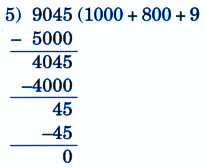
Here, N = 9045, D = 5, Q = 1809, R = 0
Since, 9045 = 5 × 1809 + 0
Therefore, N = D × Q + R
(b) 1,034 ÷ 4
Solution:
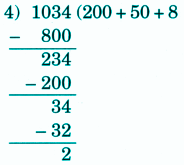
Since, 1034 = 4 × 258 + 2
Therefore, N = D × Q + R
(c) 2,504 ÷ 7
Solution:
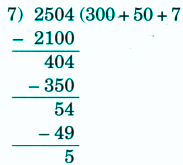
Since, 2504 = 7 × 357 + 5
Therefore, N = D × Q + R
(d) 8,900 ÷ 15
Solution:
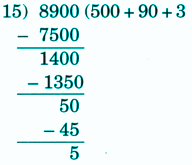
Since, 8900 = 15 × 593 + 5
Therefore, N = D × Q + R
(e) 9,876 ÷ 32
Solution:
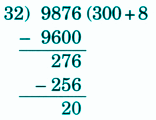
Since, 9872 = 32 × 308 + 20
Therefore, N = D × Q + R
(f) 7,506 ÷ 24
Solution:
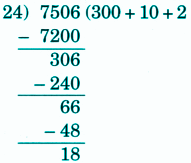
Here, N = 7506, D = 24, Q = 312, R = 18
Since, 7506 = 24 × 312 + 18
Therefore, N = D × Q + R
Question 5.
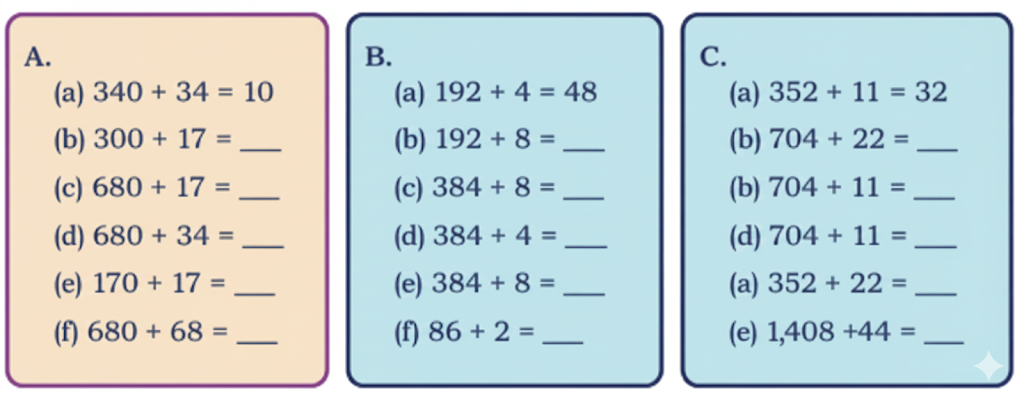
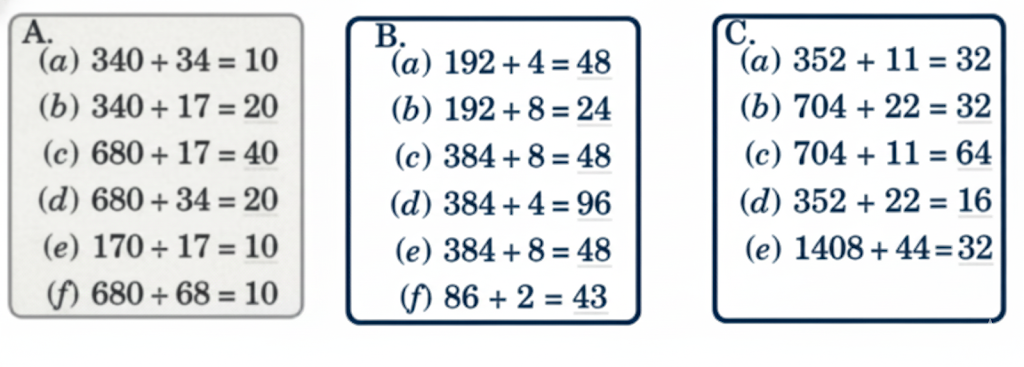
Find the solutions for part A. Observe the relations between the quotient, divisor and dividend and use it to answer parts B and C.
Solution:
From Part A, we observe the following patterns:
When the divisor is doubled, the quotient becomes half, and when the divisor is halved, the quotient becomes double.
In contrast, when the dividend is doubled, the quotient also doubles, and when the dividend is halved, the quotient becomes half.
Question 6.
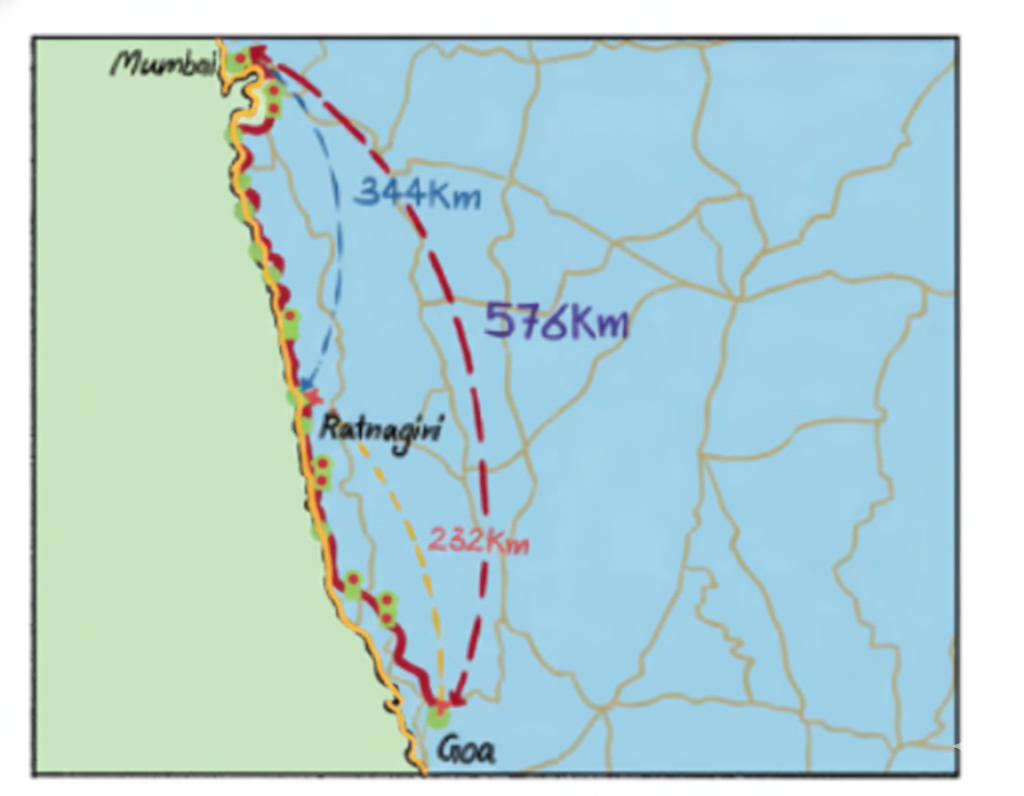
A company in Mumbai organises cycle rallies from Mumbai to Panjim, Goa every year. They aim to cover 576 km in 12 days.
(а) How much distance should they cycle every day, to cover the distance evenly?
(b) After reaching Ratnagiri, they rest for 1 day. How much distance should they cycle each day to reach Goa in 4 days? Assume that they cover the distance evenly.
Solution:
(a)
The distance they need to cycle each day is:
576 ÷ 12 = 48 km.
(b)
The total distance from Ratnagiri to Goa is 232 km.
To cover this distance in 4 days, they must cycle:
232 ÷ 4 = 58 km per day.
Question 7.
Given below are a few problems. You may need some additional information to solve these. Identify the missing information. Write the missing information and find the answer.
(a) A fruit vendor sells 6 baskets of mangoes. Each basket contains 12 mangoes. How much did the vendor earn in total?
(b) A school has 8 classrooms, and each classroom has an equal number of desks. How many desks are there in each classroom?
(c) Rahul buys 5 cricket bats for his team. The total bill is ₹ 3500. How much does one bat cost?
(d) A restaurant serves 125 plates of idlis in a day. The total earnings from selling all the idli plates is ₹ 6250. How many idlis are there in each plate?
Solution:
(a)
Missing information: Cost of one mango.
Assume the cost of each mango is ₹10.
Then, the cost of one basket = 12 × 10 = ₹120.
So, the cost of 6 baskets = 6 × 120 = ₹720.
Hence, the vendor earns ₹720 in total.
(Answers might be different)
(b)
Missing information: Total number of desks in the school.
Assume there are 160 desks in the school.
Then, the number of desks in each classroom = 160 ÷ 8 = 20.
( (Answers might be different)
(c)
No information is missing.
The cost of one bat = 3500 ÷ 5 = ₹700.
(d)
Missing information: Cost of one idli.
Assume the cost of each idli is ₹25.
The cost of one plate of idlis = 6250 ÷ 125 = ₹50.
So, the number of idlis in one plate = 50 ÷ 25 = 2.
( (Answers might be different)
Question 8.
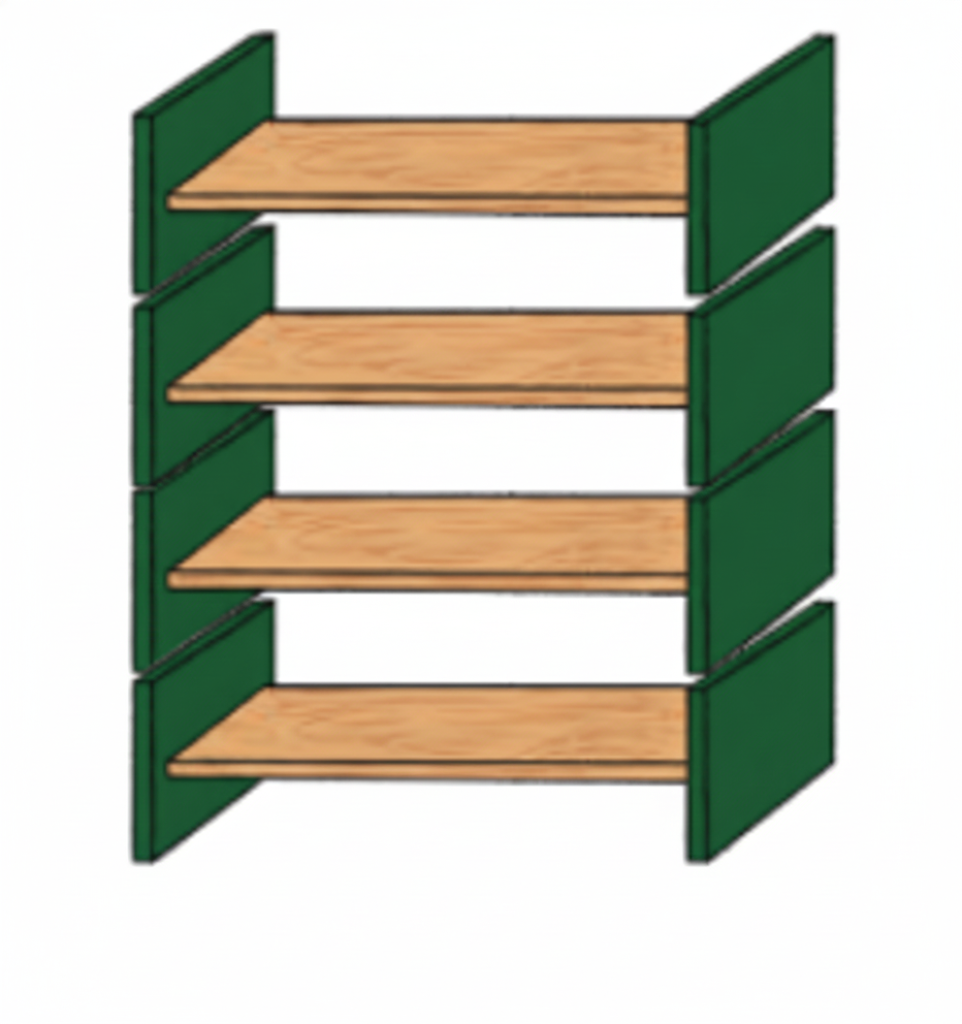
To make one bookshelf, a carpenter needs the following things 4 long wooden panels 8 short wooden panels 16 small clips 4 large clips 32 screws
The carpenter has a stock of 264 long wooden panels, 306 short wooden panels, 2400 small clips, 120 large clips, and 2800 screws. How many bookshelves can the carpenter make? Discuss your thoughts.
Solution:
Since 264 ÷ 4 = 66, the long wooden panels are enough to make 66 bookshelves.
Next, 306 ÷ 8 = 38, with a remainder of 2, so the short wooden panels can be used to make 38 bookshelves.
Also, 2400 ÷ 16 = 150, with a remainder of 2, which means the small clips are sufficient for 150 bookshelves.
Further, 120 ÷ 4 = 30, so the large clips can be used for 30 bookshelves.
Lastly, 2800 ÷ 32 = 87, with a remainder of 16, so the screws are enough for 87 bookshelves.
Considering all these materials, the carpenter is limited by the item available in the least number. Therefore, the carpenter can make only 30 bookshelves.
NCERT Textbook Page 134
Vegetable Market
Munshi Lai has a big farm in Bihar. Every Saturday, he sells the vegetables from his farm at Sundar Sabzi Mandi. Munshi ji maintains a detailed record of the quantity of vegetables he sends to the Mandi and the cost of each vegetable. The following table shows his record book on one Saturday.
His naughty grandson has erased some numbers from his record book. Help Munshi Lai complete the table.
Solution:
Let Us Solve
Divide the following. Try dividing using place values, whenever you can. Identify the remainder, if any, and check whether N = D × Q + R.
1. 506 ÷ 5
Solution:
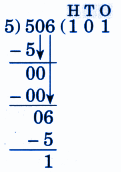
5 × 101 + 1 = 505 + 1 = 506
Therefore, N = D × Q + R
2. 918 ÷ 8
Solution:
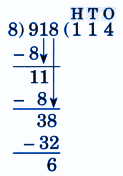
N = 918, D = 8, Q = 114, R = 6
8 × 114 + 6 = 912 + 6 = 918
Therefore, N = D × Q + R
3. 8,126 ÷ 7
Solution:
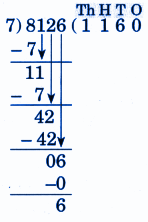
7 × 1160 + 6 = 8120 + 6 = 8126
Therefore, N = D × Q + R
4. 9,324 ÷ 4
Solution:
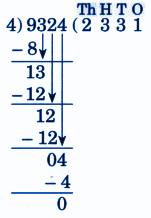
N = 9324, D = 4, Q = 233, R = 0
Therefore, N = D × Q + R
5. 876 ÷ 6
Solution:
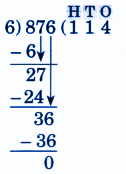
N = 876, D = 6, Q = 146, R = 0
Therefore, N = D × Q + R
6. 7,008 ÷ 3
Solution:
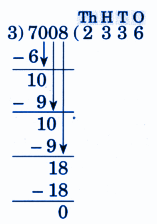
N = 9324, D = 4, Q = 233, R = 0
Therefore, N = D × Q + R
7. 934 ÷ 12
Solution:
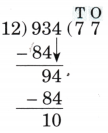
N = 934, D = 12, Q = 77, R = 10
12 × 77 + 10 = 924 + 10 = 934
Therefore, N = D × Q + R
8. 829 ÷ 23
Solution:
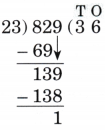
N = 829, D = 23, Q = 36, R = 1
23 × 36 + 1 = 828 + 1 = 829
Therefore, N = D × Q + R
9. 705 ÷ 18
Solution:
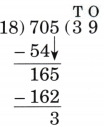
N = 705, D = 18, Q = 39, R = 3
18 × 39 + 3 = 702 + 3 = 705
Therefore, N = D × Q + R
10. 8,704 ÷ 32
Solution:
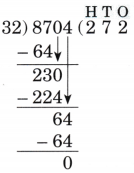
N = 705, D = 18, Q = 39, R = 3
Therefore, N = D × Q + R
11. 6,790 ÷ 45
Solution:
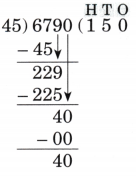
N = 6790, D = 45, Q = 150, R = 40
45 × 150 + 40 = 6750 + 40 = 6790
Therefore, N = D × Q + R
12. 5,074 ÷ 21
Solution:
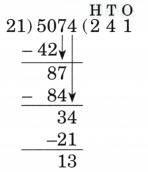
21 × 241 + 13 = 5074
Therefore, N = D × Q + R
NCERT Textbook Page 135
Mathematical Statements
Question 1.
Find out whether the following statements are True (T) or False (F). A true sentence is one where both sides of the ‘=’ sign have the same value.
(a) 8 × 9 = 70 + 2
(b) 20 – 6 = 7 × 3
(c) 48 – 3 = 4 × 4
(d) 89 – 9 = 90 + 0
(e) 25 + 10 = 45 – 10
Solution:
(a) 8 × 9 = 72 and 70 + 2 = 72
Therefore, 8 × 9 = 70 + 2 is True.
(b) 20 – 6 = 14 and 7 × 3 = 21
Since 14 and 21 are not equal.
Therefore, 20 – 6 = 7 × 3 is False.
(c) 48 – 3 = 16 and 4 × 4 = 16
Therefore, 48 + 3 = 4 × 4 is True.
(d) 89 – 9 = 80 and 90 + 0 = 90
Since, 80 and 90 are not equal.
Therefore, 89 – 9 = 90 + 0 is False.
(e) 25 + 10 = 35 and 45 – 10 = 35
Therefore, 25 + 10 = 45 – 10 is True.
Question 2.
Complete the following statements such that they are true.
(a) 7 × 6 = _____ + 17
(b) 87 + 6 = _____ × 31
(c) 63 + _____ = 74 – 4
(d) _____ – 9 = 16 – 2
Solution:
(a) 7 × 6 = 42 and 25 + 17 = 42
Therefore, 7 × 6 = 25 +17
(b) 87 + 6 = 93 and 3 × 31 = 93
Therefore, 87 + 6 = 3 × 31
(c) 74 – 4 = 70 and 63 + 7 = 70
Therefore, 63 + 7 = 74 – 4
(d) 16 – 2 = 8 and 72 – 9 = 8
Therefore, 72 – 9 = 16 – 2
Question 3.
Think about the following statements and find examples as suggested below.
(a) “When two odd numbers are added, the sum is even.”
Find 5 examples for the above statement. Can you find an example to show that the statement can be false? Always true
(b) “Multiplying a number by 2 can give an odd number.”
Give some example for this statement. Can you find any? -Never true
(c) “Halving a number always leads to an even number.”
Give 3 example
Solution:
(a) “When two odd numbers are added, the sum is even.”
Examples (5):
3 + 5 = 8
7 + 9 = 16
11 + 13 = 24
15 + 17 = 32
21 + 25 = 46
Can you find an example where the statement is false?
No. The sum of any two odd numbers is always even.
So, this statement is always true.
(b) “Multiplying a number by 2 can give an odd number.”
Examples:
Try any number:
2 × 1 = 2
2 × 3 = 6
2 × 5 = 10
All results are even.
Conclusion:
There is no example where multiplying a number by 2 gives an odd number.
So, this statement is never true.
(c) “Halving a number always leads to an even number.”
Examples (3):
10 ÷ 2 = 5 (odd)
6 ÷ 2 = 3 (odd)
14 ÷ 2 = 7 (odd)
Conclusion:
Halving a number does not always result in an even number.
So, this statement is false.
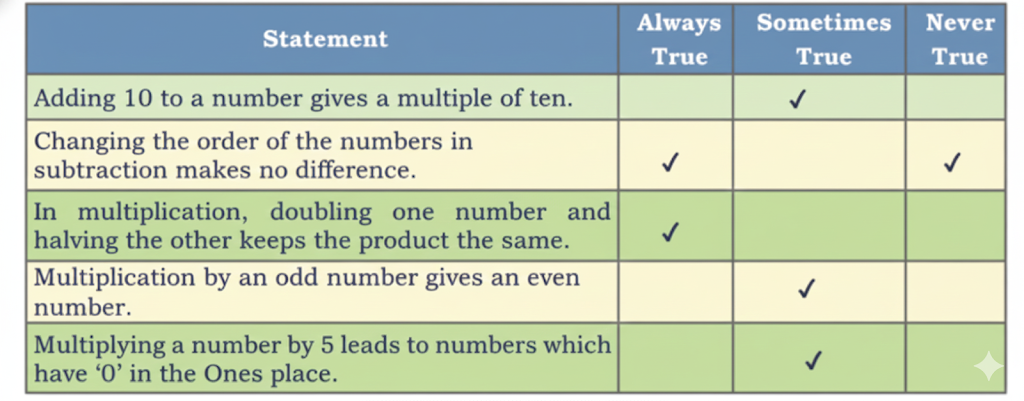
Question 4.
Tick in the appropriate cell for the following statements.
Solution:
Division and Multiplication Concepts in NCERT Solutions Class 5 Maths Mela Chapter 9 Coconut Farm
Mastering division and multiplication facts is crucial in NCERT Solutions Class 5 Maths Mela Chapter 9 Coconut Farm (2026-27). Students should focus on understanding the relationship between dividend, divisor, and quotient for strong foundational skills.
This chapter introduces real-life word problems and clever strategies to solve division and multiplication questions. Practicing these problems boosts calculation speed, promotes logical thinking, and ensures full concept clarity before exams.
Review each exercise solution and pattern in the chapter to build confidence. Regular revision and application of these concepts will help you score better and face complex problems with ease in your NCERT Maths exams.
FAQs on NCERT Solutions For Class 5 Maths Chapter 9 Coconut Farm - 2026-27 Free PDF Download (Sign-in Required)
1. What is included in the NCERT Solutions for Class 5 Maths Chapter 9 Coconut Farm?
NCERT Solutions for Class 5 Maths Chapter 9 Coconut Farm provide stepwise answers, clear diagrams, key definitions, and important exam strategies. These solutions include:
- Intext and back exercise solutions following the CBSE syllabus
- Stepwise explanations for every question
- Important definitions and formulae to help with quick revision
- Tips for drawing and labelling diagrams
- CBSE marking scheme insights for scoring high marks
- Downloadable PDF for offline study
2. How do NCERT Solutions for Class 5 Maths Mela Chapter 9 Coconut Farm help me score more marks in CBSE exams?
NCERT Solutions for Class 5 Maths Mela Chapter 9 Coconut Farm are teacher-reviewed, follow the CBSE 2026–27 marking scheme, and use stepwise answers to boost scores. They help by:
- Showing how to write step-by-step solutions for each question
- Including important keywords, diagrams, and definitions required for exams
- Offering answer structure and length guidance as per CBSE marking
- Highlighting common mistakes and how to avoid them
3. Which questions from Chapter 9 Coconut Farm are likely to be asked in school exams?
Key questions from Chapter 9 Coconut Farm often appear in CBSE school exams:
- Stepwise problem solving related to the coconut farm context
- Word problems that test understanding of farm mathematics
- Definitions and short answers from the chapter
- Diagram-based questions requiring clear labelling
- Exercise and exemplar questions at the end of the chapter
4. Are diagrams or definitions mandatory in NCERT answers for Class 5 Maths Chapter 9?
Diagrams and definitions are important in Class 5 Maths Chapter 9 answers to score full marks:
- Well-labelled diagrams can fetch easy marks in CBSE exams
- Clear definitions improve answer quality and exam grades
- Follow NCERT conventions for neatness and accuracy
5. How can I write stepwise NCERT answers to score full marks in Class 5 Maths Chapter 9?
To score full marks in Class 5 Maths Chapter 9, always write step-by-step solutions:
- Start with a clear statement of the problem
- Show all calculation steps with working
- Use proper units and label diagrams neatly
- End with final answer in a box
6. Where can I download the free PDF of NCERT Solutions for Class 5 Maths Chapter 9 Coconut Farm?
You can download the free PDF of NCERT Solutions for Class 5 Maths Chapter 9 Coconut Farm from trusted educational websites like Vedantu. The PDF includes:
- Chapterwise stepwise solutions
- Revision notes and diagrams
- Ready for offline study and quick revision
7. How should I structure long answers for CBSE marking in Class 5 Maths?
For CBSE exams, structure long answers using the following steps:
- Begin with a clear introduction or statement of the problem
- Break down the solution into logical steps
- Use diagrams and labelled sketches if required
- Write definitions or explanations where necessary
- Underline key points or box the final answer
8. What are the most important definitions and formulae in Class 5 Maths Chapter 9 Coconut Farm?
The most important definitions and formulae in Chapter 9 Coconut Farm include:
- Area and perimeter of rectangular fields
- Number patterns used in farming contexts
- Basic units of measurement (metre, square metre, etc.)
- Simple word problem methods relevant to farm scenarios
9. Are NCERT Solutions enough for Class 5 Maths exams?
NCERT Solutions are sufficient for Class 5 Maths exams if you practice all intext, back exercises, and understand each step. For best results:
- Revise each solution regularly
- Solve exemplar and sample questions for extra practice
- Use marking-scheme insights included in the solutions
10. How to learn diagrams or maps for Class 5 Maths Chapter 9 quickly?
To master diagrams and maps in Chapter 9 Coconut Farm:
- Practice drawing each type of diagram multiple times
- Use a checklist for labels and units
- Follow CBSE tips for neatness – use pencil and ruler, box labels
- Study the solved examples in NCERT Solutions
