



Stepwise Answers & Diagrams for Class 5 Maths Weight and Capacity
NCERT Textbook Page 104
Check! Check!
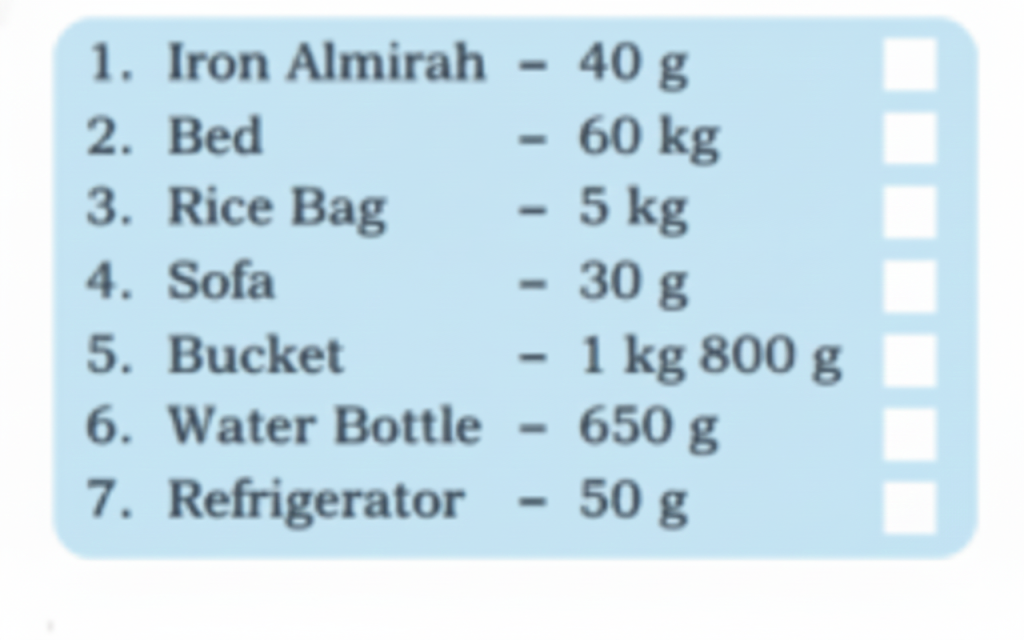
Anu has recorded the weights of the items in her house. Check if she has recorded them correctly by putting a tick against them if they look correct.
Let Us Do
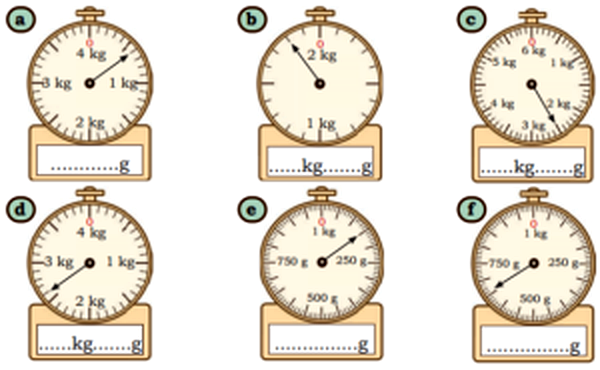
Read the scales. Write the correct weight in the space given below.
Solution:

In parts (a) to (d), each small marking on the scale corresponds to 100 g, while in parts (e) and (f), each small marking represents 10 g.
NCERT Textbook Page 105
Different Units but Same Measure
Match the bags that have the same weights. You can use the double number line given below.


Solution:


NCERT Textbook Page 106
Let Us Find
Question 1.
Shamim and Rehan observed someone buying sugar weighing 5 kg 50 g. They thought of the quantity in grams. How much is it?

Solution:
5 kg is equal to 5,000 g.
Therefore, 5 kg 50 g = 5,000 g + 50 g = 5,050 g.
Hence, Shamim’s answer is correct.
Question 2.
Complete the conversions by filling in the blanks. You can use the double number line given below on which some numbers have been marked.

(a) 7 kg 67 g = ___________ g
Solution:
7 kg = 7,000 g
7 kg 67 g = 7,000 g + 67 g = 7,067g
7 kg 67g = 7,067 g
(b) 3 kg 300 g = ___________ g
Solution:
3 kg = 3,000 g
3 kg 300 g = 3,000 g + 300 g
= 3,300 g
3 kg 300 g = 3,300 g
(c) 8 kg 69 g = ___________ g
Solution:
8 kg = 8,000 g
8 kg 69 g = 8,000 g + 69 g
= 8,069 g
8 kg 69 g = 8,069 g
(d) 10,760 g = _____ kg ____ g
Solution:
10,760 g = 10,000 g + 760 g
= 10 kg + 760 g
10,760 g = 10 kg 760 g
(e) 4,080 g = _____ kg ____ g
Solution:
4,080 g = 4,000 g + 80 g
= 4 kg + 80 g
4,080 g = 4 kg 80 g
(f) 12,042 g = _____ kg ____ g
Solution:
12,042 g = 12,000 g + 42 g
= 12 kg + 42 g
12,042 g = 12 kg 42 g
NCERT Textbook Page 107
Comparison between Different Weights
Question 1.
Harpreet’s family planned a picnic over the weekend. Her mother and father packed different food items to take along. The following is the list of fruits they carried.

Among the fruits they carried, which one has the
(a) highest weight?
(b) least weight?
(c) Arrange the items in descending order of their weight.
Solution:
(a)
The weight of the watermelon is 3 kg, which equals 3,000 g.
The pineapple weighs 1 kg 750 g, or 1,750 g.
The apples weigh 1 kg 250 g, or 1,250 g.
The mangoes weigh 2 kg, or 2,000 g.
Among these, 3,000 g is the greatest weight. Hence, the watermelon is the heaviest fruit.
(b)
Out of the given weights, 1,250 g is the smallest. Therefore, the apples are the lightest fruit.
(c)
Arranging the weights in descending order:
3,000 g > 2,000 g > 1,750 g > 1,250 g
So, the fruits in decreasing order of weight are: Watermelon, Mangoes, Pineapple, and Apples.
Question 2.
Compare the weights using <, =, > signs.
(a) 1 kg 600 g ____ 1,700 g
Solution:
1 kg 600 g = 1,600 g < 1,700 g
1 kg 600 g < 1,700 g
(b) 1 kg 600 g ____ 1 kg 60 g
Solution:
In 1 kg 600 g and 1 kg 60 g
1 kg = 1 kg but 600 g > 60 g
1 kg 600 g > 1 kg 60 g
(c) 10 kg 35 g ____ 10035 g
Solution:
10 kg 35 g = 10,035 g
10 kg 35 g = 10,035 g
(d) 1 kg 600 g ____ 2 kg 500 g
Solution:
In 1 kg 600 g and 2 kg 500 g 1 kg < 2 kg
1 kg 600 g < 2 kg 500 g
(e) 5 kg 50 g ____ 4 kg 500 g
Solution:
In 5 kg 50 g and 4 kg 500 g
5 kg > 4 kg 5 kg
50 g > 4 kg 500 g
(f) 900 g + 7,000 g ____ 7 kg + 900 g
Solution:
900 g + 7,000 g = 900 g + 7 kg
900 g + 7,000 g = 7 kg + 900 g
NCERT Textbook Pages 108-109
Let Us Find
Question 1.
If a sugar sachet weighs 5 g, how much will it be in milligrams?

Solution:
1 g = 1,000 mg
5 g = 5 × 1,000 = 5,000 mg
Therefore, the sugar sachet weighs 5,000 milligrams.
Question 2.
Complete the double number line below appropriately.

Solution:

Question 3.
An ornament weighs 4 g 100 mg. What will be the weight in milligrams?

Question 4.
A goldsmith has made an ornament weighing 10 g 500 mg. What will its weight be in milligrams?
Solution:
10 g = 10,000 mg
10 g 500 mg = 10,500 mg
Therefore, the weight of the ornament is 10,5000 mg.
Question 5.
Compare the weights using <, =, > signs.
(a) 20 g ___________ 200 mg
Solution:
20 g = 20,000 mg
20,000 mg > 200 mg
20 g > 200 mg
(b) 16 g 50 mg ___________ 50 g 16 mg
Solution:
16 g < 50 g
16 g 50 mg < 50 g 16 mg
(c) 2,010 mg ___________ 2 g 100 mg
Solution:
2,010 mg = 2,000 mg + 10 mg
= 2 g 10 mg
Now, 2 g = 2 g but 10 mg < 100 mg
2,010 mg < 2 g 100 mg
(d) 9,000 mg ___________ 90 g
Solution:
9,000 mg = 9 g < 90 g
9,000 mg < 90 g
(e) 5,000 g ___________ 7,500 g
Solution:
5,000 g < 7,500 g
5,0 g < 7,500 g
(f) 800 mg + 88 mg ___________ 880 mg + 8 mg
Solution:
800 mg + 88 mg = 888 mg,
880 mg + 8 mg = 888 mg
800 mg + 88 mg = 880 mg + 8 mg
Question 6.
Observe the pictures given below and fill in the blanks.

Solution:

Question 7.
Answer the following questions.
(a) 5,000 kg = ____ quintals = ____ tonne
(b) 9,000 kg = ____ quintals
(c) ____ kg = 8 tonnes
Solution:
(a) 100 kg = 1 quintal
5,000 kg = $\frac{5,000}{100}$ quintals
= 50 quintals
Also, 10 quintals = 1 tonne
50 quintal = $\frac{50}{10}$
tonnes
= 5 tonne
Therefore, 5,000 kg = 50 quintals = 5 tonne
(b) 9,000 kg =$\frac{9,000}{100}$ quintals
= 90 quintals
(c) 1 tonne = 1,000 kg
8 tonnes = 8 × 1,000 kg = 8,000 kg
Therefore, 8,000 kg = 8 tonnes.
NCERT Textbook Page 109
King’s Weight
In a kingdom, the king donates wheat grains equal to 10 times his weight on his birthday.

(a) If he donates 800 kg of wheat grain this birthday, what is his current weight?
Solution:
On his birthday, the king donates 800 kg of wheat grains. This amount is ten times his body weight.
So,
10 × (king’s weight) = 800 kg
Therefore, the king’s weight is:
800 ÷ 10 = 80 kg
(b) If he had donated 780 kg of wheat grain on his last birthday, what was his weight last year?
Solution:
On his previous birthday, the king donated 780 kg of wheat grains, which was ten times his body weight at that time.
So,
10 × (king’s weight last year) = 780 kg
Therefore, the king’s weight last year was:
780 ÷ 10 = 78 kg
(c) How much weight did he gain in a year until this birthday?
Solution:
The increase in the king’s weight is found by subtracting his weight last year from his weight this year:
80 kg − 78 kg = 2 kg
NCERT Textbook Page 111
Let Us Do
Question 1.
A restaurant owner uses 5 kg 200 g, 8 kg 900 g, and 12 kg 600 g of onions over 3 days. What is the total weight of onions used by the restaurant owner in 3 days?
Solution:

Therefore, the total quantity of onions used by the restaurant owner over 3 days is 26 kg 700 g.
Question 2.
Aarav is helping his grandfather at the fruit stall. He lifts two baskets of apples weighing 2 kg 100 g and 3 kg 950 g. What is the total weight of apples he lifted?
Solution:

Therefore, the total weight of the apples Aarav lifted is 6 kg 50 g.
Question 3.
4 kg 500 g of sand is used from a sack weighing 10 kg. How much sand is left in the sack?
Solution:

Hence, 5 kg 500 g of sand remains in the sack.
Question 4.
A rice sack weighs 9 kg 750 g. After some rice is used, it weighs 3 kg 700 g. How much rice was used?
Solution:

Therefore, 6 kg 50 g rice was used.
Question 5.
A delivery truck delivered 17 kg 900 g of supplies in the morning and 12 kg 700 g in the afternoon. How much total supplies did it deliver?
Solution:

Question 6.
A box of books weighs 14 kg 750 g. After removing some books, the weight of the box is 10 kg 500 g. What is the weight of the books removed?
Solution:

Question 7.
In a community kitchen of a Gurdwara, 65 kg of flour was purchased on one day. Out of this, 42 kg 275 g flour was used for preparing langar. The next day, an additional 52 kg 500 g of flour was bought. What is the total quantity of flour now available in the kitchen store?
Solution:
Flour purchased + additional flour bought:

Flour used: 42 kg 275 g
Flour now available in the kitchen store:

NCERT Textbook Pages 112-113
Let Us Do
Question 1.
The cost of some grocery items is given in the following table. Find the total cost of each item.
Solution:
Rice: Cost of 12 kg = 12 × ₹ 60 = ₹ 720
Cost of lkg (1,000 g) = ₹ 60
Cost of 500 g = ₹ 30
Therefore, cost of 12 kg 500 g = ₹ 720 + ₹ 30
= ₹ 750
Flour: Cost of 7 kg = 7 × ₹ 40 = ₹ 280
Cost of 1 kg (250 g + 250 g + 250 g + 250 g)
= ₹ 40 (10 + 10 + 10 + 10)
Cost of 250 g = ₹ 10
Therefore, cost of 7 kg 250 g = ₹ 280 + ₹ 10
= ₹ 290
Sugar: Cost of 5 kg = 5 × ₹ 45 = ₹ 225
Chana dal: Cost of 3 kg = 3 × ₹ 70 = ₹ 210
Cost of 1 kg (1000 g) = ₹ 70
Cost of 100 g = ₹ 7
Cost of 600 g = 6 × ₹ 7 = ₹ 42
Therefore, cost of 3 kg 600 g = ₹ 210 + ₹ 42
= ₹ 252
Besan: Cost of 4 kg = 4 × ₹ 60 = ₹ 240
Jaggery: Cost of 1 kg (1000 g) = ₹ 50
Cost of 100 g = ₹ 5
Cost of 400 g = 4 ×₹ 5 = ₹ 20
Cost of 1 kg 400 g = ₹ 50 + ₹ 20 = ₹ 70
Hence, the complete table is:
Question 2.
4 people need 500 g rice for a meal. How much rice will be needed for 8 people if they eat similar quantity of rice?

Solution:
4 people × 2 = 8 people
500 g rice × 2 = 1000 g rice
1000 g rice is needed for 8 people.

Question 3.
5 kg of tomatoes cost ₹ 73. How much will 10 kg of tomatoes cost?

Solution:
5 kg × 2 = 10 kg
₹ 73 × 2 = ₹ 146
10 kg of tomatoes will cost ₹ 146.

Question 4.
Nitesh is a scrap dealer. How much would he have paid for

(а) 16 kg of old newspaper, if he paid ₹ 8 for every 1 kg of newspaper?
Solution:
1 kg × 16 = 16 kg
₹ 8 × 16 = ₹ 128
Nitesh would have paid ₹ 128.

(b) 20 kg iron, if he paid ₹ 200 for every 10 kg of iron?
Solution:
10 kg × 2 = 20 kg
₹ 200 × 2 = ₹ 400
Nitesh would have paid ₹ 400.

(c) 10 kg plastic, if he paid ₹ 30 for 5 kg of plastic?
Make double number lines for answering (b) and (c).
Solution:
5 kg × 2 = 10 kg
₹ 30 × 2 = ₹ 60
Nitesh would have paid ₹ 60.

NCERT Textbook Page 113
Measuring Capacity
Question 1.
You must have seen tea being prepared at your home. How much water and milk do we need to make 2 cups of tea?
Solution:
Students should do it by themselves.
Do we need 11 of water to make 2 cups of tea?
Solution:
No, 1 litre of water is not required to prepare two cups of tea, as that would be more than necessary.
Is 500 ml of water sufficient for two cups of tea?
Solution:
Yes, 500 ml of water is enough to make two cups of tea.
Question 2.
A bucket can hold a maximum of 20 ml of water. Is this statement correct? Which unit should be used in such a situation?
Solution:
The statement is incorrect. In this situation, litres should be used instead of millilitres, because millilitres are too small a unit to describe the capacity of a bucket.
NCERT Textbook Pages 113-114
Big to Small, Small to Big
Question 1.
Ramiz brings a 500 ml water bottle to school. He drinks two bottles at school. How much water does he drink at school?
Ramiz drinks ____ ml + ____ ml = ____ ml.
Ramiz drinks ____ l of water in a day.
Solution:
Ramiz drinks 500 ml + 500 ml = 1000 ml of water.
This means he drinks 1 litre of water per day, since 1000 ml = 1 l.
Question 2.
Muskaan drinks 3 l of water in a day. How many times would she need to refill a 500 ml water bottle?
Muskaan drinks ml of water in a day.
Solution:
1 litre = 1000 ml.
So, 3 litres = 3000 ml, which is equal to 6 × 500 ml.
Therefore, Muskaan needs to refill a 500 ml water bottle 6 times.
She drinks 3000 ml of water in a day.
Question 3.
Write the total capacity of the following containers in each blank.

Solution:

What is Weight and Capacity? - NCERT Class 5 Maths 2026-27
Learning Weight and Capacity in NCERT Class 5 Maths helps you understand how objects are measured and compared in daily life. With practice, students build a strong foundation for higher-level maths and science concepts.
This chapter uses real-life examples for kilograms, grams, litres, and millilitres. By mastering these, you’ll easily solve problems and score better marks in your exams. Remember, clear understanding leads to faster calculation!
Regularly revise weight and capacity conversions and do the practice exercises for Class 5 Maths Chapter 8. This will make you confident and help you avoid mistakes in units – a key tip for exam success!
FAQs on NCERT Solutions For Class 5 Maths Chapter 8 Weight And Capacity - 2026-27 Free PDF Download (Sign-in Required)
1. What is weight and capacity in Class 5 Maths?
Weight refers to how heavy an object is, measured in grams (g) and kilograms (kg), while capacity means how much a container can hold, measured in millilitres (ml) and litres (l).
• Common units of weight: grams (g), kilograms (kg)
• Common units of capacity: millilitres (ml), litres (l)
• Conversions (Example): 1000 g = 1 kg; 1000 ml = 1 l
These definitions are important for answering theoretical and practical questions in NCERT Solutions for Class 5 Maths Chapter 8: Weight and Capacity.
2. Are diagrams necessary in Chapter 8 answers?
Diagrams and visual representations are highly recommended in answers for NCERT Class 5 Maths Chapter 8.
• Neat diagrams help you score better in school exams
• Diagrams explain concepts like measuring using balances, volume using containers
• Label important parts (e.g., units, measurement lines)
• Some questions specifically require diagrams—always check the question!
Including appropriate diagrams follows CBSE marking guidelines and boosts clarity.
3. How to score full marks in Maths Chapter 8 Weight and Capacity?
To score full marks in NCERT Solutions for Class 5 Maths Chapter 8:
• Write stepwise solutions for every calculation or conversion
• Include key definitions (like litres, grams) where asked
• Draw neat diagrams if required by the question
• Label all units in answers (like ml, kg, etc.)
• Avoid common errors—double-check calculations and conversions
• Highlight important steps and keywords as per CBSE marking scheme
Practicing with solved exercises will strengthen these skills.
4. Which are the most important topics from NCERT Class 5 Maths Chapter 8?
The most important topics from Maths Chapter 8: Weight and Capacity for Class 5 include:
• Unit conversions (grams to kilograms, millilitres to litres)
• Comparing weights and capacities
• Calculation-based word problems involving weight and volume
• Drawing and reading from diagrams like balances, measuring jars
• Definitions of standard units
Focusing on these will help in CBSE exam preparation and quick revision.
5. How should I write stepwise NCERT answers to score full marks?
For full marks in Class 5 Maths Chapter 8, follow this answer structure:
• Begin with a clear statement of what is given and what is to be found
• Show each calculation step clearly with units
• Write a closing statement with the final answer and unit
• Use proper keywords and definitions when required
Stepwise answers help match the CBSE marking scheme and improve accuracy.
6. Where can I download the chapter’s solutions PDF for Class 5 Maths Chapter 8?
You can download free PDF solutions for Class 5 Maths Chapter 8 Weight and Capacity from reliable CBSE study websites.
• Look for a prominent ‘Free PDF Download’ button on solution pages
• Ensure the site provides chapterwise, exam-aligned materials
• Always check if the download covers stepwise NCERT solutions, definitions, and diagrams
7. How can I avoid common mistakes in Class 5 Maths Chapter 8?
To avoid errors in NCERT Class 5 Maths Mela Chapter 8:
• Always write units (g, kg, ml, l) in each step
• Double-check conversions (e.g., 1000 g = 1 kg)
• Don’t mix up weight and capacity units
• Draw diagrams neatly and label them clearly
• Verify answer for calculation errors
Following these tips will ensure accurate, exam-ready answers.
8. How to learn diagrams and maps for Weight and Capacity in Class 5?
To learn diagrams for Chapter 8 effectively:
• Practice drawing balances, measuring cups, and related tools
• Label all parts and note measurement units
• Reproduce NCERT textbook diagrams as practice
• Refer to solved examples for CBSE-style presentation
Diagram practice ensures scoring easy marks in exams.
9. Where to get chapterwise solutions PDF for Class 5 Maths?
Chapterwise NCERT Solutions PDFs for Class 5 Maths are available on CBSE study platforms.
• Download from the respective chapter selection pages (e.g., syllabus or solution links)
• Select the correct academic year (2026–27)
• Ensure solutions include step-by-step answers, diagrams, and exam tips
10. How to present long answers to match CBSE marking in Maths Chapter 8?
To align long answers with CBSE marking in Class 5 Maths Chapter 8:
• Break your answer into clear steps or points
• Use bullet lists for calculations or comparisons
• Highlight keywords and important values
• Attach neat diagrams where suitable
• Keep explanations concise and to the point
Following this structure improves marks and clarity.
11. Do examiners award partial marks for correct steps even if the final answer is wrong?
Yes, in CBSE exams for Class 5 Maths Chapter 8, partial marks are often given for correct steps even if the final answer is incorrect.
• Always show your working clearly
• Stepwise solutions can help you earn marks for process, even with calculation mistakes
• Neat presentation and correct method are important for scoring
12. Are NCERT Solutions enough for Class 5 Maths exams?
NCERT Solutions for Class 5 Maths Chapter 8 cover all textbook exercises and core concepts, which is usually sufficient for school exams.
• Practice all solved and unsolved examples
• Revise key definitions, diagrams, and conversion methods
• Use additional worksheets and important questions for extra practice
