
Courses
Courses for Kids
Free study material
Offline Centres
More
Store Icon
Store

Table of 1 – Simple Multiplication Table for Fast Learning

ffImage
banner
widget title icon
Latest Updates

Table of 1 – Simple Multiplication Table for Fast Learning

A multiplication table of 1 or one times table is a table that contains the multiples of 1. The multiples of 1 are obtained either by multiplying one with other natural numbers like 1, 2, 3, 4, and so on or by adding 1 repeatedly to itself. For example, 1 times 3 gives the result 3. In the case of adding the number 1 repeatedly to itself three times, we get 1 + 1 + 1 = 3. In this article, we will help you to easily memorise the table of 1 with short tips and tricks.
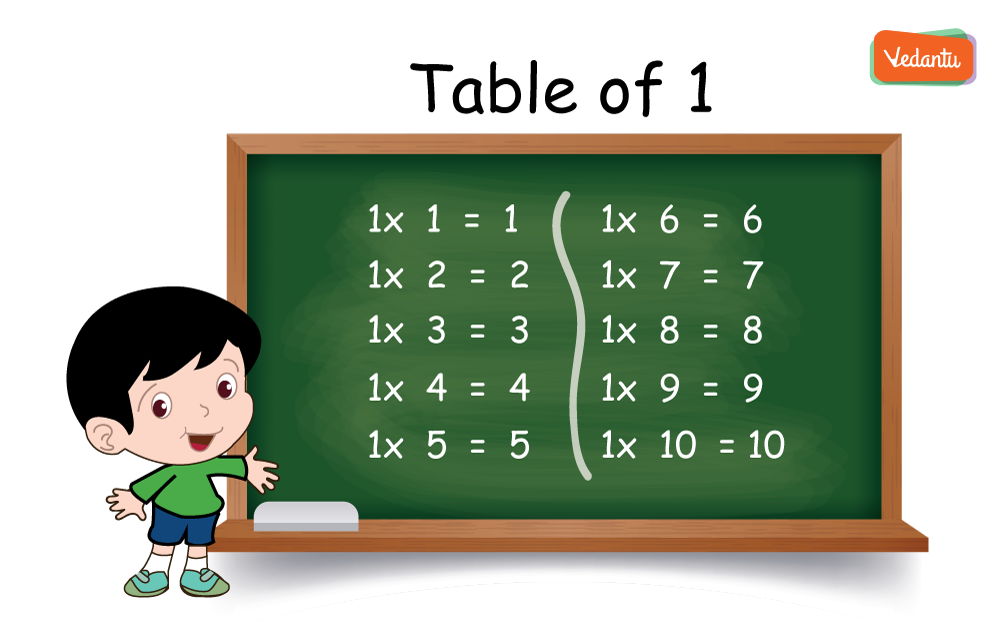

Table of 1

Table Chart of 1 from 1 to 10

Look at the table chart of 1 from 1 to 10 below to find the first ten multiples of 1.

1 × 1 = 1

1 × 6 = 6

1 × 2 = 2

1 × 7 = 7

1 × 3 = 3

1 × 8 = 8

1 × 4 = 4

1 × 9 = 9

1 × 5 = 5

1 × 10 = 10


Easy Tips and Tricks for Memorising the Table of 1

  • The most important tip to remember the table of 1 is to read it out loud. Reading out loud will help you to memorise any multiplication table in no time.

  • Another important point to remember the table of 1 is to understand the pattern the table follows. Once you understand the pattern the table follows, you will be able to solve even complex multiplication problems easily. In the case of the multiplication table of 1, every product is increasing by 1. Hence, the pattern followed here is 1, 2, 3, 4, 5, and so on.


Solved Questions Based on Table of 1

The following are some questions based on the table of 1 in the form of word problems, numericals, or multiple-choice questions.


Word Problems Based on Table of 1

1. Riya reads 1 page every day. How many pages can Riya read in 8 days?

Solution:       

In one day, Riya reads 1 page.

In 8 days, Riya can read 8 (days) × 1 (page) = 8 pages

Therefore, Riya can read 8 pages in 8 days.


2. Solve the given puzzle using the multiplication table of 1.

A number is a part of the table of 1 that is greater than 7 and less than 9. If we add once, the number is _______.

Solution: From the table chart of 1, 1 times 8  is 8.

As 8  is greater than 7 and less than 9,  the required number is 8.


Practice Questions

1. If a basket contains 1 rose, how many roses do 8 baskets have?

Ans: 8


2. Determine the 2 digit numbers that are present in the table of 1 from 1 to 20 and are less than 15.

Ans: 10, 11, 12, 13, and 14.


MCQs Based on the Multiplication Table of 1 with Practice Questions

Question: What is 8 times 1?
a) 9
b) 8
c) 7
D) 4

Ans: (b)

8 times 1 is 1 x 8 = 8.


Practice Question

Question: what is 5 times 1 plus 3?

a) 8 km
b) 16 km
c) 26 km

d) 41 km

Ans: a


Table Chart of 1 from 11 to 20

To be able to grasp the multiplication table of one, it is better to memorise the table from 11 to 20 as well. This will give an added advantage to students while fixing issues which require a higher multiple of the number 1. You can refer to and download the Table below to easily memorise the multiples of 1 from 11 to 20.

1 × 11 = 11

1 × 16 = 16

1 × 12 = 12

1 × 17 = 17

1 × 13 = 13

1 × 18 = 18

1 × 14 = 14

1 × 19 = 19

1 × 15 = 15

1 × 20 = 20


For Parents/Teachers: How to Read the Table to Your Kid?

There’s an easy way for kids to learn the multiplication table of 1. The greater they hear themselves speaking, the higher they'll be capable of holding the information, and the less difficult it will be for them to memorise the table by heart. Here is a smooth way to get things started. Follow the manner of articulating the table out loud to your kids as noted in the following chart.

  • One ones are one

  • Two twos are two

  • One threes are three

  • One fours are four

  • One fives are five

  • One sixes are six

  • One sevens are seven

  • One eighths are eight

  • One nines are nine

  • One tens are ten


Conclusion

The multiplication table of one is one of the easiest but very vital tables that students  want to memorise in order to solve the maximum of the problems of their exams. Multiplying a number by 1 is simple because it only adds 1 to the preceding result to attain the required consecutive answer.

FAQs on Table of 1 – Simple Multiplication Table for Fast Learning

1. What is the multiplication table of 1?

The multiplication table of 1, often called the 1 times table, is a fundamental concept in mathematics. It follows a simple rule: any number multiplied by 1 is the number itself. This is because multiplying by 1 is the same as taking a single group of that number. For example, 1 x 8 means one group of eight, which equals 8.

2. Why is the answer in the 1 times table always the same as the number being multiplied?

The answer is always the same because 1 is the multiplicative identity. This means that multiplying any number by 1 does not change its value or identity. Think of it like this: if you have one basket containing 7 apples (1 x 7), you still have just 7 apples. The number '1' simply confirms the quantity of the group without altering it.

3. How can we write the table of 1 using repeated addition?

Multiplication is a form of repeated addition. For the table of 1, you add the number '1' repeatedly. For instance:

  • 1 x 4 is the same as adding 1 four times: 1 + 1 + 1 + 1 = 4.
  • 1 x 6 is the same as adding 1 six times: 1 + 1 + 1 + 1 + 1 + 1 = 6.
This method helps demonstrate why 1 multiplied by any number equals that number.

4. What is the importance of learning the 1 times table in Maths?

Learning the 1 times table is crucial as it establishes the foundation for the identity property of multiplication, a key rule that applies to all numbers, including fractions and decimals. Mastering this simple table builds confidence and makes it easier for students to understand the logic behind more complex multiplication tables and mathematical operations later on.

5. Can you give a real-life example of using the table of 1?

Certainly. Imagine you want to buy one chocolate bar that costs ₹10. To find the total cost, you multiply the number of chocolate bars (1) by the cost (₹10). So, 1 x 10 = ₹10. You pay ₹10. This shows how the 1 times table is used in everyday situations like shopping.

6. How is the multiplication table of 1 different from the table of 0?

The key difference lies in their properties. The table of 1 follows the identity property, where any number multiplied by 1 remains the same (e.g., 1 x 5 = 5). In contrast, the table of 0 follows the zero property of multiplication, where any number multiplied by 0 always becomes zero (e.g., 0 x 5 = 0). One preserves the number, while the other cancels it out to zero.

7. What is the product of 1 and any large number, like 987?

The product of 1 and 987 is 987. The rule of the 1 times table applies to all numbers, no matter how large or small they are. Any number multiplied by 1 will always result in the number itself. So, 1 x 987 = 987.
