
Courses
Courses for Kids
Free study material
Offline Centres
More
Store Icon
Store

Multiplication Table of 18

ffImage
banner
widget title icon
Latest Updates

Easy Tricks to Learn and Remember the 18 Times Table

The Multiplication table of 18 is also called Table of 18. These contain the list of natural numbers which are multiples of 18. Learning the multiplication table of 18 will help students to improve Maths skills and they can solve Algebraic problems including LCM, HCF, and many others with speed and accuracy.  This article provides a short trick to help students to learn the multiplication table easily and in a fun way.
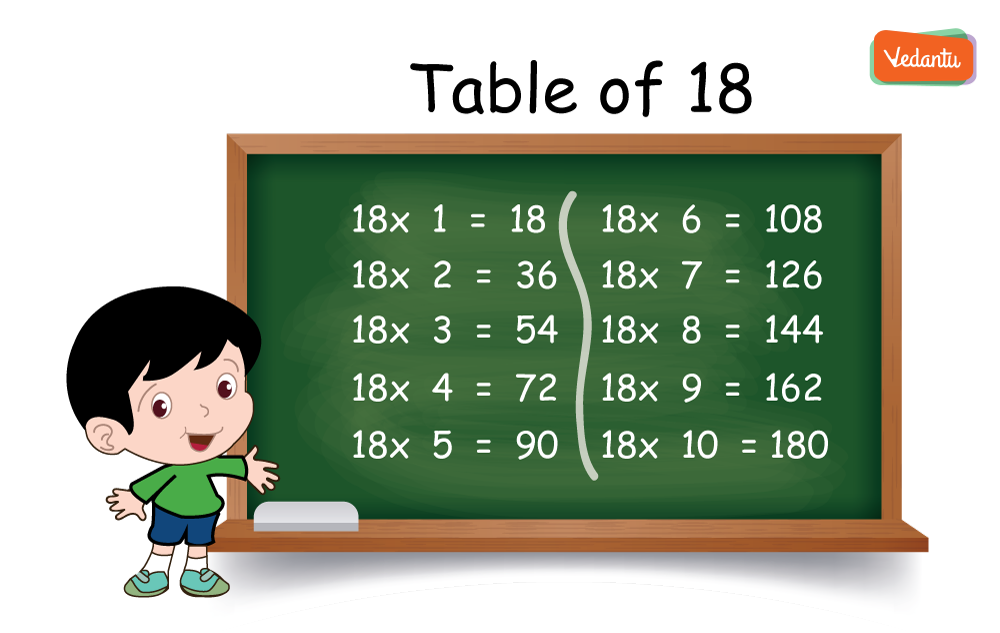

Table of 18


Important Points to be Noted in Multiplication Table of 18

Multiplication is the process of repeated addition. This implies that when we add 18 to itself repeatedly, we get the multiples of 18.


For example,

  • 3 times 18 is 54, which is the repeated addition of 18+18+18=54. 

  • Similarly, 9 times 18 is 162, which is also equal to 18+18+18+18+18+18+18+18+18=162.

Table Chart of 18 from 1 to 10

18 × 1 = 18

18 × 6 = 108

18 × 2 = 36

18 × 7 = 126

18 × 3 = 54

18 × 8 = 144

18 × 4 = 72

18 × 9 = 162

18 × 5 = 90

18 × 10 = 180


Tips and Tricks to Memorise Table of 18

  • The most common trick for memorising any table is to read the table as loud as you can. Once you dwell on the rhythm of the table, the multiplication table of 18 gets fixed in your mind in no time.

  • The other important trick to learn the table is to understand the pattern the table follows. To write the multiplication table of 18, look at the one’s digit till 18 times 5. Here, you will find that digits are written in reverse order and are decreasing by 2. Therefore, the pattern followed here is 8, 6, 4, 2, and 0. The similar pattern is followed from 18 times 6 to 18 times 10.

  • Now, look at the tens digit till 18 times 5, you will find that the numbers are increasing by 2. Therefore, the pattern followed here is 1, 3, 5, 7, and 9. Again, if you look at the tens and hundredth digit from 18 times 6 to 18 times 10, you will find that the numbers are again increasing by 2. Therefore, the pattern followed here is 10, 12, 14, 16, and 18.


Solved Question Based on Multiplication Table of 18

In this section, we are going to solve a few questions that can appear in the form of word problems, multiple choice, or numericals.


Word Problems Based on Table 18

Question 1: Ram bought 20 apples for Rs. 360. What is the cost of five apples? 

Answer:  The cost of 20  apples is Rs. 360

So, the cost of 1 apple = 360/20 = 18

Therefore, the cost of five apples = 18 * 5 =  90


Question 2: If 18 people take 4 chocolates each, then how many chocolates do they take? 

Answer:  Given that 18 people took 4 chocolates each. 

So, the total number of chocolates taken by them = 18 * 4 = 72


Question 3: Simplify 5 + 7 - 126 7 *2.

Answer: By simplifying this problem using the BODMAS rule, which is Brackets, Division, Multiplication, Addition, and Subtraction, we get, 

5 + 7 - 126 7 * 2 = 5 + 7 - 18*2 = -24


Question 4: Solve 18 times 8 plus 14 minus  8.

Answer: Here, 18 times 8 is 144. Now, if we add 14 to the resultant value, we will get 144 + 14 = 158. Now, we will subtract 8 from 158. Hence, we get 158 - 8 = 150. Therefore,  the value of 18 times 8 plus 14 minus 8 is 150.


MCQs Based on Table 18

Question: Simplify: 182 + 18 = ?

  1. 342

  2. 569

  3. 356

  4. 381

Answer: (a)

Solution: 182 = 18*18 = 324 

324 + 18 = 342.


Trick

1. Since the unit digit of 18 is 8, the square number will end with 4 . While adding 4 with 8, the unit digit of the answer will end with 2. You can check the unit digit of options to find the answer. So, you can solve such problems within a second. 

2. 182 + 18 = 18 * 18 + 18, which indirectly represents 19 times of 18. So, 19 * 18 = 342. 


Do It Yourself

Question 1: Evaluate:  36 2 + 12 * 3

Answer: 54


Question 2: If a bus covered 72 km in an hour. Then how much time does the bus take to cover 18 km?

Answer: 4


Question 3: What is the result if 18 times of 5 is added with 240. 

Answer: 330


Multiplication Table of 18 (from 11 to 20)

Memorising or practising the multiplication table of 18 from 11 to 20 helps kids in day-to-day life and also helps them to approach complex problems in an easy way. Now, let us see the table of 18 from 11 to 20.

18 × 11 = 198

18 × 16 = 288

18 × 12 = 216

18 × 17 = 306

18 × 13 = 234

18 × 18 = 324

18 × 14 = 252

18 × 19 = 342

18 × 15 = 270

18 × 20 = 360


For Parent/Teacher: How to Read the Table to Your Kid?

We request parents and teachers to help their kids to read the multiplication table of 18 in the following way. The more children read the table, the better they will recall the knowledge, and the table of 18 will become easier for them to remember. The following chart will make the articulation of the table easier for your kids.


  • Eighteen ones are eighteen

  • Eighteen twos are thirty-six

  • Eighteen threes are fifty-four

  • Eighteen fours are seventy-two

  • Eighteen fives are ninety

  • Eighteen sixes are one hundred and eight

  • Eighteen sevens are one hundred and twenty-six

  • Eighteen eighths are one hundred and forty-four

  • Eighteen nines are one hundred and sixty-two

  • Eighteen tens are one hundred and eighty


We hope you understood the pattern the table of 18 follows through this article. And, if you follow the simple trick “Reciting the table loudly and repeatedly”, you probably remember the table of 18 from your heart. If you want to learn more multiplication tables with tricks, explore our website!

FAQs on Multiplication Table of 18

1. What is the multiplication table of 18?

The multiplication table of 18, also known as the 18 times table, is a list of the products of 18 multiplied by different whole numbers. It is essentially a sequence of repeated additions of the number 18. For example, 18 x 3 is the same as 18 + 18 + 18, which equals 54. Learning this table helps in performing calculations more quickly.

2. What are the first 10 multiples in the 18 times table?

The first ten multiples in the multiplication table of 18 are essential for basic calculations. They are:

  • 18 x 1 = 18
  • 18 x 2 = 36
  • 18 x 3 = 54
  • 18 x 4 = 72
  • 18 x 5 = 90
  • 18 x 6 = 108
  • 18 x 7 = 126
  • 18 x 8 = 144
  • 18 x 9 = 162
  • 18 x 10 = 180

3. Is there a simple trick to learn the 18 times table?

Yes, there's a simple pattern-based trick. First, write the first five odd numbers (1, 3, 5, 7, 9) for the tens place. Then, write the next five even numbers starting from 10 (10, 12, 14, 16, 18). For the units place, simply write the even numbers backwards from 8 (8, 6, 4, 2, 0) and then repeat this pattern. Combining these gives you the table: 18, 36, 54, 72, 90, 108, 126, 144, 162, 180.

4. How is the table of 18 connected to the table of 2 and 9?

The table of 18 is directly related to the tables of 2 and 9 because 18 = 2 × 9. This means you can find any multiple of 18 by first multiplying the number by 9 and then doubling the result. For example, to find 18 × 5, you can calculate (9 × 5) × 2. Since 9 × 5 = 45, you just need to calculate 45 × 2, which gives you 90. This makes it easier to calculate if you already know the 9 times table.

5. How can you calculate 18 x 7 quickly using the distributive property?

You can use the distributive property of multiplication to simplify the calculation. Break 18 into simpler numbers like (10 + 8) or (20 - 2).
Using (10 + 8):
18 × 7 = (10 + 8) × 7 = (10 × 7) + (8 × 7) = 70 + 56 = 126.
Using (20 - 2):
18 × 7 = (20 - 2) × 7 = (20 × 7) - (2 × 7) = 140 - 14 = 126.
Both methods give the correct answer and can be faster than direct multiplication.

6. Why is learning the multiplication table of 18 important for students?

Learning the table of 18 is important because it strengthens a student's foundational maths skills. It enhances mental calculation speed, which is crucial for solving more complex problems in topics like division, algebra, and geometry. It also helps in real-world scenarios, such as calculating the cost of multiple items, understanding measurements, and improving overall numerical fluency as per the CBSE curriculum guidelines for 2025-26.

7. A pack of crayons has 18 different shades. How many shades would you have in total if you bought 12 packs?

This is a practical application of the 18 times table. To find the total number of shades, you need to multiply the number of shades in one pack (18) by the number of packs (12).
The calculation is: 18 × 12.
You can calculate this as 18 × (10 + 2) = (18 × 10) + (18 × 2) = 180 + 36 = 216.
So, you would have a total of 216 crayon shades.
