






How to Learn and Memorize the Table of 7 with Solved Examples
From the number of colours in a rainbow to the number of days in a week, to the number of continents in the world, all account to 7. As the number 7 is often used in the real world, learning and memorising the multiplication table of 7 at an early age is highly important. It will help students to solve problems of multiplication, division, and the fraction of large numbers with speed and accuracy.
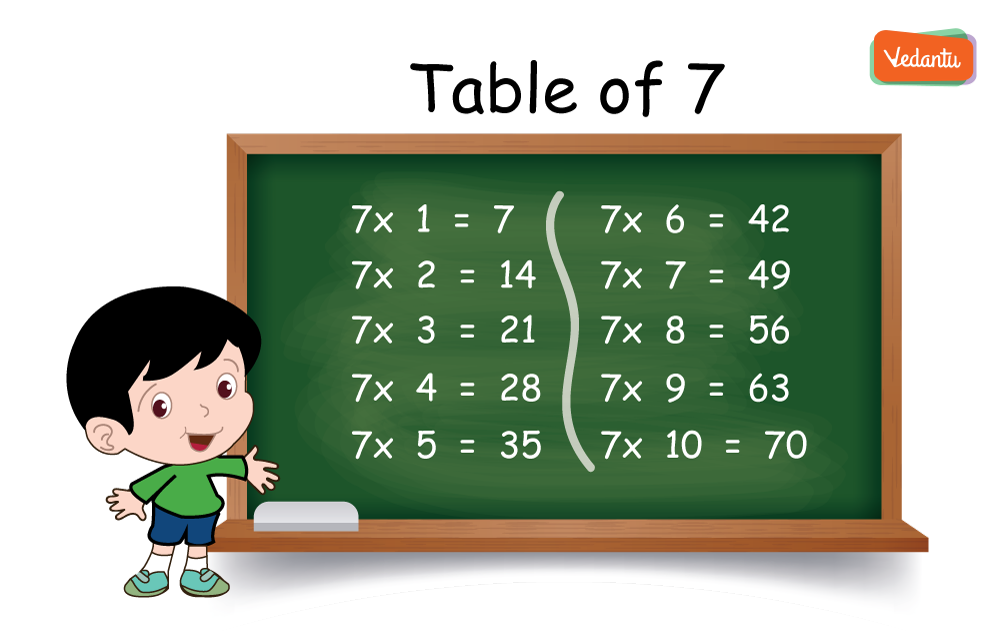
The multiplication table of 7 is also known as Table of 7 which contains a list of numbers that are the result of the multiplication of 7 with other natural numbers (1 and above). As 7 is a unit digit number, the table of 7 is considered as a building block for other multiplication tables.
FAQs on Table of 7 Times Table with Chart and Practice Questions
1. What is the table of 7?
The table of 7 is the list of multiples of 7 obtained by multiplying 7 by whole numbers. It helps in quick multiplication and division calculations.
- 7 × 1 = 7
- 7 × 2 = 14
- 7 × 3 = 21
- 7 × 4 = 28
- 7 × 5 = 35
- 7 × 6 = 42
- 7 × 7 = 49
- 7 × 8 = 56
- 7 × 9 = 63
- 7 × 10 = 70
2. How do you learn the table of 7 easily?
You can learn the 7 times table easily by repeated addition and pattern recognition. Follow these steps:
- Add 7 repeatedly: 7, 14, 21, 28, 35...
- Notice the pattern in the ones place: 7, 4, 1, 8, 5, 2, 9, 6, 3, 0.
- Practice writing and reciting the table daily.
- Use skip counting by 7s to improve speed.
3. What are the first 20 multiples in the table of 7?
The first 20 multiples of 7 are numbers obtained from 7 × 1 to 7 × 20.
- 7, 14, 21, 28, 35, 42, 49, 56, 63, 70
- 77, 84, 91, 98, 105, 112, 119, 126, 133, 140
4. What is 7 multiplied by 12?
The value of 7 multiplied by 12 is 84. You can calculate it as:
- 7 × 12 = 7 × (10 + 2)
- = (7 × 10) + (7 × 2)
- = 70 + 14
- = 84
5. What is the pattern in the table of 7?
The pattern in the multiplication table of 7 increases by 7 each time. Important patterns include:
- Each number is 7 more than the previous one.
- The ones digits follow a repeating cycle: 7, 4, 1, 8, 5, 2, 9, 6, 3, 0.
- Every 5th multiple ends in 5 or 0 (35, 70).
6. How do you use the table of 7 in division?
You use the table of 7 in division by finding which multiple of 7 matches the given number. For example:
- Divide 63 ÷ 7
- Since 7 × 9 = 63
- Therefore, 63 ÷ 7 = 9
7. Why is learning the table of 7 important?
Learning the 7 times table is important because it improves speed and accuracy in multiplication and division. It is useful in:
- Solving word problems
- Finding factors and multiples
- Working with fractions and ratios
- Mental maths calculations
8. What is 7 times 15?
The value of 7 times 15 is 105. You can calculate it as:
- 7 × 15 = 7 × (10 + 5)
- = (7 × 10) + (7 × 5)
- = 70 + 35
- = 105
9. How can I practice the table of 7?
You can practice the table of 7 by solving multiplication and division exercises daily. Effective methods include:
- Writing the table from memory
- Using flashcards for quick recall
- Solving fill-in-the-blank questions (7 × __ = 49)
- Practicing word problems involving multiples of 7
10. What are some real-life examples of the table of 7?
The table of 7 is used in real life for counting and grouping items in sets of seven. Examples include:
- Days in weeks: 7 days × 4 weeks = 28 days
- Buying 7 pencils in 6 boxes: 7 × 6 = 42 pencils
- Calculating weekly wages for 7 days of work
