




Which of the following is wrong regarding image formation by convex mirror:
A) The image lies between the pole and focus.
B) The image is diminished in size.
C) The image is erect.
D) The image is real.
Answer
 Verified
264k+ views
Hint: A convex mirror has surface bulge towards the outer surface and reflects lights off towards the viewer. A virtual mirror always gives a smaller, virtual , erect image of the object. The image in a virtual mirror is formed between the pole and focus.
Complete step by step solution:
A convex mirror is also called a diverging mirror as the incident light falls on the surface and it Diverges back in all directions. Due to the divergence of the incident rays the image formed is behind the mirror and is not real and they are smaller in size as compared to the object size.The type of image formed as reference to the placement of the object in a convex mirror is given by the below table.
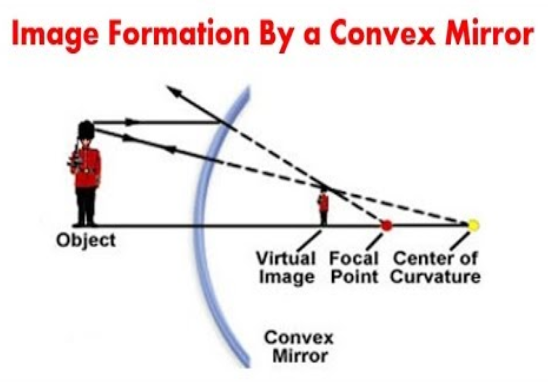
From the above diagram it is evident that an object kept at infinity or between pole and infinity from a convex mirror always forms :
i) Virtual image
ii) Straight image
iii) Diminish image
iv) Forms between focal and pole.
Therefore the correct answer for the given question is option (D) as a convex mirror never forms a real image and hence it is the incorrect answer regarding convex mirrors.
Note: A convex mirror forms an erect image but smaller in size and they are used as rear view mirrors in cars and two wheelers. They are also used as street light reflectors too since they form virtual images. They are also used in magnifying glass and telescope.
Complete step by step solution:
A convex mirror is also called a diverging mirror as the incident light falls on the surface and it Diverges back in all directions. Due to the divergence of the incident rays the image formed is behind the mirror and is not real and they are smaller in size as compared to the object size.The type of image formed as reference to the placement of the object in a convex mirror is given by the below table.
| SL.no | Position of the object | Position of the image | Size of image | Nature of image |
| 1 | At Infinity | At the focus F, behind the mirror | Highly diminished | Virtual and Erect |
| 2 | Between Infinity and the Pole | Between P and F, behind the mirror | Diminished | Virtual and Erect |
From the above diagram it is evident that an object kept at infinity or between pole and infinity from a convex mirror always forms :
i) Virtual image
ii) Straight image
iii) Diminish image
iv) Forms between focal and pole.
Therefore the correct answer for the given question is option (D) as a convex mirror never forms a real image and hence it is the incorrect answer regarding convex mirrors.
Note: A convex mirror forms an erect image but smaller in size and they are used as rear view mirrors in cars and two wheelers. They are also used as street light reflectors too since they form virtual images. They are also used in magnifying glass and telescope.
Recently Updated Pages
JEE Main 2025-26 Experimental Skills Mock Test – Free Practice

JEE Main 2025-26 Electronic Devices Mock Test: Free Practice Online
JEE Main 2025-26 Mock Tests: Free Practice Papers & Solutions
JEE Main 2025-26: Magnetic Effects of Current & Magnetism Mock Test
JEE Main 2025-26 Atoms and Nuclei Mock Test – Free Practice Online
JEE Main Mock Test 2025-26: Experimental Skills Chapter Online Practice
Trending doubts
JEE Main 2026: Exam Dates, Session 2 Updates, City Slip, Admit Card & Latest News
JEE Main Participating Colleges 2026 - A Complete List of Top Colleges
Kinematics Mock Test for JEE Main 2025-26: Comprehensive Practice
Kinematics Mock Test for JEE Main 2025-26: Practice & Ace the Exam
Hybridisation in Chemistry – Concept, Types & Applications
Understanding the Electric Field of a Uniformly Charged Ring
Other Pages
CBSE Class 12 Physics Question Paper 2026: Download SET-wise PDF with Answer Key & Analysis
JEE Advanced 2026 Notification Out with Exam Date, Registration (Extended), Syllabus and More
JEE Advanced Marks vs Ranks 2025: Understanding Category-wise Qualifying Marks and Previous Year Cut-offs
JEE Advanced Weightage Chapter Wise 2026 for Physics, Chemistry, and Mathematics
Derivation of Equation of Trajectory Explained for Students
Understanding Atomic Structure for Beginners